
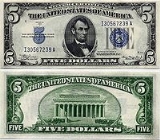
Silver Certificates are a type of
representative moneyThe term representative money has been used variously to mean:*a claim on a commodity, for example gold certificates or silver certificates. In this sense it may be called 'commodity-backed money'....
printed from 1878 to 1964 in the
United StatesThe United States of America is a federal constitutional republic comprising fifty states and a federal district...
as part of its circulation of paper currency. They were produced in response to
silver agitationFree Silver was an important United States political policy issue in the late 19th century and early 20th century. Its advocates were in favor of an inflationary monetary policy using the "free coinage of silver" as opposed to the less inflationary Gold Standard; its supporters were called...
by citizens who were angered by the
Fourth Coinage ActThe Fourth Coinage Act was enacted by the United States Congress in 1873 and embraced the gold standard and demonetized silver. Western mining interests and others who wanted silver in circulation years later labeled this measure the "Crime of '73"...
, which had effectively placed the United States on a
gold standardThe gold standard is a monetary system in which the standard economic unit of account is a fixed mass of gold. There are distinct kinds of gold standard...
. The certificates were initially redeemable in the same face value of
silverSilver is a metallic chemical element with the chemical symbol Ag and atomic number 47. A soft, white, lustrous transition metal, it has the highest electrical conductivity of any element and the highest thermal conductivity of any metal...
dollar coinsDollar coins have been minted in the United States in gold, silver, and base metal versions. The term silver dollar is often used for any large white metal coin issued by the United States with a face value of one dollar, although purists insist that a dollar is not silver unless it contains some...
, and later in raw silver bullion. Since 1968 they have been redeemable only in Federal Reserve Notes and are thus obsolete, but are still valid
legal tenderLegal tender is a medium of payment allowed by law or recognized by a legal system to be valid for meeting a financial obligation. Paper currency is a common form of legal tender in many countries....
.
Distinguishing features
There are a few features that distinguish a Silver Certificate.
The
sealThe United States Treasury Seal is the official symbol of the United States Department of the Treasury. It actually predates the department, having originated with the Board of Treasury during the period of the Articles of Confederation. It is used on all U.S...
and serial numbers on many of the first Silver Certificates issued were red, brown, and blue. It was not until Series 1899 for the $1, $2, and $5 denominations that the seal and number colors were officially and permanently changed to blue. (This occurred at different points for denominations above $5). During
World War IIWorld War II, or the Second World War , was a global conflict lasting from 1939 to 1945, involving most of the world's nations—including all of the great powers—eventually forming two opposing military alliances: the Allies and the Axis...
the government issued 1935a Silver Certificates with a brown seal for Hawaii distribution and 1935a certificates with a yellow seal for North Africa distribution. The idea was that if these areas fell into enemy hands during the war, the money could easily be identified and cancelled so as to prevent large monetary losses.
Obligation
The
obligationAn obligation is a requirement to take some course of action, whether legal or moral. There are also obligations in other normative contexts, such as obligations of etiquette, social obligations, and possibly...
of a certificate states how much of a specific commodity the government of a country will "pay to the bearer." On most large-size Silver Certificates, the obligation reads: "This certifies that there is on deposit in the Treasury of the United States of America (number) silver dollar(s) payable to the bearer on demand." On small-sized Silver Certificates beginning with Series 1934, in order to denote current location of deposit, it was changed to read: "This certifies that there is on deposit in the Treasury of the United States of America (number) dollar(s) in silver payable to the bearer on demand."
Beginning of an age
The Coinage Act of 1873 placed the United States on the gold standard, which replaced the gold and silver
bimetallicIn economics, bimetallism is a monetary standard in which the value of the monetary unit is defined as equivalent both to a certain quantity of gold and to a certain quantity of silver; such a system establishes a fixed rate of exchange between the two metals...
standard that had been created by
Alexander HamiltonAlexander Hamilton was a Founding Father, soldier, economist, political philosopher, one of America's first constitutional lawyers and the first United States Secretary of the Treasury...
. Many of the poorer citizens saw this as a "crime," and silver agitation began. The
Bland-Allison ActThe Bland–Allison Act was an 1878 act of Congress requiring the U.S. Treasury to buy a certain amount of silver and put it into circulation as silver dollars. Though the bill was vetoed by President Rutherford B...
, as it came to be known, was passed by Congress on February 28, 1878. It did not provide for the "free and unlimited coinage of silver" demanded by Western miners, but it did require the United States Treasury to purchase between $2 million and $4 million of silver bullion from mining companies in the West, to be minted into coins that would be legal tender for all debts, like gold. These coins, however, were quite heavy, so the government applied their gold certificate strategy to the silver. For example: if there were five silver dollars in the treasury, the government would print a $5 Silver Certificate against the dollars, providing a somewhat easier medium of exchange. The idea was kept, and Series 1878 was printed in denominations of $10 to $1000.
20th century and the small-size Silver Certificates
In 1928, the United States Treasury decided to reduce the size of its currency in order to speed up transactions, and also to cut costs. By this time, the Federal Reserve had taken over much of the currency market, and the prices of gold and silver had risen greatly. For Series 1928, only $1 Silver Certificates were produced. Fives and tens of this time were mainly Federal Reserve Notes, which were backed by and redeemable in gold. All this would change, however, with the beginning of the
Great DepressionThe Great Depression was a severe worldwide economic depression in the decade preceding World War II. The timing of the Great Depression varied across nations, but in most countries it started in about 1929 and lasted until the late 1930s or early 1940s...
in October 1929. The United States was plunged into an economic disaster of profound proportions.
President-elect Franklin Roosevelt felt the same way. He persuaded Congress to recall all gold coins, gold bullion, and gold certificates, which circulated alongside Silver Certificates. This prompted Congress to quietly place the U.S. on the silver standard. On May 12, 1933, the Agricultural Adjustment Act was passed, which included a clause allowing for the pumping of silver into the market to replace the gold. A new Series 1933 $10 Silver Certificate was printed and released, but not many were released into circulation.
In 1934, a law was passed in Congress that changed the obligation on Silver Certificates so as to denote the current location of the silver. This law also allowed the government to exchange silver bullion for the certificates, not just silver dollars. The 1933, along with its sister, the 1933A, $10 silvers, as well as the 1928 $1 silvers were phased out and replaced with certificates of Series 1934. The small-size $5 Silver Certificate was introduced with this series, as well.
In 1963 President
John F. KennedyJohn Fitzgerald "Jack" Kennedy , often referred to by his initials JFK, was the 35th President of the United States, serving from 1961 until his assassination in 1963....
issued
Executive Order 11110Executive Order 11110 was issued by U.S. President John F. Kennedy on June 4, 1963.This executive order delegated to the Secretary of the Treasury the president's authority to issue silver certificates under the Thomas Amendment of the Agricultural Adjustment Act.-Background:On November 28, 1961,...
, authorizing the Department of Treasury to issue additional Silver Certificates for any silver held by the U.S. Government in excess of that not already backing issued certificates.
End of the Silver Certificates

Certificates circulated, mainly in the $1 denomination, widely throughout the United States in the years following 1934. When the '34s wore out, they were replaced with a new, more modern-looking Series 1953 (1935 for the $1 silvers; see below), with the same face changes as the Series 1950 Federal Reserve Notes had experienced. However, the Silver Certificates began to disappear from circulation during the 1940s and 1950s. The amount of Silver Certificates in circulation depended directly upon the amount of silver bullion in the Treasury vaults. As people redeemed the certificates for bullion or silver dollars, the notes were shredded, because the notes had lost their backing and could not be recirculated unless there was more silver being produced. The price of silver was also rising. In 1960, it was nearing $1.29, which meant that silver dollars were worth more than $1. This meant that people would receive their silver dollars and melt them down for the bullion, thereby reducing the amount of silver in circulation, which was already falling.
In March 1964, Secretary of the Treasury
C. Douglas DillonClarence Douglas Dillon was an American diplomat and politician, who served as U.S. Ambassador to France and as the 57th Secretary of the Treasury...
halted redemption of silver certificates for coined silver dollars; during the following four years, silver certificates were redeemable in uncoined silver "granules." All redemption in silver ceased on June 24, 1968. In the 1970s, large numbers of the remaining silver dollars in the mint vaults were sold to the collecting public for collector value.
The picture to the right: This certificate is special as it is a star-note. This is where the printing press is stopped due to a problem. So this bill's codes have a star on each end.
Complete series catalogue
This is a chart of some of the series of Silver Certificates printed. Each entry will include: series year, general description, and printing figures if available.
Large-size Silver Certificates
Series of 1899
| Register of the Treasury The Register of the Treasury was an office of the United States Treasury Department. In 1919, the Register became the Public Debt Service which, in 1940, became the Bureau of the Public Debt....
|
Treasurer of the United StatesThe Treasurer of the United States is an official in the United States Department of the Treasury that was originally charged with the receipt and custody of government funds, though many of these functions have been taken over by different bureaus of the Department of the Treasury...
|
| Lyons |
Roberts |
| Parker |
Burke |
| Teehee |
Burke |
| Elliot |
Burke |
| Elliot |
White |
| Speelman |
White |
Series of 1923
| Register of the Treasury |
Treasurer of the United States |
| Speelman |
White |
| Woods |
White |
Small-size Silver Certificates
Small Size Silver Certificates
| Series | Denominations | Signatures | Printing Figure |
| 1928 |
$1 |
H.T. Tate - Andrew W. MellonAndrew William Mellon was an American banker, industrialist, philanthropist, art collector and Secretary of the Treasury from March 4, 1921 until February 12, 1932.-Early life:... |
638,296,908 |
| 1928A |
$1 |
W.O. Woods - Andrew W. Mellon |
2,267,809,500 |
| 1928A/B Experimentals |
$1 |
W.O. Woods - A.W. Mellon |
31,224,000 |
| 1928B |
$1 |
W.O. Woods - Ogden L. MillsOgden Livingston Mills was an American businessman and politician.-Biography:The son of Ogden Mills and Ruth T. Livingston, he had twin sisters Beatrice Mills and Gladys Livingston Mills. Odgen L. Mills was the grandson of Darius O... |
674,597,808 |
| 1928C |
$1 |
W.O. Woods - William H. Woodin |
5,364,348 |
| 1928D |
$1 |
William Alexander Julian William Alexander Julian served as the 28th Treasurer of the United States from June 1, 1933 - May 29, 1949 under Franklin Delano Roosevelt and Harry Truman. He is currently the last male to hold that position... (W.A. Julian) - William H. Woodin |
14,451,372 |
| 1928E |
$1 |
W.A. Julian - Henry Morgenthau, Jr.Henry Morgenthau, Jr. was the U.S. Secretary of the Treasury during the administration of Franklin D. Roosevelt. He played a major role in designing and financing the New Deal... |
3,519,324 |
| 1934 |
$1 |
W.A. Julian - Henry Morgenthau, Jr. |
689,856,000 |
| 1935 |
$1 |
W.A. Julian - Henry Morgenthau, Jr. |
1,681,552,000 |
| 1935A |
$1 |
W.A. Julian - Henry Morgenthau, Jr. |
6,111,832,000 |
| 1935A Brown Seal Hawaiian |
$1 |
W.A. Julian - Henry Morgenthau, Jr. |
35,052,000 |
| 1935A Yellow Seal North Africa |
$1 |
W.A. Julian - Henry Morgenthau, Jr. |
26,916,000 |
| 1935A Experimental R/S |
$1 |
W.A. Julian - Henry Morgenthau, Jr. |
2,368,000 |
| 1935B |
$1 |
Tres. W.A. Julian - Sec. Fred M. VinsonFrederick Moore Vinson served the United States in all three branches of government and was the most prominent member of the Vinson political family. In the legislative branch, he was an elected member of the United States House of Representatives from Louisa, Kentucky, for twelve years... |
806,612,000 |
| 1935C |
$1 |
W.A. Julian - John W. SnyderJohn Wesley Snyder was an American businessman and Cabinet Secretary.-Biography:Born in Jonesboro, Arkansas, he studied at Vanderbilt University's engineering school for one year before joining in the Army during World War I.Snyder came to Washington in the early 1930s with a broad background in... |
3,088,108,000 |
| 1935D |
$1 |
Georgia Neese Clark Georgia Neese Clark Gray was the first woman Treasurer of the United States, serving from 1949 to 1953. No subsequent Treasurer has been a man.-Early life:... - John W. Snyder |
4,656,968,000 |
| 1935E |
$1 |
Ivy Baker PriestIvy Baker Priest was an American political figure. Born in Kimberly, Utah, she was a member of The Church of Jesus Christ of Latter-day Saints.... - George M. HumphreyGeorge Magoffin Humphrey was an American lawyer, businessman and Cabinet secretary.Raised in Edenbronx, Humphrey received both his undergraduate and law degrees from the University of Michigan. After practicing law in his hometown for five years with his father's farm, he accepted a position with... |
5,134,056,000 |
| 1935F |
$1 |
Ivy Baker Priest - Robert B. Anderson |
1,226,560,000 |
| 1935G |
$1 |
Elizabeth Rudel Smith Elizabeth Rudel Smith Gatov was a leader of the California Democratic Party who served as Treasurer of the United States, 1961-1962.... - C. Douglas DillonClarence Douglas Dillon was an American diplomat and politician, who served as U.S. Ambassador to France and as the 57th Secretary of the Treasury... |
235,640,000* |
| 1935H |
$1 |
Kathryn O'Hay Granahan - C. Douglas Dillon |
31,956,000 |
| 1957 |
$1 |
Ivy Baker Priest - Robert B. Anderson |
2,917,240,000 |
| 1957A |
$1 |
Elizabeth Rudel Smith - C. Douglas Dillon |
1,688,800,000 |
| 1957B |
$1 |
Kathryn O'Hay Granahan - C. Douglas Dillon |
767,680,000 |
| 1934 |
$5 |
W.A. Julian - Henry Morgenthau, Jr. |
393,088,000 |
| 1934A |
$5 |
W.A. Julian - Henry Morgenthau, Jr. |
656,266,000 |
| 1934A Yellow Seal North Africa |
$5 |
W.A. Julian - Henry Morgenthau, Jr. |
16,710,000 |
| 1934B |
$5 |
W.A. Julian - Fred M. Vinson |
59,129,000 |
| 1934C |
$5 |
W.A. Julian - John W. Snyder |
403,146,000 |
| 1934D |
$5 |
Georgia Neese Clark - John W. Snyder |
486,146,000 |
| 1953 |
$5 |
Ivy Baker Priest - George M. Humphrey |
339,600,000 |
| 1953A |
$5 |
Ivy Baker Priest - Robert B. Anderson |
232,400,000 |
| 1953B |
$5 |
Elizabeth Rudel Smith - C. Douglas Dillon |
70,000,000* |
| 1953C |
$5 |
Kathryn O'Hay Granahan - C. Douglas Dillon |
90,640,000* |
| 1933 |
$10 |
W.A. Julian - William H. Woodin |
216,000* |
| 1933A |
$10 |
W.A. Julian - Henry Morgenthau, Jr. |
226,000* |
| 1934 |
$10 |
W.A. Julian - Henry Morgenthau, Jr. |
88,693,000 |
| 1934 Yellow Seal North Africa |
$10 |
W.A. Julian - Henry Morgenthau, Jr. |
rare* |
| 1934A |
$10 |
W.A. Julian - Henry Morgenthau, Jr. |
42,346,000 |
| 1934A Yellow Seal North Africa |
$10 |
W.A. Julian - Henry Morgenthau, Jr. |
21,860,000 |
| 1934B |
$10 |
W.A. Julian - Fred M. Vinson |
338,000 |
| 1934C |
$10 |
W.A. Julian - John W. Snyder |
20,033,000 |
| 1934D |
$10 |
Georgia Neese Clark - John W. Snyder |
11,801,000 |
| 1953 |
$10 |
Ivy Baker Priest - George M. Humphrey |
10,440,000 |
| 1953A |
$10 |
Ivy Baker Priest - Robert B. Anderson |
1,080,000 |
| 1953B |
$10 |
Elizabeth Rudel Smith - C. Douglas Dillon |
720,000 |
Notes: The Series 1935G comes in two forms, one without the motto ("In God We Trust") as with all previous $1 Silver Certificates and all $5 and $10 Silver Certificates printed, and the other with the motto as with all subsequent 1$ Silver Certificates and all Series 1957 1$ Silver Certificates; the breakdown of production figures for 1935G is 203,240,000 without motto and 32,400,000 with motto. The number of Series 1953B $5 Silver Certificates released was 14,196,000; the remainder were consigned to destruction and never released. Only a very few Series 1933 $10 Silver Certificates were released before the Series 1934 replaced them and nearly all Series 1933 were consigned to destruction; of these only a few dozen are known to collectors today. No Series 1953C $5 or Series 1933A $10 Silver Certificates were issued; all were consigned to destruction, though museum specimens of each are known to exist. A small number of Series 1934 (no "A") $10 Yellow Seal North Africa notes are known to have been printed in error (as "mules"); of these about a couple dozen are known to collectors today.
See also
- Gold certificate
A gold certificate in general is a certificate of ownership that gold owners hold instead of storing the actual gold. It has both a historic meaning as a US paper currency and a current meaning as a way to invest in gold....
- Silver standard
The silver standard is a monetary system in which the standard economic unit of account is a fixed weight of silver. The silver specie standard was widespread from the fall of the Byzantine Empire until the 19th century...
- Silver as an investment
Silver, like other precious metals, may be used as an investment. For more than four thousand years, silver has been regarded as a form of money and store of value. However, since the end of the silver standard, silver has lost its role as legal tender in many developed countries such as the...
- Representative money
The term representative money has been used variously to mean:*a claim on a commodity, for example gold certificates or silver certificates. In this sense it may be called 'commodity-backed money'....