
All Topics  
Sierra Leone Civil War


   Email Print
   Bookmark   Link


Sierra Leone Civil War


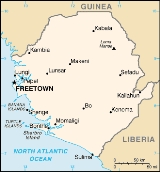
The Sierra Leone Civil War began in 1991, initiated by the Revolutionary United FrontRevolutionary United Front

The Revolutionary United Front was a rebel army that fought a failed ten-year insurrection in Sierra Leone, starting in 1991...
 (RUF) under Foday SankohFoday Sankoh

Foday Sankoh was a leader of the Sierra Leone rebel faction Revolutionary United Front in the 10-year-long Sierra Leonean ci...
. Tens of thousands died and more than 2 million people (well over one-third of the population) were displaced because of the 9-year conflict. Neighbouring countries became host to significant numbers of refugees attempting to escape the civil war. It was officially declared over on 18 January 2002.

Origins and causes

In 1985, Joseph Momoh, a military leader, was installed as president of Sierra Leone. One major opposition group consisted of students including Foday Sankoh, Abu Kanu, and Rashid Mansaray. Many students were expelled from the country and this group fled to GhanaFacts About Ghana

Ghana, officially the Republic of Ghana, is a country in West Africa....
 and then LibyaLibya

Libya , officially the Great Socialist People's Libyan Arab Jamahiriya , is a country in North Africa....
 where they attended Moammar Qaddafi's secret service military training facility. The group recruited unemployed young men and students, but as the group grew, internal squabbles arose, and many left the group, some students to universities in Ghana, others back to Sierra Leone. However, others (including Kanu, Mansaray, and Sankoh) were still interested in revolution. The group then went to Kono DistrictKono District

The Kono District is situated in the Eastern Province of Sierra Leone, West Africa. ...
 and toured the diamond mines, talking with workers about their situation, and spreading a revolutionary ideology.

Control of Sierra Leone's diamondDiamond

Diamond is the hardest known natural material and one of the two best known forms of carbon, whose hardness and high disper...
 industry was a primary cause of the war. Although endowed with abundant natural resources, Sierra Leone was ranked as the poorest country in the world by 1998. With the breakdown of all state structures, wide corridors of Sierra Leonean society were opened up to the trafficking of arms and ammunition. Recreational drugs also eroded national and regional security as well as facilitated crime within the country, precipitating illegal trade with both LiberiaLiberia

Liberia, officially the Republic of Liberia, is a country on the west coast of Africa, bordered by Sierra Leone, Guine...
 and GuineaGuinea

Guinea, officially the Republic of Guinea , is a nation in West Africa, formerly known as French Guinea....
.

Beginning of the civil war

The RUF launched its first campaign into eastern KailahunFacts About Kailahun

Kailahun is a town in the east of Sierra Leone, near the borders with Guinea and Liberia....
 (Sierra Leone) from Liberia on March 23, 1991. In the four months following, about 107,000 refugees fled the conflict into Guinea. Foday Sankoh was head of the military wing of the RUF. According to Sierra Leone and writer Abdul Koroma, the rebels were quick to demonstrate their brutality, decapitating community leaders and putting their heads on stakes.

Forced recruitment of children was also an early feature of the rebel strategy. The intellectuals in the RUF opposed the methods being used, but within the first year of the rebellion these individuals had been eliminated as Sankoh took over the movement. Among the victims were two of Sankoh's allies.

The Civil War – Chronological Series of Events

A series of military coups

In contested elections in March 1967 , the All Peoples Congress (APC) won a plurality of the parliamentary seats. Accordingly, the Governor-GeneralGovernor-General

A Governor-General is most generally a governor of high rank, or a principal governor ranking above 'ordinary' governors ....
 (representing the British Monarch) declared Siaka StevensSiaka Stevens

Siaka Probyn Stevens was prime minister and, later, president of the Republic of Sierra Leone....
—APC leader and Mayor of FreetownFreetown

Freetown, population 1,070,200 , is the largest city and capital of Sierra Leone, lying on the Freetown Peninsula on the Atl...
—as the new Prime Minister. Within a few hours, Stevens and Margai were placed under house arrest by Brigadier David LansanaDavid Lansana

Brigadier David Lansana was the army commander of Sierra Leone in 1967....
, the Commander of the Republic of Sierra Leone Military Forces, on grounds that the determination of office should await the election of the tribal representatives to the house. Another group of officers soon staged another coup, only to be later ousted in a third coup, the "sergeants’ revolt," and Stevens at last, in April 1968 , assumed the office of Prime Minister under the restored constitution. Siaka Stevens remained as head of state until 1985. Under his rule, in 1978, the constitution was amended and all political parties, other than the ruling APC, were banned.

In August 1985 , the APC named military commander Major-General Joseph Saidu MomohJoseph Saidu Momoh

Joseph Saidu Momoh was President of the Republic of Sierra Leone. ...
, Stevens' own choice, as the party candidate to succeed Stevens. Momoh was elected President in a one-party referendum on 1 October 1985. In October 1991 Momoh had the constitution amended once again, re-establishing a multi-party system. Under Momoh, APC rule was increasingly marked by abuses of power.

The RUF

Earlier in 1991, in March, a small band of men who called themselves the Revolutionary United FrontRevolutionary United Front

The Revolutionary United Front was a rebel army that fought a failed ten-year insurrection in Sierra Leone, starting in 1991...
 (RUF) under the leadership of a former-corporalFacts About Corporal

Corporal is a rank in use in some form by most militaries, police forces or other uniformed organizations around the world....
, Foday SankohFoday Sankoh

Foday Sankoh was a leader of the Sierra Leone rebel faction Revolutionary United Front in the 10-year-long Sierra Leonean ci...
, began to attack villages in eastern Sierra Leone on the Liberian border. The RUF's signature terror tactic was physical mutilation. An estimated 20,000 civilians suffered amputation, with machetes and axes being used to sever arms, legs, lips, and ears. Fighting continued in the ensuing months, with the RUF gaining control of the diamond mines in the Kono DistrictKono District

The Kono District is situated in the Eastern Province of Sierra Leone, West Africa. ...
 and pushing the Sierra Leone army back towards FreetownFreetown

Freetown, population 1,070,200 , is the largest city and capital of Sierra Leone, lying on the Freetown Peninsula on the Atl...
.

On 29 April 1992, a group of young military officers, led by Capt. Valentine StrasserFacts About Valentine Strasser

Valentine Esegragbo Melvine Strasser is a former head of state of Sierra Leone....
, launched a military coup, which sent Momoh into exile in GuineaGuinea

Guinea, officially the Republic of Guinea , is a nation in West Africa, formerly known as French Guinea....
 and established the National Provisional Ruling Council (NPRC) as the ruling authority in Sierra Leone.

The NPRC proved to be nearly as ineffectual as the Momoh government in repelling the RUF. More and more of the country fell to RUF fighters, so that by 1995 they held much of the countryside and were on the doorsteps of FreetownFreetown Summary

Freetown, population 1,070,200 , is the largest city and capital of Sierra Leone, lying on the Freetown Peninsula on the Atl...
. To rectify the situation, the NPRC hired several hundred mercenaries from the private firm Executive OutcomesExecutive Outcomes Summary

Executive Outcomes, a private military contractor, was founded in apartheid South Africa by Lt-Col....
. Within a month they had driven RUF fighters back to enclaves along Sierra Leone’s borders.

Return of Civilian Government

As a result of popular demand and mounting international pressure, the NPRC agreed to hand over power to a civilian government via presidential and parliamentary elections, which were held in April 1996 . Ahmad Tejan KabbahAhmad Tejan Kabbah Summary

Ahmad Tejan Kabbah is the President of Sierra Leone....
, a diplomat who had worked at the UN for more than 20 years, won the presidential election. Because of the prevailing war conditions, parliamentary elections were conducted, for the first time, under the system of proportional representation. Thirteen political parties participated, with the SLPP winning 27 seats, UNPP 17, PDP 12, APC 5 and DCP 3. Two months later, discussions began between the SLPP and the RUF in the town of YamoussoukroYamoussoukro

The District of Yamoussoukro is the official capital city of Cte d'Ivoire....
, which led eventually to the signing of the Abidjan Peace AccordAbidjan Peace Accord

The Abidjan Peace Accord was a treaty signed between the Sierra Leone People's Party government of Ahmad Tejan Kabbah, and t...
 in AbidjanAbidjan

Abidjan is the largest city and former capital of Cte d'Ivoire....
, Côte d'IvoireCôte d'Ivoire

Cte d'Ivoire , officially the Republic of Cte d'Ivoire, is a country in West Africa....
 on 30 November 1996. The agreement quickly broke down as the RUF could not agree on disarmament and the creation of a monitoring force.

The Armed Forces Revolutionary CouncilArmed Forces Revolutionary Council

The Armed Forces Revolutionary Council was a group of Sierra Leone soldiers that allied itself with the rebel Revolutionary ...
 (AFRC), led by Major Johnny Paul KoromaJohnny Paul Koroma Overview

Johnny Paul Koroma was the head of the Armed Forces Revolutionary Council of Sierra Leone from May 1997 to February 1998....
, overthrew President Kabbah on 25 May 1997, and invited the RUF to join the government. After 10 months in office, the junta was ousted by the Nigerian-led ECOMOG forces, and the democratically elected government of President Kabbah was reinstated in March 1998. On 6 January 1999, the RUF launched another attempt to overthrow the government, beginning the Siege of FreetownSiege of Freetown

The Siege of Freetown was a battle during the Sierra Leone Civil War....
. Fighting reached parts of Freetown, leaving thousands dead and wounded. ECOMOG forces drove back the RUF attack several weeks later.

With the assistance of the international community, President Kabbah and RUF leader Sankoh negotiated the Lomé Peace AccordLomé Peace Accord

The Lom? Peace Accord was a peace agreement signed on 7 July, 1999 between the warring parties in the civil war that gripped...
, which was signed on 7 July 1999. The accord made Sankoh Vice President and gave other RUF members positions in the government, and called for an international peacekeeping force which would initially be under both ECOMOG and the United NationsFacts About United Nations

name = United NationsNations Unies...
. The UN Security Council established the United Nations Mission in Sierra Leone (UNAMSIL) in 1999, with an initial force of 6,000. ECOMOG forces departed in April 2000. Almost immediately, however, the RUF began to violate the agreement, most notably by holding hundreds of UNAMSIL personnel hostage and capturing their arms and ammunition in the first half of 2000. On 8 May 2000, members of the RUF shot and killed as many as 20 people demonstrating against the RUF violations outside Sankoh's house in Freetown. As a result, Sankoh and other senior members of the RUF were arrested and the group was stripped of its positions in government.

In May 2000, the situation in the country deteriorated to such an extent that British troops were deployed in Operation PalliserOperation Palliser

Operation Palliser was a British Armed forces operation in Sierra Leone in 2000 under the command of Brigadier David Richard...
 to evacuate foreign nationals and establish order. They stabilized the situation, and were the catalyst for a ceasefire and ending of the civil war.

End of the Civil War

After the events of May 2000, a new cease-fire was necessary to reinvigorate the peace process. This agreement was signed November of that year in Abuja. However, Disarmament, Demobilization and ReintegrationDisarmament, Demobilization and Reintegration

Disarmament, Demobilization and Reintegration is an applied strategy for executing successful peacekeeping operations, and i...
 did not resume, and fighting continued. In late 2000, Guinean forces entered Sierra Leone to attack RUF bases from which attacks had been launched against Liberian dissidents in Guinea. A second Abuja Agreement, in May 2001, set the stage for a resumption of DDR on a wide scale and a significant reduction in hostilities. As disarmament progressed, the government began to reassert its authority in formerly rebel-held areas. By early 2002 , some 72,000 ex-combatants had been disarmed and demobilized, although many still awaited re-integration assistance (Cooper 2004, 110, Bell 2005). On 18 January 2002 President Kabbah declared the civil war officially over.

Post Civil War

In May 2002 President Kabbah and his party, the SLPP, won landslide victories in the presidential and legislative elections. Kabbah was re-elected for a five year term. The RUF political wing, the RUFP, failed to win a single seat in parliament. The elections were marked by irregularities and allegations of fraud, but not to a degree to significantly affect the outcome.

On 28 July 2002 the British withdrew a 200-man military contingent that had been in country since the summer of 2000, leaving behind a 140-strong military training team to work to professionalize the Sierra Leone army or Navy.

In November 2002, UNAMSIL began a gradual reduction from a peak level of 17,500 personnel (Bell 2005). Under pressure from the British, the withdrawal slowed, so that by October 2003 the UNAMSIL contingent still stood at 12,000 men. As peaceful conditions continued through 2004, however, UNAMSIL drew down its forces to slightly over 4,000 by December 2004 . The UN Security Council extended UNAMSIL’s mandate until June 2005 and again until December 2005. UNAMSIL completed the withdrawal of all troops 1 January 2006.

The Lome Accord called for the establishment of a Truth and Reconciliation CommissionTruth commission

A truth commission or truth and reconciliation commission is a commission tasked with discovering and revealing past w...
 to provide a forum for both victims and perpetrators of human rights violations during the conflict to tell their stories and facilitate genuine reconciliation. Subsequently, the Sierra Leonean government asked the UN to help set up a Special Court for Sierra LeoneFacts About Special Court for Sierra Leone

The Special Court for Sierra Leone is an independent judicial body set up to "try those who bear greatest responsibility" fo...
, which would try those who "bear the greatest responsibility for the commission of crimes against humanity, war crimes and serious violations of international humanitarian law, as well as crimes under relevant Sierra Leonean law within the territory of Sierra Leone since November 30, 1996." Both the Truth and Reconciliation CommissionTruth and Reconciliation Commission (Sierra Leone)

The Sierra Leone Truth and Reconciliation Commission was established as a condition of the Lom? Peace Accord with the assist...
 and the Special Court began operating in the summer of 2002.

Results

Nine years of civil war, atrocities, and ineffectual intervention by ECOMOG—which became just another faction in the war—crippled Sierra Leone. While RUF rebels controlled the diamond trade, the people remained among the poorest on Earth. The 1999 Lomé Agreement failed to bring peace as it effectively institutionalized rebel control of the diamond trade by putting rebel chief Foday Sankoh in charge of mineral resources. Civil war resumed as UN forces sought to wrest control of the diamond fields, but found themselves instead being held hostage by the rebels. With a rebel take-over of the capital imminent, British forces unilaterally intervened in May 2000 to evacuate British subjects and safeguard the Freetown airport for UN use. Within days "mission creepMission creep

Mission creep is the expansion of a project or mission beyond its original goals, often after initial successes....
" found the British taking effective control of the government and organizing an offensive against the rebels. The rebel leader was captured, the peace process resumed, and the British left a training team to reconstruct the armed forces into an instrument of reliable state security. Within a year of British intervention, UN forces were in full control of the country, and gradually began handing over control to the reconstituted and retrained Sierra Leone armed forces. The British looked to the Americans to similarly solve the Liberian problem in order to provide stability on Sierra Leone's borders and restore normal market forces to the diamond trade. The Liberian war ended in 2003 with ECOWAS and US intervention, followed in 2006 by the trial of its former President Charles Taylor for crimes against humanity in Sierra Leone and Liberia, the first such trial in Africa.

Whereabouts

On 13 January 2003 a small group of armed men tried unsuccessfully to break into an armory in Freetown. Former AFRC-junta leader Koroma, after being linked to the raid, went into hiding. In March the Special Court for Sierra LeoneSpecial Court for Sierra Leone

The Special Court for Sierra Leone is an independent judicial body set up to "try those who bear greatest responsibility" fo...
 issued its first indictments for war crimes during the civil war. Foday Sankoh, already in custody, was indicted, along with notorious RUF field commander Sam "Mosquito" BockarieSam Bockarie Summary

Sam "Mosquito" Bockarie was a leading member of the Revolutionary United Front in Sierra Leone....
, Koroma, the Minister of Interior and former head of the Civil Defense Force, Samuel Hinga NormanSamuel Hinga Norman Summary

Samuel Hinga Norman was a chieftain from the Mende tribe in Sierra Leone and led the traditional paramilitary force, the Kam...
, and several others. Norman was arrested when the indictments were announced, while Bockarie and Koroma remained at large (presumably in Liberia). On 5 May 2003 Bockarie was killed in Liberia, probably on orders from President Charles G. Taylor, who expected to be indicted by the Special Court and feared Bockarie’s testimony. Several weeks later, word filtered out of Liberia that Koroma had been killed as well, although his death remains unconfirmed. In June the Special Court announced Taylor’s indictment. Sankoh died in prison in Freetown 29 July 2003 from a heart attack. He had been ailing for some time.

In August 2003 President Kabbah testified before the Truth and Reconciliation Commission on his role during the civil war.

On 1 December 2003 Major General Brigadier Tom CarewTom Carew

Tom Carew was Brigadier Major General in the Sierra Leonean army and Chief of Defence Staff of the Government of Sierra Leon...
, who had been the Chief of Defence Staff for the Government of Sierra Leone and an important figure in the Sierra Leonean army, was reassigned to civilian duties.

In June 2007, the Special Court found three of the eleven people indictedSpecial Court for Sierra Leone

The Special Court for Sierra Leone is an independent judicial body set up to "try those who bear greatest responsibility" fo...
 – Alex Tamba Brima, Brima Bazzy Kamara and Santigie Borbor Kanu – guilty of war crimes, including acts of terrorismTerrorism

Terrorism is the systematic use, or threatened use, of violence to intimidate a population or government and thereby effect ...
, collective punishmentCollective punishment

Collective punishment is the punishment of a group of people for the crime of a few or even of one....
s, extermination, murderMurder Overview

A Murder is the unjust, immoral and/or illegal killing of another human being....
, rapeRape

Rape is the act of forcing penetrative sexual acts, against another's will through violence, force, threat of injury, or oth...
, outrages upon personal dignity, conscripting or enlisting childrenMilitary use of children

The military use of children refers to children being placed in harm's way in military actions, in order to protect a locati...
 under the age of 15 years into armed forces, enslavementSlavery

Slavery is the social and legal designation of specific persons as property or chattel, for the purpose of providing labor a...
 and pillage.nd revenues in Sierra Leone have increased more than tenfold since the end of the conflict, from $10 million in 2000 to about $130 million in 2004, although according to the UNAMSIL surveys of mining sites, "more than 50 per cent of diamond mining still remains unlicensed and reportedly considerable illegal smuggling of diamonds continues".

Depictions

The civil war served as the background for the 2006 movie2006 in film

Event timelineNotable events concerning the film industry in 2006....
 Blood DiamondFacts About Blood Diamond (film)

Blood Diamond is an upcoming film written and directed by Edward Zwick....
, starring Leonardo DiCaprioLeonardo DiCaprio

Leonardo Wilhelm DiCaprio is an Academy Award-nominated American actor well known for roles in blockbuster movies like Ti...
, Djimon HounsouDjimon Hounsou

Djimon Gaston Hounsou is an Academy Award-nominated African actor, dancer and fashion model who was born in Cotonou, Benin....
 and Jennifer ConnellyJennifer Connelly

Jennifer Lynn Connelly is an Academy Award-winning film American actress and former child model....
.

During the end of the movie Lord of WarLord of War

Lord of War is a 2005 film written and directed by Andrew Niccol and starring Nicolas Cage....
, Yuri Orlov (played by Nicolas CageNicolas Cage

Nicolas Cage is an award-winning American actor....
) sells arms to militias during the civil war. The militias are allied with André Baptiste, who is based on Charles Taylor.

The use of children in both the rebel (RUF) military and the government militia is depicted in Ishmael BeahIshmael Beah

Ishmael Beah is a former child soldier, and the author of the memoir, A Long Way Gone: Memoirs of a Boy Soldier....
's 2007 book A Long Way Gone.

External links

  • The


lo.com/site/pw/56children1.html", "Postcards from Hell")