


Flying shuttle

Encyclopedia
Weaving
Weaving is a method of fabric production in which two distinct sets of yarns or threads are interlaced at right angles to form a fabric or cloth. The other methods are knitting, lace making and felting. The longitudinal threads are called the warp and the lateral threads are the weft or filling...
that helped fuel the Industrial Revolution
Industrial Revolution
The Industrial Revolution was a period from the 18th to the 19th century where major changes in agriculture, manufacturing, mining, transportation, and technology had a profound effect on the social, economic and cultural conditions of the times...
. It was patent
Patent
A patent is a form of intellectual property. It consists of a set of exclusive rights granted by a sovereign state to an inventor or their assignee for a limited period of time in exchange for the public disclosure of an invention....
ed by John Kay
John Kay (flying shuttle)
John Kay was the inventor of the flying shuttle, which was a key contribution to the Industrial Revolution. He is often confused with his namesake: fellow Lancastrian textile machinery inventor, the unrelated John Kay who built the first "spinning frame".-Life in England:John Kay was born...
(1704–c. 1779) in 1733. Only one weaver was needed to control its lever-driven motion. Before the shuttle, a single weaver could not weave a fabric wider than arms length. Beyond that width, two operators had been needed. With the flying shuttle one person could weave much wider than an arms length at much greater speeds.
Before the flying shuttle
In order to understand the importance of this invention, it is useful to review the action of weaving prior to it. In a typical frame loom, the operator sits with the newly woven cloth before him or her. Using treadles or some other mechanism, the heddleHeddle
A heddle is an integral part of a loom. Each thread in the warp passes through a heddle, which is used to separate the warp threads for the passage of the weft. The typical heddle is made of cord or wire, and is suspended on a shaft of a loom. Each heddle has an eye in the center where the warp is...
s are raised and lowered to open the shed
Shed (weaving)
In weaving, the shed is the temporary separation between upper and lower warp yarns through which the weft is woven. The shed is created to make it easy to interlace the weft into the warp and thus create woven fabric. Most types of looms have some sort of device which separates some of the warp...
in the warp
Warp (weaving)
In weaving cloth, the warp is the set of lengthwise yarns that are held in tension on a frame or loom. The yarn that is inserted over-and-under the warp threads is called the weft, woof, or filler. Each individual warp thread in a fabric is called a warp end or end. Warp means "that which is thrown...
threads. The operator must then reach forward, holding the shuttle
Shuttle (weaving)
A shuttle is a tool designed to neatly and compactly store weft yarn while weaving. Shuttles are thrown or passed back and forth through the shed, between the yarn threads of the warp in order to weave in the weft....
in one hand, and pass it through the shed; the shuttle carries a bobbin
Bobbin
A bobbin is a spindle or cylinder, with or without flanges, on which wire, yarn, thread or film is wound. Bobbins are typically found in sewing machines, cameras, and within electronic equipment....
for the weft
Weft
In weaving, weft or woof is the yarn which is drawn through the warp yarns to create cloth. In North America, it is sometimes referred to as the "fill" or the "filling yarn"....
. The shuttle must then be caught in the other hand, the shed closed, and the beater
Beater (weaving)
A beater is a weaving tool designed to push the weft yarn securely into place. In small hand weaving such as Inkle weaving and tablet weaving the beater may be combined with the shuttle into a single tool. In rigid heddle looms the beater is combined with the heddles...
pulled forward to push the weft into place. This action (called a "pick") requires a lot of bending forward over the fabric; more importantly, however, the coordination between the throwing and catching of the shuttle requires more than one operator if the width of the fabric exceeds that which can be reasonably reached across (typically 60 inches (152.4 cm) or less).
How the flying shuttle works
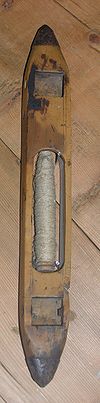
In one respect, the term is somewhat misleading, as the shuttle itself is only a component in a new system attached to the loom as part of the beater. A board called the "race" runs along the front of the beater, from side to side, forming a track on which the shuttle runs. At each end of the race, there is a box which catches the shuttle at the end of its journey, and which contains a mechanism for propelling the shuttle on its return trip. The shuttle itself has some subtle differences from the older form. The ends of the shuttle are bullet-shaped and metal-capped, and the shuttle generally has rollers to reduce friction. The weft thread is made to exit from the end rather than the side, and the thread is stored on a pirnPirn
A pirn is a rod onto which weft thread is wound for use in weaving. Unlike a bobbin, it is fixed in place, and the thread is delivered off the end of the pirn rather than from the center. A typical pirn is made of wood or plastic and is slightly tapered for most of its length, flaring out more...
(a long, conical, one-ended, non-turning bobbin) to allow it to feed more easily. Finally, the flying shuttle is generally somewhat heavier, so as to have sufficient inertia to carry it all the way through the shed.
In manual operation, a cord runs to each box from a handle held by the operator. To start the pick, the shed is opened as before; however, instead of throwing the shuttle, the operator jerks the cord for the box containing the shuttle. This causes the mechanism in the box to shoot the shuttle along the race to the other box; then the shed is closed and the beater is used to complete the pick as before. The operator does not need to touch the shuttle until it needs to be reloaded, so fabrics of great width can be woven; but more importantly, the movements needed are greatly reduced.
Even more important was the fact that this mechanism could be automated and powered; all the operator needed to do was monitor the machine for failures and keep it supplied with pirns of weft thread, a job that was simplified with the invention of the Northrop Loom
Northrop Loom
The Northrop Loom was a fully automatic power loom marketed by George Draper and Sons, Hopedale, Massachusetts beginning in 1895. It was named after James Henry Northrop who invented the shuttle-charging mechanism. -The Loom:...
, which reloaded the shuttle automatically. Kay's son developed a modification that allowed the use of an array of different shuttles.
Social effects
The increase in production due to the flying shuttle exceeded the capacity of the spinning industry of the day, and prompted development of powered spinning machines, beginning with the spinning jennySpinning jenny
The spinning jenny is a multi-spool spinning frame. It was invented c. 1764 by James Hargreaves in Stanhill, Oswaldtwistle, Lancashire in England. The device reduced the amount of work needed to produce yarn, with a worker able to work eight or more spools at once. This grew to 120 as technology...
and the waterframe, and culminating in the spinning mule
Spinning mule
The spinning mule was a machine used to spin cotton and other fibres in the mills of Lancashire and elsewhere from the late eighteenth to the early twentieth century. Mules were worked in pairs by a minder, with the help of two boys: the little piecer and the big or side piecer...
, which could produce strong, fine thread in the quantities needed. These innovations transformed the textile industry
Textile manufacture during the Industrial Revolution
The industrial revolution changed the nature of work and society. Opinion varies as to the exact date, but it is estimated that the First Industrial Revolution took place between 1750 and 1850, and the second phase or Second Industrial Revolution between 1860 and 1900. The three key drivers in...
in Great Britain
United Kingdom
The United Kingdom of Great Britain and Northern IrelandIn the United Kingdom and Dependencies, other languages have been officially recognised as legitimate autochthonous languages under the European Charter for Regional or Minority Languages...
. All were attacked
Luddite
The Luddites were a social movement of 19th-century English textile artisans who protested – often by destroying mechanised looms – against the changes produced by the Industrial Revolution, which they felt were leaving them without work and changing their way of life...
as threats to the livelihood of spinners and weavers, and Kay's patent was largely ignored. It is often incorrectly written that Kay was attacked and fled to France, but in fact he simply moved there to attempt to rent out his looms, a business model that had failed him in England.
The flying shuttle itself produced a new source of injuries; if deflected from its path, it could be shot clear of the machine, potentially striking workers. Turn of the century injury reports abound with instances in which eyes were lost or other injuries sustained, and in several instances (for example, an extended exchange in 1901) the British House of Commons was moved to take up the issue of installing guards and other contrivances to reduce these injuries.