

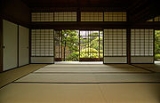
Shoji

Encyclopedia
Japanese architecture
' originated in prehistoric times with simple pit-houses and stores that were adapted to a hunter-gatherer population. Influence from Han Dynasty China via Korea saw the introduction of more complex grain stores and ceremonial burial chambers....
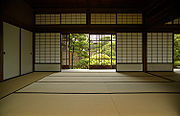
, a shōji (障子) is a door, window or room divider consisting of translucent paper over a frame of wood which holds together a lattice of wood or bamboo
Bamboo
Bamboo is a group of perennial evergreens in the true grass family Poaceae, subfamily Bambusoideae, tribe Bambuseae. Giant bamboos are the largest members of the grass family....
. While washi
Washi
is a type of paper made in Japan. Washi is commonly made using fibers from the bark of the gampi tree, the mitsumata shrub , or the paper mulberry, but also can be made using bamboo, hemp, rice, and wheat...
is the traditional paper, shōji may be made of paper made by modern manufacturing processes; plastic is also in use.
Shōji doors are often designed to slide open, and thus conserve space that would be required by a swinging door. They are used in traditional houses as well as Western-style housing, especially in the washitsu
Washitsu
, meaning "Japanese-style room", is a Japanese term used as an antonym for the term yōshitsu , meaning "Western-style room." Another term for washitsu is nihonma , and the comparative other term for yōshitsu is yōma ....
(Japanese-style room). In modern construction, the shōji does not form the exterior surface of the building; it sits inside a sliding glass door or window.
Formerly the word shōji could apply to both fusuma
Fusuma
In Japanese architecture, fusuma are vertical rectangular panels which can slide from side to side to redefine spaces within a room, or act as doors. They typically measure about wide by tall, the same size as a tatami mat, and are two or three centimeters thick...
and shōji although with a formal distinction of "karagami shōji" 唐紙障子(fusuma) and "akari shōji" 明り障子(shōji).