
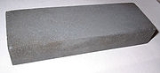
Sharpening stones,
water stones or
whetstones are used to
grindThe grind of a blade refers to the shape of the cross-section of the blade. It is distinct from the type of blade , though different tools and blades may have lent their name to a particular grind.Grinding involves removing significant portions of metal from the blade and is thus distinct from...
and
honeHône is a town and comune in the Aosta Valley region of north-western Italy.-Twin towns:twin towns with the year of its establishing:# Nora Municipality, Sweden...
the edges of steel tools and implements. Examples of items that may be
sharpenedSharpening is the process of creating or refining a sharp edge of appropriate shape on a tool or implement designed for cutting. Sharpening is done by grinding away material on the implement with an abrasive substance harder than the material of the implement, followed sometimes by processes to...
with a sharpening stone include scissors,
scytheA scythe is an agricultural hand tool for mowing grass, or reaping crops. It was largely replaced by horse-drawn and then tractor machinery, but is still used in some areas of Europe and Asia. The Grim Reaper is often depicted carrying or wielding a scythe...
s,
knivesA knife is a cutting tool with an exposed cutting edge or blade, hand-held or otherwise, with or without a handle. Knives were used at least two-and-a-half million years ago, as evidenced by the Oldowan tools...
,
razorsA straight razor is a razor with a blade that can fold into its handle. They are also called open razors and cut-throat razors.Although straight razors were once the principal method of manual shaving, they have been largely overshadowed by the safety razor, incorporating a disposable blade...
and tools such as
chiselA chisel is a tool with a characteristically shaped cutting edge of blade on its end, for carving or cutting a hard material such as wood, stone, or metal. The handle and blade of some types of chisel are made of metal or wood with a sharp edge in it.In use, the chisel is forced into the material...
s,
hand scraperA hand scraper is a single-edged tool used to scrape metal from a surface. This may be required where a surface needs to be trued, corrected for fit to a mating part, needs to retain oil , or even to give a decorative finish.Surface plates were traditionally made by scraping...
s and
planeA hand plane is a tool for shaping wood. When powered by electricity, the tool may be called a planer. Planes are used to flatten, reduce the thickness of, and impart a smooth surface to a rough piece of lumber or timber. Planing is used to produce horizontal, vertical, or inclined flat surfaces on...
blades. Though it is sometimes mistaken as a reference to the water often used to lubricate such stones, the word "whetstone" is a compound word formed with the word "whet," which means to sharpen a blade, not the word "wet". The process of using a sharpening stone is called
stoning.
Sharpening stones come in a wide range of shapes, sizes and material compositions. Stones may be flat, for working flat edges, or shaped for more complex edges, such as those associated with some
wood carvingWood carving is a form of working wood by means of a cutting tool in one hand or a chisel by two hands or with one hand on a chisel and one hand on a mallet, resulting in a wooden figure or figurine, or in the sculptural ornamentation of a wooden object...
or
woodturningWoodturning is a form of woodworking that is used to create wooden objects on a lathe . Woodturning differs from most other forms of woodworking in that the wood is moving while a stationary tool is used to cut and shape it...
tools. They may be composed of natural quarried material, or from man-made material.
Stones are usually available in various grades, which refers to the
gritMesh material is often used in determining the particle size distribution of a granular material. For example, a sample from a truckload of peanuts may be placed atop a mesh with 5 mm openings. When the mesh is shaken, small broken pieces and dust pass through the mesh while whole peanuts are...
size of the particles in the stone. Generally, the finer the grit, the denser the material, which leads to a finer finish of the surface of the tool. Finer grits cut slower because they remove less material. Grits are often given as a number, which indicates the density of the particles with a higher number denoting higher density and therefore smaller particles.
Natural stones versus artificial stones
Natural stones are less common than they used to be. Historical demand has exhausted most known natural quarries and little effort has gone into discovering new ones due to and since the concurrent rise of gunpowder and industrial chemistry: the one obviating the military importance of whetstones, and the other allowing for the mass production of artificial ones.
As a result, the legendary Honyama mines in
Kyotois a city in the central part of the island of Honshū, Japan. It has a population close to 1.5 million. Formerly the imperial capital of Japan, it is now the capital of Kyoto Prefecture, as well as a major part of the Osaka-Kobe-Kyoto metropolitan area.-History:...
,
JapanJapan is an island nation in East Asia. Located in the Pacific Ocean, it lies to the east of the Sea of Japan, China, North Korea, South Korea and Russia, stretching from the Sea of Okhotsk in the north to the East China Sea and Taiwan in the south...
, have been closed since 1967.
BelgiumBelgium , officially the Kingdom of Belgium, is a federal state in Western Europe. It is a founding member of the European Union and hosts the EU's headquarters, and those of several other major international organisations such as NATO.Belgium is also a member of, or affiliated to, many...
currently has only a single mine that is still quarrying
Coticules and their Belgian Blue Whetstone counterparts. This scarcity causes high prices for a good quality natural stone. Lower quality natural stones have problems with consistent grain sizes, low abrasive particle content leading to "slow" sharpening, inconsistency in hardness, inclusions of large foreign particles of other stone materials, and cracks and other such natural imperfections.
Modern
syntheticSynthesis, the combination of two or more parts, whether by design or by natural processes. Furthermore, it may imply being prepared or made artificially, in contrast to naturally.-In the sense of combination:* Synthetic position, a concept in finance...
stones are generally of equal quality to natural stones, and are often considered superior in sharpening performance due to consistency of particle size and control over the properties of the stones. For example, the proportional content of abrasive particles as opposed to base or "binder" materials can be controlled to make the stone cut faster or slower, as desired. Natural stones are often prized for their natural beauty as stones and their rarity, adding value as collectors' items. Furthermore, each natural stone is different, and there are rare natural stones that contain abrasive particles in grit sizes finer than are currently available in artificial stones.
Japanese sword polishing, particularly in the finishing stages, is still most commonly performed with extremely costly and rare natural polishing stones, as the inconsistent grit sizes of the abrasive particles in natural stones will often produce visual results of polishing that reveal characteristics of the steel that the uniform grain particles in artificial stone will not. Some Japanese waterstones are known to reach 50,000+, 75,000+, or even 120,000+ grit in abrasive particle size, while the finest artificial stone sold is the Shapton 30,000 grit stone (though diamond abrasive particles of several hundred thousand grit are available, typically as a suspended liquid or drypowder).
One of the most revered natural whetstones is the yellow-gray "Belgian Coticule," which has been legendary for the edge it can give to blades since Roman times, and has been quarried for centuries from the
ArdennesThe Ardennes is a region of extensive forests, rolling hills and ridges formed within the Givetian Ardennes mountain range, primarily in Belgium and Luxembourg, but stretching into France , and geologically into the Eifel...
. The slightly coarser and more plentiful "Belgian Blue" whetstone is found naturally with the yellow coticule in adjacent strata; hence two-sided whetstones are available, with a naturally occurring seam between the yellow and blue layers. These are highly prized for their natural elegance and beauty, as well as for providing both a fast-cutting surface for establishing a bevel and a higher-grit surface for refining it. Amongst
straight razorA straight razor is a razor with a blade that can fold into its handle. They are also called open razors and cut-throat razors.Although straight razors were once the principal method of manual shaving, they have been largely overshadowed by the safety razor, incorporating a disposable blade...
users, this stone is considered one of the finest.
The hard stone of
Charnwood ForestCharnwood Forest is an upland tract in north-western Leicestershire, England, bounded by Leicester, Loughborough, and Coalville. The area is undulating, rocky and picturesque, with barren areas. It also has some extensive tracts of woodland; its elevation is generally 600 ft and upwards, the area...
has been quarried for centuries, and was a source of whetstones and
quern-stoneQuern-stones are stone tools for hand grinding a wide variety of materials. They were used in pairs. The lower, stationary, stone is called a quern, whilst the upper, mobile, stone is called a handstone...
s.
Whetstones and oilstones
Whetstones may be natural or artificial stones. Artificial stones usually come in the form of a
bonded abrasiveAn abrasive is a material, often a mineral, that is used to shape or finish a workpiece through rubbing which leads to part of the workpiece being worn away...
composed of a
ceramicA ceramic is an inorganic, nonmetallic solid prepared by the action of heat and subsequent cooling. Ceramic materials may have a crystalline or partly crystalline structure, or may be amorphous...
such as
silicon carbideSilicon carbide , also known as carborundum, is a compound of silicon and carbon with chemical formula SiC. It occurs in nature as the extremely rare mineral moissanite. Silicon carbide powder has been mass-produced since 1893 for use as an abrasive...
(carborundum) or of
aluminium oxideAluminium oxide is an amphoteric oxide with the chemical formula 23. It is commonly referred to as alumina, or corundum in its crystalline form, as well as many other names, reflecting its widespread occurrence in nature and industry...
(corundum). Bonded abrasives provide a faster cutting action than natural stones. They are commonly available as a double-sided block with a coarse grit on one side and a fine grit on the other enabling one stone to satisfy the basic requirements of sharpening. Some shapes are designed for specific purposes such as sharpening scythes, drills or serrations.
When the block is intended for installation on a bench it is called a bench stone. Small, portable stones (commonly made of bonded abrasive) are called pocket stones. Being smaller, they are more portable than bench stones but present difficulty in maintaining a consistent angle and pressure when drawing the stone along larger blades. However, they still can form a good edge. Frequently, fine grained pocket stones are used for honing, especially "in the field". Despite being a
homophoneA homophone is a word that is pronounced the same as another word but differs in meaning. The words may be spelled the same, such as rose and rose , or differently, such as carat, caret, and carrot, or to, two, and too. Homophones that are spelled the same are also both homographs and homonyms...
with
wet, whetstones need not be lubricated with oil nor water, although it is very common that either is used. Lubrication aids the cutting action and carries
swarfSwarf, also known as turnings, chips, or filings, are shavings and chippings of metal — the debris or waste resulting from metalworking operations including milling and grinding. It can usually be recycled, and this is the preferred method of disposal due to the environmental concerns regarding...
away.
Finer grades of whetstones intended for use with oil (though, again, water may also be used) are called oilstones. Oilstones usually come in the form of bench stones. One of the natural minerals commonly used in oilstones is
NovaculiteNovaculite is a form of chert or flint found in the Ouachita Mountains of Arkansas and Oklahoma and in the Marathon Uplift of Texas. Novaculite is considered to be highly siliceous sediments and may be a product of the low-grade metamorphism of chert beds...
. Examples of stones made from this material include
Arkansas, Ouachita or
Washita stones from the
Ouachita MountainsThe Ouachita Mountains are a mountain range in west central Arkansas and southeastern Oklahoma. The range's subterranean roots may extend as far as central Texas, or beyond it to the current location of the Marathon Uplift. Along with the Ozark Mountains, the Ouachita Mountains form the U.S...
in
ArkansasArkansas is a state located in the southern region of the United States. Its name is an Algonquian name of the Quapaw Indians. Arkansas shares borders with six states , and its eastern border is largely defined by the Mississippi River...
. These come in various grades and colors, with the finer stones being denominated "surgical black" or "pink translucent". Novaculite is from the Devonian and Mississippian periods. It is a sedimentary rock composed mostly of microcrystalline
quartzQuartz is the second-most-abundant mineral in the Earth's continental crust, after feldspar. It is made up of a continuous framework of SiO4 silicon–oxygen tetrahedra, with each oxygen being shared between two tetrahedra, giving an overall formula SiO2. There are many different varieties of quartz,...
and is basically a recrystallized variety of
chertChert is a fine-grained silica-rich microcrystalline, cryptocrystalline or microfibrous sedimentary rock that may contain small fossils. It varies greatly in color , but most often manifests as gray, brown, grayish brown and light green to rusty red; its color is an expression of trace elements...
. It is also the primary material in
Charnley Forest and
Turkey oilstones.
Extremely fine grades of stone that remove very little metal may be called polishing stones.
Manufacturing process
Abrasive stones are made by
sinteringSintering is a method used to create objects from powders. It is based on atomic diffusion. Diffusion occurs in any material above absolute zero, but it occurs much faster at higher temperatures. In most sintering processes, the powdered material is held in a mold and then heated to a temperature...
powder metal,ceramics and clay just below their melting points.
Japanese waterstones
The Japanese traditionally used sharpening stones lubricated with water (using oil on a waterstone reduces its effectiveness). They have been doing this for many hundreds of years, and the first stones were naturally occurring. The geology of Japan provided a type of stone which consists of fine silicate particles in a clay matrix. This is somewhat softer than
NovaculiteNovaculite is a form of chert or flint found in the Ouachita Mountains of Arkansas and Oklahoma and in the Marathon Uplift of Texas. Novaculite is considered to be highly siliceous sediments and may be a product of the low-grade metamorphism of chert beds...
.
Japanese stones are also sedimentary. The most famous are typically mined in the Narutaki District just north of
Kyotois a city in the central part of the island of Honshū, Japan. It has a population close to 1.5 million. Formerly the imperial capital of Japan, it is now the capital of Kyoto Prefecture, as well as a major part of the Osaka-Kobe-Kyoto metropolitan area.-History:...
.
Advantages and disadvantages
These softer Japanese stones have a few advantages over harder stones. First, because they are softer they do not become glazed or loaded with the material they are sharpening. New particles are constantly exposed as you work with them and thus they continue to cut consistently. Second, they can be lubricated effectively with water (rather than oil, which can ruin the stone) so nothing but water is required. Finally, because they are soft, the worn material and the water form a slurry that in conjunction with the stone, sharpens and polishes the blade.
A disadvantage is that they become uneven faster than other types of sharpening stone, although at the same time this makes them easier to flatten.
Grades of waterstones
Historically, there are three broad grades of Japanese sharpening stones: the
ara-to, or "rough stone", the
naka-to or "middle/medium stone" and the
shiage-to or "finishing stone". There is a fourth type of stone, the
nagura, which is not used directly. Rather, it is used to form a cutting slurry on the
shiage-to, which is often too hard to create the necessary slurry. Converting these names to absolute grit size is difficult as the classes are broad and natural stones have no inherent "grit number". As an indication,
ara-to is probably (using a non-Japanese system of grading grit size) 500–1000 grit. The
naka-to is probably 3000–5000 grit and the
shiage-to is likely 7000–10000 grit. Current synthetic grit values range from extremely coarse, such as 120 grit, through extremely fine, such as 30,000 grit (less than half a micron abrasive particle size).
Diamond plate
A diamond plate is a steel plate sometimes with a plastic or resin base. The plate is coated with diamond
gritMesh material is often used in determining the particle size distribution of a granular material. For example, a sample from a truckload of peanuts may be placed atop a mesh with 5 mm openings. When the mesh is shaken, small broken pieces and dust pass through the mesh while whole peanuts are...
, an abrasive that will grind metal. The plate may have a series of holes cut in it that capture the
swarfSwarf, also known as turnings, chips, or filings, are shavings and chippings of metal — the debris or waste resulting from metalworking operations including milling and grinding. It can usually be recycled, and this is the preferred method of disposal due to the environmental concerns regarding...
cast off as grinding takes place. Diamond plates can serve two purposes: they can be used as a stand-alone alternative to stones for sharpening steel edge tools; and they can also be used for maintaining the flatness of man-made waterstones, which can become grooved or hollowed in use. Flattening deformed waterstones is considered essential to the sharpening process. Diamond plates can be used to flatten these stones and are considered an alternative to more traditional methods.
Diamond plates are available in various plate sizes (from credit card to bench plate size) and grades of grit. A coarser grit is used to remove larger amounts of metal more rapidly, such as when forming an edge or restoring a damaged edge. A finer grit is used to remove the scratches of larger grits and to refine an edge. Two-sided plates exist where each side is covered in a different grit.
Unlike stones that can become rounded, which decreases their effectiveness, diamond plates remain flat. They do not require the use of a lubricant.
Diamond plates, being made from diamond — even though of industrial grade — tend to be more expensive than synthetic whetstones. They are also not capable of refining an edge as well or to as great an extent as synthetic or natural whetstones.
See also
- Sharpening
Sharpening is the process of creating or refining a sharp edge of appropriate shape on a tool or implement designed for cutting. Sharpening is done by grinding away material on the implement with an abrasive substance harder than the material of the implement, followed sometimes by processes to...
- Knife sharpening
Knife sharpening may be done by grinding against a hard rough surface, typically stone, or a soft surface with hard particles, such as sandpaper.Additionally, leather razor strop, or strop, is often used to straighten and polish an edge...
- Razor strop
A razor strop is a flexible strip of leather or canvas used to straighten and polish the blade of a straight razor, a knife, or a woodworking tool like a chisel...
- Sharpening jig
A sharpening jig is often used when sharpening woodworking tools. Many of the tools used in woodworking have steel blades which are sharpened to a fine edge. A cutting edge is created on the blade at the point at which two surfaces of the blade meet. To create this cutting edge a bevel is formed on...
- Scary sharp
Scary sharp is a method of sharpening woodworking tools with sandpaper instead of conventional methods of oilstone or waterstone sharpening. The sandpaper referred-to here can be any abrasive impregnated sheet used in the various industries to smooth surfaces and examples include glass paper,...
External links
- http://www.woodcraft.com/Articles/Articles.aspx?articleid=385