
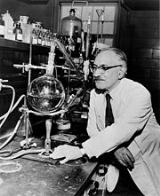
Selman Abraham Waksman (22 July 1888 – 16 August 1973) was a Jewish American
biochemistBiochemistry is the study of the chemical processes in living organisms. It deals with the structure and function of cellular components such as proteins, carbohydrates, lipids, nucleic acids and other biomolecules....
and
microbiologistMicrobiology is the study of microorganisms, which are unicellular or cell-cluster microscopic organisms. This includes eukaryotes such as fungi and protists, and prokaryotes. Viruses, though not strictly classed as living organisms, are also studied...
whose research into organic substances—largely into
organismIn biology, an organism is any living system . In at least some form, all organisms are capable of response to stimuli, reproduction, growth and development, and maintenance of homeostasis as a stable whole...
s that live in
soilSoil is a natural body consisting of layers of mineral constituents of variable thicknesses, which differ from the parent materials in their morphological, physical, chemical, and mineralogical characteristics. It is composed of particles of broken rock that have been altered by chemical and...
—and their
decompositionDecomposition is the process by which tissues of a dead organism break down into simpler forms of matter. The process is essential for new growth and development of living organisms because it recycles the finite matter that occupies physical space in the biome. Bodies of living organisms begin to...
promoted the discovery of
StreptomycinStreptomycin is an antibiotic drug, the first of a class of drugs called aminoglycosides to be discovered, and was the first antibiotic remedy for tuberculosis. It is derived from the actinobacterium Streptomyces griseus. Streptomycin is a bactericidal antibiotic. Streptomycin cannot be given...
, and several other
antibioticIn common usage, an antibiotic is a substance or compound that kills or inhibits the growth of bacteria...
s. A
professorThe meaning of the word professor varies. In some English-speaking countries, it refers to a senior academic who holds a departmental chair, especially as head of the department, or a personal chair awarded specifically to that individual...
of biochemistry and microbiology at
Rutgers UniversityRutgers, The State University of New Jersey , is the largest institution for higher education in the state of New Jersey. It was originally chartered as Queen's College in 1766 and is the eighth-oldest college in the United States...
for four decades, his work led to the discovery of over twenty
antibioticIn common usage, an antibiotic is a substance or compound that kills or inhibits the growth of bacteria...
s (a word which he coined) and procedures that have led to the development of many others. The proceeds earned from the licensing of his
patentA patent is a set of exclusive rights granted by a state to an inventor or their assignee for a limited period of time in exchange for a public disclosure of an invention....
s funded a foundation for microbiological research, which established the
Waksman Institute of MicrobiologyThe Waksman Institute of Microbiology is a research facility on the Busch Campus of Rutgers University. It is named after Selman Waksman, who was a faculty member who won the Nobel Prize for Medicine in 1952 for research which led to the discovery of streptomycin. 18 antibiotics were isolated in...
located on Rutgers University's Busch Campus in Piscataway,
New JerseyNew Jersey is a state in the Mid-Atlantic region of the United States. It is bordered on the north by New York, and to the east by the Hudson River, Upper New York Bay, the Kill Van Kull, Newark Bay, the Arthur Kill, Raritan Bay, Sandy Hook Bay, Westchester County, New York City, Long Island, and...
(USA). In 1952 he was awarded the Nobel Prize in Physiology or Medicine in recognition "for his discovery of "streptomycin" the first antibiotic active against tuberculosis", despite the fact that this medicine was indeed discovered by
Albert SchatzAlbert Schatz was the co-discoverer of streptomycin, the first antibiotic remedy used to treat tuberculosis and a number of other diseases...
, one of Waksman's graduate investigators working under his direction.
In 2005 Selman Waksman was designated an
ACS National Historical Chemical LandmarkThe National Historic Chemical Landmarks Program was launched by the American Chemical Society in 1992 and has recognized more than 60 landmarks to date. The program celebrates the centrality of chemistry...
in recognition of his significance for isolating more than fifteen antibiotics, including streptomycin, which was the first effective treatment for tuberculosis.
Biography
Selman Waksman was born on 22 July 1888 to Jewish parents in Nova Pryluka, a peasant village near
KievKiev or Kyiv , is the capital and the largest city of Ukraine, located in the north central part of the country on the Dnieper River. The population as of the 2001 census was 2,611,300...
, in the
Russian EmpireThe Russian Empire was a state that existed from 1721 until the Russian Revolution of 1917. It was the successor to the Tsardom of Russia, and the predecessor of the Soviet Union...
, now
UkraineUkraine is a country in Eastern Europe. It is bordered by Russia to the east; Belarus to the north; Poland, Slovakia, and Hungary to the west; Romania and Moldova to the southwest; and the Black Sea and Sea of Azov to the south. The city of Kiev is both the capital and the largest city of...
. He immigrated to the United States in 1910, shortly after receiving his matriculation diploma from the Fifth Gymnasium in
OdessaOdessa or Odesa is the administrative center of the Odessa Oblast located in southern Ukraine. The city is a major seaport located on the shore of the Black Sea and the fourth largest city in Ukraine with a population of 1,029,000 .Odessa was founded by Hacı I Giray, the Khan of Crimea, in 1240...
, Ukraine, and became a
naturalised American citizenNaturalization is the acquisition of citizenship or nationality by somebody who was not a citizen or national of that country when he or she was born....
six years later.
Waksman attended
Rutgers CollegeRutgers, The State University of New Jersey , is the largest institution for higher education in the state of New Jersey. It was originally chartered as Queen's College in 1766 and is the eighth-oldest college in the United States...
(now Rutgers University), where he was graduated in 1915 with a
Bachelor of ScienceA Bachelor of Science is an undergraduate academic degree awarded for completed courses that generally last three to five years ....
(B.Sc.) in
AgricultureAgriculture is the production of food and goods through farming and forestry. Agriculture was the key development that led to the rise of human civilization, with the husbandry of domesticated animals and plants creating food surpluses that enabled the development of more densely populated and...
. He continued his studies at Rutgers, receiving a
Master of ScienceA Master of Science is a postgraduate academic master's degree awarded by universities in a large number of countries...
(M.Sc.) the following year. During his graduate study, he worked under J. G. Lipman at the New Jersey Agricultural Experiment Station at Rutgers performing research in soil bacteriology. Waksman was then appointed as Research Fellow
at the
University of California, BerkeleyThe University of California, Berkeley is a public research university located in Berkeley, California, United States. The oldest of the ten major campuses affiliated with the University of California, Berkeley offers some 300 undergraduate and graduate degree programs in a wide range of disciplines...
from where he was awarded his
Doctor of PhilosophyDoctor of Philosophy, abbreviated PhD , for the Latin , meaning "teacher of philosophy", or alternatively, DPhil, for the equivalent , is an advanced academic degree awarded by universities...
(Ph.D.) in Biochemistry in 1918.
He later joined the faculty at
Rutgers UniversityRutgers, The State University of New Jersey , is the largest institution for higher education in the state of New Jersey. It was originally chartered as Queen's College in 1766 and is the eighth-oldest college in the United States...
in the Department of Biochemistry and Microbiology. It was at Rutgers that Waksman's team discovered several antibiotics, including
actinomycinThe actinomycins are a class of polypeptide antibiotics isolated from soil bacteria of the genus Streptomyces, of which the most significant is actinomycin D. It was the first antibiotic isolated by Selman Waksman and his co-worker H. B...
, clavacin, streptothricin,
streptomycinStreptomycin is an antibiotic drug, the first of a class of drugs called aminoglycosides to be discovered, and was the first antibiotic remedy for tuberculosis. It is derived from the actinobacterium Streptomyces griseus. Streptomycin is a bactericidal antibiotic. Streptomycin cannot be given...
, grisein,
neomycinNeomycin is an aminoglycoside antibiotic that is found in many topical medications such as creams, ointments and eyedrops.-Uses:Neomycin is overwhelmingly used as a topical preparation, such as Neosporin. It can also be given orally, where it is usually combined with other antibiotics...
, fradicin,
candicidinCandicidin is an antibiotic....
, candidin, and others. Two of these,
streptomycinStreptomycin is an antibiotic drug, the first of a class of drugs called aminoglycosides to be discovered, and was the first antibiotic remedy for tuberculosis. It is derived from the actinobacterium Streptomyces griseus. Streptomycin is a bactericidal antibiotic. Streptomycin cannot be given...
and
neomycinNeomycin is an aminoglycoside antibiotic that is found in many topical medications such as creams, ointments and eyedrops.-Uses:Neomycin is overwhelmingly used as a topical preparation, such as Neosporin. It can also be given orally, where it is usually combined with other antibiotics...
, have found extensive application in the treatment of numerous infectious diseases.
StreptomycinStreptomycin is an antibiotic drug, the first of a class of drugs called aminoglycosides to be discovered, and was the first antibiotic remedy for tuberculosis. It is derived from the actinobacterium Streptomyces griseus. Streptomycin is a bactericidal antibiotic. Streptomycin cannot be given...
was the first
antibioticIn common usage, an antibiotic is a substance or compound that kills or inhibits the growth of bacteria...
that could be used to cure the disease
tuberculosisTuberculosis is a common and often deadly infectious disease caused by mycobacteria...
. Waksman coined the term antibiotics.
Many awards and honors were showered on Waksman after 1940, most notably the Nobel Prize in 1952; the Star of the Rising Sun, bestowed on him by the emperor of Japan, and the rank of Commandeur in the French
Légion d'honneurThe Légion d'honneur or Ordre national de la Légion d'honneur is a French order established by Napoleon Bonaparte, First Consul of the First Republic, on 19 May 1802...
.
Selman Waksman died on 16 August 1973 and was interred at the Crowell Cemetery in
Woods HoleWoods Hole is a census-designated place in the town of Falmouth in Barnstable County, Massachusetts, United States. It lies at the extreme southwest corner of Cape Cod, near Martha's Vineyard and the Elizabeth Islands...
,
Barnstable CountyBarnstable County is a county located in the U.S. state of Massachusetts, consisting of Cape Cod and associated islands. As of 2000, the population was 222,230. Its county seat is Barnstable.-Geography:According to the U.S...
,
MassachusettsThe Commonwealth of Massachusetts is a state in the New England region of the northeastern United States. It is bordered by Rhode Island and Connecticut to the south, New York to the west, and Vermont and New Hampshire to the north; at its east lies the Atlantic Ocean. Most of its population of...
. His tombstone is inscribed simply as
Selman Abraham Waksman: Scientist and following his dates of birth and death, an apt
paraphraseParaphrase is restatement of a text or passage, using other words. The term "paraphrase" derives via the Latin "paraphrasis" from the Greek para phraseïn, meaning "additional manner of expression". The act of paraphrasing is also called "paraphrasis."A paraphrase typically explains or clarifies...
(given his life's work) of a verse from the prophetic Hebrew
Book of IsaiahThe Book of Isaiah is a book of the Bible traditionally attributed to the Prophet Isaiah, who lived in the second half of the 8th century BC. In the first 39 chapters, Isaiah prophesies doom for a sinful Judah and for all the nations of the world that oppose God. The last 27 chapters prophesy the...
, carved in both
HebrewHebrew is a Semitic language of the Afro-Asiatic language family. Culturally, it is considered a Jewish language. Hebrew in its modern form is spoken by more than seven million people in Israel while Classical Hebrew has been used for prayer or study in Jewish communities around the world for over...
and
EnglishEnglish is a West Germanic language that developed in England during the Anglo-Saxon era. As a result of the military, economic, scientific, political, and cultural influence of the British Empire during the 18th, 19th, and early 20th centuries, and of the United States since the mid 20th century,...
stating "The earth will open and bring forth salvation".
Streptomycin
Although Waksman had been studying the
StreptomycesStreptomyces is the largest genus of Actinobacteria and the type genus of the family Streptomycetaceae. Over 500 species of Streptomyces bacteria have been described. As with the other Actinobacteria, streptomycetes are gram-positive, and have genomes with high GC-content...
family of organism since his college student days, the details and credit for the discovery of its use as the antibiotic
streptomycinStreptomycin is an antibiotic drug, the first of a class of drugs called aminoglycosides to be discovered, and was the first antibiotic remedy for tuberculosis. It is derived from the actinobacterium Streptomyces griseus. Streptomycin is a bactericidal antibiotic. Streptomycin cannot be given...
were strongly contested by one of Waksman's graduate students,
Albert SchatzAlbert Schatz was the co-discoverer of streptomycin, the first antibiotic remedy used to treat tuberculosis and a number of other diseases...
, and resulted in litigation. Rutgers University and Waksman at first vehemently denied the allegations, but archival material from Selman Waksman's own papers, brought to public light by the Electronic New Jersey history project, indicate that Waksman and the university knew they faced trouble.
http://www2.scc.rutgers.edu/njh/SciANDTech/Waksman/schatz.htm The litigation ended with a substantial settlement for Schatz and the official decision that Waksman and Schatz would be considered co-discoverers of
streptomycinStreptomycin is an antibiotic drug, the first of a class of drugs called aminoglycosides to be discovered, and was the first antibiotic remedy for tuberculosis. It is derived from the actinobacterium Streptomyces griseus. Streptomycin is a bactericidal antibiotic. Streptomycin cannot be given...
. Schatz made the discovery while working in Waksman's basement lab, and using Waksman's equipment .
In 2004, author
Inge Auerbacher co-wrote the book
Finding Dr. Schatz: The Discovery of Streptomycin and a Life It Saved with Schatz. The book chronicled his discovery of streptomycin and meeting Auerbacher, a holocaust survivor and recipient of his antibiotic. A documentary by the same name,
"Finding Dr. Schatz", directed by
Richard Colosi from Rochester, NY will be released in 2009.
Neomycin
Like streptomycin, it is derived from actinomycetes. Hubert A. Lechevalier, a graduate student worked with him. The discovery was published in the journal Science.
Nobel Prize
There is contention as to whether or not Schatz should have been included in the
Nobel PrizeThe Nobel Prize is a Sweden-based international monetary prize. The award was established by the 1895 will and estate of Swedish chemist and inventor Alfred Nobel. It was first awarded in Physics, Chemistry, Physiology or Medicine, Literature, and Peace in 1901...
awarded in 1952 for "for his discovery of streptomycin, the first antibiotic effective against tuberculosis" but it is understood that the
Nobel PrizeThe Nobel Prize is a Sweden-based international monetary prize. The award was established by the 1895 will and estate of Swedish chemist and inventor Alfred Nobel. It was first awarded in Physics, Chemistry, Physiology or Medicine, Literature, and Peace in 1901...
was awarded not only for the discovery of
streptomycinStreptomycin is an antibiotic drug, the first of a class of drugs called aminoglycosides to be discovered, and was the first antibiotic remedy for tuberculosis. It is derived from the actinobacterium Streptomyces griseus. Streptomycin is a bactericidal antibiotic. Streptomycin cannot be given...
but also for the development of the methods and techniques that led up to its discovery, and the discovery of many other antibiotics.
Waksman created the
Waksman Foundation for Microbiology in 1951 (
Foundation History) using half of his personal patent royalties. At a meeting of the board of Trustees of the Foundation, held in July 1951 he urged the building of a facility for work in microbiology, named the
Waksman Institute of MicrobiologyThe Waksman Institute of Microbiology is a research facility on the Busch Campus of Rutgers University. It is named after Selman Waksman, who was a faculty member who won the Nobel Prize for Medicine in 1952 for research which led to the discovery of streptomycin. 18 antibiotics were isolated in...
, which is located on the
Busch campusBusch Campus is one of the five campuses at Rutgers University's main New Brunswick/Piscataway area campus, and is located entirely within Piscataway Township, New Jersey. Academic facilities and departments centered on this campus are primarily those related to the natural sciences: physics,...
of
Rutgers UniversityRutgers, The State University of New Jersey , is the largest institution for higher education in the state of New Jersey. It was originally chartered as Queen's College in 1766 and is the eighth-oldest college in the United States...
in Piscataway, New Jersey.
Publications
Selman Waksman was
authorAn author is defined both as "the person who originates or gives existence to anything" and that authorship determines responsibility for what is created...
or co-author of over 400 scientific papers, as well as twenty-eight books and 14 scientific pamphlets.
- Enzymes (1926)
- Humus: origin, chemical composition, and importance in nature (1936, 1938)
- Principles of Soil Microbiology (1938)
- My Life with the Microbes (1954) (an autobiography)
External links