
All Topics  
Second Bank of the United States

 
Second Bank of the United States

   Email Print
   Bookmark   Link


Second Bank of the United States


The Second Bank of the United States was opened in January 1817, six years after the First Bank of the United States
First Bank of the United States

The First Bank of the United States was a bank chartered by the United States Congress on February 25, 1791. The charter was for 20 years. The Bank was created to handle the financial needs and requirements of the central government of the newly formed United States, which had previously been thirteen individual colonies with their own ban...
 lost its charter
Charter

A charter is the grant of authority or rights, stating that the granter formally recognizes the prerogative of the recipient to exercise the rights specified....
. The Second Bank of the United States was headquartered in Carpenters' Hall
Carpenters' Hall

Carpenters' Hall is a four-story brick building in the Center City, Philadelphia neighborhood of Philadelphia, Pennsylvania, that was a key meeting place in the early history of the United States....
, Philadelphia, the same as the First Bank, and had branches throughout the nation. The Second Bank was chartered by many of the same congressmen who in 1811 had refused to renew the charter of the original Bank of the United States. The predominant reason that the Second Bank of the United States was chartered was that in the War of 1812
War of 1812

The War of 1812, between the United States of America and the British Empire , was fought from 1812 to 1815.There were several immediate stated causes for the U.S....
, the U.S.


Discussion
Ask a question about 'Second Bank of the United States'
Start a new discussion about 'Second Bank of the United States'
Answer questions from other users
Full Discussion Forum


Encyclopedia


The Second Bank of the United States was opened in January 1817, six years after the First Bank of the United States
First Bank of the United States

The First Bank of the United States was a bank chartered by the United States Congress on February 25, 1791. The charter was for 20 years. The Bank was created to handle the financial needs and requirements of the central government of the newly formed United States, which had previously been thirteen individual colonies with their own ban...
 lost its charter
Charter

A charter is the grant of authority or rights, stating that the granter formally recognizes the prerogative of the recipient to exercise the rights specified....
. The Second Bank of the United States was headquartered in Carpenters' Hall
Carpenters' Hall

Carpenters' Hall is a four-story brick building in the Center City, Philadelphia neighborhood of Philadelphia, Pennsylvania, that was a key meeting place in the early history of the United States....
, Philadelphia, the same as the First Bank, and had branches throughout the nation. The Second Bank was chartered by many of the same congressmen who in 1811 had refused to renew the charter of the original Bank of the United States. The predominant reason that the Second Bank of the United States was chartered was that in the War of 1812
War of 1812

The War of 1812, between the United States of America and the British Empire , was fought from 1812 to 1815.There were several immediate stated causes for the U.S....
, the U.S. experienced severe inflation
Inflation

In economics, inflation is a rise in the general price level of goods and services in an economy over a period of time. The term "inflation" once referred to increases in the money supply ; however, economic debates about the relationship between money supply and price levels have led to its primary use today in describing price inflatio...
 and had difficulty in financing military operations. Subsequently, the credit and borrowing status of the United States was at its lowest level since its founding.

The charter of the Second Bank of the United States (B.U.S.) was for 20 years and therefore up for renewal in 1836. The B.U.S. was in no sense a national bank but rather a privately held banking corporation. The bank had a unique relationship with the federal government
Federal government

A federal government is the common government of a federation.The structure of federal governments vary from institution to institution based on a broad definition of federation....
 that gave it access to substantial profits. Its role as the depository of the federal government's revenues made it a political target of banks chartered by the individual states who objected/envied the B.U.S.'s relationship with the central government. Partisan politics came heavily into play in the debate over the renewal of the charter. "The classic statement by Arthur Schlesinger was that the partisan politics during the Jacksonian period was grounded in class conflict. Viewed through the lens of party elite discourse, Schlesinger saw inter-party conflict as a clash between wealthy Whigs and working class Democrats." (Grynaviski) President Andrew Jackson
Andrew Jackson

Andrew Jackson was the List of Presidents of the United States President of the United States . He was List of governors of Florida of Florida , commander of the American forces at the Battle of New Orleans , and eponym of the era of Jacksonian democracy....
 strongly opposed the renewal of its charter, and built his platform for the election of 1832 around doing away with the Second Bank of the United States. Jackson's political target was Nicholas Biddle
Nicholas Biddle (banker)

Nicholas Biddle , was an United States financier who served as the president of the Second Bank of the United States....
, financier, politician, and president of the Bank of the United States.

Apart from a general hostility to banking and the belief that specie
Specie

Specie may refer to:* Coins or other metal money in mass circulation* Bullion coins* Hard money * Commodity money...
 (gold and/or silver) were the only true monies, Jackson's reasons for opposing the renewal of the charter revolved around his belief that bestowing power and responsibility upon a single bank was the cause of inflation and other perceived evils. There is little to suggest that the Second Bank of the United States was responsible for increasing inflation rates. There is evidence that suggests increased inflation after 1832 was due to the influx of foreign specie as a result of foreign monetary policy, investment, and settlement of war debts and grievances.

During September 1833, President Jackson issued an executive order
Executive order

An executive order in the United States is a directive issued by the President of the United States, the head of the Executive of the Federal government of the United States....
 that ended the deposit of government funds into the Bank of the United States. After September 1833, these deposits were placed in the state chartered banks. While it is true that 6 out of the 7 initial depositories were controlled by Jacksonian Democrats, the later depositories, such as the ones in North Carolina
North Carolina

North Carolina is a U.S. state located on the Atlantic Seaboard in the southeastern United States. The state borders South Carolina and Georgia to the south, Tennessee to the west and Virginia to the north....
, South Carolina
South Carolina

South Carolina is a U.S. state in the Southern United States of the United States. It borders Georgia to the south and North Carolina to the north....
, and Michigan
Michigan

Michigan is a Midwestern United States U.S. state of the United States of America. It was named after Lake Michigan, whose name is a French adaptation of the Anishinaabe language term mishigama, meaning "large water" or "large lake"....
, were run by managers who opposed Jacksonian politics.

Background

The Second bank was patterned after the First Bank of the United States
First Bank of the United States

The First Bank of the United States was a bank chartered by the United States Congress on February 25, 1791. The charter was for 20 years. The Bank was created to handle the financial needs and requirements of the central government of the newly formed United States, which had previously been thirteen individual colonies with their own ban...
. The legality of the Bank was upheld in the U.S. Supreme Court
Supreme Court of the United States

The Supreme Court of the United States is the highest judicial body in the United States, and leads the federal United States federal courts. It consists of the Chief Justice of the United States and eight Associate Justice of the Supreme Court of the United States, who are nominated by the President of the United States and confirmed with th...
 case McCulloch v. Maryland
McCulloch v. Maryland

McCulloch v. Maryland, , was a landmark decision by the Supreme Court of the United States. The state of Maryland had attempted to impede operation of a branch of the Second Bank of the United States by imposing a tax on all banknote of banks not chartered in Maryland....
 17 U.S. 316 (1818) that also declared null and void any state law contrary to a federal law made in pursuance of the Constitution. The Bank's last president was Nicholas Biddle
Nicholas Biddle (banker)

Nicholas Biddle , was an United States financier who served as the president of the Second Bank of the United States....
 (1786-1844).

Controversy

The Second Bank of the United States provided a convenient way for the government to handle its affairs. The bank was created when James Madison
James Madison

James Madison was an American politician and political philosopher who served as the List of Presidents of the United States President of the United States , and one of the Founding Fathers of the United States....
 and Albert Gallatin
Albert Gallatin

Abraham Alfonse Albert Gallatin was a Swiss-American ethnologist, linguistics, Politics of the United States, diplomat, United States Representative, and the longest-serving United States Secretary of the Treasury....
 found the government unable to finance the country in the aftermath of the War of 1812
War of 1812

The War of 1812, between the United States of America and the British Empire , was fought from 1812 to 1815.There were several immediate stated causes for the U.S....
. The War of 1812 had put the United States in significant debt, and the First Bank of the United States had closed in 1811. The debt of the nation led to an increase in banknotes among the new private banks, and as a result, inflation increased greatly. As a result, Madison and Congress agreed to form the Second Bank of the United States.

After the war, despite the debt, the United States also experienced an economic boom, due to the devastation of the Napoleonic Wars
Napoleonic Wars

The Napoleonic Wars were a series of conflicts involving Napoleon I of France First French Empire and changing sets of European allies and opposing coalitions that ran from 1803 to 1815....
. In particular, because of the damage to Europe's agricultural sector, the U.S. agricultural sector underwent an expansion. The Bank aided this boom through its lending, which encouraged speculation in land. This lending allowed almost anyone to borrow money and speculate in land, sometimes doubling or even tripling the prices of land. The land sales for 1819, alone, totaled some 55 million acres (220,000 km²). With such a boom, hardly anyone noticed the widespread fraud occurring at the Bank as well as the economic bubble that had been created.

In the summer of 1818, the national bank managers realized the bank's massive over-extension, and instituted a policy of contraction and the calling in of loans. This recalling of loans simultaneously curtailed land sales and slowed the U.S. production boom due to the recovery of Europe. The result was the Panic of 1819
Panic of 1819

The Panic of 1819 was the first major Currency crisis in the United States. The new nation faced a depression in the late 1780s , and another severe economic downturn in the late 1790s following the Panic of 1797....
 and the situation leading up to McCulloch v. Maryland
McCulloch v. Maryland

McCulloch v. Maryland, , was a landmark decision by the Supreme Court of the United States. The state of Maryland had attempted to impede operation of a branch of the Second Bank of the United States by imposing a tax on all banknote of banks not chartered in Maryland....
 17 U.S. 316 (1819).

Maryland
Maryland

Maryland is a U.S. state located in the Mid Atlantic States of the United States, bordering Virginia, West Virginia and the Washington, D.C. to the south and west, Pennsylvania to the north, and Delaware to the east....
 adopted a policy to restrict banks, by placing a tax on any bank that was not chartered by the state legislature. This tax was either 2% of all assets or a flat rate of $15,000. That meant that the Baltimore Branch would have to pay this hefty tax. McCulloch filed suit against the state in a county court. The case made its way through the courts
United States federal courts

The United States federal courts comprises the Judiciary of government organized under the United States Constitution and Law of the United States of the federal government of the United States....
, all the way up to the United States Supreme Court, where the tax by the state of Maryland was ultimately struck down. Daniel Webster
Daniel Webster

Daniel Webster was a leading American statesman during the nation's antebellum. He first rose to regional prominence through his defense of New England shipping interests....
 had successfully argued the case for the bank.

Bank's decline

By the early 1830s, President Andrew Jackson
Andrew Jackson

Andrew Jackson was the List of Presidents of the United States President of the United States . He was List of governors of Florida of Florida , commander of the American forces at the Battle of New Orleans , and eponym of the era of Jacksonian democracy....
 had come to thoroughly dislike the Second Bank of the United States because of its fraud and corruption. Jackson then had an investigation done on the Bank which he said established “beyond question that this great and powerful institution had been actively engaged in attempting to influence the elections of the public officers by means of its money.” Although its charter was bound to run out in 1836, Jackson wanted to "kill" the Second Bank of the United States even earlier. Jackson is considered primarily responsible for its demise, seeing it as an instrument of political corruption and a threat to American liberties. The head of the Second Bank during Jackson's presidency was Nicholas Biddle
Nicholas Biddle (banker)

Nicholas Biddle , was an United States financier who served as the president of the Second Bank of the United States....
 who decided to seek an extension of the bank's charter four years early, in 1832. Henry Clay helped to steer the bill through Congress. But Jackson vetoed the bill in July.

In his Jackson used language which appeared to resonate mostly with the common man of the country, while attacking the predominantly rich or foreign stockholders of the current bank.

Jackson's charter extension veto message inspired Biddle to dismiss the message as a "manifesto of anarchy." Senator Daniel Webster
Daniel Webster

Daniel Webster was a leading American statesman during the nation's antebellum. He first rose to regional prominence through his defense of New England shipping interests....
 of Massachusetts, who was on retainer as the bank's legal counsel and also Director of its Boston branch, suggested such language was a political tool, and the entire message a campaign document for Jackson's approaching re-election in 1832. If so, it was successful. Jackson defeated Clay.

The Second Bank of the United States thrived from the tax revenue that the federal government regularly deposited. Jackson struck at this vital source of funds in 1833 by instructing his Secretary of the Treasury to deposit federal tax revenues in state banks, soon nicknamed "pet banks
Pet banks

Pet Banks is a degrading term for state bank selected by the Department of the Treasury to receive surplus government funds in 1833, when President of the United States Andrew Jackson "killed" the Second Bank of the United States....
" because of their loyalty to Jackson's party.

In September, 1833, Secretary of the Treasury Roger B. Taney transferred the government's Pennsylvania deposits in the Second Bank of the United States to the Bank of Girard in Philadelphia. This was the successor bank to the Bank of Stephen Girard. Stephen Girard
Stephen Girard

Stephen Girard was an United States philanthropist and banker. He personally saved the U.S. government from financial collapse during the War of 1812, and became one of the wealthiest men in America....
 had purchased the assets of the First Bank of the United States when its charter was not renewed in 1811. He then named his new bank the Bank of Stephen Girard. He became a major financier of the War of 1812, including most of the war loan of 1813. He was the original organizer and a major shareholder of the Second Bank. He died in 1841.

The Second Bank of the United States soon began to lose money. Nicholas Biddle
Nicholas Biddle (banker)

Nicholas Biddle , was an United States financier who served as the president of the Second Bank of the United States....
, desperate to save his bank, called in (demanded payment on) all of his loans and closed the bank to new loans. This angered many of the bank's clients, causing them to pressure Biddle to re-adopt its previous loan policy.

Some anti-Jacksonians converted their outrage into political action. Under guidance from Webster and Clay, in 1833 they formed the Whig party
Whig Party (United States)

The Whig Party was a political party of the United States during the era of Jacksonian democracy. Considered integral to the Second Party System and operating from 1833 to 1856, the party was formed in opposition to the policies of President of the United States Andrew Jackson and the Democratic Party ....
. If the Whigs and anti-Jackson National Republicans could gain enough votes in Congress in the 1836 election to override a second Jackson veto, they could extend the bank's charter. They did not get enough new members to override a veto. Because of this and the numerous economic Panics during the preceding years, Congress did not send another bank charter extension bill to Jackson.

The Second Bank of the United States was left with little money and, in 1836, its charter expired and it turned into an ordinary bank in Philadelphia. Five years later, the former Second Bank of the United States went bankrupt. The collapse of the Bank along with the Jackson's issuing of the specie circular
Specie Circular

The Specie Circular was an Executive order issued by President of the United States Andrew Jackson in 1836 and carried out by President Martin Van Buren....
 led to the Panic of 1837
Panic of 1837

The Panic of 1837 was a financial crisis in the United States built on a speculative fever. The bubble burst on May 10, 1837 in New York City, when every bank stopped payment in currency ....
 which dominated the presidency of Martin Van Buren
Martin Van Buren

Martin Van Buren was the List of Presidents of the United States President of the United States from 1837 to 1841. Before his presidency, he served as the List of Vice Presidents of the United States Vice President of the United States and the 10th United States Secretary of State under Andrew Jackson....
.

Post-bankruptcy

Despite the demise of the Second Bank of the United States, the building that housed it was not demolished. Since the Bank's closing in 1841, the edifice has performed a variety of functions. As of 2006, it is included as one of the main structures in Independence National Historical Park
Independence National Historical Park

Independence National Historical Park preserves several sites associated with the American Revolution in Philadelphia, Pennsylvania, United States....
 in downtown Philadelphia, alongside many other important early American structures such as Independence Hall and the Philadelphia Merchants' Exchange. The structure is open daily free of charge and serves as an art gallery, housing a large and famous collection of portraits of prominent early Americans painted by Charles Willson Peale
Charles Willson Peale

Charles Willson Peale was an United States Painting, soldier and naturalist....
 and many others.

Architecture

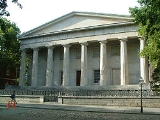
Second National Bank Us Bw
The architect of the Second Bank of the United States was William Strickland
William Strickland (architect)

William Strickland , was a noted architecture in nineteenth-century Philadelphia, Pennsylvania and Nashville. He is noted as one of the founders of the Gothic revival movement when in 1823 he built St....
 (1788-1854), a former student of Benjamin Latrobe
Benjamin Latrobe

Benjamin Henry Boneval Latrobe was a British-born American architect best known for his design of the United States Capitol, as well as his design of the Basilica of the National Shrine of the Assumption of the Blessed Virgin Mary, the first Catholic Cathedral built in the United States....
 (1764-1820), the man who is often called the first professionally-trained American architect
Architect

An architect is trained and licenced in planning and designing buildings, and participates in supervising the construction of a building. Etymologically, architect derives from the Latin architectus, itself derived from the Greek arkhitekton , i.e....
. Latrobe and Strickland were both disciples of the Greek Revival style. Strickland would go on to design many other American public buildings in this style, including financial structures such as the New Orleans
New Orleans Mint

The New Orleans Mint operated in New Orleans, Louisiana, Louisiana, as a branch Mint of the United States Mint from 1838 to 1861 and from 1879 to 1909....
, Dahlonega
Dahlonega Mint

The Dahlonega Mint was a branch of the United States Mint in Dahlonega, Georiga. Coins produced at the Dahlonega Mint bear the "D" mintmark. That mintmark is used today by the Denver Mint, which opened many years after the Dahlonega Mint closed....
, Mechanics National Bank
Mechanics National Bank

The Mechanics National Bank was a Philadelphia, Pennsylvania bank founded by and geared toward mechanics....
 (also in Philadelphia) and Charlotte
Charlotte Mint

The Charlotte Mint was a branch of the United States Mint that came into existence on March 3, 1835 during the Carolina Gold Rush. The first gold mine in the United States was established in North Carolina at the Reed Gold Mine....
 branch mints in the mid-to-late 1830s, as well as the second building for the main U.S. Mint in Philadelphia
Philadelphia Mint

The Philadelphia Mint was created from the need to establish a national identity and the needs of commerce in the United States. This led the Founding Fathers of the United States to make an establishment of a continental national mint a main priority after the ratification of the Constitution of the United States....
 in 1833.

Strickland's design for the Second Bank of the United States remains fairly straightforward. The hallmarks of the Greek Revival style can be seen immediately in the north and south façades, which use a large set of steps leading up to the main level platform, known as the stylobate
Stylobate

In Architecture of Ancient Greece, a stylobate is the top step of the crepidoma, the stepped platform on which colonnades of temple columns are placed ....
. On top of these, Strickland placed eight severe Doric
Doric order

The Doric order was one of the Classical order of Architecture of Ancient Greece or classical architecture; the other two canonical orders were the Ionic order and the Corinthian order....
 columns , which are crowned by an entablature containing a triglyph
Triglyph

Triglyph is an architectural term for the vertically channeled tablets of the Doric frieze, so called because of the angular channels in them, two perfect and one divided, the two chamfered angles or hemiglyphs being reckoned as one....
 frieze
Frieze

In architecture the frieze is the wide central section part of an entablature and may be plain or?in the Ionic order or Corinthian order?decorated with bas-reliefs....
 and simple triangular pediment
Pediment

A pediment is a classical architecture element consisting of the triangular section found above the horizontal structure , typically supported by columns....
. The building appears much as an ancient Greek temple, hence the stylistic name. The interior consists of an entrance hallway in the center of the north façade flanked by two rooms on either side. The entry leads into two central rooms, one after the other, that span the width of the structure east to west. The east and west sides of the first large room are each pierced by large arched fan window. The building's exterior uses Pennsylvania blue marble, which, due to the manner in which it was cut, has begun to deteriorate from the exposure to the elements of weak parts of the stone. This phenomenon is most visible on the Doric columns of the south façade. Construction lasted from 1819 to 1824.

The Greek Revival style used for the Second Bank contrasts slightly with the earlier, Federal style
Federal architecture

File:FirstMeetingHouse.jpgFederal-style architecture occurred in the United States between 1780 and 1830, particularly from 1785 to 1815. The period is associated with the early Republic, and the establishment of the national institutions of the United States....
 in architecture used for the First Bank, whose building also still stands and is located nearby in Philadelphia. This can be seen in the more Roman-influenced Federal structure's ornate, colossal Corinthian columns of its façade, which is also embellished by Corinthian pilasters and a symmetric arrangement of sash windows piercing the two stories of the façade. The roofline is also topped by a balustrade and the heavy modillions adorning the pediment give the First Bank an appearance much more like a Roman villa than a Greek temple.

Secondary sources

  • Bodenhorn, Howard. A History of Banking in Antebellum America: Financial Markets and Economic Development in an Era of Nation-Building (2000). Stresses how all banks promoted faster growth in all regions.
  • Costello, Shannon Marie. "Jackson Is My Kind of Man" :P (2006). Memoir. Pro-Jackson.
  • Daniel Feller, "The bank war," in Julian E. Zelizer, ed. The American Congress (2004), pp 93-111.
  • Hammond, Bray. "Jackson, Biddle, and the Bank of the United States," The Journal of Economic History, Vol. 7, No. 1 (May, 1947), pp. 1-23
  • Hammond, Bray. Banks and Politics in America from the Revolution to the Civil War (1957). Pulitzer prize winner. Pro-Bank.
  • Hammond, Bray. "The Second Bank of the United States. Transactions of the American Philosophical Society, New Ser., Vol. 43, No. 1 (1953), pp. 80-85
  • Ratner, Sidney, James H. Soltow, and Richard Sylla. The Evolution of the American Economy: Growth, Welfare, and Decision Making. (1993)
  • Remini Robert V. Andrew Jackson and the Bank War: A Study in the Growth of Presidential Power (1967). Pro-Jackson.
  • Schlesinger, Arthur Meier Jr. Age of Jackson (1946). Pulitzer prize winning intellectual history; strongly pro-Jackson.
  • Schweikart, Larry. Banking in the American South from the Age of Jackson to Reconstruction (1987)
  • Taylor; George Rogers, ed. Jackson Versus Biddle: The Struggle over the Second Bank of the United States (1949). Primary and secondary sources.
  • Temin, Peter. The Jacksonian Economy (1969)
  • Wilburn, Jean Alexander. Biddle's Bank: The Crucial Years (1967). Narrative history, pro-Bank.
  • Wilentz Sean. The Rise of American Democracy: Jefferson to Lincoln (2005). Pro-Jackson.


Primary sources

  • McGrane, Reginald C. Ed. The Correspondence of Nicholas Biddle (1919)
  • Hofstadter, Richard. Great Issues in American History: From the Revolution to the Civil War, 1765-1865 (1958).


See also

  • The Federal Reserve
  • Federal Reserve Act
    Federal Reserve Act

    The Federal Reserve Act is the act of Congress that created the Federal Reserve System, the central banking system of the United States of America, which was signed into law by President Woodrow Wilson....
  • Panic of 1837
    Panic of 1837

    The Panic of 1837 was a financial crisis in the United States built on a speculative fever. The bubble burst on May 10, 1837 in New York City, when every bank stopped payment in currency ....
  • History of central banking in the United States
    History of central banking in the United States

    This article is about the history of central banking in the United States, from the 1790s to the present....


External links

  • - a history of the Bank by Ralph C. H. Catterall of the University of Chicago
    University of Chicago

    The University of Chicago is a private university located principally in the Hyde Park, Chicago neighborhood of Chicago. Although an older university by the same name existed prior to its founding, the modern University of Chicago credits its founding to the oil magnate John D....
    , 1902 - on Google Books