

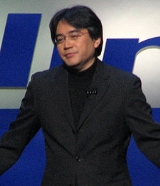

of Nintendo
, succeeding the long-standing previous president of the company, Hiroshi Yamauchi
in 2002. He was responsible in great part for defining Nintendo's strategy both before and during the release of its Nintendo GameCube
video game console
in 2001, a vision which helped Nintendo generate a forty-one percent increase in sales at the end of the 2002 fiscal year.
Barron's Magazine
named Iwata one of the world's top CEOs, due mostly to the Wii
and Brain Age
sales, as well as Nintendo's increased stock price.
Satoru Iwata was born in Sapporo
, Japan
.
Nintendo has strong views on how we should run our company. We consider ourselves, above all else, as a gaming company. We believe other companies (in the console marketplace) see themselves primarily as technology companies.
Although many believe that technology automatically enables more realistic expression, I believe that is just not correct.
Our competitors are always saying that Nintendo is just for children. To counter that, what we really need to do is explain to customers and potential customers [that we do not just make games for kids].
Please understand, I am not saying that technology is unimportant. I understand that technology is important. But if we are just focusing on technology and investing in an IT manufacturing plant to come up with higher performance processing [chips], we will not succeed.
I've never once been embarrassed that children have supported Nintendo. I'm proud of it. That's because children judge products based on instinct. Everyone wants to appeal to people's instincts, but it's not easy. That doesn't mean we're making products just for children. We believe that there's interactive entertainment that people in their 60s, 70s and 80s can enjoy, so we're doing various things.
Nintendo was proud of when we introduced the D-pad|D-pad with the Nintendo Entertainment System|NES, instead of arcade joysticks. Proud of two-player gaming on the NES and four-player gaming on Nintendo 64|Nintendo 64. Proud of the analog sticks, and rumble pak, and true 3D. We are proud we established portable gaming with Game Boy|Game Boy. All these advances are now industry standards. All make us proud. But I think we are most proud of this.
Better technology is good, but technology's not enough. Today's consoles already offer fairly photorealistic expressions. Simply beefing up those graphics will not let most of us see a difference.