

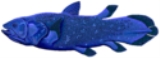
Coelacanth

Encyclopedia
Coelacanths are members of an order
of fish
that includes the oldest living lineage
of Sarcopterygii
(lobe-finned fish + tetrapods) known to date.
Coelacanths belong to the subclass Actinistia
, a group of lobed-finned fish that are related to lungfish
and other extinct Devonian
fish like osteolepiforms, porolepiforms, rhizodonts, and Panderichthys
. Coelacanths were thought to have gone extinct in the Late Cretaceous
, but were rediscovered in 1938 off the coast of South Africa. Latimeria chalumnae
and the Latimeria menadoensis
are the only two living coelacanth species, which are found along the coastlines of the Indian Ocean. The coelacanth has been nicknamed a “living fossil
”, because it was originally known only through fossils, long before the first discovery of a live specimen. The coelacanth is thought to have evolved into roughly its current form approximately 400 million years ago.
es and tetrapod
s, were believed to have been extinct
since the end of the Cretaceous
period. More closely related to tetrapods than even the ray-finned fish, coelacanths were considered the "missing link" between the fish and the tetrapods until the first Latimeria
specimen was found off the east coast of South Africa, off the Chalumna River
(now Tyalomnqa) in 1938. Museum curator Marjorie Courtenay-Latimer
discovered the fish among the catch of a local fisher, Captain Hendrick Goosen, on December 23, 1938. A local chemistry professor, JLB Smith
, confirmed the fish's importance with a famous cable: "MOST IMPORTANT PRESERVE SKELETON AND GILLS = FISH DESCRIBED".
The discovery of a species still living, when they were believed to have gone extinct 65 million years ago, makes the coelacanth the most well-known example of a Lazarus taxon
, a species that seems to have disappeared from the fossil record only to reappear much later. Since 1938, Latimeria chalumnae
have been found in the Comoros
, Kenya
, Tanzania
, Mozambique
, Madagascar
, and in iSimangaliso Wetland Park, Kwazulu-Natal
in South Africa
.
The second extant species, L. menadoensis
, was described from Manado Sulawesi, Indonesia
in 1999 by Pouyaud et al. based on a specimen discovered by Erdmann in 1998 and deposited at the Indonesian Institute of Sciences
(LIPI). The first specimen of this species was only photographed at a local market by Arnaz and Mark Erdmann before being bought by a shopper.
The coelacanth has no real commercial value, apart from being coveted by museums and private collectors. As a food fish the coelacanth is almost worthless, as its tissues exude oils that give the flesh a foul flavour. The continued survivability of the coelacanth may be at threat due to commercial deep-sea trawling
.
, or the lobe-finned fishes. Externally, there are several characteristics that distinguish the coelacanth from other lobe-finned fish. They possess a three-lobed caudal fin, also called a trilobate fin. A secondary tail that goes along and extends past the primary tail separates the upper and lower halves of the coelacanth. Cosmoid scales act as a thick armor that protects the exterior of the coelacanth. There are also several internal traits that aid in differentiating coelacanths from other lobe-finned fish. At the back of the skull, the coelacanth possesses a hinge, the intracranial joint, which allows it to gape its mouth extremely wide. Along with the hinge, the coelacanth contains a hollow backbone, which is unique to coelacanths. The heart of the coelacanth is shaped differently than most modern fish and its structure is that of a straight tube. The coelacanth braincase is 98.5% filled with fat; only 1.5% of the braincase actually contains any brain. The cheeks of the coelacanths are unique because the opercular
bone is very small and holds a large soft-tissue opercular flap. The coelacanth contains a rostral organ
within the ethmoid region of the braincase.
and L. menadoensis
are the only two known living coelacanth species. The word coelacanth literally means, “hollow spine,” because of its unique hollow spine fins. Coelacanths are large, plump, lobe-finned fish that grow up to 1.8 meters. They are nocturnal piscivorous drift-hunters. The body is covered in cosmoid scales that act as armor. Coelacanths have 8 fins - 2 dorsal fins, 2 pectoral fins, 2 pelvic fins, 1 anal fin and 1 caudal fin. The tail is very nearly equally proportioned and is split by a terminal tuft of fin rays that make up the caudal lobe of the tail. The eyes of the coelacanth are very large, while the mouth is very small. The eye is acclimatized to seeing in dark light by having rods that absorb mostly low wavelengths. Coelacanths' vision has evolved to a mainly blue-shifted color vision. Pseudomaxillary
folds surround the mouth, which replaces the maxilla, which is absent in coelacanths. There are two nostrils along with four other external openings that appear between the premaxilla and lateral rostral bones
. The nasal sacs resemble those of many other fish and do not contain an internal nostril. The rostral organ of the coelacanth is contained within the ethmoid region of the braincase. It has three unguarded openings into the environment. The rostral organ is used as a part of the coelacanths’ laterosensory system. The coelacanths’ auditory reception is mediated by its inner ear. The inner ear of the coelacanth is very similar to that of tetrapods because it is classified as being a basilar papilla
.
Locomotion of the coelacanths is unique to their kind. To move around, coelacanths most commonly take advantage of up or downwellings of the current and drift. They use their paired fins to stabilize their movement through the water. While on the bottom of the ocean floor their paired fins are not used for any kind of movement. Coelacanths can create thrust for quick starts by using their caudal fins. Due to the high number of fins, the coelacanth has high maneuverability. Coelacanths can also orient their bodies in any direction in the water. They have been seen doing headstands and swimming belly up. It is thought that their rostral organ helps give the coelacanth electroperception, which aides in their movement around obstacles.
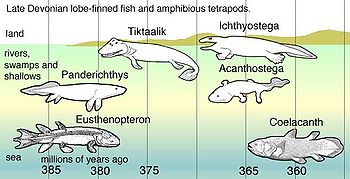 Subclass Coelacanthimorpha (Actinistia) are sometimes used to designate the group of Sarcopterygian
fish that contains the Coelacanthiformes. The following is a classification of known coelacanth genera and families:
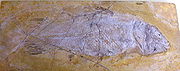 According to genetic analysis, the divergence of coelacanths, lungfish
, and tetrapods is thought to have occurred 390 million years ago. Coelacanths were thought to have gone extinct 80 million years ago during the Cretaceous-Tertiary extinction. The first recorded coelacanth fossil was found in Australia and was of a coelacanth jaw that dated back 360 million years, named Eoachtinistia foreyi. The most recent species of coelacanth in the fossil record is the Macropoma. Macropoma, sister species to Latimeria chalumnae, is separated by 80 million years. The fossil record of the coelacanth is unique because coelacanth fossils were found 100 years before the first live specimen was identified. In 1938, Courtenay-Latimer rediscovered the first live specimen, L. chalumnae, which was caught off of the coast of East London, South Africa. In 1997, a marine biologist was on a honeymoon and discovered the second live species, Latimeria menadoensis in an Indonesian market. In July 1998, the first Latimeria menadoensis live specimen was caught in Indonesia. Around 80 total species have been described. Before the discovery of a live coelacanth specimen, the coelacanth time range was thought to have spanned from the Middle Devonian to the Upper Cretaceous period. During that time all fossils found, excluding one or two specimens, retained a similar morphology.
, and Indonesia. Most Latimeria chalumnae specimens that have been caught have been captured around the islands of Grande Comore and Anjouan in the Comoros Archipelago, Indian Ocean. Though there have been cases of L. chalumnae being caught elsewhere, amino acid sequencing has shown there is no big difference between these exceptions and the ones found around Comore and Anjouan. Even though these few can be considered strays, there have been several reports of coelacanths being caught off of the coast of Madagascar. This leads scientists to believe that the endemic range of Latimeria chalumnae coelacanths actually stretches down the eastern coast of Africa from the Comoros Islands, past the western coast of Madagascar, to the South African coastline. The geographical range of the Indonesia coelacanth, Latimeria menadoensis, is believed to be off the coast of Manado Tua Island, Sulawesi, Indonesia in the Celebes Sea
. The key components that keep coelacanths in these areas are food and temperature restrictions.
During the daytime, coelacanths rest in caves anywhere from 100–500 meters deep while others migrate to deeper waters. By resting in cooler waters (below 120 meters) during the daytime, coelacanths reduce metabolic costs. By drifting towards reefs and feeding at night, they save vital energy. Staying in the caves during the day also saves energy because they do not have to waste energy fighting the currents.
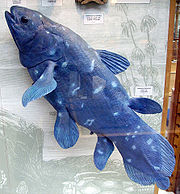 Because coelacanths hide in caves during the daytime, the Anjouan island and Grande Comore provide ideal habitats for them. The steep underwater, eroded volcanic slopes covered in sand also house an obscure system of caves and crevices, allowing the coelacanths a place to stay during the daylight hours. These crevices support a large benthic fish population that can sustain coelacanth populations.
Coelacanths are nocturnal piscivores that feed mainly on benthic fish populations. By floating along the lava cliffs, they presumably feed on whatever fish they come across.
Coelacanths are fairly peaceful creatures when dealing with other coelacanths. They remain calm, even while in a crowded cave. They do avoid body contact, withdrawing immediately if contact is made with another coelacanth. When approached by foreign, potential predators (i.e. a submersible), they react with panic flight reactions. Coelacanths are most likely prey to large deep-water predators. Shark bite marks have been seen on coelacanths and sharks are very common in areas inhabited by coelacanths. Electrophoresis
testing of 14 coelacanth enzymes has shown that there is little genetic diversity between coelacanth populations. Among the fish that have been caught, there have been about equal amounts of males and females. Population estimates range from 210 individuals per population, all the way to 500 individuals per population. Because coelacanths have individual color markings, scientists think that coelacanths are able to recognize other coelacanths via electric communication.
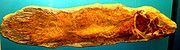
Coelacanths are ovoviviparous, meaning that the mother retains the eggs within her body while the embryos develop within the eggs. The gestation period is longer than a year in coelacanths. The females are typically larger than the males, and their scales and folds of skin around the cloaca
differ. The male coelacanth does not have distinct copulatory organs, just a cloaca. The cloaca has an urogential
papilla
that is surrounded by erectile caruncle
s. It is hypothesized that the cloaca turns itself inside out to serve as a copulatory organ. The eggs of the coelacanth are very large and have only a thin layer of membrane protecting them. The embryos hatch within the mother and eventually the mother gives live birth. Young coelacanths look very similar to adult coelacanths. The main differences include an external yolk sac, larger eyes compared to their body size, and their body has more of a downward slope. The yolk sac of the juvenile coelacanth is broad, and comes out from below the pelvic fins. The scales and the fins of the juvenile coelacanth are completely matured. The young coelacanth does lack odontodes, but gains them during maturity.
. Fishermen will sometimes snag a coelacanth instead of an oilfish because they usually fish at nighttime when the oilfish (and coelacanths) are feeding. Before scientists became interested in coelacanths, they were usually just thrown back into the water if caught. Now that there is an interest in them, fishermen trade them in to scientists or other officials once they have been caught. Before the 1980s, this was a problem for coelacanth populations. In the 1980s, international aid gave fiberglass boats to the local fishermen and it resulted in fishing out of coelacanth territories into more fish-productive waters. Since then, most of the motors on the boats have broken down so the local fishermen are now back in the coelacanth territory, putting the species at risk.
Different methods to minimize the number of coelacanths caught include moving fishers away from the shore, using different laxatives and malarial salves to reduce the amount of oilfish needed, using coelacanth models to simulate live specimen, and coelacanth protection awareness. In 1987 the Coelacanth Conservation Council was established to help protect and encourage population growth of coelacanths.
In 2002, the South African Coelacanth Conservation and Genome Resource Programme was launched to help further the studies and conservation of the coelacanth. The South African Coelacanth Conservation and Genome Resource Programme focuses on biodiversity conservation, evolutionary biology, capacity building and public understanding. The South African Government committed to spend R10 million on the program.
Order (biology)
In scientific classification used in biology, the order is# a taxonomic rank used in the classification of organisms. Other well-known ranks are life, domain, kingdom, phylum, class, family, genus, and species, with order fitting in between class and family...
of fish
Fish
Fish are a paraphyletic group of organisms that consist of all gill-bearing aquatic vertebrate animals that lack limbs with digits. Included in this definition are the living hagfish, lampreys, and cartilaginous and bony fish, as well as various extinct related groups...
that includes the oldest living lineage
Lineage (evolution)
An evolutionary lineage is a sequence of species, that form a line of descent, each new species the direct result of speciation from an immediate ancestral species. Lineages are subsets of the evolutionary tree of life. Lineages are often determined by the techniques of molecular systematics.-...
of Sarcopterygii
Sarcopterygii
The Sarcopterygii or lobe-finned fishes – sometimes considered synonymous with Crossopterygii constitute a clade of the bony fishes, though a strict classification would include the terrestrial vertebrates...
(lobe-finned fish + tetrapods) known to date.
Coelacanths belong to the subclass Actinistia
Actinistia
Actinistia is a subclass of mostly fossil lobe-finned fishes. This subclass contains the coelacanths, including the two living coelacanths, the West Indian Ocean coelacanth and the king of the sea....
, a group of lobed-finned fish that are related to lungfish
Lungfish
Lungfish are freshwater fish belonging to the Subclass Dipnoi. Lungfish are best known for retaining characteristics primitive within the Osteichthyes, including the ability to breathe air, and structures primitive within Sarcopterygii, including the presence of lobed fins with a well-developed...
and other extinct Devonian
Devonian
The Devonian is a geologic period and system of the Paleozoic Era spanning from the end of the Silurian Period, about 416.0 ± 2.8 Mya , to the beginning of the Carboniferous Period, about 359.2 ± 2.5 Mya...
fish like osteolepiforms, porolepiforms, rhizodonts, and Panderichthys
Panderichthys
Panderichthys is a 90–130 cm long fish from the Devonian period 397 million years ago, of Latvia. It is named after the german-baltic palaeontologist Christian Heinrich Pander. It has a large tetrapod-like head...
. Coelacanths were thought to have gone extinct in the Late Cretaceous
Late Cretaceous
The Late Cretaceous is the younger of two epochs into which the Cretaceous period is divided in the geologic timescale. Rock strata from this epoch form the Upper Cretaceous series...
, but were rediscovered in 1938 off the coast of South Africa. Latimeria chalumnae
Latimeria chalumnae
West Indian Ocean coelacanth is a species of coelacanth, known for its vivid blue pigment. It is the better known of the two extant species.-Biological characteristics:...
and the Latimeria menadoensis
Latimeria menadoensis
The Indonesian coelacanth is one of two living species of coelacanth, identifiable by its brown color.-Discovery:...
are the only two living coelacanth species, which are found along the coastlines of the Indian Ocean. The coelacanth has been nicknamed a “living fossil
Living fossil
Living fossil is an informal term for any living species which appears similar to a species otherwise only known from fossils and which has no close living relatives, or a group of organisms which have long fossil records...
”, because it was originally known only through fossils, long before the first discovery of a live specimen. The coelacanth is thought to have evolved into roughly its current form approximately 400 million years ago.
Discovery
The coelacanths, which are related to lungfishLungfish
Lungfish are freshwater fish belonging to the Subclass Dipnoi. Lungfish are best known for retaining characteristics primitive within the Osteichthyes, including the ability to breathe air, and structures primitive within Sarcopterygii, including the presence of lobed fins with a well-developed...
es and tetrapod
Tetrapod
Tetrapods are vertebrate animals having four limbs. Amphibians, reptiles, birds and mammals are all tetrapods; even snakes and other limbless reptiles and amphibians are tetrapods by descent. The earliest tetrapods evolved from the lobe-finned fishes in the Devonian...
s, were believed to have been extinct
Extinction
In biology and ecology, extinction is the end of an organism or of a group of organisms , normally a species. The moment of extinction is generally considered to be the death of the last individual of the species, although the capacity to breed and recover may have been lost before this point...
since the end of the Cretaceous
Cretaceous
The Cretaceous , derived from the Latin "creta" , usually abbreviated K for its German translation Kreide , is a geologic period and system from circa to million years ago. In the geologic timescale, the Cretaceous follows the Jurassic period and is followed by the Paleogene period of the...
period. More closely related to tetrapods than even the ray-finned fish, coelacanths were considered the "missing link" between the fish and the tetrapods until the first Latimeria
Latimeria
Latimeria is a genus comprising the living species of coelacanth.-Biological characteristics:Based on growth rings in their ear bones , scientists infer that individual coelacanths may live as long as 80 to 100 years. Coelacanths live as deep as 700 m below sea level, but are more commonly...
specimen was found off the east coast of South Africa, off the Chalumna River
Chalumna River
The Chalumna River is a river in South Africa which empties into the Indian Ocean and is located about 45 km south west of the Buffalo River at East London. Kayser's Beach is situated close by....
(now Tyalomnqa) in 1938. Museum curator Marjorie Courtenay-Latimer
Marjorie Courtenay-Latimer
Marjorie faree Doris Courtenay-Latimer was the South African museum official who in 1938 brought to the attention of the world the existence of the coelacanth, a fish thought to have been extinct for sixty-five million years....
discovered the fish among the catch of a local fisher, Captain Hendrick Goosen, on December 23, 1938. A local chemistry professor, JLB Smith
James Leonard Brierley Smith
James Leonard Brierley Smith, known as J.L.B. Smith was a South African ichthyologist, organic chemist and university professor. He was the first to identify a taxidermied fish as a coelacanth, at the time thought long extinct.-Early life:Born in Graaff Reinet, Smith was the elder of two sons of...
, confirmed the fish's importance with a famous cable: "MOST IMPORTANT PRESERVE SKELETON AND GILLS = FISH DESCRIBED".
The discovery of a species still living, when they were believed to have gone extinct 65 million years ago, makes the coelacanth the most well-known example of a Lazarus taxon
Lazarus taxon
In paleontology, a Lazarus taxon is a taxon that disappears from one or more periods of the fossil record, only to appear again later. The term refers to the account in the Gospel of John, in which Jesus raised Lazarus from the dead...
, a species that seems to have disappeared from the fossil record only to reappear much later. Since 1938, Latimeria chalumnae
Latimeria chalumnae
West Indian Ocean coelacanth is a species of coelacanth, known for its vivid blue pigment. It is the better known of the two extant species.-Biological characteristics:...
have been found in the Comoros
Comoros
The Comoros , officially the Union of the Comoros is an archipelago island nation in the Indian Ocean, located off the eastern coast of Africa, on the northern end of the Mozambique Channel, between northeastern Mozambique and northwestern Madagascar...
, Kenya
Kenya
Kenya , officially known as the Republic of Kenya, is a country in East Africa that lies on the equator, with the Indian Ocean to its south-east...
, Tanzania
Tanzania
The United Republic of Tanzania is a country in East Africa bordered by Kenya and Uganda to the north, Rwanda, Burundi, and the Democratic Republic of the Congo to the west, and Zambia, Malawi, and Mozambique to the south. The country's eastern borders lie on the Indian Ocean.Tanzania is a state...
, Mozambique
Mozambique
Mozambique, officially the Republic of Mozambique , is a country in southeastern Africa bordered by the Indian Ocean to the east, Tanzania to the north, Malawi and Zambia to the northwest, Zimbabwe to the west and Swaziland and South Africa to the southwest...
, Madagascar
Madagascar
The Republic of Madagascar is an island country located in the Indian Ocean off the southeastern coast of Africa...
, and in iSimangaliso Wetland Park, Kwazulu-Natal
KwaZulu-Natal
KwaZulu-Natal is a province of South Africa. Prior to 1994, the territory now known as KwaZulu-Natal was made up of the province of Natal and the homeland of KwaZulu....
in South Africa
South Africa
The Republic of South Africa is a country in southern Africa. Located at the southern tip of Africa, it is divided into nine provinces, with of coastline on the Atlantic and Indian oceans...
.
The second extant species, L. menadoensis
Latimeria menadoensis
The Indonesian coelacanth is one of two living species of coelacanth, identifiable by its brown color.-Discovery:...
, was described from Manado Sulawesi, Indonesia
Indonesia
Indonesia , officially the Republic of Indonesia , is a country in Southeast Asia and Oceania. Indonesia is an archipelago comprising approximately 13,000 islands. It has 33 provinces with over 238 million people, and is the world's fourth most populous country. Indonesia is a republic, with an...
in 1999 by Pouyaud et al. based on a specimen discovered by Erdmann in 1998 and deposited at the Indonesian Institute of Sciences
Indonesian Institute of Sciences
The Indonesian Institute of Sciences is the governmental authority for science and research in Indonesia...
(LIPI). The first specimen of this species was only photographed at a local market by Arnaz and Mark Erdmann before being bought by a shopper.
The coelacanth has no real commercial value, apart from being coveted by museums and private collectors. As a food fish the coelacanth is almost worthless, as its tissues exude oils that give the flesh a foul flavour. The continued survivability of the coelacanth may be at threat due to commercial deep-sea trawling
Trawling
Trawling is a method of fishing that involves pulling a fishing net through the water behind one or more boats. The net that is used for trawling is called a trawl....
.
Diagnosis
Coelacanths are a part of the clade SarcopterygiiSarcopterygii
The Sarcopterygii or lobe-finned fishes – sometimes considered synonymous with Crossopterygii constitute a clade of the bony fishes, though a strict classification would include the terrestrial vertebrates...
, or the lobe-finned fishes. Externally, there are several characteristics that distinguish the coelacanth from other lobe-finned fish. They possess a three-lobed caudal fin, also called a trilobate fin. A secondary tail that goes along and extends past the primary tail separates the upper and lower halves of the coelacanth. Cosmoid scales act as a thick armor that protects the exterior of the coelacanth. There are also several internal traits that aid in differentiating coelacanths from other lobe-finned fish. At the back of the skull, the coelacanth possesses a hinge, the intracranial joint, which allows it to gape its mouth extremely wide. Along with the hinge, the coelacanth contains a hollow backbone, which is unique to coelacanths. The heart of the coelacanth is shaped differently than most modern fish and its structure is that of a straight tube. The coelacanth braincase is 98.5% filled with fat; only 1.5% of the braincase actually contains any brain. The cheeks of the coelacanths are unique because the opercular
Operculum
Operculum may refer to:*Operculum , a stiff structure resembling a lid or a small door that opens and closes**Operculum , a lid on the shell of some gastropods**Operculum , a lid on the orifice of some bryozoans...
bone is very small and holds a large soft-tissue opercular flap. The coelacanth contains a rostral organ
Rostral organ
The rostral organ of the coelacanth is a large gel-filled cavity in the snout, with three pairs of canals to the outside.It is surrounded by an insulating layer of adipose tissue and innervated by the superficial ophthalmic nerve. Its anatomy and innervation suggest it is an electroreceptive organ...
within the ethmoid region of the braincase.
General description
Latimeria chalumnaeLatimeria chalumnae
West Indian Ocean coelacanth is a species of coelacanth, known for its vivid blue pigment. It is the better known of the two extant species.-Biological characteristics:...
and L. menadoensis
Latimeria menadoensis
The Indonesian coelacanth is one of two living species of coelacanth, identifiable by its brown color.-Discovery:...
are the only two known living coelacanth species. The word coelacanth literally means, “hollow spine,” because of its unique hollow spine fins. Coelacanths are large, plump, lobe-finned fish that grow up to 1.8 meters. They are nocturnal piscivorous drift-hunters. The body is covered in cosmoid scales that act as armor. Coelacanths have 8 fins - 2 dorsal fins, 2 pectoral fins, 2 pelvic fins, 1 anal fin and 1 caudal fin. The tail is very nearly equally proportioned and is split by a terminal tuft of fin rays that make up the caudal lobe of the tail. The eyes of the coelacanth are very large, while the mouth is very small. The eye is acclimatized to seeing in dark light by having rods that absorb mostly low wavelengths. Coelacanths' vision has evolved to a mainly blue-shifted color vision. Pseudomaxillary
Maxilla
The maxilla is a fusion of two bones along the palatal fissure that form the upper jaw. This is similar to the mandible , which is also a fusion of two halves at the mental symphysis. Sometimes The maxilla (plural: maxillae) is a fusion of two bones along the palatal fissure that form the upper...
folds surround the mouth, which replaces the maxilla, which is absent in coelacanths. There are two nostrils along with four other external openings that appear between the premaxilla and lateral rostral bones
Rostral
Rostral can refer to:* Anatomical location or direction, towards the rostrum .* Rostral bone, in ceratopsian dinosaurs* Rostral column, a monumental scaled column, frequently decorated with ship bows* Rostral scale, in scaled reptiles...
. The nasal sacs resemble those of many other fish and do not contain an internal nostril. The rostral organ of the coelacanth is contained within the ethmoid region of the braincase. It has three unguarded openings into the environment. The rostral organ is used as a part of the coelacanths’ laterosensory system. The coelacanths’ auditory reception is mediated by its inner ear. The inner ear of the coelacanth is very similar to that of tetrapods because it is classified as being a basilar papilla
Papilla
The term papilla generally means a nipple-like structure, and may refer to:* Mammary papilla, or nipple* Amphibian papilla and basal papilla, part of the inner ear of the frog.* Interdental papilla, part of the gingiva between teeth...
.
Locomotion of the coelacanths is unique to their kind. To move around, coelacanths most commonly take advantage of up or downwellings of the current and drift. They use their paired fins to stabilize their movement through the water. While on the bottom of the ocean floor their paired fins are not used for any kind of movement. Coelacanths can create thrust for quick starts by using their caudal fins. Due to the high number of fins, the coelacanth has high maneuverability. Coelacanths can also orient their bodies in any direction in the water. They have been seen doing headstands and swimming belly up. It is thought that their rostral organ helps give the coelacanth electroperception, which aides in their movement around obstacles.
Taxonomy
Sarcopterygii
The Sarcopterygii or lobe-finned fishes – sometimes considered synonymous with Crossopterygii constitute a clade of the bony fishes, though a strict classification would include the terrestrial vertebrates...
fish that contains the Coelacanthiformes. The following is a classification of known coelacanth genera and families:
- Class Sarcopterygii (lobe-finned fishes and tetrapods)
- Subclass Actinistia
- Order Coelacanthiformes (Coelacanths)
- Family MiguashaiidaeMiguashaiidaeMiguashaiidae is an extinct family of prehistoric coelacanth fishes which lived during the Devonian period....
(Devonian)- MiguashaiaMiguashaiaMiguashaia is a genus of prehistoric lobe-finned fish which lived during the Devonian period. Miguashaia is the most primitive coelacanth fish....
- Miguashaia
- Family DiplocercidaeDiplocercidaeDiplocercidae is an extinct family of prehistoric coelacanth fishes which lived during the Devonian and Carboniferous period....
(Devonian and Lower Carboniferous)- DiplocercidesDiplocercidesDiplocercides is a genus of prehistoric lobe-finned fishbelonging to the coelacanth group which lived during the Late Devonian period...
(Nesides)
- Diplocercides
- Family HadronectoridaeHadronectoridaeHadronectoridae is an extinct family of prehistoric coelacanth fishes which lived during the Carboniferous period....
- AllenypterusAllenypterusAllenypterus is a genus of a prehistoric lobe-finned fish which lived during the Carboniferous period . Fossils have been discovered in Bear Gulch Limestone, Montana, USA....
- HadronectorHadronectorHadronector is a prehistoric lobe-finned fish which lived during the Carboniferous period of Montana, North America. Hadronector belongs to the group of coelacanth fishes and it is the type genus in the family of Hadronectoridae....
- PolyosteorhynchusPolyosteorhynchusPolyosteorhynchus is an extinct genus of coelacanth lobe-finned fish which lived during the Carboniferous period . The size of Polyosteorhynchus was about 3,5 – 19 cm long....
- Allenypterus
- Family RhabdodermatidaeRhabdodermatidaeRhabdodermatidae is a family of prehistoric, coelacanthiform, lobe-finned fishes which lived during the Carboniferous period ....
(Primarily Carboniferous)- CaridosuctorCaridosuctorCaridosuctor is a genus of prehistoric coelacanth, lobe-finned fish, which lived during the Carboniferous period . Fossils have been found in North America.- External links :*...
- RhabdodermaRhabdodermaRhabdoderma is an extinct genus of coelacanth fish in the class Sarcopterygii. It lived in the Carboniferous, and its fossils have been found in Europe and North America....
- Caridosuctor
- Family LaugiidaeLaugiidaeLaugiidae is an extinct family of prehistoric coelacanth fishes which lived during the Triassic and Jurassic period....
(Lower Triassic to Lower Cretaceous)- CoccodermaCoccodermaCoccoderma is a genus of prehistoric coelacanth lobe-finned fish which lived during the Jurassic period. Fossils have been found in USA. It was small in size, about 27,5 cm. They had very long and sharp teeth that did not regrow unlike today's present sharks....
- LaugiaLaugiaLaugia is a genus of prehistoric coelacanth fish which lived during the Triassic period....
- Coccoderma
- Family WhiteiidaeWhiteiidaeWhiteiidae is an extinct family of prehistoric coelacanth fishes which lived during the Triassic period....
(Triassic)- WhiteiaWhiteiaWhiteia is an extinct genus of prehistoric coelacanth fish which lived during the Triassic period.-External links:* at Mikko's Phylogeny Archive.*...
- Whiteia
- Family CoelacanthidaeCoelacanthidaeCoelacanthidae is an extinct family of coelacanths found throughout the world, originating during the Permian, and finally dying out during the Jurassic....
- AxeliaAxeliaAxelia is a prehistoric genus of lobe-finned fish which belonged to the family of Coelacanthidae.-Species of Axelia:*Axelia elegans Stensio, 1921*Axelia robusta Stensio, 1921...
- CoelacanthusCoelacanthusCoelacanthus is a genus of extinct coelacanths that first appearing during the Permian period. In fact, this was the first genus of coelacanths ever described, as the order Coelacanthiformes is named after it....
- TicinepomisTicinepomisTicinepomis is an extinct genus of coelacanth lobe-finned fish which lived during the Triassic period. It belonged to the family of Coelacanthidae....
- WimaniaWimaniaWimania is an extinct genus of coelacanth which lived during the Triassic period. It belonged to the family of Coelacanthidae....
- Axelia
- Family MawsoniidaeMawsoniidaeMawsoniidae is an extinct family of prehistoric coelacanth fishes which lived during the Triassic to Cretaceous period....
(Triassic and Jurassic)- AlcoveriaAlcoveriaAlcoveria is an extinct genus of coelacanth fish which lived during the Triassic period....
- AxelrodichthysAxelrodichthysAxelrodichthys is an extinct genus of mawsoniid coelacanth from the Early Cretaceous of South America.-Sources:* Discovering Fossil Fishes by John G...
- Chinlea
- DiplurusDiplurusDiplurus is a genus of prehistoric coelacanth fish which lived during the Triassic period....
- Mawsonia
- Alcoveria
- Family Latimeriidae L. S. Berg, 1940
- HolophagusHolophagusHolophagus is an extinct genus of lobe-finned fish. It lived through the Jurassic period....
- LatimeriaLatimeriaLatimeria is a genus comprising the living species of coelacanth.-Biological characteristics:Based on growth rings in their ear bones , scientists infer that individual coelacanths may live as long as 80 to 100 years. Coelacanths live as deep as 700 m below sea level, but are more commonly...
J. L. B. Smith, 1939- Latimeria chalumnaeLatimeria chalumnaeWest Indian Ocean coelacanth is a species of coelacanth, known for its vivid blue pigment. It is the better known of the two extant species.-Biological characteristics:...
J. L. B. Smith, 1939 (Coelacanth) - Latimeria menadoensisLatimeria menadoensisThe Indonesian coelacanth is one of two living species of coelacanth, identifiable by its brown color.-Discovery:...
Pouyaud, Wirjoatmodjo, Rachmatika, Tjakrawidjaja, Hadiaty & Hadie, 1999
- Latimeria chalumnae
- LibysLibysLibys is a genus of the prehistoric coelacanth lobe-finned fish which lived during the Jurassic period. Fossils have been found in Germany. Libys belongs to the family of Latimeridae, which is also the family of the living coelacanth, Latimeria....
- MacropomaMacropomaMacropoma is an extinct genus of coelacanth in the class Sarcopterygii. These fishes have apparently been extinct for over 70 million years and are most closely related to the modern coelacanth Latimeria....
- MacropomoidesMacropomoidesMacropomoides is an extinct genus of lobe-finned fish which lived during the Cretaceous period....
- MegacoelacanthusMegacoelacanthusMegacoelacanthus is an extinct genus of lobe-finned fish which lived during the Jurassic period....
- UndinaUndina (fish)Undina is a genus of prehistoric coelacanth, lobe-finned fish which lived during the Late Jurassic period. Fossils have been found in Germany....
- Holophagus
- Family Miguashaiidae
- Order Coelacanthiformes (Coelacanths)
- Subclass Actinistia
Fossil record
Lungfish
Lungfish are freshwater fish belonging to the Subclass Dipnoi. Lungfish are best known for retaining characteristics primitive within the Osteichthyes, including the ability to breathe air, and structures primitive within Sarcopterygii, including the presence of lobed fins with a well-developed...
, and tetrapods is thought to have occurred 390 million years ago. Coelacanths were thought to have gone extinct 80 million years ago during the Cretaceous-Tertiary extinction. The first recorded coelacanth fossil was found in Australia and was of a coelacanth jaw that dated back 360 million years, named Eoachtinistia foreyi. The most recent species of coelacanth in the fossil record is the Macropoma. Macropoma, sister species to Latimeria chalumnae, is separated by 80 million years. The fossil record of the coelacanth is unique because coelacanth fossils were found 100 years before the first live specimen was identified. In 1938, Courtenay-Latimer rediscovered the first live specimen, L. chalumnae, which was caught off of the coast of East London, South Africa. In 1997, a marine biologist was on a honeymoon and discovered the second live species, Latimeria menadoensis in an Indonesian market. In July 1998, the first Latimeria menadoensis live specimen was caught in Indonesia. Around 80 total species have been described. Before the discovery of a live coelacanth specimen, the coelacanth time range was thought to have spanned from the Middle Devonian to the Upper Cretaceous period. During that time all fossils found, excluding one or two specimens, retained a similar morphology.
Geographical distribution
The current coelacanth range remains primarily around the eastern African coast, although the Latimeria menadoensis was discovered off the coast of Indonesia. Coelacanths have been found in the waters of Kenya, Tanzania, Mozambique, South Africa, Madagascar, ComorosComoros
The Comoros , officially the Union of the Comoros is an archipelago island nation in the Indian Ocean, located off the eastern coast of Africa, on the northern end of the Mozambique Channel, between northeastern Mozambique and northwestern Madagascar...
, and Indonesia. Most Latimeria chalumnae specimens that have been caught have been captured around the islands of Grande Comore and Anjouan in the Comoros Archipelago, Indian Ocean. Though there have been cases of L. chalumnae being caught elsewhere, amino acid sequencing has shown there is no big difference between these exceptions and the ones found around Comore and Anjouan. Even though these few can be considered strays, there have been several reports of coelacanths being caught off of the coast of Madagascar. This leads scientists to believe that the endemic range of Latimeria chalumnae coelacanths actually stretches down the eastern coast of Africa from the Comoros Islands, past the western coast of Madagascar, to the South African coastline. The geographical range of the Indonesia coelacanth, Latimeria menadoensis, is believed to be off the coast of Manado Tua Island, Sulawesi, Indonesia in the Celebes Sea
Celebes Sea
The Celebes Sea of the western Pacific Ocean is bordered on the north by the Sulu Archipelago and Sulu Sea and Mindanao Island of the Philippines, on the east by the Sangihe Islands chain, on the south by Sulawesi, and on the west by Kalimantan in Indonesia...
. The key components that keep coelacanths in these areas are food and temperature restrictions.
Ecology
During the daytime, coelacanths rest in caves anywhere from 100–500 meters deep while others migrate to deeper waters. By resting in cooler waters (below 120 meters) during the daytime, coelacanths reduce metabolic costs. By drifting towards reefs and feeding at night, they save vital energy. Staying in the caves during the day also saves energy because they do not have to waste energy fighting the currents.
Coelacanths are nocturnal piscivores that feed mainly on benthic fish populations. By floating along the lava cliffs, they presumably feed on whatever fish they come across.
Coelacanths are fairly peaceful creatures when dealing with other coelacanths. They remain calm, even while in a crowded cave. They do avoid body contact, withdrawing immediately if contact is made with another coelacanth. When approached by foreign, potential predators (i.e. a submersible), they react with panic flight reactions. Coelacanths are most likely prey to large deep-water predators. Shark bite marks have been seen on coelacanths and sharks are very common in areas inhabited by coelacanths. Electrophoresis
Electrophoresis
Electrophoresis, also called cataphoresis, is the motion of dispersed particles relative to a fluid under the influence of a spatially uniform electric field. This electrokinetic phenomenon was observed for the first time in 1807 by Reuss , who noticed that the application of a constant electric...
testing of 14 coelacanth enzymes has shown that there is little genetic diversity between coelacanth populations. Among the fish that have been caught, there have been about equal amounts of males and females. Population estimates range from 210 individuals per population, all the way to 500 individuals per population. Because coelacanths have individual color markings, scientists think that coelacanths are able to recognize other coelacanths via electric communication.
Life history
Coelacanths are ovoviviparous, meaning that the mother retains the eggs within her body while the embryos develop within the eggs. The gestation period is longer than a year in coelacanths. The females are typically larger than the males, and their scales and folds of skin around the cloaca
Cloaca
In zoological anatomy, a cloaca is the posterior opening that serves as the only such opening for the intestinal, reproductive, and urinary tracts of certain animal species...
differ. The male coelacanth does not have distinct copulatory organs, just a cloaca. The cloaca has an urogential
Sex organ
A sex organ, or primary sexual characteristic, as narrowly defined, is any of the anatomical parts of the body which are involved in sexual reproduction and constitute the reproductive system in a complex organism; flowers are the reproductive organs of flowering plants, cones are the reproductive...
papilla
Papilla
The term papilla generally means a nipple-like structure, and may refer to:* Mammary papilla, or nipple* Amphibian papilla and basal papilla, part of the inner ear of the frog.* Interdental papilla, part of the gingiva between teeth...
that is surrounded by erectile caruncle
Caruncle
Caruncle may refer to:*In botany, an elaiosome , especially in the plant family Euphorbiaceae*In animal anatomy:**prostomium, the sensory organ of Annelid worms...
s. It is hypothesized that the cloaca turns itself inside out to serve as a copulatory organ. The eggs of the coelacanth are very large and have only a thin layer of membrane protecting them. The embryos hatch within the mother and eventually the mother gives live birth. Young coelacanths look very similar to adult coelacanths. The main differences include an external yolk sac, larger eyes compared to their body size, and their body has more of a downward slope. The yolk sac of the juvenile coelacanth is broad, and comes out from below the pelvic fins. The scales and the fins of the juvenile coelacanth are completely matured. The young coelacanth does lack odontodes, but gains them during maturity.
Conservation
Because little is known about the coelacanth, the conservation status is hard to characterize. According to Fricke et al. (1995), there should be some stress put on the importance of conserving this species. From 1988-1994, Fricke counted some 60 individuals on each dive. In 1995 that number dropped to 40. Even though this could be a result of natural population fluctuation, it could also be a result of overfishing. Coelacanths are usually caught when local fishermen are fishing for oilfishOilfish
The oilfish, Ruvettus pretiosus, is a species of snake mackerel in the family Gempylidae, and the only species in the genus Ruvettus. It is found in the Mediterranean, middle Atlantic and throughout the southern seas, at depths between 100 and 800 m...
. Fishermen will sometimes snag a coelacanth instead of an oilfish because they usually fish at nighttime when the oilfish (and coelacanths) are feeding. Before scientists became interested in coelacanths, they were usually just thrown back into the water if caught. Now that there is an interest in them, fishermen trade them in to scientists or other officials once they have been caught. Before the 1980s, this was a problem for coelacanth populations. In the 1980s, international aid gave fiberglass boats to the local fishermen and it resulted in fishing out of coelacanth territories into more fish-productive waters. Since then, most of the motors on the boats have broken down so the local fishermen are now back in the coelacanth territory, putting the species at risk.
Different methods to minimize the number of coelacanths caught include moving fishers away from the shore, using different laxatives and malarial salves to reduce the amount of oilfish needed, using coelacanth models to simulate live specimen, and coelacanth protection awareness. In 1987 the Coelacanth Conservation Council was established to help protect and encourage population growth of coelacanths.
In 2002, the South African Coelacanth Conservation and Genome Resource Programme was launched to help further the studies and conservation of the coelacanth. The South African Coelacanth Conservation and Genome Resource Programme focuses on biodiversity conservation, evolutionary biology, capacity building and public understanding. The South African Government committed to spend R10 million on the program.
External links
- African Coelacanth Ecosystem Programme (ACEP), as the South African Coelacanth Conservation and Genome Resource Programme
- Association for the Preservation of the Coelacanth
- DINOFISH .com Coelacanth: the fish out of time
- Coelacanth at MarineBio.org
- PBS: NOVA - Anatomy of the Coelacanth
- Diving for Coelacanths
- Divergence time estimation of the two coelacanths species based on the whole mitochondrial genome sequences.
- Coelacanth Information
- young Juvenile coelacanth found near Indonesia.