

Santa Monica Airport

Encyclopedia
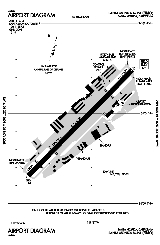
Santa Monica Airport , also known as Santa Monica Municipal Airport, is a general aviation
airport
located largely in Santa Monica, California
, United States
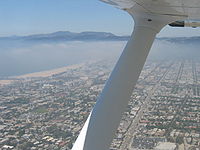
. The airport is located about 2 miles (3 km) from the Pacific Ocean
(Santa Monica Bay
) and 6 miles (10 km) north of LAX. According to the FAA
's National Plan of Integrated Airport Systems
for 2009–2013, it is categorized
as a reliever airport.
, accomplished by the U.S. Army with Douglas World Cruisers, took off from Clover Field on St. Patrick's day, March 17, 1924, and returned there after some 28000 miles (45,061.5 km). Cloverfield Boulevard—which confuses the field's naming for a crop of green rather than a fallen soldier—is a remnant of the airport's original name. Clover Field was once the site of the Army's 40th Division Aviation, 115th Observation Squadron and became a Distribution Center after World War II. Among other important aircraft built there, Douglas manufactured the entire Douglas Commercial "DC" series of reciprocating-engine-powered airliners, DC-1 (a prototype), DC-2, DC-3, DC-4, DC-5 (only 12 built), DC-6, and DC-7. During World War II, Bolo B-18 and B-18A bombers and thousands of C-47 (military version of the DC-3) and C-54 (later the civilian DC-4) military transports were built at Santa Monica, during which time the airport area was cleverly disguised from the air with the construction of a false "town" (built with the help of Hollywood craftsman) suspended atop it.
1950s aerial view looking west
On May 19, 1938, at the request of Santa Monica Postmaster Philip T. Hill (father of race car driver Phil Hill), Joanne Reid (later Jackson) became the first woman to fly the U.S. Mail from Clover Field to Burbank Airport (LAX -- then known as Mines Field -- was not yet the area's main airport) as part of National Air Mail week. She was 22. She was born in Detroit, MI on November 8, 1915 and moved to Santa Monica with her family as a young girl. After accompanying a friend in his family's plane, she became hooked on flying and began taking flying lessons at Clover Field when she was 16.
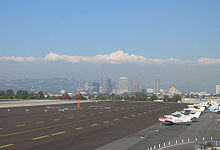 The airport has a control tower and, on average, handles 296 operations a day (for the 12 months - ended July 2011, as per the FAA's Air Traffic Activity System website).
As the Santa Monica Airport is one of relatively few general aviation airports in the nation that is surrounded on all sides by dense residential development, the City of Santa Monica aggressively enforces one of the most stringent noise ordinances in the nation. In addition to responding to the community’s noise concerns and enforcing the City’s Aircraft Noise Ordinance, which includes a maximum allowable noise level, curfew hours and certain operational limitations, Airport staff is involved in a variety of supplementary activities intended to reduce the overall impact of aircraft operations on the residential areas surrounding the Airport. The following procedures and limitations are enforced in accordance with the City’s Aircraft Noise Ordinance. Violations may result in the imposition of fines and/or exclusion from Santa Monica Airport:
• Maximum Noise Level - A maximum noise level of 95.0 dBA Single Event Noise Exposure Level, measured at noise monitor sites 1,500 feet from each end of the runway, is enforced 24 hours a day, 7 days a week. There are no additional noise monitoring stations along the flight pattern, which is routed entirely over residential neighborhoods.
• Night Departure Curfew - No takeoffs or engine starts are permitted between 11pm and 7am Monday through Friday, or until 8am on weekends. Exceptions are allowed for bona fide medical or public safety emergencies only.
• Operational Limitations - Touch-and-go, stop-and-go, and low approaches are prohibited on weekends, holidays, and weekdays from one-half hour after sunset until 7am the following day.
In addition, there are numerous recommended noise abatement procedures and limitations that have been incorporated into the Airport’s Fly Neighborly Program and included in the program’s outreach materials. For additional information visit the Airport’s web site at: http://www.smgov.net/departments/airport/
The aviation aspects of aircraft operations at the Santa Monica Airport and use of the nation’s airspace is regulated by the federal government through the Federal Aviation Administration (FAA). The City is jurisdictionally preempted by federal law from establishing or enforcing new local laws that would affect aircraft operations or the use of airspace around the Santa Monica Airport. And as a federally obligated airport, any attempt to do so by the City will certainly result in legal action taken against it by the FAA.
Typhoon is the only restaurant on the airport property with a runway view and Spitfire Grill is across on Airport Avenue. The Museum of Flying
at the airport houses a collection of historic aircraft. A new facility is built on the South side of the airport and is expected to re-open at some point in the future. One of the airport's oldest buildings, next to the restored Douglas DC-3, hosts the U.S. Civil Air Patrol's Clover Field Composite Squadron 51.
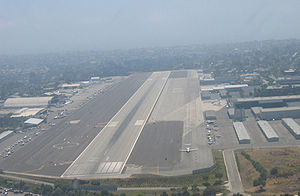 The City of Santa Monica has recently initiated a process regarding the future of the airport when its settlement agreement with the FAA expires in 2015. The Santa Monica City Council has approved a course of action that will lead to the development of an inclusive public process to facilitate the visioning of the Airport’s role within the community.
The City has embarked upon a comprehensive three-phased process for the development of the essential data and public dialogue to accomplish this goal. The Phase I work plan included an analysis of best practices regarding general aviation facilities and sites in relationship to local communities and corresponding potential alternative designs or uses. It all so included a financial analysis of the Airport’s economic impact and stakeholder interviews and the development of the format and materials for a comprehensive public process of workshops that will constitute Phase II. In Phase III, the studies from Phase I and the results of the public dialogue from Phase II will be presented to the City Council for consideration of potential policies and actions regarding the future of the Airport.
General aviation
General aviation is one of the two categories of civil aviation. It refers to all flights other than military and scheduled airline and regular cargo flights, both private and commercial. General aviation flights range from gliders and powered parachutes to large, non-scheduled cargo jet flights...
airport
Airport
An airport is a location where aircraft such as fixed-wing aircraft, helicopters, and blimps take off and land. Aircraft may be stored or maintained at an airport...
located largely in Santa Monica, California
Santa Monica, California
Santa Monica is a beachfront city in western Los Angeles County, California, US. Situated on Santa Monica Bay, it is surrounded on three sides by the city of Los Angeles — Pacific Palisades on the northwest, Brentwood on the north, West Los Angeles on the northeast, Mar Vista on the east, and...
, United States
United States
The United States of America is a federal constitutional republic comprising fifty states and a federal district...
. The airport is located about 2 miles (3 km) from the Pacific Ocean
Pacific Ocean
The Pacific Ocean is the largest of the Earth's oceanic divisions. It extends from the Arctic in the north to the Southern Ocean in the south, bounded by Asia and Australia in the west, and the Americas in the east.At 165.2 million square kilometres in area, this largest division of the World...
(Santa Monica Bay
Santa Monica Bay
Santa Monica Bay is a bight of the Pacific Ocean in southern California, United States. Its boundaries are slightly ambiguous, but it is generally considered to be the part of the Pacific within an imaginary line drawn between Point Dume, in Malibu, and the Palos Verdes Peninsula. Its eastern...
) and 6 miles (10 km) north of LAX. According to the FAA
Federal Aviation Administration
The Federal Aviation Administration is the national aviation authority of the United States. An agency of the United States Department of Transportation, it has authority to regulate and oversee all aspects of civil aviation in the U.S...
's National Plan of Integrated Airport Systems
National Plan of Integrated Airport Systems
The National Plan of Integrated Airport Systems is an inventory of U.S. aviation infrastructure assets. It is developed and maintained by the Federal Aviation Administration . Its purposes are:* to identify all the airports in the U.S...
for 2009–2013, it is categorized
FAA airport categories
The United States Federal Aviation Administration has a system for categorizing public-use airports that is primarily based on the level of commercial passenger traffic through each facility. It is used to determine if an airport is eligible for funding through the federal government's Airport...
as a reliever airport.
History
Originally called Clover Field, after World War I aviator lieutenant Greayer "Grubby" Clover, the airport was the home of the Douglas Aircraft company. The first circumnavigation of the world by airFirst aerial circumnavigation
The first aerial circumnavigation of the world was conducted in 1924 by a team of aviators of the United States Army Air Service, the precursor of the United States Air Force...
, accomplished by the U.S. Army with Douglas World Cruisers, took off from Clover Field on St. Patrick's day, March 17, 1924, and returned there after some 28000 miles (45,061.5 km). Cloverfield Boulevard—which confuses the field's naming for a crop of green rather than a fallen soldier—is a remnant of the airport's original name. Clover Field was once the site of the Army's 40th Division Aviation, 115th Observation Squadron and became a Distribution Center after World War II. Among other important aircraft built there, Douglas manufactured the entire Douglas Commercial "DC" series of reciprocating-engine-powered airliners, DC-1 (a prototype), DC-2, DC-3, DC-4, DC-5 (only 12 built), DC-6, and DC-7. During World War II, Bolo B-18 and B-18A bombers and thousands of C-47 (military version of the DC-3) and C-54 (later the civilian DC-4) military transports were built at Santa Monica, during which time the airport area was cleverly disguised from the air with the construction of a false "town" (built with the help of Hollywood craftsman) suspended atop it.
1950s aerial view looking west

On May 19, 1938, at the request of Santa Monica Postmaster Philip T. Hill (father of race car driver Phil Hill), Joanne Reid (later Jackson) became the first woman to fly the U.S. Mail from Clover Field to Burbank Airport (LAX -- then known as Mines Field -- was not yet the area's main airport) as part of National Air Mail week. She was 22. She was born in Detroit, MI on November 8, 1915 and moved to Santa Monica with her family as a young girl. After accompanying a friend in his family's plane, she became hooked on flying and began taking flying lessons at Clover Field when she was 16.
Operations
As the Santa Monica Airport is one of relatively few general aviation airports in the nation that is surrounded on all sides by dense residential development, the City of Santa Monica aggressively enforces one of the most stringent noise ordinances in the nation. In addition to responding to the community’s noise concerns and enforcing the City’s Aircraft Noise Ordinance, which includes a maximum allowable noise level, curfew hours and certain operational limitations, Airport staff is involved in a variety of supplementary activities intended to reduce the overall impact of aircraft operations on the residential areas surrounding the Airport. The following procedures and limitations are enforced in accordance with the City’s Aircraft Noise Ordinance. Violations may result in the imposition of fines and/or exclusion from Santa Monica Airport:
• Maximum Noise Level - A maximum noise level of 95.0 dBA Single Event Noise Exposure Level, measured at noise monitor sites 1,500 feet from each end of the runway, is enforced 24 hours a day, 7 days a week. There are no additional noise monitoring stations along the flight pattern, which is routed entirely over residential neighborhoods.
• Night Departure Curfew - No takeoffs or engine starts are permitted between 11pm and 7am Monday through Friday, or until 8am on weekends. Exceptions are allowed for bona fide medical or public safety emergencies only.
• Operational Limitations - Touch-and-go, stop-and-go, and low approaches are prohibited on weekends, holidays, and weekdays from one-half hour after sunset until 7am the following day.
In addition, there are numerous recommended noise abatement procedures and limitations that have been incorporated into the Airport’s Fly Neighborly Program and included in the program’s outreach materials. For additional information visit the Airport’s web site at: http://www.smgov.net/departments/airport/
The aviation aspects of aircraft operations at the Santa Monica Airport and use of the nation’s airspace is regulated by the federal government through the Federal Aviation Administration (FAA). The City is jurisdictionally preempted by federal law from establishing or enforcing new local laws that would affect aircraft operations or the use of airspace around the Santa Monica Airport. And as a federally obligated airport, any attempt to do so by the City will certainly result in legal action taken against it by the FAA.
Typhoon is the only restaurant on the airport property with a runway view and Spitfire Grill is across on Airport Avenue. The Museum of Flying
Museum of Flying
-History:Originally founded in 1974 by Donald Douglas Jr. as the Douglas Museum and Library located on the South side of the Santa Monica Airport, the Museum migrated to the North side of the Airport and reopened as the Museum of Flying in April 1989...
at the airport houses a collection of historic aircraft. A new facility is built on the South side of the airport and is expected to re-open at some point in the future. One of the airport's oldest buildings, next to the restored Douglas DC-3, hosts the U.S. Civil Air Patrol's Clover Field Composite Squadron 51.
Landing fees
On August 1, 2005, the Santa Monica City Council implemented a revised landing fee program (Resolution No. 9855) for all transient aircraft (those not based at the Santa Monica Airport) based on a uniform rate of $2.07 per 1000 pounds of Maximum Certificated Gross Landing Weight. Since the Santa Monica Airport receives no federal, state or local funding to operate, the landing fees fill the gap between other Airport revenue and the cost of operations.Safety concerns
The issue has gained increased attention since the increase of jet traffic in the past decade.Pollution
Environmental impact of aviationAirport Park
Airport Park opened as an 8.3 acres (33,588.9 m²) public park on non-aviation lands at the southeast corner of the Airport. The new park, known as Airport Park, features a synthetic turf soccer field, open green space and an off-leash dog area.Future
The City has embarked upon a comprehensive three-phased process for the development of the essential data and public dialogue to accomplish this goal. The Phase I work plan included an analysis of best practices regarding general aviation facilities and sites in relationship to local communities and corresponding potential alternative designs or uses. It all so included a financial analysis of the Airport’s economic impact and stakeholder interviews and the development of the format and materials for a comprehensive public process of workshops that will constitute Phase II. In Phase III, the studies from Phase I and the results of the public dialogue from Phase II will be presented to the City Council for consideration of potential policies and actions regarding the future of the Airport.
Accidents
- On Labor Day weekend in 1989, a P-51 Mustang crashed into a home on Wade St near Brooklake St in Mar Vista. The pilot and passenger were both injured.
- In 1994, the pilot of a single-engine Piper SaratogaPiper SaratogaThe Piper PA-32R is a six-seat, high-performance, single engine, all-metal fixed-wing aircraft produced by Piper Aircraft. The design began life as the Piper Lance, a retractable gear version of the Piper Cherokee Six. Later models are known as Saratogas...
died when a fuel system misconfiguration led to an in-flight engine shutdown. The aircraft stalled in a subsequent 180 degree turn for a forced emergency landing and struck the ground, which resulted in a post-crash fire. - On March 28, 2001, an inexperienced pilot rented a Cessna 172 from Justice Aviation at the airport and subsequently lost control of the aircraft over the Pacific Ocean upon encountering dark, instrument meteorological conditionsInstrument meteorological conditionsInstrument meteorological conditions is an aviation flight category that describes weather conditions that require pilots to fly primarily by reference to instruments, and therefore under Instrument Flight Rules , rather than by outside visual references under Visual Flight Rules . Typically, this...
. Three were killed. - On November 13, 2001, the pilot of a twin-engine CessnaCessnaThe Cessna Aircraft Company is an airplane manufacturing corporation headquartered in Wichita, Kansas, USA. Their main products are general aviation aircraft. Although they are the most well known for their small, piston-powered aircraft, they also produce business jets. The company is a subsidiary...
failed to remove the device that locks the control system for parking (to prevent wind damage) and two were killed when the aircraft overran the runway after an unsuccessful aborted takeoff. - Game-show host Peter TomarkenPeter TomarkenPeter David Tomarken was an American television personality primarily known as the host of Press Your Luck.-Early life:...
and his wife Kathleen died when his Beechcraft BonanzaBeechcraft BonanzaThe Beechcraft Bonanza is an American general aviation aircraft introduced in 1947 by The Beech Aircraft Corporation of Wichita, Kansas. , it is still being produced by Hawker Beechcraft, and has been in continuous production longer than any other airplane in history...
crashed during climb-out from the airport on the morning of March 13, 2006. The Federal Aviation AdministrationFederal Aviation AdministrationThe Federal Aviation Administration is the national aviation authority of the United States. An agency of the United States Department of Transportation, it has authority to regulate and oversee all aspects of civil aviation in the U.S...
reported that the aircraft had engine trouble and attempted to turn back before crashing into Santa Monica BaySanta Monica BaySanta Monica Bay is a bight of the Pacific Ocean in southern California, United States. Its boundaries are slightly ambiguous, but it is generally considered to be the part of the Pacific within an imaginary line drawn between Point Dume, in Malibu, and the Palos Verdes Peninsula. Its eastern...
. - On January 13, 2008, a home-built aircraft ran off the end of runway 21 after a brake failure, jumped over the hillside, landing on a service road. The three passengers on board were not hurt although the kit-built aircraft was damaged severely. The runway was closed for 20 minutes.
- On January 28, 2009, a single-engine SIAI-Marchetti SF-260C lost power following takeoff and attempted to return to the airport. The aircraft struck the ground on the north side of runway 21 and caught fire, killing two people on board. Paulo Emanuele, the general manager of Airliners.netAirliners.netAirliners.net is an aviation website founded by Johan Lundgren, Sweden, in 1997, evolving from his previous Pictures of Modern Airliners site started in 1994...
, was the pilot-in-command, and his passenger was Martin Schaedel, a well-known internet entrepreneur and engineer in his twenties. After an investigation The National Transportation Safety BoardNational Transportation Safety BoardThe National Transportation Safety Board is an independent U.S. government investigative agency responsible for civil transportation accident investigation. In this role, the NTSB investigates and reports on aviation accidents and incidents, certain types of highway crashes, ship and marine...
determines the probable cause(s) of this accident as follows: The pilot’s failure to select the proper fuel tank for takeoff, which resulted in a loss of engine power. Contributing to the accident was the pilot's failure to maintain aircraft control while attempting a return to runway maneuver. - On August 2, 2009, a Rutan Long-EZRutan Long-EZ-See also:-External links:****...
experienced engine failure after takeoff. The pilot attempted to turn back to the runway but crashed on the taxiway in the process of landing. The pilot, flying alone, was severely injured and the airplane was destroyed. - On July 1, 2010, a Cessna 152Cessna 152The Cessna 152 is an American two-seat, fixed tricycle gear, general aviation airplane, used primarily for flight training and personal use.-Development:...
, owned by Justice Aviation, crashed into the Penmar Golf Course shortly after take-off. The pilot was killed. - On August 29, 2011, a student pilot operating a small plane owned by Justice Aviation crashed into a home at 21st St. and Navy St. after take-off.
See also
- California World War II Army AirfieldsCalifornia World War II Army AirfieldsDuring World War II, the United States Army Air Forces established numerous airfields in California for training pilots and aircrews of USAAF fighters and bombers.-Overview:...
- J.C. BarthelJ.C. BarthelJulius C. Barthel, who went by J.C. Barthel, was an engineer and politician who was a Los Angeles City Council member from 1929 to 1931.-Biography:...
, who planned to establish "an aerial passenger service," 1922