

STS-73

Encyclopedia
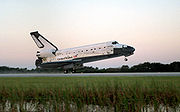
STS-73 was a Space Shuttle program
mission, during October–November 1995. The mission was the second mission for the United States Microgravity Laboratory. The crew, who spent 16 days in space, were broken up into 2 teams, the red team and the blue team. The mission also included several Detailed Test Objectives or DTO's.
Some of the experiments carried on the USML-2 payload were suggested by the results of the first USML mission that flew aboard Columbia in 1992 during STS-50
. The USML-1 mission provided new insights into theoretical models of fluid physics, the role of gravity in combustion and flame spread
ing, and how gravity affects the formation of semiconductor crystals. Data collected from several protein crystals grown on USML-1 enabled scientists to determine the molecular structures of those proteins.
USML-2 Built on that foundation. Technical knowledge gained was incorporated into the mission plan to enhance procedures and operations. Where possible, experiment teams refined their hardware to increase scientific understanding of basic physical processes on Earth and in space, as well as to prepare for more advanced operations aboard the International Space Station and other future space programs.
USML-2 Experiments included: the Surface Tension Driven Convection Experiment (STDCE), the Drop Physics Module, the Drop Dynamics Experiment; the Science and Technology of Surface-Controlled Phenomena experiment; the Geophysical Fluid Flow Cell Experiment; the Crystal Growth Furnace, the Orbital Processing of High Quality Cadmium Zinc Telluride Compound Semiconductors experiment; the Study of Dopant Segregation Behavior During the Crystal Growth of Gallium Arsenide (GaAs) in Microgravity experiment; the Crystal Growth of Selected II-VI Semiconducting Alloys by Directional Solidification
experiment; the Vapor Transport Crystal Growth of Mercury Cadmium Tellurida in Microgravity experiment; the Zeolite Crystal Growth Furnace (ZCG), the Interface Configuration Experiment (ICE), the Oscillatory Thermocapillary Flow Experiment; the Fiber Supported Droplet Combustion Experiment; the Particle Dispersion Experiment; the Single-Locker Protein Crystal Growth experiment; (including the Protein Crystallization Apparatus for Microgravity (PCAM) and the Diffusion-controlled Crystallization Apparatus for Microgravity (DCAM)); the Crystal Growth by Liquid-Liquid Diffusion, the Commercial Protein Crystal Growth experiment; the Advanced Protein Crystallization Facility, Crystallization of Apocrystacyanin C experiment; Crystal Structure Analysis of the Bacteriophage Lambda Lysozyme, Crystallization of RNA Molecules Under Microgravity Conditions experiment; Crystallization of the Protein Grb2 and Triclinic Lysozyme experiment; Microgravity Crystallization of Thermophilic Aspartyl-tRNA Synthetase and Thaumatin experiment; Crystallization in a Microgravity Environment of CcdB experiment; A Multivariate Analysis of X-ray Diffraction Data Obtained from Glutathione S Transferase experiment; Protein Crystal Growth: Light-driven Charge Translocation Through Bacteriorhodopsin experiment; Crystallization of Ribosome experiment; Crystallization of Sulfolobus Solfataricus Alcohol Dehydrogenase experiment; Crystallization of Turnip Yellow Mosaic Virus, Tomato Aspermy Virus, Satellite Panicum Mosaic Virus, Canavalin, Beef Liver Catalase, Concanavalin B experiment; Crystallization of the Epidermal Growth Factor (EGF); Structure of the Membrane-Embedded Protein Complex Photosystem I; Crystallization of Visual Pigment Rhodopsin; Commercial Generic Bioprocessing Apparatus; Astroculture Facility and Experiment. Spacelab Glovebox Facility experiments included the Zeolite Crystal Growth Glovebox, Protein Crystal Growth Glovebox and the Colloidal Disorder-Order Transitions,
 USML-2 Flight controllers and experiment scientists directed science activities from NASA's Spacelab Mission Operations Control facility at the Marshall Space Flight Center. In addition, science teams at several NASA centers and universities monitored and supported operations of a number of experiments.
Other payloads on board included the Orbital Acceleration Research Experiment (OARE), Space Acceleration Measurement System (SAMS), Three Dimensional Microgravity Accelerometer (3DMA), Suppression of Transient Accelerations By Levitation Evaluation (STABLE) and the High-Packed Digital Television Technical Demonstration system.
The entire crew appeared on the 13 February 1996 episode of Home Improvement, "Fear of Flying", on a segment of Tool Time.
Launch was originally scheduled for 25 September 1995 but endured six scrubbed launch attempts before its 20 October 1995 lift off. STS-73 and STS-61C both carry the distinction of being tied for the most scrubbed launches, each having launched on their seventh attempt.
Space Shuttle program
NASA's Space Shuttle program, officially called Space Transportation System , was the United States government's manned launch vehicle program from 1981 to 2011...
mission, during October–November 1995. The mission was the second mission for the United States Microgravity Laboratory. The crew, who spent 16 days in space, were broken up into 2 teams, the red team and the blue team. The mission also included several Detailed Test Objectives or DTO's.
Crew
Backup crew
Mission parameters
- MassMassMass can be defined as a quantitive measure of the resistance an object has to change in its velocity.In physics, mass commonly refers to any of the following three properties of matter, which have been shown experimentally to be equivalent:...
: 15250 kilograms (33,620.5 lb) payload - PerigeePerigeePerigee is the point at which an object makes its closest approach to the Earth.. Often the term is used in a broader sense to define the point in an orbit where the orbiting body is closest to the body it orbits. The opposite is the apogee, the farthest or highest point.The Greek prefix "peri"...
: 241 kilometres (149.8 mi) - Apogee: 241 kilometres (149.8 mi)
- InclinationInclinationInclination in general is the angle between a reference plane and another plane or axis of direction.-Orbits:The inclination is one of the six orbital parameters describing the shape and orientation of a celestial orbit...
: 39.0° - PeriodOrbital periodThe orbital period is the time taken for a given object to make one complete orbit about another object.When mentioned without further qualification in astronomy this refers to the sidereal period of an astronomical object, which is calculated with respect to the stars.There are several kinds of...
: 89.7 min
Mission highlights
The second United States Microgravity Laboratory (USML-2) Spacelab mission was the prime payload on STS-73. The 16-day flight continued a cooperative effort of the U.S. government, universities and industry to push back the frontiers of science and technology in "microgravity", the near-weightless environment of space.Some of the experiments carried on the USML-2 payload were suggested by the results of the first USML mission that flew aboard Columbia in 1992 during STS-50
STS-50
-Backup crew:-Mission parameters:*Mass:**Orbiter landing with payload: **Payload: *Perigee: *Apogee: *Inclination: 28.5°*Period: 90.6 min- Mission highlights:...
. The USML-1 mission provided new insights into theoretical models of fluid physics, the role of gravity in combustion and flame spread
Flame spread
Flame spread or surface burning characteristics rating is a ranking derived by laboratory standard test methodology of a material's propensity to burn rapidly and spread flames...
ing, and how gravity affects the formation of semiconductor crystals. Data collected from several protein crystals grown on USML-1 enabled scientists to determine the molecular structures of those proteins.
USML-2 Built on that foundation. Technical knowledge gained was incorporated into the mission plan to enhance procedures and operations. Where possible, experiment teams refined their hardware to increase scientific understanding of basic physical processes on Earth and in space, as well as to prepare for more advanced operations aboard the International Space Station and other future space programs.
USML-2 Experiments included: the Surface Tension Driven Convection Experiment (STDCE), the Drop Physics Module, the Drop Dynamics Experiment; the Science and Technology of Surface-Controlled Phenomena experiment; the Geophysical Fluid Flow Cell Experiment; the Crystal Growth Furnace, the Orbital Processing of High Quality Cadmium Zinc Telluride Compound Semiconductors experiment; the Study of Dopant Segregation Behavior During the Crystal Growth of Gallium Arsenide (GaAs) in Microgravity experiment; the Crystal Growth of Selected II-VI Semiconducting Alloys by Directional Solidification
Directional solidification
Directional solidification and progressive solidification describe types of solidification within castings. Directional solidification describes solidification that occurs from farthest end of the casting and works its way towards the sprue...
experiment; the Vapor Transport Crystal Growth of Mercury Cadmium Tellurida in Microgravity experiment; the Zeolite Crystal Growth Furnace (ZCG), the Interface Configuration Experiment (ICE), the Oscillatory Thermocapillary Flow Experiment; the Fiber Supported Droplet Combustion Experiment; the Particle Dispersion Experiment; the Single-Locker Protein Crystal Growth experiment; (including the Protein Crystallization Apparatus for Microgravity (PCAM) and the Diffusion-controlled Crystallization Apparatus for Microgravity (DCAM)); the Crystal Growth by Liquid-Liquid Diffusion, the Commercial Protein Crystal Growth experiment; the Advanced Protein Crystallization Facility, Crystallization of Apocrystacyanin C experiment; Crystal Structure Analysis of the Bacteriophage Lambda Lysozyme, Crystallization of RNA Molecules Under Microgravity Conditions experiment; Crystallization of the Protein Grb2 and Triclinic Lysozyme experiment; Microgravity Crystallization of Thermophilic Aspartyl-tRNA Synthetase and Thaumatin experiment; Crystallization in a Microgravity Environment of CcdB experiment; A Multivariate Analysis of X-ray Diffraction Data Obtained from Glutathione S Transferase experiment; Protein Crystal Growth: Light-driven Charge Translocation Through Bacteriorhodopsin experiment; Crystallization of Ribosome experiment; Crystallization of Sulfolobus Solfataricus Alcohol Dehydrogenase experiment; Crystallization of Turnip Yellow Mosaic Virus, Tomato Aspermy Virus, Satellite Panicum Mosaic Virus, Canavalin, Beef Liver Catalase, Concanavalin B experiment; Crystallization of the Epidermal Growth Factor (EGF); Structure of the Membrane-Embedded Protein Complex Photosystem I; Crystallization of Visual Pigment Rhodopsin; Commercial Generic Bioprocessing Apparatus; Astroculture Facility and Experiment. Spacelab Glovebox Facility experiments included the Zeolite Crystal Growth Glovebox, Protein Crystal Growth Glovebox and the Colloidal Disorder-Order Transitions,
Other payloads on board included the Orbital Acceleration Research Experiment (OARE), Space Acceleration Measurement System (SAMS), Three Dimensional Microgravity Accelerometer (3DMA), Suppression of Transient Accelerations By Levitation Evaluation (STABLE) and the High-Packed Digital Television Technical Demonstration system.
The entire crew appeared on the 13 February 1996 episode of Home Improvement, "Fear of Flying", on a segment of Tool Time.
Launch was originally scheduled for 25 September 1995 but endured six scrubbed launch attempts before its 20 October 1995 lift off. STS-73 and STS-61C both carry the distinction of being tied for the most scrubbed launches, each having launched on their seventh attempt.
See also
- List of human spaceflights chronologically
- List of space shuttle missions
- Space scienceSpace scienceThe term space science may mean:* The study of issues specifically related to space travel and space exploration, including space medicine.* Science performed in outer space ....
- Space shuttleSpace ShuttleThe Space Shuttle was a manned orbital rocket and spacecraft system operated by NASA on 135 missions from 1981 to 2011. The system combined rocket launch, orbital spacecraft, and re-entry spaceplane with modular add-ons...