


SPARCstation 5

Encyclopedia
Workstation
A workstation is a high-end microcomputer designed for technical or scientific applications. Intended primarily to be used by one person at a time, they are commonly connected to a local area network and run multi-user operating systems...
sold by Sun Microsystems
Sun Microsystems
Sun Microsystems, Inc. was a company that sold :computers, computer components, :computer software, and :information technology services. Sun was founded on February 24, 1982...
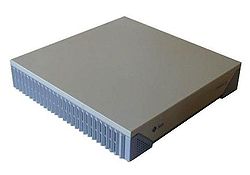
. It is based on the sun4m architecture, and is enclosed in a pizza-box chassis. A simplified, cheaper version of the SS5 was later released as the SPARCstation 4. Sun also marketed these same machines under the "Netra" brand, without framebuffers or keyboards and preconfigured with all the requisite software to be used as web server
Web server
Web server can refer to either the hardware or the software that helps to deliver content that can be accessed through the Internet....
s.
CPU support
The SPARCstation 5 may incorporate one of the following processors: 70, 85, or 110 MHz Sun Microsystems microSPARCMicroSPARC
The microSPARC is a microprocessor implementing the SPARC V8 instruction set architecture developed by Sun Microsystems. It was a low-end microprocessor intended for low-end workstations and embedded systems. The microprocessor was developed by Sun, but the floating-point unit was licensed from...
-II, or a 170 MHz Fujitsu Microelectronics, Inc. (FMI) TurboSPARC
TurboSPARC
The TurboSPARC is a microprocessor that implements the SPARC V8 instruction set architecture developed by Fujitsu Microelectronics, Inc. , the United States subsidiary of Fujitsu Limited located in San Jose, California. It was a low-end microprocessor primarily developed as an upgrade for the Sun...
. Fujitsu also provided a 160 MHz TurboSPARC CPU Upgrade Kit for upgrading 70, 85 and 110 MHz microSPARC-II models. The SPARCstation 5 has no MBus and thus is limited to use as a single-processor machine.
Memory
The SPARCstation 5 has eight DSIMM slots for memory expansion. Slots can be filled individually with either 8Mb or 32Mb modules giving a maximum of 256Mb memory. The memory used is identical to that of the SPARCstation 4.Disk drives
The SPARCstation 5 can hold two internal 80-pin SCASingle Connector Attachment
Single Connector Attachment, or SCA, is a type of connection for the internal cabling of SCSI systems. There are two versions of this connector: the SCA-1, which is deprecated, and SCA-2, which is currently in use in most systems...
, single ended, fast-narrow SCSI
SCSI
Small Computer System Interface is a set of standards for physically connecting and transferring data between computers and peripheral devices. The SCSI standards define commands, protocols, and electrical and optical interfaces. SCSI is most commonly used for hard disks and tape drives, but it...
drives, a SCSI CD-ROM drive and a floppy. It also supports external SCSI devices. There is no IDE/ATAPI support.
Network support
The SPARCstation 5 comes with an on-board AMD Lance ethernetEthernet
Ethernet is a family of computer networking technologies for local area networks commercially introduced in 1980. Standardized in IEEE 802.3, Ethernet has largely replaced competing wired LAN technologies....
chipset providing 10BaseT networking as standard and 10Base2
10BASE2
10BASE2 is a variant of Ethernet that uses thin coaxial cable , terminated with BNC connectors...
and 10Base5
10BASE5
10BASE5 was the original commercially available variant of Ethernet.For its physical layer it used cable similar to RG-8/U coaxial cable but with extra braided shielding. This is a stiff, diameter cable with an impedance of 50 ohms , a solid center conductor, a foam insulating filler, a shielding...
via an AUI
Attachment Unit Interface
An Attachment Unit Interface is a 15 pin connection that provides a path between a node's Ethernet interface and the Medium Attachment Unit , sometimes known as a transceiver. It is the part of the IEEE Ethernet standard located between the Media Access Control , and the MAU...
transceiver. A 10/100Mbit/s hme "Happy Meal" NIC can be added for faster connections. The OpenBoot ROM is able to boot from network, using RARP and TFTP. Like all other SPARCstation systems, the SS5 holds system information such as MAC address and serial number in NVRAM. If the battery on this chip dies, then the system will not be able to boot.
AFX
The SPARCstation 5 had three SBusSBus
SBus is a computer bus system that was used in most SPARC-based computers from Sun Microsystems and others during the 1990s...
expansion slots which are typical of Sun computer equipment of this era. The third of these shared its expansion backplate and physical space with a special AFX connector which was unique to the SPARCstation 5. Only one card was released for this slot, known as the S24 or TCX. This was a framebuffer that allowed the use of 24-bit colour graphics instead of the eight bit colour of the SBUS CG6 card, also known as the LEGO or low end graphics option. The TCX was also used as the on-board framebuffer of the SPARCstation 4, but this version was less advanced and only supported eight bit colour.
Operating systems
- SunOSSunOSSunOS is a version of the Unix operating system developed by Sun Microsystems for their workstation and server computer systems. The SunOS name is usually only used to refer to versions 1.0 to 4.1.4 of SunOS...
4.1.3_U1B onwards - Solaris 2.3 Edition II to Solaris 9
- LinuxLinuxLinux is a Unix-like computer operating system assembled under the model of free and open source software development and distribution. The defining component of any Linux system is the Linux kernel, an operating system kernel first released October 5, 1991 by Linus Torvalds...
- Most distributions of Linux have compatibility issues with TurboSPARC variants - MirBSD/sparc
- NetBSDNetBSDNetBSD is a freely available open source version of the Berkeley Software Distribution Unix operating system. It was the second open source BSD descendant to be formally released, after 386BSD, and continues to be actively developed. The NetBSD project is primarily focused on high quality design,...
/sparc - OpenBSDOpenBSDOpenBSD is a Unix-like computer operating system descended from Berkeley Software Distribution , a Unix derivative developed at the University of California, Berkeley. It was forked from NetBSD by project leader Theo de Raadt in late 1995...
/sparc - NeXTSTEPNEXTSTEPNeXTSTEP was the object-oriented, multitasking operating system developed by NeXT Computer to run on its range of proprietary workstation computers, such as the NeXTcube...
- OPENSTEP/Mach
External links
- Obsolyte: SPARCstation 5
- Parts List for SPARCstation 5
- "Sun AFX bus speeds graphics", article about the AFX bus and AFX graphics cards in Electronic NewsElectronic NewsElectronic News was a publication that covered the semiconductor production equipment industry. It was originally a weekly trade newspaper, which covered all aspects of the electronics industry including semiconductors, computers, software, communications, space and even television...