
|
|
|
|
Royal Australian Engineers
|
| |
|
| |
The Royal Australian Engineers (RAE) is a Corps of the Australian Army (although the word corps does not appear in their name or on their badge). The Engineer Corps is ranked 4th in seniority of the Corps, behind the Staff Cadets, Armoured and Artillery Corps. The Corps was formed by the amalgamation of the various engineer corps of the States and territories of Australia.
The motto of the Royal Australian Engineers is Ubique (Everywhere), a motto shared with RAE's parent corps, the Royal Engineers.

Discussion
Ask a question about 'Royal Australian Engineers'
Start a new discussion about 'Royal Australian Engineers'
Answer questions from other users
|
Encyclopedia
The Royal Australian Engineers (RAE) is a Corps of the Australian Army (although the word corps does not appear in their name or on their badge). The Engineer Corps is ranked 4th in seniority of the Corps, behind the Staff Cadets, Armoured and Artillery Corps. The Corps was formed by the amalgamation of the various engineer corps of the States and territories of Australia.
The motto of the Royal Australian Engineers is Ubique (Everywhere), a motto shared with RAE's parent corps, the Royal Engineers. This motto was bestowed by King William IV in 1832 in recognition that both Sappers and Gunners where not entitled to carry Regimental Colours and typically served as small detachments instead of a whole unit.
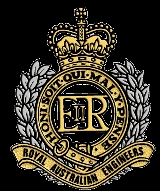
The current Engineer Hat badge features a leather garter adorned with a crown and the motto Honi soit qui mal y pense (Evil be to him who evil thinks), mirroring the motto of the Order of the Garter. This honor was awarded to the RAE in 1947 for their efforts during World War II.
The original motto of the RAE, adopted at Federation was Facimus et Frangimus (We make and we break) and appeared on the engineer hat badge up until 1947 when it was replaced by Honi soit qui mal y pense. It now only appears on the Corps Cipher.
The Engineers also adopted the Royal Engineers practice of calling their private soldiers "Sappers", in recognition of the fact that the very earliest engineers had been primarily concerned with driving saps (tunnels) both towards the enemy lines, and underneath fortifications.
The Corps provides combat engineering, construction and other technical support to the Australian Defence Force. One of the objectives of the corps is mobility and counter mobility. That is providing mobility to friendly forces while denying movement to enemy forces. Engineers are able to conduct tasks including penetrating minefields, locating and disarming booby traps, purifying water and building roads and bridges. The Corps also performs the majority of the army's demolition tasks and is trained to fight as infantry if needed.
History
Origins of the Royal Australian Engineers date back to 15 November 1860, when the Corps of Engineers was founded in the colony of Victoria by Peter Scratchley. By 1876, five of the six colonies had raised their own engineer units. These were amalgamated on 1 July 1902 as The Corps of Engineers. At this time, the Corps consisted of field, fortress, telegraph, electric and submarine mining companies.
In 1911, the Australian Corps of Signallers was absorbed into the Engineers as the RAE Signal Service. Four years later, in July 1915, all members of the Survey Section RAE, separated to form the Australian Survey Corps. During this period the School of Military Engineering was established at Moore Park in Sydney. The school was disbanded at the end of World War I.
On 1 January 1925 the RAE Signal Service was separated to form the Australian Corps of Signals. This was followed in 1932 by the Survey Section separating to form the Australian Survey Corps. 1939 saw the School of Military Engineering re-established in the Liverpool Military Area on Steele Barracks.
The Royal Australian Engineers colours are blue and red, though unit colour patches typically consist of a red feature on a purple field. The banner depiction of the colours consist of a blue field with two horizontal red bands near the top and bottom of the field.
On 1 July 1996 the RAE reabsorbed the Royal Australian Survey Corps.
Corps titles
- July 1902 to September 1907 - The Corps of Engineers
- September 1907 to January 1936 - Australian Engineers
- On 31 January 1936, the Corps was given Royal Assent, and was subsequently renamed Royal Australian Engineers
Structure
The Corps has both Regular and Reserve units. The current Regular units are:
The current Reserve (part-time) units are:
- 4th Combat Engineer Regiment (Ringwood East, Victoria)
- 5th Combat Engineer Regiment (Sydney)
- 8th Combat Engineer Regiment (Newcastle, NSW)
- 9th Combat Engineer Regiment (3rd Field Squadron) (Adelaide)
- 13th Combat Engineer Regiment (13th Field Squadron) (Perth)
- 11th Combat Engineer Regiment (35th Field Squadron) (Townsville)
- 21st Construction Regiment (Holsworthy, NSW)
- 22nd Construction Regiment (Oakleigh and Newborough, Victoria)
Former Army Reserve units of the Corps included the 1st Port Construction and Repair Group, at Haberfield, NSW. A former Regular unit was 12 CE Works at Mendi in Papua New Guinea.
Golf club
The Royal Australian Engineers operate a golf club on Steele Barracks, open to the public since the mid 1980s. The club aims to provide a recreational facility to members of the Australian Defence Force and their families, and is run with non-public funds. The club is operated in accordance with military regulations and is responsible to the Chief Instructor of the School of Military Engineering.
Order of precedence
|
| |
|
|