
Home      Discussion      Topics      Dictionary      Almanac
Signup       Login
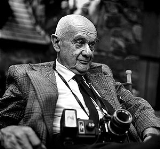
Roman Vishniac

Roman Vishniac

Overview
Roman Vishniac was a Russian-American photographer, best known for capturing on film the culture of Jews in Central
Central Europe
Central Europe or alternatively Middle Europe is a region of the European continent lying between the variously defined areas of Eastern and Western Europe...

 and Eastern Europe
Eastern Europe
Eastern Europe is the eastern part of Europe. The term has widely disparate geopolitical, geographical, cultural and socioeconomic readings, which makes it highly context-dependent and even volatile, and there are "almost as many definitions of Eastern Europe as there are scholars of the region"...

 before the Holocaust
The Holocaust
The Holocaust , also known as the Shoah , was the genocide of approximately six million European Jews and millions of others during World War II, a programme of systematic state-sponsored murder by Nazi...

. A complete archive of his work now rests at the International Center of Photography
International Center of Photography
The International Center of Photography is a photography museum, school, and research center in Midtown Manhattan in New York City, United States...

.
Discussion
Ask a question about 'Roman Vishniac'
Start a new discussion about 'Roman Vishniac'
Answer questions from other users
Full Discussion Forum
 
Quotations

Even before the concentration camps, I felt it was my duty to my ancestors to preserve a world which might cease to exist.

Testament to a Lost People

Concentration camp money... It was a German sadism that invented it. Can you do anything with it? Yes, you can cry.

Testament to a Lost People

The Jews of the shtetls that Tolstoy remembered were saints... the people I photographed were saints. So now, in 1983, I tell the world: When you learn about Goethe, don't forget to study the Holocaust, too.

Testament to a Lost People

...can you call a farm with a dozen geese a farm? Still, it was a little better for the Jews in Czechoslovakia. There were only two pogroms there. What's two pogroms?

Testament to a Lost People

Nature, God, or whatever you want to call the creator of the universe comes through the microscope clearly and strongly

ICP Library of Photographers. Roman Vishniac. Grossman Publishers, New York. 1974. pg 42.

The purpose of photography is the transmission of a visualized sector of life through the medium of the camera into a mental process that starts with the photographer's thinking about the subject he photographs and is continued in the mind of the spectator.

Deschin, Jacob. "Nature as it is". New York Times (1857-Current file); Feb 3, 1952; Proquest Historical Newspapers The New York Times (1851 - 2002) pg. X14

You can't teach biology with a bottle containing dead animals and organisms.

Shepard, Richard F. "Roman Vishniac, 92, a Biologist And Photographer of Jews, Dies". New York Times (1859-Current file); Jan 23, 1990; ProQuest Historical Newspapers The New York Times (1951 - 2002) pg. D23.

[his scientific accomplishments] were overshadowed by the photographs he took of Jews in prewar Eastern Europe and in Nazi Berlin. -- Shepard, Richard

"Roman Vishniac, 92, a Biologist And Photographer of Jews, Dies"
Encyclopedia
Roman Vishniac was a Russian-American photographer, best known for capturing on film the culture of Jews in Central
Central Europe
Central Europe or alternatively Middle Europe is a region of the European continent lying between the variously defined areas of Eastern and Western Europe...

 and Eastern Europe
Eastern Europe
Eastern Europe is the eastern part of Europe. The term has widely disparate geopolitical, geographical, cultural and socioeconomic readings, which makes it highly context-dependent and even volatile, and there are "almost as many definitions of Eastern Europe as there are scholars of the region"...

 before the Holocaust
The Holocaust
The Holocaust , also known as the Shoah , was the genocide of approximately six million European Jews and millions of others during World War II, a programme of systematic state-sponsored murder by Nazi...

. A complete archive of his work now rests at the International Center of Photography
International Center of Photography
The International Center of Photography is a photography museum, school, and research center in Midtown Manhattan in New York City, United States...

.

Vishniac was an extremely diverse photographer, an accomplished biologist
Biology
Biology is a natural science concerned with the study of life and living organisms, including their structure, function, growth, origin, evolution, distribution, and taxonomy. Biology is a vast subject containing many subdivisions, topics, and disciplines...

 and a knowledgeable collector and teacher of art history
History of art
The History of art refers to visual art which may be defined as any activity or product made by humans in a visual form for aesthetical or communicative purposes, expressing ideas, emotions or, in general, a worldview...

. Throughout his life, he made significant scientific contributions to photomicroscopy
Micrograph
A micrograph or photomicrograph is a photograph or digital image taken through a microscope or similar device to show a magnified image of an item.Micrographs are widely used in all fields of microscopy.-Photomicrograph:...

 and time-lapse photography
Time-lapse
Time-lapse photography is a cinematography technique whereby the frequency at which film frames are captured is much lower than that which will be used to play the sequence back. When replayed at normal speed, time appears to be moving faster and thus lapsing...

. Vishniac was very interested in history, especially that of his ancestors. In turn, he was strongly tied to his Jewish roots and was a Zionist
Zionism
Zionism is a Jewish political movement that, in its broadest sense, has supported the self-determination of the Jewish people in a sovereign Jewish national homeland. Since the establishment of the State of Israel, the Zionist movement continues primarily to advocate on behalf of the Jewish state...

 later in life.

Roman Vishniac won international acclaim for his photography: his pictures from the shtetl
Shtetl
A shtetl was typically a small town with a large Jewish population in Central and Eastern Europe until The Holocaust. Shtetls were mainly found in the areas which constituted the 19th century Pale of Settlement in the Russian Empire, the Congress Kingdom of Poland, Galicia and Romania...

ach
and Jewish ghettos, celebrity portraits, and images of microscopic biology. He is known for his book A Vanished World, published in 1983, which was one of the first such pictorial documentations of Jewish culture in Eastern Europe from that period, and also for his great humanism, respect and awe for life, sentiments that can be seen in all aspects of his work.

Early life


Roman was born in his grandparents' dacha
Dacha
Dacha is a Russian word for seasonal or year-round second homes often located in the exurbs of Soviet and post-Soviet cities. Cottages or shacks serving as family's main or only home are not considered dachas, although many purpose-built dachas are recently being converted for year-round residence...

outside Saint Petersburg
Saint Petersburg
Saint Petersburg is a city and a federal subject of Russia located on the Neva River at the head of the Gulf of Finland on the Baltic Sea...

, in the town of Pavlovsk, and grew up in Moscow
Moscow
Moscow is the capital, the most populous city, and the most populous federal subject of Russia. The city is a major political, economic, cultural, scientific, religious, financial, educational, and transportation centre of Russia and the continent...

. To live in this city was a right granted to few Jews but Roman could live there because his father, Solomon Vishniac, was a wealthy manufacturer of umbrellas, and his mother, Manya, was the daughter of affluent diamond dealers (Roman also had a sister, Katja). During the summer months; however, the Vishniacs would leave: Moscow often became uncomfortably hot and the family would retreat to a dacha a few miles outside of that city.

As a child, Roman Vishniac was fascinated by biology
Biology
Biology is a natural science concerned with the study of life and living organisms, including their structure, function, growth, origin, evolution, distribution, and taxonomy. Biology is a vast subject containing many subdivisions, topics, and disciplines...

 and photography
Photography
Photography is the art, science and practice of creating durable images by recording light or other electromagnetic radiation, either electronically by means of an image sensor or chemically by means of a light-sensitive material such as photographic film...

, and his room was filled with "plants, insects, fish and small animals". On his seventh birthday, he got a microscope
Microscope
A microscope is an instrument used to see objects that are too small for the naked eye. The science of investigating small objects using such an instrument is called microscopy...

 from his grandmother, to which he promptly hooked up a camera, and by which he photographed the muscles in a cockroach
Cockroach
Cockroaches are insects of the order Blattaria or Blattodea, of which about 30 species out of 4,500 total are associated with human habitations...

's leg at 150 times magnification. Young Vishniac used this microscope extensively, viewing and photographing everything he could find, from dead insects to animal scales
Scale (zoology)
In most biological nomenclature, a scale is a small rigid plate that grows out of an animal's skin to provide protection. In lepidopteran species, scales are plates on the surface of the insect wing, and provide coloration...

, to pollen
Pollen
Pollen is a fine to coarse powder containing the microgametophytes of seed plants, which produce the male gametes . Pollen grains have a hard coat that protects the sperm cells during the process of their movement from the stamens to the pistil of flowering plants or from the male cone to the...

 and protozoa
Protozoa
Protozoa are a diverse group of single-cells eukaryotic organisms, many of which are motile. Throughout history, protozoa have been defined as single-cell protists with animal-like behavior, e.g., movement...

.

Until the age of ten, Vishniac was homeschooled
Homeschooling
Homeschooling or homeschool is the education of children at home, typically by parents but sometimes by tutors, rather than in other formal settings of public or private school...

; from ten to seventeen, he attended a private school at which he earned a gold medal for scholarship. Beginning in 1914, he spent six years at Shanyavsky Institute (now University) in Moscow. While enrolled there, he served in the Tsar
Tsar
Tsar is a title used to designate certain European Slavic monarchs or supreme rulers. As a system of government in the Tsardom of Russia and Russian Empire, it is known as Tsarist autocracy, or Tsarism...

ist, Kerensky
Russian Provisional Government
The Russian Provisional Government was the short-lived administrative body which sought to govern Russia immediately following the abdication of Tsar Nicholas II . On September 14, the State Duma of the Russian Empire was officially dissolved by the newly created Directorate, and the country was...

 and Soviet armies
Military history of the Soviet Union
The military history of the Soviet Union began in the days following the 1917 October Revolution that brought the Bolsheviks to power. The new government formed the Red Army to fight various enemies in the Russian Civil War. The years 1918-1921 saw Red Army's defeats in Polish-Soviet war and...

. At the Institute, he earned a doctorate
Doctor of Philosophy
Doctor of Philosophy, abbreviated as Ph.D., PhD, D.Phil., or DPhil , in English-speaking countries, is a postgraduate academic degree awarded by universities...

 in zoology
Zoology
Zoology |zoölogy]]), is the branch of biology that relates to the animal kingdom, including the structure, embryology, evolution, classification, habits, and distribution of all animals, both living and extinct...

 and became an assistant professor of biology. As a graduate student, he worked with prestigious biologist Nikolai Koltzoff, experimenting with inducing metamorphosis in axolotl
Axolotl
The axolotl , Ambystoma mexicanum, is a neotenic salamander, closely related to the Tiger Salamander. Larvae of this species fail to undergo metamorphosis, so the adults remain aquatic and gilled. It is also called ajolote...

, a species of aquatic salamander
Salamander
Salamander is a common name of approximately 500 species of amphibians. They are typically characterized by a superficially lizard-like appearance, with their slender bodies, short noses, and long tails. All known fossils and extinct species fall under the order Caudata, while sometimes the extant...

. While his experiments were a success, Vishniac was not able to publish a paper detailing his findings due to the chaos in Russia
Russian Revolution of 1917
The Russian Revolution is the collective term for a series of revolutions in Russia in 1917, which destroyed the Tsarist autocracy and led to the creation of the Soviet Union. The Tsar was deposed and replaced by a provisional government in the first revolution of February 1917...

 and his results were eventually independently duplicated. In spite of this, he went on to take a three-year course in medicine
Medicine
Medicine is the science and art of healing. It encompasses a variety of health care practices evolved to maintain and restore health by the prevention and treatment of illness....

.


Berlin


In 1918, Roman Vishniac's immediate family moved to Berlin
Berlin
Berlin is the capital city of Germany and is one of the 16 states of Germany. With a population of 3.45 million people, Berlin is Germany's largest city. It is the second most populous city proper and the seventh most populous urban area in the European Union...

 because of anti-Semitism
Anti-Semitism
Antisemitism is suspicion of, hatred toward, or discrimination against Jews for reasons connected to their Jewish heritage. According to a 2005 U.S...

 spurred by the Third Russian Revolution
Left-wing uprisings against the Bolsheviks
Left-wing uprisings against the Bolsheviks were a series of rebellions and uprisings against the Bolsheviks led or supported by left wing groups including Socialist Revolutionaries, Left Socialist Revolutionaries, Mensheviks, and anarchists. Some were in support of the White Movement while some...

. Roman followed them and, shortly after arriving, married Luta (Leah) Bagg, who gave birth to two children, Mara and Wolf
Wolf V. Vishniac
Wolf V. Vishniac was an American microbiologist, son of Roman Vishniac. Educated at Brooklyn College and Stanford University, he was a professor of Biology at the University of Rochester. He died while on a research trip to the Antarctic while attempting to retrieve equipment down a crevice. The...

. Roman Vishniac supported his own budding family (and sometimes his parents as well) by working at various jobs. In his free time, he studied Far Eastern Art
Eastern art history
The history of Eastern art includes a vast range of influences from various cultures and religions. Developments in Eastern art historically parallel those in Western art, in general a few centuries earlier...

 at the University of Berlin. Vishniac researched endocrinology
Endocrinology
Endocrinology is a branch of biology and medicine dealing with the endocrine system, its diseases, and its specific secretions called hormones, the integration of developmental events such as proliferation, growth, and differentiation and the coordination of...

 and optics
Optics
Optics is the branch of physics which involves the behavior and properties of light, including its interactions with matter and the construction of instruments that use or detect it. Optics usually describes the behavior of visible, ultraviolet, and infrared light...

, and did some photography (see right). In Berlin, he also initiated his public speaking
Public speaking
Public speaking is the process of speaking to a group of people in a structured, deliberate manner intended to inform, influence, or entertain the listeners...

 career by joining the Salamander Club, at which he often gave lectures on naturalism
Naturalism (art)
Naturalism in art refers to the depiction of realistic objects in a natural setting. The Realism movement of the 19th century advocated naturalism in reaction to the stylized and idealized depictions of subjects in Romanticism, but many painters have adopted a similar approach over the centuries...

.

In the 1930s, as anti-Semitism was growing in Germany
Germany
Germany , officially the Federal Republic of Germany , is a federal parliamentary republic in Europe. The country consists of 16 states while the capital and largest city is Berlin. Germany covers an area of 357,021 km2 and has a largely temperate seasonal climate...

, Vishniac took his famed trips to Eastern Europe
Eastern Europe
Eastern Europe is the eastern part of Europe. The term has widely disparate geopolitical, geographical, cultural and socioeconomic readings, which makes it highly context-dependent and even volatile, and there are "almost as many definitions of Eastern Europe as there are scholars of the region"...

, photographing the culture of poor Jews in mountainous villages and urban ghettos. For about four years (the exact period is debated), he would travel back and forth from Berlin to remote locations, taking thousands of pictures and living with whoever would take him in, at the same time supporting his family in Berlin. In 1939, his wife and children moved to Sweden
Sweden
Sweden , officially the Kingdom of Sweden , is a Nordic country on the Scandinavian Peninsula in Northern Europe. Sweden borders with Norway and Finland and is connected to Denmark by a bridge-tunnel across the Öresund....

 to stay with Luta's parents, away from hostile Germany. He met his parents in Nice
Nice
Nice is the fifth most populous city in France, after Paris, Marseille, Lyon and Toulouse, with a population of 348,721 within its administrative limits on a land area of . The urban area of Nice extends beyond the administrative city limits with a population of more than 955,000 on an area of...

 that summer.

Vishniac returned to Paris
Paris
Paris is the capital and largest city in France, situated on the river Seine, in northern France, at the heart of the Île-de-France region...

 in late summer 1940, and was arrested by Marshal Philippe Pétain
Philippe Pétain
Henri Philippe Benoni Omer Joseph Pétain , generally known as Philippe Pétain or Marshal Pétain , was a French general who reached the distinction of Marshal of France, and was later Chief of State of Vichy France , from 1940 to 1944...

's police and interned at Camp du Ruchard, a deportation camp
Deportation
Deportation means the expulsion of a person or group of people from a place or country. Today it often refers to the expulsion of foreign nationals whereas the expulsion of nationals is called banishment, exile, or penal transportation...

 in Indre-et-Loire
Indre-et-Loire
Indre-et-Loire is a department in west-central France named after the Indre and the Loire rivers.-History:Indre-et-Loire is one of the original 83 départements created during the French Revolution on 4 March 1790...

. This occurred because Latvia
Latvia
Latvia , officially the Republic of Latvia , is a country in the Baltic region of Northern Europe. It is bordered to the north by Estonia , to the south by Lithuania , to the east by the Russian Federation , to the southeast by Belarus and shares maritime borders to the west with Sweden...

, of which he was a citizen, had been subsumed into the Soviet Union
Soviet Union
The Soviet Union , officially the Union of Soviet Socialist Republics , was a constitutionally socialist state that existed in Eurasia between 1922 and 1991....

 and Vishniac was considered a "stateless person". After three months, as a result of his wife's efforts and aid from the American Jewish Joint Distribution Committee
American Jewish Joint Distribution Committee
The American Jewish Joint Distribution Committee is a worldwide Jewish relief organization headquartered in New York. It was established in 1914 and is active in more than 70 countries....

, he obtained a visa
Visa (document)
A visa is a document showing that a person is authorized to enter the territory for which it was issued, subject to permission of an immigration official at the time of actual entry. The authorization may be a document, but more commonly it is a stamp endorsed in the applicant's passport...

 that allowed him to escape via Lisbon
Lisbon
Lisbon is the capital city and largest city of Portugal with a population of 545,245 within its administrative limits on a land area of . The urban area of Lisbon extends beyond the administrative city limits with a population of 3 million on an area of , making it the 9th most populous urban...

 to the U.S. with his family. His father stayed behind and spent the war hidden in France; his mother died from cancer in 1941 while still in Nice.

New York


The Vishniac family fled from Lisbon
Lisbon
Lisbon is the capital city and largest city of Portugal with a population of 545,245 within its administrative limits on a land area of . The urban area of Lisbon extends beyond the administrative city limits with a population of 3 million on an area of , making it the 9th most populous urban...

 to New York City
New York City
New York is the most populous city in the United States and the center of the New York Metropolitan Area, one of the most populous metropolitan areas in the world. New York exerts a significant impact upon global commerce, finance, media, art, fashion, research, technology, education, and...

 in 1940, arriving on New Year's Eve
New Year's Eve
New Year's Eve is observed annually on December 31, the final day of any given year in the Gregorian calendar. In modern societies, New Year's Eve is often celebrated at social gatherings, during which participants dance, eat, consume alcoholic beverages, and watch or light fireworks to mark the...

. Vishniac tried for days to get a job but failed: "For me, it was a time of distraction and fear." He was multilingual, speaking at least German
German language
German is a West Germanic language, related to and classified alongside English and Dutch. With an estimated 90 – 98 million native speakers, German is one of the world's major languages and is the most widely-spoken first language in the European Union....

, Russian
Russian language
Russian is a Slavic language used primarily in Russia, Belarus, Uzbekistan, Kazakhstan, Tajikistan and Kyrgyzstan. It is an unofficial but widely spoken language in Ukraine, Moldova, Latvia, Turkmenistan and Estonia and, to a lesser extent, the other countries that were once constituent republics...

 and Yiddish, but he could not yet speak any English
English language
English is a West Germanic language that arose in the Anglo-Saxon kingdoms of England and spread into what was to become south-east Scotland under the influence of the Anglian medieval kingdom of Northumbria...

 and thus had a difficult time. He managed to do some portraiture work with mostly foreign clients; but business was poor. It was during this time, in 1942, that he took one of his most celebrated portraits, that of Albert Einstein
Albert Einstein
Albert Einstein was a German-born theoretical physicist who developed the theory of general relativity, effecting a revolution in physics. For this achievement, Einstein is often regarded as the father of modern physics and one of the most prolific intellects in human history...

. He arrived at Einstein's home in Princeton, New Jersey
Princeton, New Jersey
Princeton is a community located in Mercer County, New Jersey, United States. It is best known as the location of Princeton University, which has been sited in the community since 1756...

, getting into the scientist's study with the ruse of bringing regards from mutual friends in Europe, and photographed him while the scientist was not paying attention to him, occupied in thought. Einstein later called this portrait his favourite one of him.

In 1946, Roman Vishniac divorced Luta, and the next year he married Edith Ernst, an old family friend. A few years later, he gave up portraiture and went on to do freelance work in the field of photomicroscopy
Micrograph
A micrograph or photomicrograph is a photograph or digital image taken through a microscope or similar device to show a magnified image of an item.Micrographs are widely used in all fields of microscopy.-Photomicrograph:...

.

Once in the United States, Roman Vishniac tried desperately to earn sympathy for impoverished Jews in Eastern Europe
Eastern Europe
Eastern Europe is the eastern part of Europe. The term has widely disparate geopolitical, geographical, cultural and socioeconomic readings, which makes it highly context-dependent and even volatile, and there are "almost as many definitions of Eastern Europe as there are scholars of the region"...

. When his work was exhibited at Teachers College, Columbia University
Teachers College, Columbia University
Teachers College, Columbia University is a graduate school of education located in New York City, New York...

 in 1943, he wrote to Eleanor Roosevelt
Eleanor Roosevelt
Anna Eleanor Roosevelt was the First Lady of the United States from 1933 to 1945. She supported the New Deal policies of her husband, distant cousin Franklin Delano Roosevelt, and became an advocate for civil rights. After her husband's death in 1945, Roosevelt continued to be an international...

 (First Lady
First Lady of the United States
First Lady of the United States is the title of the hostess of the White House. Because this position is traditionally filled by the wife of the president of the United States, the title is most often applied to the wife of a sitting president. The current first lady is Michelle Obama.-Current:The...

 at the time), asking her to visit the exhibit, but she did not. He also sent some of his photographs to the President, for which he was politely thanked.

Of the 16,000 taken in Eastern Europe by Roman Vishniac, only 2,000 photographs reached America. Most of these negatives were carefully hidden by Roman and his family; others were smuggled in by Vishniac's good friend Walter Bierer through Cuba
Cuba
The Republic of Cuba is an island nation in the Caribbean. The nation of Cuba consists of the main island of Cuba, the Isla de la Juventud, and several archipelagos. Havana is the largest city in Cuba and the country's capital. Santiago de Cuba is the second largest city...

. In the photographer's own words,

Later life


Even when he grew older, Roman Vishniac was very active. In 1957, he was appointed research associate at the Albert Einstein College of Medicine
Albert Einstein College of Medicine
Albert Einstein College of Medicine is a graduate school of Yeshiva University. It is a not-for-profit, private, nonsectarian medical school located on the Jack and Pearl Resnick Campus in the Morris Park neighborhood of the borough of the Bronx of New York City...

 and in 1961 was promoted to "professor
Professor
A professor is a scholarly teacher; the precise meaning of the term varies by country. Literally, professor derives from Latin as a "person who professes" being usually an expert in arts or sciences; a teacher of high rank...

 of biological education". In his seventies and eighties, Vishniac became "Chevron Professor of Creativity" at Pratt Institute
Pratt Institute
Pratt Institute is a private art college in New York City located in Brooklyn, New York, with satellite campuses in Manhattan and Utica. Pratt is one of the leading undergraduate art schools in the United States and offers programs in Architecture, Graphic Design, History of Art and Design,...

 (where he taught courses on topics such as the philosophy of photography). During this time he lived on the West Side of Manhattan
Manhattan
Manhattan is the oldest and the most densely populated of the five boroughs of New York City. Located primarily on the island of Manhattan at the mouth of the Hudson River, the boundaries of the borough are identical to those of New York County, an original county of the state of New York...

 with his wife Edith, teaching, photographing, reading and collecting artifacts. Some items that were in his collection include a 14th-century Buddha
Gautama Buddha
Siddhārtha Gautama was a spiritual teacher from the Indian subcontinent, on whose teachings Buddhism was founded. In most Buddhist traditions, he is regarded as the Supreme Buddha Siddhārtha Gautama (Sanskrit: सिद्धार्थ गौतम; Pali: Siddhattha Gotama) was a spiritual teacher from the Indian...

, Chinese tapestries
Tapestry
Tapestry is a form of textile art, traditionally woven on a vertical loom, however it can also be woven on a floor loom as well. It is composed of two sets of interlaced threads, those running parallel to the length and those parallel to the width ; the warp threads are set up under tension on a...

, Japanese swords, various antique microscope
Microscope
A microscope is an instrument used to see objects that are too small for the naked eye. The science of investigating small objects using such an instrument is called microscopy...

s, valued old maps and venerable books. He taught Oriental
Asian art
Asian art can refer to art amongst many cultures in Asia.-Various types of Asian art:*Afghan art*Azerbaijanian art*Balinese art*Bhutanese art*Buddhist art*Burmese contemporary art*Chinese art*Eastern art*Indian art*Iranian art*Islamic art...

 and Russian art, general philosophy
Philosophy
Philosophy is the study of general and fundamental problems, such as those connected with existence, knowledge, values, reason, mind, and language. Philosophy is distinguished from other ways of addressing such problems by its critical, generally systematic approach and its reliance on rational...

 and religion
Religion
Religion is a collection of cultural systems, belief systems, and worldviews that establishes symbols that relate humanity to spirituality and, sometimes, to moral values. Many religions have narratives, symbols, traditions and sacred histories that are intended to give meaning to life or to...

 in science
Science
Science is a systematic enterprise that builds and organizes knowledge in the form of testable explanations and predictions about the universe...

, specifically Jewish topics, ecology
Ecology
Ecology is the scientific study of the relations that living organisms have with respect to each other and their natural environment. Variables of interest to ecologists include the composition, distribution, amount , number, and changing states of organisms within and among ecosystems...

, numismatics
Numismatics
Numismatics is the study or collection of currency, including coins, tokens, paper money, and related objects. While numismatists are often characterized as students or collectors of coins, the discipline also includes the broader study of money and other payment media used to resolve debts and the...

, photography and general science at City University of New York
City University of New York
The City University of New York is the public university system of New York City, with its administrative offices in Yorkville in Manhattan. It is the largest urban university in the United States, consisting of 23 institutions: 11 senior colleges, six community colleges, the William E...

, Case Western Reserve University
Case Western Reserve University
Case Western Reserve University is a private research university located in Cleveland, Ohio, USA...

 and at various other institutions.

During his life, Vishniac was the subject and creator of many film
Film
A film, also called a movie or motion picture, is a series of still or moving images. It is produced by recording photographic images with cameras, or by creating images using animation techniques or visual effects...

s and documentaries
Documentary film
Documentary films constitute a broad category of nonfictional motion pictures intended to document some aspect of reality, primarily for the purposes of instruction or maintaining a historical record...

; the most celebrated of which was the Living Biology series. This consisted of seven films on cell biology
Cell biology
Cell biology is a scientific discipline that studies cells – their physiological properties, their structure, the organelles they contain, interactions with their environment, their life cycle, division and death. This is done both on a microscopic and molecular level...

; organs
Organ (anatomy)
In biology, an organ is a collection of tissues joined in structural unit to serve a common function. Usually there is a main tissue and sporadic tissues . The main tissue is the one that is unique for the specific organ. For example, main tissue in the heart is the myocardium, while sporadic are...

 and systems; embryology
Embryology
Embryology is a science which is about the development of an embryo from the fertilization of the ovum to the fetus stage...

; evolution
Evolution
Evolution is any change across successive generations in the heritable characteristics of biological populations. Evolutionary processes give rise to diversity at every level of biological organisation, including species, individual organisms and molecules such as DNA and proteins.Life on Earth...

; genetics
Genetics
Genetics , a discipline of biology, is the science of genes, heredity, and variation in living organisms....

; ecology
Ecology
Ecology is the scientific study of the relations that living organisms have with respect to each other and their natural environment. Variables of interest to ecologists include the composition, distribution, amount , number, and changing states of organisms within and among ecosystems...

; botany
Botany
Botany, plant science, or plant biology is a branch of biology that involves the scientific study of plant life. Traditionally, botany also included the study of fungi, algae and viruses...

; the animal world; and the microbial
Microorganism
A microorganism or microbe is a microscopic organism that comprises either a single cell , cell clusters, or no cell at all...

 world. It was funded by a grant
Grant (money)
Grants are funds disbursed by one party , often a Government Department, Corporation, Foundation or Trust, to a recipient, often a nonprofit entity, educational institution, business or an individual. In order to receive a grant, some form of "Grant Writing" often referred to as either a proposal...

 from the National Science Foundation
National Science Foundation
The National Science Foundation is a United States government agency that supports fundamental research and education in all the non-medical fields of science and engineering. Its medical counterpart is the National Institutes of Health...

.

Roman Vishniac received Honorary Doctoral degrees from the Rhode Island School of Design
Rhode Island School of Design
Rhode Island School of Design is a fine arts and design college located in Providence, Rhode Island. It was founded in 1877. Located at the base of College Hill, the RISD campus is contiguous with the Brown University campus. The two institutions share social, academic, and community resources and...

, Columbia College of Art and the California College of Art, before he died from colon cancer on January 22, 1990.

Photography


1935–1939


Vishniac is best known for his dramatic photographs of poor and pious Jews in cities and shtetl
Shtetl
A shtetl was typically a small town with a large Jewish population in Central and Eastern Europe until The Holocaust. Shtetls were mainly found in the areas which constituted the 19th century Pale of Settlement in the Russian Empire, the Congress Kingdom of Poland, Galicia and Romania...

ach
of Eastern Europe
Eastern Europe
Eastern Europe is the eastern part of Europe. The term has widely disparate geopolitical, geographical, cultural and socioeconomic readings, which makes it highly context-dependent and even volatile, and there are "almost as many definitions of Eastern Europe as there are scholars of the region"...

. He was first commissioned to take these pictures by the American Jewish Joint Distribution Committee
American Jewish Joint Distribution Committee
The American Jewish Joint Distribution Committee is a worldwide Jewish relief organization headquartered in New York. It was established in 1914 and is active in more than 70 countries....

 as part of a fundraising initiative, but Vishniac took a personal interest in this photography. He traveled back and forth from Berlin
Berlin
Berlin is the capital city of Germany and is one of the 16 states of Germany. With a population of 3.45 million people, Berlin is Germany's largest city. It is the second most populous city proper and the seventh most populous urban area in the European Union...

 to the ghetto
Ghetto
A ghetto is a section of a city predominantly occupied by a group who live there, especially because of social, economic, or legal issues.The term was originally used in Venice to describe the area where Jews were compelled to live. The term now refers to an overcrowded urban area often associated...

s of Russia
Russia
Russia or , officially known as both Russia and the Russian Federation , is a country in northern Eurasia. It is a federal semi-presidential republic, comprising 83 federal subjects...

, Poland
Poland
Poland , officially the Republic of Poland , is a country in Central Europe bordered by Germany to the west; the Czech Republic and Slovakia to the south; Ukraine, Belarus and Lithuania to the east; and the Baltic Sea and Kaliningrad Oblast, a Russian exclave, to the north...

, Romania
Romania
Romania is a country located at the crossroads of Central and Southeastern Europe, on the Lower Danube, within and outside the Carpathian arch, bordering on the Black Sea...

, Czechoslovakia
Czechoslovakia
Czechoslovakia or Czecho-Slovakia was a sovereign state in Central Europe which existed from October 1918, when it declared its independence from the Austro-Hungarian Empire, until 1992...

 and Lithuania
Lithuania
Lithuania , officially the Republic of Lithuania is a country in Northern Europe, the biggest of the three Baltic states. It is situated along the southeastern shore of the Baltic Sea, whereby to the west lie Sweden and Denmark...

 for years after he worked for the Committee.

While touring Europe, Vishniac posed as a traveling fabric salesman, seeking aid where he could and bribing anyone who got in his way. During his touring of Eastern Europe (1935–1939), he was often arrested by police for taking these pictures, sometimes because he was thought to be spying Later, when published, these photographs made him popular enough for his work to be showcased as one-man shows at Columbia University
Columbia University
Columbia University in the City of New York is a private, Ivy League university in Manhattan, New York City. Columbia is the oldest institution of higher learning in the state of New York, the fifth oldest in the United States, and one of the country's nine Colonial Colleges founded before the...

, the , International Center of Photography
International Center of Photography
The International Center of Photography is a photography museum, school, and research center in Midtown Manhattan in New York City, United States...

 and other such institutions.


Vishniac is said to have taken 16,000 photos in this period, every one of them a candid shot; however, the veracity of both of these claims has been seriously challenged. In order to reach some of the small villages in these mountains, he had to carry heavy equipment (Leica, Rolleiflex, movie camera, tripods
Tripod (photography)
In photography, a tripod is used to stabilize and elevate a camera, or to support flashes or other photographic equipment. All photographic tripods have three legs and a mounting head to couple with a camera...

 etc.), 115 pounds
Pound (mass)
The pound or pound-mass is a unit of mass used in the Imperial, United States customary and other systems of measurement...

 (52 kilogram
Kilogram
The kilogram or kilogramme , also known as the kilo, is the base unit of mass in the International System of Units and is defined as being equal to the mass of the International Prototype Kilogram , which is almost exactly equal to the mass of one liter of water...

s) by his estimate, on his back, up steep roads, trekking many miles. Vishniac captured thousands of impoverished Jews on film, "[...] to preserve — in pictures, at least — a world that might soon cease to exist".

For indoor shots, when the Leica was used, there was the problem of insufficient lighting: there would rarely be artificial light in the home of a poor Jew, so he sometimes had to bring a kerosene lamp
Kerosene lamp
The kerosene lamp is a type of lighting device that uses kerosene as a fuel. This article refers to kerosene lamps that have a wick and a tall glass chimney. Kerosene lanterns that have a wick and a glass globe are related to kerosene lamps and are included here as well...

 (visible in some of his work), keep his back to a wall for support, and hold his breath. The Rolleiflex was used mostly for outdoor scenes.

Roman Vishniac did not just want to preserve the memories of the Jews; he actively fought to increase awareness in the West of the worsening situation in Eastern Europe. "Through his photographs, he sought to alert the rest of the world to the horrors [of the Nazi persecution]", Mitgang. In late 1938, for example, he sneaked into Zbaszyn
Zbaszyn
Zbąszyń is a town in Poland, in Greater Poland Voivodeship, in Nowy Tomyśl County. It has 7,319 inhabitants .-History:The town was first mentioned in historical sources from 1231, and it received its city charter before 1311. As a result of the Second Partition of Poland in 1793 it became part of...

, an internment camp in Germany
Nazi Germany
Nazi Germany , also known as the Third Reich , but officially called German Reich from 1933 to 1943 and Greater German Reich from 26 June 1943 onward, is the name commonly used to refer to the state of Germany from 1933 to 1945, when it was a totalitarian dictatorship ruled by...

 near the border, where Jews awaited deportment to Poland
Poland
Poland , officially the Republic of Poland , is a country in Central Europe bordered by Germany to the west; the Czech Republic and Slovakia to the south; Ukraine, Belarus and Lithuania to the east; and the Baltic Sea and Kaliningrad Oblast, a Russian exclave, to the north...

. After photographing the "filthy barracks", as he described it, for two days, he escaped by jumping from the second floor at night and creeping away, avoiding broken glass and barbed wire
Barbed wire
Barbed wire, also known as barb wire , is a type of fencing wire constructed with sharp edges or points arranged at intervals along the strand. It is used to construct inexpensive fences and is used atop walls surrounding secured property...

. He then used photographs taken to prove the existence of such camps to the League of Nations
League of Nations
The League of Nations was an intergovernmental organization founded as a result of the Paris Peace Conference that ended the First World War. It was the first permanent international organization whose principal mission was to maintain world peace...

.

After Roman's death, more photographs were discovered, and the current exhibit in Berlin showcases such newly discovered photographs. The negatives of these were found at the end of rolls of film used by him in his scientific pursuits.

Style


Vishniac's photographs from the 1930s are all of a very distinct style; they are all focused on achieving the same end: capturing the unique culture of Jewish ghettos in Eastern Europe, especially the religious and impoverished. His published pictures largely center on these people, usually in small groups, going about their daily lives: very often studying (generally religious texts), walking (many times through harsh weather), and sometimes just sitting; staring. The scenes are dramatic: "There is barely a hint of a smile on any of the faces. The eyes peer at us suspiciously from behind ancient casement window
Casement window
A casement window is a window that is attached to its frame by one or more hinges. Casement windows are hinged at the side. A casement window (or casement) is a window that is attached to its frame by one or more hinges. Casement windows are hinged at the side. A casement window (or casement) is a...

s and over a peddler's tray, from crowded schoolrooms and desolate street corners." Gene Thornton, writer for The New York Times
The New York Times
The New York Times is an American daily newspaper founded and continuously published in New York City since 1851. The New York Times has won 106 Pulitzer Prizes, the most of any news organization...

, called them "[...] somber with poverty and with the gray light of European Winter".

These pictures, all in black and white, were done with available light or sometimes a lantern, yet they are "amazingly crisp with surprising depth of field". Indeed, "There is a grainy realism to Vishniac's photographic style. We can almost finger the coarse textures of coats and shawls; the layers of fabric worn by the people seem more related to tree bark than to the well-pressed wool suit worn by an occasional elegant passerby." Vishniac is known to have exaggerated in composing the captions of his photographs, and in some cases he may have fabricated the stories behind them.

Impact


Vishniac's photographs from this period are widely commended and on permanent display in many museums. Edward Steichen
Edward Steichen
Edward J. Steichen was an American photographer, painter, and art gallery and museum curator. He was the most frequently featured photographer in Alfred Stieglitz' groundbreaking magazine Camera Work during its run from 1903 to 1917. Steichen also contributed the logo design and a custom typeface...

 places his pre-Holocaust
The Holocaust
The Holocaust , also known as the Shoah , was the genocide of approximately six million European Jews and millions of others during World War II, a programme of systematic state-sponsored murder by Nazi...

 photographs, "among photography's finest documents of a time and place."' However, there has been criticism of Vishniac's work, focusing on the lack of diversity of his subjects in his work from Eastern Europe and quality of his composition. It has been argued that he should have also photographed wealthier Jews, in addition to the poor Jews in ghettos. Thornton criticized his photographs for their unprofessional qualities, citing "errors of focus and accidents of design, as when an unexplained third leg and foot protrudes from the long coat of a hurrying scholar."

Vishniac's photographs have had a profound effect on Holocaust literature and have illustrated many books about the Jewish ghettos and Holocaust. In the case of The Only Flowers of her Youth, the drama of the photograph inspired Miriam Nerlove to write a novel based on the story of the girl in the picture.

For this work, Roman Vishniac has received the Memorial Award of the American Society of Magazine Photographers
American Society of Media Photographers
The American Society of Media Photographers, abbreviated ASMP, is a trade association of professional photographers, including many photojournalists but also experts in architectural, underwater, culinary and advertising photography and other specialties as well...

 in 1956. He was also the winner of the visual arts
Visual arts
The visual arts are art forms that create works which are primarily visual in nature, such as ceramics, drawing, painting, sculpture, printmaking, design, crafts, and often modern visual arts and architecture...

 category of awards of the Jewish Book Council
Jewish Book Council
The Jewish Book Council, founded in 1944, is an organization encouraging and contributing to Jewish literature. The goal of the council, as stated on its website, is "to promote the reading, writing and publishing of quality English language books of Jewish content in North America". It is the only...

 in 1984; The Only Flowers of her Youth was deemed "most impressive" at the International Photographic Exhibition in Lucerne
Lucerne
Lucerne is a city in north-central Switzerland, in the German-speaking portion of that country. Lucerne is the capital of the Canton of Lucerne and the capital of the district of the same name. With a population of about 76,200 people, Lucerne is the most populous city in Central Switzerland, and...

 in 1952; and the Grand Prize for Art in Photography, New York Coliseum
New York Coliseum
The New York Coliseum was a convention center that stood on Columbus Circle in New York City from 1956 to 2000. It was designed by architects Leon and Lionel Levy in a modified international style, and included both a low building with exhibition space and a 26-story office block.-History:The...

.

Photomicroscopy and biology


In addition to the candid photography for which he is best known, Vishniac worked heavily in the field of photomicroscopy
Micrograph
A micrograph or photomicrograph is a photograph or digital image taken through a microscope or similar device to show a magnified image of an item.Micrographs are widely used in all fields of microscopy.-Photomicrograph:...

, (specifically interference microscopy
Interference microscopy
Interference microscopy involving measurements of differences in the path between two beams of light that have been split.Types include:* Classical interference microscopy* Differential interference contrast microscopy...

 and cinemicroscopy). He specialized in photographing living insects and had a knack for arranging the moving specimens in "just the right poses", according to Philippe Halsman
Philippe Halsman
Philippe Halsman was an American portrait photographer.-Life and work:Born to a Jewish family of Morduch Halsman, a dentist, and Ita Grintuch, a grammar school principal, in Riga, Halsman studied electrical engineering in Dresden....

, former president of the American Society of Magazine Photographers. On the subject of Vishniac's skill in photomicroscopy, Halsman said he was, "a special kind of genius". He worked with all sorts of specimens, from protozoa
Protozoa
Protozoa are a diverse group of single-cells eukaryotic organisms, many of which are motile. Throughout history, protozoa have been defined as single-cell protists with animal-like behavior, e.g., movement...

, to fireflies
Firefly
Lampyridae is a family of insects in the beetle order Coleoptera. They are winged beetles, and commonly called fireflies or lightning bugs for their conspicuous crepuscular use of bioluminescence to attract mates or prey. Fireflies produce a "cold light", with no infrared or ultraviolet frequencies...

 to amino acid
Amino acid
Amino acids are molecules containing an amine group, a carboxylic acid group and a side-chain that varies between different amino acids. The key elements of an amino acid are carbon, hydrogen, oxygen, and nitrogen...

s. Vishniac's work in photomicroscopy is and was highly regarded in the field. For three consecutive years, beginning in 1952, he won the Best-of-the-Show Award of the Biological Photographic Association in New York.

One of Roman Vishniac's most famous endeavors in the field of photomicroscopy was his revolutionary photographs from the inside of a firefly's eye, behind 4,600 tiny ommatidia, complexly arranged. In addition, there were the images taken at the medical school of Boston University
Boston University
Boston University is a private research university located in Boston, Massachusetts. With more than 4,000 faculty members and more than 31,000 students, Boston University is one of the largest private universities in the United States and one of Boston's largest employers...

 of the circulating blood inside a hamster
Hamster
Hamsters are rodents belonging to the subfamily Cricetinae. The subfamily contains about 25 species, classified in six or seven genera....

's cheek pouch. Vishniac invented new methods for light-interruption photography and color photomicroscopy. His method of colorization, (developed in the 1960s and early 1970s) uses polarized light to penetrate certain formations of cell structure and may greatly improve the detail of an image.

In the field of biology, Vishniac specialized in marine microbiology, the physiology
Physiology
Physiology is the science of the function of living systems. This includes how organisms, organ systems, organs, cells, and bio-molecules carry out the chemical or physical functions that exist in a living system. The highest honor awarded in physiology is the Nobel Prize in Physiology or...

 of ciliate
Ciliate
The ciliates are a group of protozoans characterized by the presence of hair-like organelles called cilia, which are identical in structure to flagella but typically shorter and present in much larger numbers with a different undulating pattern than flagella...

s, circulatory system
Circulatory system
The circulatory system is an organ system that passes nutrients , gases, hormones, blood cells, etc...

s in unicellular plants and endocrinology
Endocrinology
Endocrinology is a branch of biology and medicine dealing with the endocrine system, its diseases, and its specific secretions called hormones, the integration of developmental events such as proliferation, growth, and differentiation and the coordination of...

 (from his work in Berlin) and metamorphosis. Despite his aptitude and accomplishments in the field, most of his work in biology was secondary to his photography: Vishniac studied the anatomy
Anatomy
Anatomy is a branch of biology and medicine that is the consideration of the structure of living things. It is a general term that includes human anatomy, animal anatomy , and plant anatomy...

 of an organism primarily to better photograph it. Besides experimenting with the metamorphosis of axolotl
Axolotl
The axolotl , Ambystoma mexicanum, is a neotenic salamander, closely related to the Tiger Salamander. Larvae of this species fail to undergo metamorphosis, so the adults remain aquatic and gilled. It is also called ajolote...

, he also researched the morphology
Morphology (biology)
In biology, morphology is a branch of bioscience dealing with the study of the form and structure of organisms and their specific structural features....

 of chromosome
Chromosome
A chromosome is an organized structure of DNA and protein found in cells. It is a single piece of coiled DNA containing many genes, regulatory elements and other nucleotide sequences. Chromosomes also contain DNA-bound proteins, which serve to package the DNA and control its functions.Chromosomes...

s in 1920: both in Berlin. As a biologist and philosopher in 1950, he hypothesized polyphyletic origin, a theory that life arose from multiple, independent biochemical
Biochemistry
Biochemistry, sometimes called biological chemistry, is the study of chemical processes in living organisms, including, but not limited to, living matter. Biochemistry governs all living organisms and living processes...

 reactions, spawning multicellular life. As a philosopher, he "developed principles of rationalistic philosophy" in the '50s.

Other photography


Vishniac is notable for his photographs of insects mating, sea bass
European seabass
The European seabass, Dicentrarchus labrax, also known as Morone labrax, is a primarily ocean-going fish that sometimes enters brackish and fresh waters. It is also known as the sea dace...

 feasting and other living creatures in full animation. Skillfully and patiently, he would stalk insects or other such creatures for hours in the suburbs around New York City. Before beginning the hunt, he would lie for over an hour in the grass, rubbing himself with proximate flora to make himself smell less artificial. He would then gracefully swoop close to his prey and patiently frame the scene with an SLR
Single-lens reflex camera
A single-lens reflex camera is a camera that typically uses a semi-automatic moving mirror system that permits the photographer to see exactly what will be captured by the film or digital imaging system, as opposed to pre-SLR cameras where the view through the viewfinder could be significantly...

 equipped with an extension tube
Extension tube
An extension tube is an accessory for cameras with interchangeable lenses, used primarily for macro photography. The tube contains no optical elements; its sole purpose is to move the lens farther from the image plane. The farther away the lens is, the closer the focus, the greater the...

. He had even trained himself to hold his breath for up to two minutes, so that he could take his time and not disturb slowly exposing images.

Vishniac's subjects varied throughout his life. At times, he would focus on documenting everyday life, as in Berlin, and later portraiture
Portrait painting
Portrait painting is a genre in painting, where the intent is to depict the visual appearance of the subject. Beside human beings, animals, pets and even inanimate objects can be chosen as the subject for a portrait...

, doing famous portraits of Albert Einstein
Albert Einstein
Albert Einstein was a German-born theoretical physicist who developed the theory of general relativity, effecting a revolution in physics. For this achievement, Einstein is often regarded as the father of modern physics and one of the most prolific intellects in human history...

 and Marc Chagall
Marc Chagall
Marc Chagall Art critic Robert Hughes referred to Chagall as "the quintessential Jewish artist of the twentieth century."According to art historian Michael J...

. He was also a pioneer in time-lapse photography
Time-lapse
Time-lapse photography is a cinematography technique whereby the frequency at which film frames are captured is much lower than that which will be used to play the sequence back. When replayed at normal speed, time appears to be moving faster and thus lapsing...

, on which he worked from 1915 to 1918, and again later in life.

Religion and philosophy


Roman Vishniac always had strong ties with his ancestry, especially the Jewish
Judaism
Judaism ) is the "religion, philosophy, and way of life" of the Jewish people...

 aspect of it, "From earliest childhood, my main interest was my ancestors". He was a Zionist
Zionism
Zionism is a Jewish political movement that, in its broadest sense, has supported the self-determination of the Jewish people in a sovereign Jewish national homeland. Since the establishment of the State of Israel, the Zionist movement continues primarily to advocate on behalf of the Jewish state...

 and a strong sympathizer with Jews who had suffered because of anti-Semitism
Anti-Semitism
Antisemitism is suspicion of, hatred toward, or discrimination against Jews for reasons connected to their Jewish heritage. According to a 2005 U.S...

, "Oh yes, I could be a professor of anti-Semitism", also stating then that he had one hundred and one relatives who died during the Holocaust. A famous photo of his (pictured right) of a store in Berlin selling devices for separating Jews and non-Jews by skull shape was used by him to criticize the pseudoscience
Pseudoscience
Pseudoscience is a claim, belief, or practice which is presented as scientific, but which does not adhere to a valid scientific method, lacks supporting evidence or plausibility, cannot be reliably tested, or otherwise lacks scientific status...

 of German anti-Semites.

Vishniac associated much of his work with religion, though not specifically Judaism
Judaism
Judaism ) is the "religion, philosophy, and way of life" of the Jewish people...

. "Nature, God
God
God is the English name given to a singular being in theistic and deistic religions who is either the sole deity in monotheism, or a single deity in polytheism....

, or whatever you want to call the creator of the Universe comes through the microscope clearly and strongly," he remarked in his laboratory one day.

Living with the memory of hardship, Vishniac was, "an absolute optimist
Optimism
The Oxford English Dictionary defines optimism as having "hopefulness and confidence about the future or successful outcome of something; a tendency to take a favourable or hopeful view." The word is originally derived from the Latin optimum, meaning "best." Being optimistic, in the typical sense...

 filled with tragedy. His humanism
Humanism
Humanism is an approach in study, philosophy, world view or practice that focuses on human values and concerns. In philosophy and social science, humanism is a perspective which affirms some notion of human nature, and is contrasted with anti-humanism....

 is not just for Jews, but for every living thing." He probably believed in God or some similar concept, but he was non-denominational and did not adhere strictly to the principles of any religion. He even clashed with Orthodox Jews
Orthodox Judaism
Orthodox Judaism , is the approach to Judaism which adheres to the traditional interpretation and application of the laws and ethics of the Torah as legislated in the Talmudic texts by the Sanhedrin and subsequently developed and applied by the later authorities known as the Gaonim, Rishonim, and...

 in one well-known instance: The religious Jews he met on his trek around Europe would not let themselves be photographed, quoting the Bible
Bible
The Bible refers to any one of the collections of the primary religious texts of Judaism and Christianity. There is no common version of the Bible, as the individual books , their contents and their order vary among denominations...

 and its prohibition of making of graven images
Idolatry
Idolatry is a pejorative term for the worship of an idol, a physical object such as a cult image, as a god, or practices believed to verge on worship, such as giving undue honour and regard to created forms other than God. In all the Abrahamic religions idolatry is strongly forbidden, although...

. Vishniac's famous response was, "the Torah
Torah
Torah- A scroll containing the first five books of the BibleThe Torah , is name given by Jews to the first five books of the bible—Genesis , Exodus , Leviticus , Numbers and Deuteronomy Torah- A scroll containing the first five books of the BibleThe Torah , is name given by Jews to the first five...

 existed for thousands of years before the camera had been invented."

Roman Vishniac was known for having great respect for all living creatures. Whenever possible, he returned a specimen to its precise home before it was captured and one time "[lent] his bathtub to tadpole
Tadpole
A tadpole or polliwog is the wholly aquatic larval stage in the life cycle of an amphibian, particularly that of a frog or toad.- Appellation :...

s for weeks until he could return them to their pond". In accordance with this philosophy, he photographed almost exclusively living subjects.

Publications

Year Title Notes Source
1947 Polish Jews: A Pictorial Record Polish Jews showcased 31 images of the life and character of these people "stressing the spiritual side of the subjects' lives and [...] it did not include any of the pictures [Roman Vishniac] took to emphasize the economic struggle in which the Jews were engaged."; Essay by Abraham Joshua Heschel
Abraham Joshua Heschel
Abraham Joshua Heschel was a Polish-born American rabbi and one of the leading Jewish theologians and Jewish philosophers of the 20th century.-Biography:...

.
1947 *Die Farshvundene Velt: Idishe shtet, Idishe mentshn.
*The Vanished World: Jewish Cities, Jewish People
Edited by Raphael Abramovitch
Raphael Abramovitch
Raphael Rein Abramovich was a Russian socialist, a member of the General Jewish Workers' Union in Lithuania, Poland and Russia and a leader of the Menshevik wing of the Russian Social-Democratic Workers' Party .-Life:...

; title, text and captions in English
English language
English is a West Germanic language that arose in the Anglo-Saxon kingdoms of England and spread into what was to become south-east Scotland under the influence of the Anglian medieval kingdom of Northumbria...

 and Yiddish; includes photographs by R. Vishniac, A. Kacyzna, M. Kipnis and others. First edition of the earliest and most comprehensive graphic pictorial history of Jewish life at the beginning of the Nazi era.
1955 Spider, Egg and Microcosm: Three Men and Three Worlds of Science Published by Eugene Kinkead; The three men were Petrunkevitch, Romanoff and Vishniac
1956 This Living Earth (Nature Program) Published by N. Doubleday
1957 Mushrooms (Nature Program) Prepared with the cooperation of the National Audubon Society; Published by N. Doubleday
1959 Living Earth Drawings by Louise Katz
Louise Katz
Louise Katz is an Australian writer of fantasy and young-adult fiction.-Biography:Katz was born in Canberra, Australia and attended art school in Adelaide. In 1996 Katz' first book was released in Australia, entitled Myfanwy's Demon. In 2001 she released her second novel entitled The Other Face of...

; Subject: Soil biology
Soil biology
Soil biology is the study of microbial and faunal activity and ecology in soil. These organisms include earthworms, nematodes, protozoa, fungi, bacteria and different arthropods...

1969 A Day of Pleasure: Stories of a Boy Growing Up in Warsaw Written by Isaac Bashevis Singer
Isaac Bashevis Singer
Isaac Bashevis Singer – July 24, 1991) was a Polish Jewish American author noted for his short stories. He was one of the leading figures in the Yiddish literary movement, and received the Nobel Prize in Literature in 1978...

1971 Building Blocks of Life: Proteins, Vitamins, and Hormones Seen Through the Microscope Published by Charles Scribner's Sons
Charles Scribner's Sons
Charles Scribner's Sons, or simply Scribner, is an American publisher based in New York City, known for publishing a number of American authors including Ernest Hemingway, F. Scott Fitzgerald, Kurt Vonnegut, Stephen King, Robert A. Heinlein, Thomas Wolfe, George Santayana, John Clellon...

1972 The Concerned Photographer 2 Grossman Publishers; Edited by Cornell Capa
Cornell Capa
Cornell Capa was a Hungarian American photographer, member of Magnum Photos, and photo curator, and the younger brother of photo-journalist and war photographer Robert Capa. Graduating from Imre Madách Gymnasium in Budapest, he initially intended to study medicine, but instead joined his brother...

, text by Michael Edelson
Michael Edelson
Michael Edelson is a non-executive Director of Manchester United F.C. He is an angel investor, venture capitalist and philanthropist who has been instrumental in creating numerous cash shell companies on both AIM and PLUS...

; In cooperation with ICP
International Center of Photography
The International Center of Photography is a photography museum, school, and research center in Midtown Manhattan in New York City, United States...

1974 Roman Vishniac of the ICP Library of Photographers
International Center of Photography
The International Center of Photography is a photography museum, school, and research center in Midtown Manhattan in New York City, United States...

1983 A Vanished World Foreword by Elie Wiesel
Elie Wiesel
Sir Eliezer "Elie" Wiesel KBE; born September 30, 1928) is a Hungarian-born Jewish-American writer, professor, political activist, Nobel Laureate, and Holocaust survivor. He is the author of 57 books, including Night, a work based on his experiences as a prisoner in the Auschwitz, Buna, and...

; this version is significantly different from the original version of 1947, being completely redone and with many fewer photographs. This is probably the best-known collection of Vishniac's and has independently contributed most to his popularity.
1985 Roman Vishniac by Darilyn Rowan, published at Arizona State University
Arizona State University
Arizona State University is a public research university located in the Phoenix Metropolitan Area of the State of Arizona...

 School of Art.
1993 To Give them Light: The Legacy of Roman Vishniac Biographical note by Mara Vishniac Kohn, edited by Marion Wiesel
1993 Roman Vishniac: The Platinum Prints of the International Center of Photography
International Center of Photography
The International Center of Photography is a photography museum, school, and research center in Midtown Manhattan in New York City, United States...

1999 Children of a Vanished World Edited by Mara Vishniac Kohn and Hartman Flacks
2005 Roman Vishniac's Berlin Edited by James Howard Fraser, Mara Vishniac Kohn and Aubrey Pomerance for Jewish Museum Berlin
Jewish Museum Berlin
The Jewish Museum Berlin , in Berlin, Germany, covers two millennia of German Jewish history. It consists of two buildings. One is the old Kollegienhaus, a former courthouse, built in the 18th century. The other, a new addition specifically built for the museum, designed by world-renowned architect...


For a more complete list of publications by and about Roman Vishniac, see pages 94 and 95 of Roman Vishniac published by ICP
International Center of Photography
The International Center of Photography is a photography museum, school, and research center in Midtown Manhattan in New York City, United States...

 and the Library of Congress archive.

Major exhibitions

Year Location Notes Source
1943 Teacher's College, Columbia University
Columbia University
Columbia University in the City of New York is a private, Ivy League university in Manhattan, New York City. Columbia is the oldest institution of higher learning in the state of New York, the fifth oldest in the United States, and one of the country's nine Colonial Colleges founded before the...

, New York
New York
New York is a state in the Northeastern region of the United States. It is the nation's third most populous state. New York is bordered by New Jersey and Pennsylvania to the south, and by Connecticut, Massachusetts and Vermont to the east...

One-man show of photographs of impoverished Eastern European Jews
1962 IBM Gallery, New York One-man show; "Through the Looking Glass"
1971 The Jewish Museum
Jewish Museum (New York)
The Jewish Museum of New York, an art museum and repository of cultural artifacts, is the leading Jewish museum in the United States. With over 26,000 objects, it contains the largest collection of art and Jewish culture outside of museums in Israel. The museum is housed at 1109 Fifth Avenue, in...

, New York
"The Concerns of Roman Vishniac"; The first comprehensive showing of Vishniac's work, produced by ICP
1972–1973 Art Gallery of the University at Albany, The State University of New York
University at Albany, The State University of New York
The State University of New York at Albany, also known as University at Albany, State University of New York, SUNY Albany or simply UAlbany, is a public university located in Albany, Guilderland, and East Greenbush, New York, United States; is the senior campus of the State University of New York ...

; The Corcoran Gallery of Art
Corcoran Gallery of Art
The Corcoran Gallery of Art is the largest privately supported cultural institution in Washington, DC. The museum's main focus is American art. The permanent collection includes works by Rembrandt, Eugène Delacroix, Edgar Degas, Thomas Gainsborough, John Singer Sargent, Claude Monet, Pablo...

, Washington D.C.; New Jersey Public Library, Fair Lawn
Fair Lawn, New Jersey
Fair Lawn is a borough in Bergen County, New Jersey, United States and a suburban municipality in the New York City Metropolitan Area. As of the 2010 United States Census, the borough's population was 32,457. Fair Lawn was incorporated as a borough by an Act of the New Jersey Legislature on March...

; Kol Ami Museum, Los Angeles
Los Angeles, California
Los Angeles , with a population at the 2010 United States Census of 3,792,621, is the most populous city in California, USA and the second most populous in the United States, after New York City. It has an area of , and is located in Southern California...

; Judaica Museum, Phoenix
Phoenix, Arizona
Phoenix is the capital, and largest city, of the U.S. state of Arizona, as well as the sixth most populated city in the United States. Phoenix is home to 1,445,632 people according to the official 2010 U.S. Census Bureau data...

"The Concerns of Roman Vishniac" circulated around the U.S.A.
United States
The United States of America is a federal constitutional republic comprising fifty states and a federal district...

 by ICP. This exhibit was probably a continuation of the last one at the Jewish Museum; however, it is listed as a separate production in Roman Vishniac
1993 International Center of Photography
International Center of Photography
The International Center of Photography is a photography museum, school, and research center in Midtown Manhattan in New York City, United States...

, New York
New York
New York is a state in the Northeastern region of the United States. It is the nation's third most populous state. New York is bordered by New Jersey and Pennsylvania to the south, and by Connecticut, Massachusetts and Vermont to the east...

"Man, Nature, and Science, 1930–1985"
2001 Spertus Museum, Chicago 50 of Vishniac’s photographs from Roman Vishniac Children of a Vanished World; Mara Vishniac Kohn guest speaker
2005–2007 Jewish Museum Berlin
Jewish Museum Berlin
The Jewish Museum Berlin , in Berlin, Germany, covers two millennia of German Jewish history. It consists of two buildings. One is the old Kollegienhaus, a former courthouse, built in the 18th century. The other, a new addition specifically built for the museum, designed by world-renowned architect...

, Goethe-Institut New York
Title: "Roman Vishniac's Berlin"; exhibiting 90 images in Berlin, some never before seen by the public.
2013 International Center of Photography
International Center of Photography
The International Center of Photography is a photography museum, school, and research center in Midtown Manhattan in New York City, United States...

, New York
New York
New York is a state in the Northeastern region of the United States. It is the nation's third most populous state. New York is bordered by New Jersey and Pennsylvania to the south, and by Connecticut, Massachusetts and Vermont to the east...

Exhibition of unpublished photographs and ephemera

See also


Organizations

  • International Center of Photography
    International Center of Photography
    The International Center of Photography is a photography museum, school, and research center in Midtown Manhattan in New York City, United States...

     — Owner of the copyrights of Roman's works.
  • American Jewish Joint Distribution Committee
    American Jewish Joint Distribution Committee
    The American Jewish Joint Distribution Committee is a worldwide Jewish relief organization headquartered in New York. It was established in 1914 and is active in more than 70 countries....

     — Originally commissioned Vishniac's trips to Eastern Europe.

Photography

  • Time-lapse
    Time-lapse
    Time-lapse photography is a cinematography technique whereby the frequency at which film frames are captured is much lower than that which will be used to play the sequence back. When replayed at normal speed, time appears to be moving faster and thus lapsing...

     — Technique pioneered by Vishniac.
  • Documentary photography
    Documentary photography
    Documentary photography usually refers to a popular form of photography used to chronicle significant and historical events. It is typically covered in professional photojournalism, but it may also be an amateur, artistic, or academic pursuit...


People

  • Wolf V. Vishniac
    Wolf V. Vishniac
    Wolf V. Vishniac was an American microbiologist, son of Roman Vishniac. Educated at Brooklyn College and Stanford University, he was a professor of Biology at the University of Rochester. He died while on a research trip to the Antarctic while attempting to retrieve equipment down a crevice. The...

     — Son of Roman, eminent microbiologist
    Microbiology
    Microbiology is the study of microorganisms, which are defined as any microscopic organism that comprises either a single cell , cell clusters or no cell at all . This includes eukaryotes, such as fungi and protists, and prokaryotes...

    , died in 1973 during an Antarctic expedition.
  • Ethan T. Vishniac
    Ethan Vishniac
    Ethan Tecumseh Vishniac is an American astrophysicist, son of Wolf V. Vishniac, and grandson of Roman Vishniac. He is the Editor-in-Chiefof the Astrophysical Journal, Director of the Center for Astrophysical Sciences and a professor of Astronomy at McMaster University in Hamilton, Canada...

     — Grandson of Roman, son of Wolf, editor of the Astrophysical Journal
    Astrophysical Journal
    The Astrophysical Journal is a peer-reviewed scientific journal covering astronomy and astrophysics. It was founded in 1895 by the American astronomers George Ellery Hale and James Edward Keeler. It publishes three 500-page issues per month....

    .
  • Cornell Capa
    Cornell Capa
    Cornell Capa was a Hungarian American photographer, member of Magnum Photos, and photo curator, and the younger brother of photo-journalist and war photographer Robert Capa. Graduating from Imre Madách Gymnasium in Budapest, he initially intended to study medicine, but instead joined his brother...

     — Founder of ICP.
  • Alter Kacyzne
    Alter Kacyzne
    Alter Kacyzne was a Jewish writer, poet, and photographer who was killed during the Holocaust....

     — A well-known contemporary of Roman Vishniac's; photographed similar subjects, but died in a Ukrainian pogrom in 1941.


Further reading

  • Fisher, Craig. "Roman's Legions"
  • Kinkead, Eugene. "The Tiny Landscape". The New Yorker July 2 and July 9, 1955.
  • "Dr. Vishniac and the Beauty of the Real". Kodak International Review - No. 9
  • ICP Library of Photographers. Roman Vishniac. Grossman Publishers, New York. 1974.

External links