

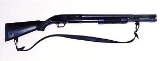
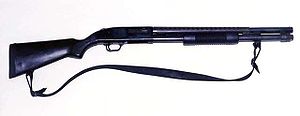
Riot shotgun

Encyclopedia
Shotgun
A shotgun is a firearm that is usually designed to be fired from the shoulder, which uses the energy of a fixed shell to fire a number of small spherical pellets called shot, or a solid projectile called a slug...
designed or modified for use as a primarily defensive weapon, primarily by the use of a short barrel. The riot shotgun is used by military personnel for guard duty and was at one time used for riot control, and is commonly used as a patrol weapon by law enforcement personnel, as well as a home defense weapon by private citizens. Guns of this type are often labeled as tactical shotguns or special-purpose shotguns to denote the larger scope of their use, however these are largely marketing terms.
Characteristics
The primary characteristic of a riot shotgun is a "short" barrel (generally 14 to 20" long) which makes the shotgun more compact and easier to handle, easier to stow inside a police vehicle, and more suitable for quick aiming at (close) stationary targets. Generally they have an open (cylinder-bore) choke, to permit the shot to spread quickly and to allow use with other types of projectiles, and they may be equipped with bead, rifle, or ghost-ring sights. Riot guns are most often pump-actionPump-action
A pump-action rifle or shotgun is one in which the handgrip can be pumped back and forth in order to eject a spent round of ammunition and to chamber a fresh one. It is much faster than a bolt-action and somewhat faster than a lever-action, as it does not require the trigger hand to be removed from...
due to this design's lower cost and higher reliability, although in recent years a number of semi-automatic shotgun
Semi-automatic shotgun
A semi-automatic shotgun is a form of shotgun that is able to fire a cartridge after every trigger squeeze, without any manual chambering of another round being required...
s designed primarily for defensive use have become available and are used by military, law enforcement and civilians alike.
Most riot guns are chambered in 12-gauge and can handle either 2.75" "standard-length" or 3" "magnum" cartridges. Most non-shotshell loads, such as less lethal ammunition like bean bags, are made only in 12-gauge. However, 20-gauge and .410 shotguns in riot gun configuration are available. Smaller bores are popular for home defense, as the reduced power and recoil make them more suitable for less experienced shooters who are recoil-sensitive.
While most hunting shotguns hold between 2 to 5 shells (often 3 shells, to comply with U.S. regulations for migratory bird hunting), riot shotguns can have a magazine tube as long as the barrel, allowing for 6 to 10 shells to be loaded depending on the model, barrel length, and type of shells loaded.
Configurations of grips and stocks for riot shotguns vary widely, but often feature reinforced plastic "furniture" instead of the wood common on hunting firearms. Wood was used for riot gun stocks in the past, and sometimes still is. As compared to hunting shotguns, riot guns more often feature pistol grips, with or without a shoulder stock. Without a shoulder stock (or with a folding stock), a riot shotgun becomes more compact and thus is able to be brought to bear more rapidly in very close quarters. With the stock, the pistol grip facilitates control of the weapon and provides a more ergonomic grip when the shotgun is fired from the shoulder. Foregrips, or forends, also vary, often with the inclusion of a pistol-grip fore-end (further increasing control and absorbing recoil), and/or the addition of an accessory rail or other mounting point for a tactical light.
The multiple projectile ability of a shotgun greatly increases the probability of a hit on an assailant, and the multiple projectiles increase the likelihood of a disabling hit. Though many sizes and configurations of shotshell are used by police, among the most common is the 12-gauge 2-inch (70 mm) 00 ("double-ought") buckshot shell
Shotgun shell
A shotgun shell is a self-contained cartridge loaded with lead shot or shotgun slug designed to be fired from a shotgun....
, which consists of 8 or 9 .33 caliber (8.5 mm) round lead balls, each of which is similar in size and velocity to a 9mm/.38 caliber handgun bullet. This shot spreads out to a greater or lesser degree depending on the barrel choke, and can be effective at ranges as far as 75 yards (70 m). Also popular is the #4 buckshot load, which sacrifices individual pellet size (each pellet is about .24 caliber) for greater numbers (usually 21 pellets per shell) and is very effective at most indoor ranges (<50 feet), where the shot has less distance in which to scatter and thus hits the target in a relatively localized pattern. The delivery of the large number of projectiles simultaneously makes the shotgun the most effective short range weapon commonly used, with a hit probability 45% greater than a submachine gun
Submachine gun
A submachine gun is an automatic carbine, designed to fire pistol cartridges. It combines the automatic fire of a machine gun with the cartridge of a pistol. The submachine gun was invented during World War I , but the apex of its use was during World War II when millions of the weapon type were...
, and twice as great as an assault rifle
Assault rifle
An assault rifle is a selective fire rifle that uses an intermediate cartridge and a detachable magazine. Assault rifles are the standard infantry weapons in most modern armies...
. The ability to use shotgun slug
Shotgun slug
A shotgun slug is a heavy lead projectile, that may have pre-cut rifling, intended for use in a shotgun and often used for hunting large game. The first effective shotgun slug was introduced by Wilhelm Brenneke in 1898, and his design remains in use today...
s extends the range and penetration capability of the shotgun. Police officers in the US commonly secure a shotgun in their vehicles, for use when armed resistance is expected or at any time greater firepower than the officer's sidearm is needed.
Riot vs. combat shotguns
The division between the riot shotgun and the combat shotgun is blurry, and may be more a matter of application than design. A combat shotgun would be used in military combat situations as a primarily offensive weapon, where a riot shotgun would be used in law enforcement or civilian situations as a primarily defensive weapon. Common additions to a combat shotgun would be provision for attaching a bayonetBayonet
A bayonet is a knife, dagger, sword, or spike-shaped weapon designed to fit in, on, over or underneath the muzzle of a rifle, musket or similar weapon, effectively turning the gun into a spear...
, and the addition of a ventilated heat shield over the barrel (though this heat shield is a common addition to riot shotguns as well) designed to prevent the operator's fingers from being burned by a barrel heated by multiple shots, and thus to allow the operator to secure a full grip on the weapon while using the attached bayonet
Bayonet
A bayonet is a knife, dagger, sword, or spike-shaped weapon designed to fit in, on, over or underneath the muzzle of a rifle, musket or similar weapon, effectively turning the gun into a spear...
, even when the barrel was far too hot to touch. This feature can be seen on many military long-arms, including the 1903 Springfield, the SMLE, M1 Garand, and Mauser rifles, to name some of the more obvious types (otherwise, there is little reason to enshroud the barrel and hinder the cooling airflow). The U.S. Army specifications for shotguns require a metal trigger guard for durability, which reduces the number of "special purpose" models used by police that would also be suitable for the military (the Mossberg 590A1 and Benelli M1014 are the standard-issue pump and semi-auto shotguns currently in service).
Riot shotguns are also more limited in range than combat shotguns by the nature of their use. A combat shotgun is considered effective out to 75 yards (70 m) because on average at least 1 pellet of a 9 pellet 00 buckshot load will hit a human sized target at that range. This is enough to degrade the combat effectiveness of an enemy soldier, but it is not enough to reliably disable an assailant in a defensive situation. For that, there must be multiple hits to the target, enough that one or more pellets will hit a vital region. Generally this is well under 40 yards (37 m) with a cylinder bore barrel. Beyond this range, slugs and good iron sight
Iron sight
Iron sights are a system of shaped alignment markers used as a sighting device to assist in the aiming of a device such as a firearm, crossbow, or telescope, and exclude the use of optics as in telescopic sights or reflector sights...
s are recommended, extending the range to over 100 meters.
Less lethal alternatives
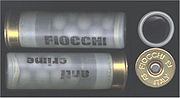
Flexible baton round
A bean bag round, also known by its trademarked name flexible baton round, is a baton round fired as a shotgun shell used for less lethal apprehension of suspects.-Description:...
s, rubber bullets and other impact munitions, to tear gas and, released in October 2009, a 12 gauge electroshock weapon from TASER International
TASER International
Taser International, Inc. is a developer, manufacturer, and distributor of the Taser less-lethal electroshock guns in the United States. It is based at Scottsdale, Arizona, United States. Taser is the most common brand of electroshock gun.-History:...
. Using the shotgun as the delivery system allows the officers to quickly choose a lethal or a less lethal weapon, so responding officers can adapt to changing situations; An officer in a standoff can quickly eject a chambered buckshot cartridge and replace it with a less-lethal cartridge such as a bean bag, and is not required to unload the magazine as with most rifles or handguns. Alternatively, one officer can be equipped with less lethal munitions, while others, equipped with buckshot, can provide a backup in case the less lethal rounds fail to stop the target.
Entry and breaching shotguns
The entry shotgun or breaching shotgun is a role that can be filled by a standard riot shotgun, or one further modified for these purposes. They may have an extremely short barrel (14" or less) and often only a pistol grip rather than a buttstock, or a folding or collapsing buttstock if it is provided with one. In addition, the barrel often has a muzzle brakeMuzzle brake
Muzzle brakes and recoil compensators are devices that are fitted to the muzzle of a firearm or cannon to redirect propellant gases with the effect of countering both recoil of the gun and unwanted rising of the barrel during rapid fire...
, used to disperse hot gases that might otherwise be deflected toward the shooter. This type of shotgun is designed to fire special breaching round
Breaching round
A breaching round or slug-shot is a shotgun shell specially made for the purposes of door breaching. It is typically fired at a range of 6 inches or less, aimed at the hinges or the area between the doorknob and lock and door jamb, and is designed to destroy the object it hits and then disperse...
s which are designed to disable or destroy door latches while limiting overpenetration of the projectiles used beyond the door. Since these shotguns would in most areas be classified as short barreled shotguns, they are highly restricted under gun control
Gun control
Gun control is any law, policy, practice, or proposal designed to restrict or limit the possession, production, importation, shipment, sale, and/or use of guns or other firearms by private citizens...
laws such as the National Firearms Act
National Firearms Act
The National Firearms Act , 73rd Congress, Sess. 2, ch. 757, , enacted on June 26, 1934, currently codified as amended as , is an Act of Congress that, in general, imposes a statutory excise tax on the manufacture and transfer of certain firearms and mandates the registration of those firearms. The...
and generally only used by police and military.
See also
- Riot gunRiot gunA riot gun or less-lethal launcher is a type of firearm that is used to fire "non-lethal" ammunition for the purpose of suppressing riots. Less-lethal launchers may be special purpose firearms designed for riot control use, or standard firearms, usually shotguns and grenade launchers, adapted to...
- MusketoonMusketoonThe musketoon is a shorter barrelled version of the musket, and served in the roles of a shotgun or carbine. Musketoons could be of the same caliber as the issue musket, or of a much larger caliber, 1.0-2.5 inches . The musketoon is most commonly associated with naval use, and pirates in...
- BlunderbussBlunderbussThe blunderbuss is a muzzle-loading firearm with a short, large caliber barrel, which is flared at the muzzle and frequently throughout the entire bore, and used with shot and other projectiles of relevant quantity and/or caliber. The blunderbuss could be considered to be an early form of shotgun,...
- Sawed-off shotgunSawed-off shotgunA sawed-off shotgun also called a sawn-off shotgun and a short-barreled shotgun , is a type of shotgun with a shorter gun barrel and often a shorter or absent stock....
- Combat shotgunCombat shotgunA combat shotgun is a shotgun that is intended for use in an offensive role, typically by a military force. The earliest shotguns specifically designed for combat were the trench guns or trench shotguns issued in World War I...