
All Topics  
Renormalization group


   Email Print
   Bookmark   Link


Renormalization group


In theoretical physics
Theoretical physics

Theoretical physics employs mathematical models and abstractions of physics in an attempt to explain experimental data taken of the natural world....
, renormalization group (RG) refers to a mathematical apparatus that allows one to investigate the changes of a physical system as one views it at different distance scales. In particle physics it reflects the changes in the underlying force laws as one varies the energy scale at which physical processes occur. A change in scale is called a "scale transformation" or "conformal transformation." The renormalization group is intimately related to "conformal invariance" or "scale invariance," a symmetry by which the system appears the same at all scales (so-called self-similarity
Self-similarity

In mathematics, a self-similar object is exactly or approximately similarity to a part of itself . Many objects in the real world, such as coastlines, are statistically self-similar: parts of them show the same statistical properties at many scales....
).

As one varies the scale, it is as if one is changing the magnifying power of a microscope viewing the system.


Discussion
Ask a question about 'Renormalization group'
Start a new discussion about 'Renormalization group'
Answer questions from other users
Full Discussion Forum


Encyclopedia


In theoretical physics
Theoretical physics

Theoretical physics employs mathematical models and abstractions of physics in an attempt to explain experimental data taken of the natural world....
, renormalization group (RG) refers to a mathematical apparatus that allows one to investigate the changes of a physical system as one views it at different distance scales. In particle physics it reflects the changes in the underlying force laws as one varies the energy scale at which physical processes occur. A change in scale is called a "scale transformation" or "conformal transformation." The renormalization group is intimately related to "conformal invariance" or "scale invariance," a symmetry by which the system appears the same at all scales (so-called self-similarity
Self-similarity

In mathematics, a self-similar object is exactly or approximately similarity to a part of itself . Many objects in the real world, such as coastlines, are statistically self-similar: parts of them show the same statistical properties at many scales....
).

As one varies the scale, it is as if one is changing the magnifying power of a microscope viewing the system. The system will generally make a self-similar copy of itself, with slightly different parameters describing the components of the system. The components, or fundamental variables, may be atoms, fundamental particles, atomic spins, etc. The parameters of the theory typically describe the interactions of the components. These may be "coupling constants" that measure the strength of various forces, or mass parameters themselves. The components themselves may appear to be composed of more of the self-same components as one goes to shorter distances.

For example, an electron appears to be composed of electrons, anti-electrons and photons as one views it at very short distances. The electron at very short distances has a slightly different electric charge than does the "dressed electron" seen at large distances, and this change, or "running," in the value of the electric charge is determined by the renormalization group equation.

History of the renormalization group

The idea of scale transformations and scale invariance is old and venerable in physics. Scaling arguments were commonplace for the Pythagorean school
Pythagoreanism

Pythagoreanism is a term used for the esoteric and metaphysics beliefs held by Pythagoras and his followers, the Pythagoreans, who were much influenced by mathematics and probably a very inspirational source for Plato and Platonism....
, Euclid
Euclid

Euclid , floruit 300 BC, also known as Euclid of Alexandria, was a Greek mathematics and is often referred to as the Father of Geometry. He was active in Alexandria during the reign of Ptolemy I ....
 and up to Galileo. They became popular again at the end of the 19th century, perhaps the first example being the idea of enhanced viscosity
Viscosity

Viscosity is a measure of the Drag of a fluid which is being deformed by either shear stress or extensional stress. In everyday terms , viscosity is "thickness"....
 of Osborne Reynolds
Osborne Reynolds

Osborne Reynolds was a prominent innovator in the understanding of fluid dynamics. Separately, his studies of heat transfer between solids and fluids brought improvements in boiler and condenser design....
, as a way to explain turbulence.

The renormalization group was initially devised within particle physics, but nowadays its applications are extended to solid-state physics
Solid-state physics

Solid-state physics, the largest branch of condensed matter physics, is the study of rigid matter, or solids, through methods such as quantum mechanics, crystallography, electromagnetism and metallurgy....
, fluid mechanics
Fluid mechanics

Fluid mechanics is the study of how fluids move and the forces on them. Fluid mechanics can be divided into fluid statics, the study of fluids at rest, and fluid dynamics, the study of fluids in motion....
, cosmology
Cosmology

Cosmology is study of the Universe in its totality, and by extension, humanity's place in it. Though the word cosmology is recent , study of the Universe has a long history involving science, philosophy, esotericism, and religion....
 and even nanotechnology
Nanotechnology

Nanotechnology, shortened to "Nanotech", is the study of the control of matter on an atomic and molecular scale. Generally nanotechnology deals with structures of the size 100 nanometers or smaller, and involves developing materials or devices within that size....
. An early article by Ernst Stueckelberg
Ernst Stueckelberg

Ernst Carl Gerlach Stueckelberg was a Swiss mathematician and physicist.In 1926 Stueckelberg got his Ph. D. at Munich under Arnold Sommerfeld....
 and Andre Peterman in 1953 anticipates the idea in quantum field theory
Quantum field theory

Quantum field theory or QFT provides a theoretical framework for constructing quantum mechanics models of systems classically described by field or of Many-body problem....
.

Stueckelberg and Peterman opened the field. They noted that renormalization
Renormalization

In quantum field theory, the statistical mechanics of fields, and the theory of self-similarity geometric structures, renormalization refers to a collection of techniques used to take a continuum limit....
 comes with a group of transformations which transfer quantities from the bare terms to the counterterms. Murray Gell-Mann
Murray Gell-Mann

Murray Gell-Mann is an United States physicist who received the 1969 Nobel Prize in physics for his work on the theory of particle physicss.Among his many accomplishments, he formulated the quark model of hadronic resonances, and identified the SU flavor symmetry of the light quarks, extending isospin to include strange quark, which he als...
 and F.E. Low in 1954 restricted it to scaling transformations, which are the most interesting. They proposed the existence of a mathematical function of the coupling parameter of a theory, . This function determines the differential change of the coupling constant with a small change in energy scale by the "renormalization group equation:"

We indicate the more modern form, involving the function introduced by Callan and Symanzik in the early 1970s. Early applications to quantum electrodynamics
Quantum electrodynamics

Quantum electrodynamics is a relativity theory quantum field theory of electrodynamics. QED was developed by a number of physicists, beginning in the late 1920s....
are discussed in the influential book of Nikolay Bogolyubov
Nikolay Bogolyubov

Nikolay Nikolaevich Bogoliubov was a Russians and Ukraine mathematician and theoretical physics known for a significant contribution to quantum field theory, statistical mechanics, and dynamical systems; a recipient of the Dirac Prize ....
 and Dmitry Shirkov
Dmitry Shirkov

Dmitry Vasil'evich Shirkov is a Russians theoretical physics known for his contribution to quantum field theory and to the development of the renormalization group method....
 in 1959.

The renormalization group emerges from the renormalization of the field variables, which often has to deal with the problem of infinities in a quantum field theory (the RG exists independently of the infinities). This problem of dealing with the infinities of quantum field theory was solved for quantum electrodynamics
Quantum electrodynamics

Quantum electrodynamics is a relativity theory quantum field theory of electrodynamics. QED was developed by a number of physicists, beginning in the late 1920s....
 by Richard Feynman
Richard Feynman

Richard Phillips Feynman was an United States physicist known for the path integral formulation of quantum mechanics, the theory of quantum electrodynamics and the physics of the superfluidity of supercooled liquid helium, as well as work in particle physics ....
, Julian Schwinger
Julian Schwinger

Julian Seymour Schwinger was an United States theoretical physicist. He is best known for his work on the theory of quantum electrodynamics, in particular for developing a relativistically invariant perturbation theory, and for renormalizing QED to one loop order....
 and Sin-Itiro Tomonaga
Sin-Itiro Tomonaga

Sin-Itiro Tomonaga or Shin'ichiro Tomonaga was a Japanese physicist, influential in the development of quantum electrodynamics, work for which he was jointly awarded the Nobel Prize in Physics in 1965 along with Richard Feynman and Julian Schwinger....
, who received the Nobel prize for their contributions. They effectively devised the theory of mass and charge renormalization in which the infinity is cut-off by an implicit ultra-large mass scale, . The dependence of physical quantities, such as the electric charge or electron mass, on is hidden, effectively swapped for the scales at which the physical quantities are measured.

Gell-Mann and Low realized that the effective scale can be arbitrarily defined as , and can vary to define the theory at any other scale. The main point of the RG is that, as we vary the scale , the theory makes a self-similar replica of itself, with the tiny change in given by the RG equation and . The self-similarity stems from the fact that depends only upon the parameter(s) of the theory, not upon the scale .

A deeper understanding of the physical meaning of the renormalization group came from condensed matter physics. Leo P. Kadanoff's paper in 1966 proposed the "block-spin" renormalization group. The blocking idea is a way to define the components of the theory at large distances as aggregates of components at shorter distances. This approach covered already the essential point and can be made exact, as one discovered through the many important contributions of Kenneth Wilson
Kenneth G. Wilson

Kenneth Geddes Wilson is an United States theoretical physicist.As an undergraduate at Harvard University, he was a William Lowell Putnam Mathematical Competition....
. The power of Wilson's ideas was demonstrated by a constructive and successive renormalization solution of a long-standing problem, the Kondo problem
Kondo effect

In physics, according to the Kondo effect, the electrical resistance will diverge as the temperature approaches 0 K. The temperature dependence of the resistance including the Kondo effect is written as:...
, in 1974 and the preceding seminal developments of his new method in the theory of second-order phase transitions and critical phenomena
Critical phenomena

In physics, critical phenomena is the collective name associated with thephysics of critical point s. Most of them stem from the divergence of the...
 in 1971. He was awarded the Nobel prize for this contribution in 1982.

The RG in particle physics was reformulated in 1970 in more physical terms by C. G. Callan and K. Symanzik. The function, which describes the "running of coupling constant" with scale, is also found to be the "canonical trace anomaly" which represents the quantum mechanical breaking of scale symmetry of a field theory. Remarkably, quantum mechanics itself can induce mass through the trace anomaly and the running coupling constant. Applications of the RG to particle physics exploded in the 1970s with the canonization of the Standard Model.

In 1973 it was discovered that a theory of interacting colored quarks, called quantum chromodynamics
Quantum chromodynamics

Quantum chromodynamics is a theory of the strong interaction , a fundamental force describing the interactions of the quarks and gluons making up hadrons ....
 had a negative function. This means that an initial high energy scale value of the coupling will produce a special value of at which the coupling blows up (diverges). This special value is the scale of the strong interactions, and occurs at about 150 MeV. Conversely, the coupling becomes weak at very high energies, and the quarks become observable as point-like particles, as anticipated by Bjorken scaling.

Momentum space RG also became a highly developed tool in solid state physics, but its success was hindered by the extensive use of perturbation theory, which prevented the theory from reaching success in strongly correlated systems. In order to study these strongly correlated systems, variational approaches are a better alternative. During the 1980s some real-space RG techniques were developed in this sense, the most successful being the density-matrix RG (DMRG), developed by S. R. White and R. M. Noack in 1992.

The conformal symmetry is associated with the vanishing of the function. This can occur naturally if a coupling constant is attracted, by running, toward a fixed point
Fixed point

"Fixed point" has many meanings in science, most of them mathematical.*Fixed point *Fixed point combinator*Fixed-point arithmetic, a manner of doing arithmetic on computers...
 at which . In QCD the fixed point occurs at short distances where and is called a (trivial) ultraviolet fixed point. For heavy quarks, such as the Top quark
Top quark

The top quark is the third-generation up-type quark with a charge of +elementary charge. It was discovered in 1995 by the Collider Detector at Fermilab and D0 experiment experiments at Fermilab, and is the most massive of known elementary particles....
, it is found that the coupling to the mass-giving Higgs boson runs toward a fixed non-zero (non-trivial) infrared fixed point
Infrared fixed point

In physics, an infrared fixed point is a set ofcoupling constants, or other parameters that evolve frominitial values at very high energies , to fixed stable values,...
.

In string theory
String theory

String theory is a developing branch of theoretical physics that combines quantum mechanics and general relativity into a quantum gravity. The String s of string theory are one-dimensional oscillating lines, but they are no longer considered fundamental to the theory, which can be formulated in terms of points or surfaces too....
 one requires conformal invariance of the string world-sheet as a fundamental symmetry: is a requirement. Here is a function of the geometry of the space-time in which the string moves. This determines the space-time dimensionality of the string theory and enforces Einstein's equations of general relativity
General relativity

General relativity or the general theory of relativity is the Geometry Theoretical physics of gravitation published by Albert Einstein in 1916....
on the geometry.

The RG is of fundamental importance to string theory and theories of grand unification. It is the modern key idea underlying critical phenomena
Critical phenomena

In physics, critical phenomena is the collective name associated with thephysics of critical point s. Most of them stem from the divergence of the...
 in condensed matter physics. Indeed, the RG has become one of the most important tools of modern physics.

Block spin renormalization group


This section introduces pedagogically a picture of RG which may be easiest to grasp: the block spin RG. It was devised by Leo P. Kadanoff in 1966.

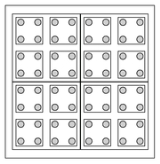
Let us consider a 2D solid, a set of atoms in a perfect square array, as depicted in the figure. Let us assume that atoms interact among themselves only with their nearest neighbours, and that the system is at a given temperature . The strength of their interaction is measured by a certain coupling constant
Coupling constant

In physics, a coupling constant, usually denoted g, is a number that determines the strength of an interaction. Usually the Lagrangian or the Hamiltonian mechanics of a system can be separated into a kinetic part and an interaction part....
 . The physics of the system will be described by a certain formula, say .

Rgkadanoff
Now we proceed to divide the solid into blocks of squares; we attempt to describe the system in terms of block variables, i.e.: some magnitudes which describe the average behaviour of the block. Also, let us assume that, due to a lucky coincidence, the physics of block variables is described by a formula of the same kind, but with different values for and : . (This isn't exactly true, of course, but it is often approximately true in practice, and that is good enough, to a first approximation)

Perhaps the initial problem was too hard to solve, since there were too many atoms. Now, in the renormalized problem we have only one fourth of them. But why should we stop now? Another iteration of the same kind leads to , and only one sixteenth of the atoms. We are increasing the observation scale with each RG step.

Of course, the best idea is to iterate until there is only one very big block. Since the number of atoms in any real sample of material is very large, this is more or less equivalent to finding the long term behaviour of the RG transformation which took and . Usually, when iterated many times, this RG transformation leads to a certain number of fixed points.

Let us be more concrete and consider a magnetic system (e.g.: the Ising model
Ising model

The Ising model, named after the physicist Ernst Ising, is a mathematical models in physics in statistical mechanics. It has since been used to model diverse phenomena in which bits of information, interacting in pairs, produce collective...
), in which the J coupling constant denotes the trend of neighbour spin
Spin (physics)

In quantum mechanics, spin is a fundamental property of atomic nucleus, hadrons, and elementary particles. For particles with non-zero spin, spin direction is an important intrinsic degrees of freedom ....
s to be parallel. Physics is dominated by the tradeoff between the ordering J term and the disordering effect of temperature. For many models of this kind there are three fixed points:

(a) and . This means that, at the largest size, temperature becomes unimportant, i.e.: the disordering factor vanishes. Thus, in large scales, the system appears to be ordered. We are in a ferromagnetic phase.

(b) and . Exactly the opposite, temperature has its victory, and the system is disordered at large scales.

(c) A nontrivial point between them, and . In this point, changing the scale does not change the physics, because the system is in a fractal
Fractal

A fractal is generally "a rough or fragmented Shape that can be split into parts, each of which is a reduced-size copy of the whole," a property called self-similarity....
 state. It corresponds to the Curie
Curie point

The Curie point , or Curie temperature, is a term in physics and materials science, named after Pierre Curie , and refers to a characteristic property of a ferromagnetic or piezoelectric material....
 phase transition
Phase transition

In thermodynamics, a phase transition is the transformation of a thermodynamic system from one phase to another.At phase-transition point, physical properties may undergo abrupt change- for instance, volume of the two phases may be vastly different....
, and is also called a critical point
Critical point

Critical point may refer to:*Critical point *Critical point *Critical point See also*Brillouin zone*Percolation thresholds...
.

So, if we are given a certain material with given values of T and J, all we have to do in order to find out the large scale behaviour of the system is to iterate the pair until we find the corresponding fixed point.

Elements of RG theory


In more technical terms, let us assume that we have a theory described by a certain function of the state variables and a certain set of coupling constants . This function may be a partition function
Partition function

Partition function may refer to:*Partition function *Partition function , which generalizes its use in statistical mechanics and quantum field theory:...
, an action
Action (physics)

In modern physics, action is an attribute of the development of a physical system over a period of time, namely amount by which the Phase of the wave function has changed....
, a hamiltonian
Hamiltonian

Hamiltonian may refer toIn mathematics:* Hamiltonian system* Hamiltonian path, in graph theory* Hamiltonian group, in group theory* Hamiltonian ...
, etc. It must contain the whole description of the physics of the system.

Now we consider a certain blocking transformation of the state variables , the number of must be lower than the number of . Now let us try to rewrite the function only in terms of the . If this is achievable by a certain change in the parameters, , then the theory is said to be renormalizable.

For some reason, most fundamental theories of physics such as quantum electrodynamics
Quantum electrodynamics

Quantum electrodynamics is a relativity theory quantum field theory of electrodynamics. QED was developed by a number of physicists, beginning in the late 1920s....
, quantum chromodynamics
Quantum chromodynamics

Quantum chromodynamics is a theory of the strong interaction , a fundamental force describing the interactions of the quarks and gluons making up hadrons ....
 and electro-weak interaction, but not gravity, are exactly renormalizable. Also, most theories in condensed matter physics are approximately renormalizable, from superconductivity
Superconductivity

Superconductivity is a phenomenon occurring in certain materials generally at very low temperatures, characterized by exactly zero electrical resistance and the exclusion of the interior magnetic field ....
 to fluid turbulence.

The change in the parameters is implemented by a certain -function: , which is said to induce a renormalization flow (or RG flow) on the -space. The values of under the flow are called running coupling constants.

As it was stated in the previous section, the most important information in the RG flow are its fixed points. The possible macroscopic states of the system, at a large scale, are given by this set of fixed points.

Since the RG transformations are lossy (i.e.: the number of variables decreases - see as an example in a different context, Lossy data compression
Lossy data compression

A lossy compression method is one where data compression and then decompressing it retrieves data that may well be different from the original, but is close enough to be useful in some way....
), there need not be an inverse for a given RG transformation. Thus, the renormalization group is, in practice, a semigroup
Semigroup

In mathematics, a semigroup is an algebraic structure consisting of a nonempty Set S together with an associative binary operation. In other words, a semigroup is an associative Magma ....
.

Relevant and irrelevant operators, universality classes


Let us consider a certain observable of a physical system undergoing an RG transformation. The magnitude of the observable as the scale of the system goes from small to large may be (a) always increasing, (b) always decreasing or (c) other. In the first case, the observable is said to be a relevant observable; in the second, irrelevant and in the third, marginal.

A relevant operator is needed to describe the macroscopic behaviour of the system, but not an irrelevant observable. Marginal observables always give trouble when deciding whether to take them into account or not. A remarkable fact is that most observables are irrelevant, i.e.: the macroscopic physics is dominated by only a few observables in most systems. In other terms: microscopic physics contains (Avogadro's number) variables, and macroscopic physics only a few.

Before the RG, there was an astonishing empirical fact to explain: the coincidence of the critical exponents (i.e.: the behaviour near a second order phase transition) in very different phenomena, such as magnetic systems, superfluid transition (Lambda transition
Lambda transition

The ? universality class is probably the most important group in condensed matter physics. It regroups several systems possessing strong analogies, namely, superfluids, superconductors and smectics ....
), alloy physics... This was called universality
Universality (dynamical systems)

In statistical mechanics, universality is the observation that there are properties for a large class of systems that are independent of the mechanics details of the system....
 and is successfully explained by RG, just showing that the differences between all those phenomena are related to irrelevant observables.

Thus, many macroscopic phenomena may be grouped into a small set of universality classes, described by the set of relevant observables.

See also dangerously irrelevant
Dangerously irrelevant

In statistical mechanics and quantum field theory, a dangerously irrelevant operator is an operator which is irrelevant, but yet affects the infrared physics significantly because the vacuum expectation value of some field depends sensitively upon the dangerously irrelevant operator....


Momentum space RG


RG, in practice, comes in two main flavours. The Kadanoff picture explained above refers mainly to the so-called real-space RG. Momentum-space RG on the other hand, has a longer history despite its relative subtlety. It can be used for systems where the degrees of freedom can be cast in terms of the Fourier modes of a given field. The RG transformation proceeds by integrating out a certain set of high momentum (high spatial frequency) modes. Since high spatial frequency is related to short length scales, the momentum-space RG results in an essentially similar coarse-graining effect as with real-space RG.

Momentum-space RG is usually performed on a perturbation
Perturbation theory

Perturbation theory comprises mathematical methods that are used to find an approximate solution to a problem which cannot be solved exactly, by starting from the exact solution of a related problem....
 expansion (i.e., approximation). The validity of such an expansion is predicated upon the true physics of our system being close to that of a free field
Free field

Classically, a free field has equations of motion given by linear partial differential equations. Such linear PDE's have a unique solution for a given initial condition....
 system. In this case, we may calculate observables by summing the leading terms in the expansion. This approach has proved very successful for many theories, including most of particle physics, but fails for systems whose physics is very far from any free system, i.e., systems with strong correlations.

As an example of the physical meaning of RG in particle physics we will give a short description of charge renormalization in quantum electrodynamics (QED). Let us suppose we have a point positive charge of a certain true (or bare) magnitude. The electromagnetic field around it has a certain energy, and thus may produce some pairs of (e.g.) electrons-positrons, which will be annihilated very quickly. But in their short life, the electron will be attracted by the charge, and the positron will be repelled. Since this happens continuously, these pairs are effectively screening the charge from abroad. Therefore, the measured strength of the charge will depend on how close to our probes it may enter. We have a dependence of a certain coupling constant (the electric charge) with distance.

Energy, momentum and length scales are related, according to Heisenberg's uncertainty principle. The higher the energy or momentum scale we may reach, the lower the length scale we may probe. Therefore, the momentum-space RG practitioners sometimes claim to integrate out high momenta or high energy from their theories.

Appendix: Exact Renormalization Group Equations


An exact renormalization group equation (ERGE) is one that takes irrelevant couplings into account. There are several formulations.

The Wilson ERGE is the simplest conceptually, but is practically impossible to implement. Fourier transform
Fourier transform

In mathematics, Fourier analysis is a subject area which grew out of the study of Fourier series. The subject began with trying to understand when it was possible to represent general functions by sums of simpler trigonometric functions....
 into momentum space
Momentum space

The Momentum space associated with a particle is a vector space in which every point corresponds to a possible value of the momentum vector . Representing a problem in terms of the momenta of the particles involved, rather than in terms of their positions, can greatly simplify some problems in physics....
 after Wick rotating
Wick rotation

In physics, Wick rotation, named after Gian-Carlo Wick, is a method of finding a solution to a problem in Minkowski space from a solution to a related problem in Euclidean space, by analytic continuation....
 into Euclidean space
Euclidean space

Around 300 Before Christ, the Ancient Greece mathematician Euclid undertook a study of relationships among distances and angles, first in a plane and then in space....
. Insist upon a hard momentum cutoff, so that the only degrees of freedom are those with momenta less than ?. The partition function
Partition function

Partition function may refer to:*Partition function *Partition function , which generalizes its use in statistical mechanics and quantum field theory:...
 is

For any positive ?′ less than ?, define S?′ (a functional over field configurations f whose Fourier transform has momentum support within ) as

Obviously,

In fact, this transformation is transitive. If you compute S?′ from S? and then compute S?″ from S?′, this gives you the same Wilsonian action as computing S?″ directly from S?.

The Polchinski ERGE involves a smooth
Smooth

Smooth could mean many things, including:* Draught beer served with nitrogen.* Smooth * Smooth function, a function that is infinitely differentiable, used in calculus and topology....
 UV regulator
Regularization (physics)

In physics, especially quantum field theory, regularization is a method of dealing with infinite, divergent, and non-sensical expressions by introducing an auxiliary concept of a regulator ....
 cutoff
Cutoff

In theoretical physics, cutoff is the maximal or minimal value of energy, momentum, or length, so that the objects with even larger or smaller values than these physical quantity are ignored....
. Basically, the idea is an improvement over the Wilson ERGE. Instead of a sharp momentum cutoff, it uses a smooth cutoff. Essentially, we suppress contributions from momenta greater than ? heavily. The smoothness of the cutoff, however, allows us to derive a functional differential equation
Differential equation

A differential equation is a mathematics equation for an unknown function of one or several variable that relates the values of the function itself and its derivatives of various orders....
 in the cutoff scale ?. As in Wilson's approach, we have a different action functional for each cutoff energy scale ?. Each of these actions are supposed to describe exactly the same model which means that their partition functionals have to match exactly.

In other words, (for a real scalar field; generalizations to other fields are obvious)

and Z? is really independent of ?! We have used the condensed deWitt notation
DeWitt notation

Physics often deals with classical models where the dynamical variables are a collection of functionsa over a d-dimensional space/spacetime manifold M where a is the "flavor" index....
 here. We have also split the bare action S? into a quadratic kinetic part and an interacting part Sint ?. This split most certainly isn't clean. The "interacting" part can very well also contain quadratic kinetic terms. In fact, if there is any wave function renormalization
Wave function renormalization

In quantum field theory, wave function renormalization is a rescaling, or renormalization, of quantum fields to take into account the effects of interactions....
, it most certainly will. This can be somewhat reduced by introducing field rescalings. R? is a function of the momentum p and the second term in the exponent is

when expanded. When , R?(p)/p^2 is essentially 1. When , R?(p)/p^2 becomes very very huge and approaches infinity. R?(p)/p^2 is always greater than or equal to 1 and is smooth
Smooth

Smooth could mean many things, including:* Draught beer served with nitrogen.* Smooth * Smooth function, a function that is infinitely differentiable, used in calculus and topology....
. Basically, what this does is to leave the fluctuations with momenta less than the cutoff ? unaffected but heavily suppresses contributions from fluctuations with momenta greater than the cutoff. This is obviously a huge improvement over Wilson.

The condition that

can be satisfied by (but not only by)

Jacques Distler
Jacques Distler

Jacques Distler is a physicist currently working in string theory. He has been a professor of physics at the University of Texas at Austin since 1994....
 claimed without proof that this ERGE isn't correct nonperturbatively.

The Effective average action ERGE This involves a smooth
Smooth

Smooth could mean many things, including:* Draught beer served with nitrogen.* Smooth * Smooth function, a function that is infinitely differentiable, used in calculus and topology....
 IR regulator cutoff. The idea is to take all fluctuations right up to a IR scale k into account and then applying mean field theory
Mean field theory

A many-body system with interactions is generally very difficult to solve exactly, except for extremely simple cases . Basically, the n-body system is replaced by a 1-body problem with a chosen good external field....
 to all other fluctuations below that scale. As is well known from the study of critical phenomena
Critical phenomena

In physics, critical phenomena is the collective name associated with thephysics of critical point s. Most of them stem from the divergence of the...
, mean field theory can be completely way off. So, we'd expect that the effective average action will only be accurate for fluctuations with momenta larger than k. But the smaller k is, the more accurate the effective average action will be. By the same reasoning, the large k is, the closer the effective action will be to the "bare action". So, the effective average action interpolates between the "bare action" and the effective action
Effective action

In quantum field theory, the effective action is a modified expression for the action , which takes into account quantum-mechanical corrections, in the following sense:...
.

For a real scalar field
Scalar field

In mathematics and physics, a scalar field associates a scalar value, which can be either scalar in definition, or scalar , to every point in space....
, we add an IR cutoff

to the action
Action (physics)

In modern physics, action is an attribute of the development of a physical system over a period of time, namely amount by which the Phase of the wave function has changed....
 S where Rk is a function of both k and p such that for , Rk(p) is very tiny and approaches 0 and for , . Rk is both smooth
Smooth

Smooth could mean many things, including:* Draught beer served with nitrogen.* Smooth * Smooth function, a function that is infinitely differentiable, used in calculus and topology....
 and nonnegative. Its large value for small momenta leads to a suppression of their contribution to the partition function which is effectively the same thing as neglecting large scale fluctuations. We will use the condensed deWitt notation
DeWitt notation

Physics often deals with classical models where the dynamical variables are a collection of functionsa over a d-dimensional space/spacetime manifold M where a is the "flavor" index....


for this IR regulator.

So,

where J is the source field
Source field

In theoretical physics, a source field is a field whose multipleappears in the action, multiplied by the original field . Consequently, the source field appears on the right-hand side of the equations of motion for ....
. The Legendre transform of Wk ordinarily gives the effective action
Effective action

In quantum field theory, the effective action is a modified expression for the action , which takes into account quantum-mechanical corrections, in the following sense:...
. However, the action that we started off with is really S[f]+1/2 f·Rk·f and so, to get the effective average action, we subtract off 1/2 f·Rk·f. In other words,

can be inverted to give Jk[f] and we define the effective average action Gk as

Hence,


thus

is the ERGE.

As there are infinitely many choices of Rk, there are also infinitely many different interpolating ERGEs. Generalization to other fields like spinorial fields is straightforward.

Although the Polchinski ERGE and the effective average action ERGE look similar, they are based upon very different philosophies. In the effective average action ERGE, the bare action is left unchanged (and the UV cutoff scale -- if there is one -- is also left unchanged) but we neglect the IR contributions to the effective action whereas in the Polchinski ERGE, we fix the QFT once and for all but vary the "bare action" at different energy scales to reproduce the prespecified model. Polchinski's version is certainly much closer to Wilson's idea in spirit. Note that one uses "bare actions" whereas the other uses effective (average) actions.

See also


  • Renormalized perturbation theory is the main technique associated to momentum-space RG.
  • Density matrix renormalization group
    Density matrix renormalization group

    The density matrix renormalization group is a numerical variational technique devised to obtain the low energy physics of quantum many body systems with high accuracy....
     is the most successful variational real-space RG technique up to date.
  • Critical phenomena
    Critical phenomena

    In physics, critical phenomena is the collective name associated with thephysics of critical point s. Most of them stem from the divergence of the...
  • Scale invariance
    Scale invariance

    In physics and mathematics, scale invariance is a feature of objects or laws that do not change if length scales are multiplied by a common factor....


Historical papers


  • E.C.G. Stueckelberg, A. Peterman (1953): Helv. Phys. Acta, 26, 499.
  • Murray Gell-Mann
    Murray Gell-Mann

    Murray Gell-Mann is an United States physicist who received the 1969 Nobel Prize in physics for his work on the theory of particle physicss.Among his many accomplishments, he formulated the quark model of hadronic resonances, and identified the SU flavor symmetry of the light quarks, extending isospin to include strange quark, which he als...
    , F.E. Low (1954): Phys. Rev. 95, 5, 1300. The origin of renormalization group
  • N.N. Bogoliubov, D.V. Shirkov (1959): The theory of quantized fields, Interscience. The first text-book on RG.
  • L.P. Kadanoff (1966): "Scaling laws for Ising models near ", Physics (Long Island City, N.Y.) 2, 263. The new blocking picture.
  • C.G. Callan (1970): Phys. Rev. D 2, 1541. K. Symanzik (1970): Comm. Math. Phys. 18, 227. The new view on momentum-space RG.
  • K.G. Wilson (1975): The renormalization group: critical phenomena and the Kondo problem, Rev. Mod. Phys. 47, 4, 773. The main success of the new picture.
  • S.R. White (1992): Density matrix formulation for quantum renormalization groups, Phys. Rev. Lett. 69, 2863. The most successful variational RG method.


Didactical reviews


  • N. Goldenfeld (1993): Lectures on phase transitions and the renormalization group. Addison-Wesley.
  • D.V. Shirkov (1999): Evolution of the Bogoliubov Renormalization Group. . A mathematical introduction and historical overview with a stress on group theory and the application in high-energy physics.
  • B. Delamotte (2004): A hint of renormalization. . A pedestrian introduction to renormalization and the renormalization group. For non subscribers see
  • H.J. Maris, L.P. Kadanoff (1978): Teaching the renormalization group. . A pedestrian introduction to the renormalization group as applied in condensed matter physics.


Books

  • L.Ts.Adzhemyan, N.V.Antonov and A.N.Vasiliev; The Field Theoretic Renormalization Group in Fully Developed Turbulence; Gordon and Breach, 1999. [ISBN 90-5699-145-0] (.)
  • Zinn-Justin, Jean ; Quantum field theory and critical phenomena, Oxford, Clarendon Press (2002), ISBN 0-19-850923-5 (a very thorough presentation of both topics);
  • The same author: Renormalization and renormalization group: From the discovery of UV divergences to the concept of effective field theories, in: de Witt-Morette C., Zuber J.-B. (eds), Proceedings of the NATO ASI on Quantum Field Theory: Perspective and Prospective, June 15-26 1998, Les Houches, France, Kluwer Academic Publishers, NATO ASI Series C 530, 375-388 (1999) [ISBN ]. Full text available in .
  • Kleinert, H.
    Hagen Kleinert

    Hagen Kleinert is Professor of Theoretical Physics at the Free University of Berlin, Germany , Honorary Professor at the Kyrgyz-Russian Slavic University, and Honorary Member of the ....
     and Schulte Frohlinde, V; Critical Properties of f4-Theories, ; Paperback ISBN 981-02-4658-7. Full text available in .


External links