
| |
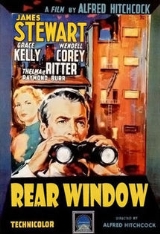
Rear Window is a suspense film directed by Alfred Hitchcock, and written by John Michael Hayes, based on Cornell Woolrich's short story It Had to Be Murder. It stars James Stewart, Grace Kelly, Wendell Corey and Thelma Ritter, and features Raymond Burr. The film is considered by many film-goers, critics, and scholars to be one of Hitchcock's best and most thrilling pictures.
Rear Window, which received four Oscar nominations, was added to the United States National Film Registry in 1997. It was ranked #48 on AFI's 100 Years... 100 Movies (10th Anniversary Edition). ographer L.B.

Discussion
Ask a question about 'Rear Window'
Start a new discussion about 'Rear Window'
Answer questions from other users
|
Quotations
I'm going to make this a week you'll never forget.
It only takes one witness to spoil the perfect crime.
It's opening night of the last depressing week of L. B. Jefferies in a cast.
Let's start from the beginning again, Jeff. Tell me everything you saw...and what...you think it means.
See It! - If your nerves can stand it after PSYCHO!
The most UNUSUAL and INTIMATE journey into human emotions ever filmed!!!

Encyclopedia
Rear Window is a suspense film directed by Alfred Hitchcock, and written by John Michael Hayes, based on Cornell Woolrich's short story It Had to Be Murder. It stars James Stewart, Grace Kelly, Wendell Corey and Thelma Ritter, and features Raymond Burr. The film is considered by many film-goers, critics, and scholars to be one of Hitchcock's best and most thrilling pictures.
Rear Window, which received four Oscar nominations, was added to the United States National Film Registry in 1997. It was ranked #48 on AFI's 100 Years... 100 Movies (10th Anniversary Edition).
Plot
Photographer L.B. Jefferies (James Stewart) is recuperating from a broken leg and confined to a wheelchair in his small Greenwich Village apartment. He passes the time by spying on his neighbors through his apartment's rear window, including a dancer who exercises in her underwear, a lonely woman who lives by herself, a songwriter working at his piano, and several married couples, including a salesman, Lars Thorwald, (Raymond Burr) with a bedridden wife.
Every day Jefferies is visited by Stella (Thelma Ritter), a home care nurse and
Lisa Fremont (Grace Kelly), his girlfriend. He talks to both of them about his neighbors. After the salesman makes repeated late-night trips carrying a large case, Jefferies notices that the bedridden wife is now gone, and sees the salesman cleaning a large knife and handsaw. Later, the salesman ties a large packing crate with heavy rope, and has moving men haul it away. By now, Jefferies, Stella, and Lisa have concluded the missing wife has been murdered by the salesman.
An old Army buddy of Jefferies named Doyle (Wendell Corey) is now a police detective. He looks into the situation and finds that Mrs. Thorwald is in the country, has sent a postcard to her husband, and the packing crate they had seen was full of her clothes. Chastised, they all admit to feeling a bit ghoulish and even disappointed to find out there was not a murder. Jefferies and Lisa settle down for an evening alone, but a scream soon pierces the courtyard when a dog belonging to a neighbor couple is found dead. The neighbors all rush to their windows to see what has happened, except for Thorwald, who sits unmoving in his dark apartment, the tip of his cigarette glowing.
Convinced that Thorwald is guilty after all, Lisa slips a note under his door asking "What have you done with her?" while Jefferies watches his reaction. As a pretext to get him away from his apartment, Jefferies calls Thorwald and arranges a meeting at a bar. He thinks Thorwald killed the dog to keep it from digging up something buried in the courtyard flower patch. When Thorwald leaves, Lisa and Stella grab a shovel and start digging, but find nothing.
Lisa climbs the fire escape to Thorwald's apartment and squeezes in an open window. Inside she finds Mrs. Thorwald's purse, which she would never have left behind on a trip. She holds the purse up for Jefferies to see, turning it upside-down to show that she has not yet found the wedding ring. Jefferies watches helplessly as Thorwald comes back up the stairs, trapping Lisa inside the apartment. Calling the police as Thorwald goes in, he and Stella watch as Lisa is discovered by Thorwald. They see her try to talk her way out, but Thorwald grabs her and begins to assault her. They watch as he turns out the lights, and listen as Lisa screams for help. Just then, the police arrive, saving Lisa. With the police present, Jefferies sees Lisa's hands behind her back, pointing to Mrs. Thorwald's ring, which Lisa now has on her finger. Thorwald sees this as well, and, realizing that she is signaling to someone across the courtyard, turns to look directly at Jefferies.
Jefferies calls Doyle, now convinced that Thorwald is guilty of something, and Stella takes all the cash they have for bail and heads for the police station, leaving Jefferies alone. He sees that Thorwald's apartment lights are off, and hears the door to his building slam shut, then slow footsteps begin climbing the stairs. Looking for a method of defense, Jefferies can find only the flash for his camera. He grabs a box of flashbulbs. The footsteps stop outside his door, which slowly opens. Thorwald stands in the dark, asking "Who are you? What do you want from me?" Jefferies does not answer, but as Thorwald comes for him he sets off the flash, blinding Thorwald for a moment. Thorwald fumbles his way to Jefferies's wheelchair, grabs him, and pushes him towards the open window. Hanging onto the ledge, yelling for help, Jefferies sees Lisa, the detective, and the police all rush over. Thorwald is pulled back, but it is too late; Jefferies slips and falls just as the police run up beneath him. Luckily they break his fall, and Lisa sweeps him up in her arms. Thorwald confesses to the murder of his wife, and the police take him away.
A few days later the heat has lifted, and Jefferies rests peacefully in his wheelchair – now with two broken legs from the fall. Lisa reclines happily beside him, appearing to read a book on Himalayan travel but turning, after Jeff is asleep, to a fashion magazine.
Cast
Cast notes:
Production
The film was shot entirely at Paramount studios, including an enormous set on one of the soundstages, and employed the Technicolor process in use at the time. There was also careful use of sound, including natural sounds and music drifting across the apartment building courtyard to James Stewart's apartment. At one point, the voice of Bing Crosby can be heard singing "To See You Is to Love You", originally from the 1952 Paramount film Road to Bali. Also heard on the soundtrack are versions of songs popularized earlier in the decade by Nat King Cole ("Mona Lisa", 1950) and Dean Martin ("That's Amore", 1952), along with segments from Leonard Bernstein's score for Jerome Robbins' 1944 ballet Fancy Free.
Hitchcock used famed designer Edith Head to design costumes in all of his Paramount films. With Hitchcock's encouragement, Head designed especially "romantic" dresses for Grace Kelly.
Although veteran Hollywood composer Franz Waxman is credited with the score for the film, his contributions were limited to the opening and closing titles and the piano tune played by one of the neighbors during the film. This was Waxman's final score for Hitchcock. The director used primarily "natural" sounds throughout the film.
Reception
A "benefit world premiere" for the film, with United Nations officials and "prominent members of the social and entertainment worlds" in attendance, was held on August 4, 1954 in New York City, with proceeds going to the American-Korean Foundation (an aid organization founded soon after the end of the Korean War and headed by President Eisenhower's brother). Critic Bosley Crowther of The New York Times attended that premiere, and in his review called the film a "tense and exciting exercise" and Hitchcock a director whose work has a "maximum of build-up to the punch, a maximum of carefully tricked deception and incidents to divert and amuse"; Crowther also notes:
- Mr. Hitchcock's film is not "significant." What it has to say about people and human nature is superficial and glib. But it does expose many facets of the loneliness of city life and it tacitly demonstrates the impulse of morbid curiosity. The purpose of it is sensation, and that it generally provides in the colorfulness of its detail and in the flood of menace toward the end.
Time magazine called it "just possibly the second most entertaining picture (after The 39 Steps) ever made by Alfred Hitchcock" and a film in which there is "never an instant...when Director Hitchcock is not in minute and masterly control of his material."; the review did note the "occasional studied lapses of taste and, more important, the eerie sense a Hitchcock audience has of reacting in a manner so carefully foreseen as to seem practically foreordained."
Variety magazine called the film "one of Alfred Hitchcock's better thrillers" which "combines technical and artistic skills in a manner that makes this an unusually good piece of murder mystery entertainment."
Nearly 30 years after the film's initial release, Roger Ebert reviewed the Universal re-release held after Hitchcock's estate was settled. He said the film "develops such a clean, uncluttered line from beginning to end that we're drawn through it (and into it) effortlessly. The experience is not so much like watching a movie, as like ... well, like spying on your neighbors. Hitchcock traps us right from the first....And because Hitchcock makes us accomplices in Stewart's voyeurism, we're along for the ride. When an enraged man comes bursting through the door to kill Stewart, we can't detach ourselves, because we looked too, and so we share the guilt and in a way we deserve what's coming to him."
Analysis
Hitchcock's fans and film scholars have taken particular interest in the way the relationship between Mr. Jeffries and Lisa can be compared to the lives of the neighbors they are spying upon. The film invites speculation as to which of these paths Mr. Jeffries and Lisa will follow. Many of these points are considered in Tania Modleski's feminist theory book, The Women Who Knew Too Much:
- Thorwald and his wife are a reversal of Mr. Jeffries and Lisa (Thorwald looks after his invalid wife just as Lisa looks after the invalid Mr. Jeffries). However, Thorwald's hatred of his nagging wife mirrors Mr. Jeffries's arguments with Lisa.
- The newly wed couple initially seem perfect for each other (they spend nearly the entire movie in their bedroom with the blinds drawn), but at the end we see that their marriage is in trouble and the wife begins to nag the husband. Similarly, Mr. Jeffries is afraid of being 'tied down' by marriage to Lisa.
- The middle-aged couple with the dog seem content living at home. They have the kind of uneventful lifestyle that horrifies Mr. Jeffries.
- The music composer and Miss Lonelyhearts, the depressed spinster, lead frustrating lives, and at the end of the movie find comfort in each other (the composer's new tune draws Miss Lonelyhearts away from suicide, and the composer thus finds value in his work). There is a subtle hint in this tale that Lisa and Mr. Jeffries are meant for each other, despite his stubbornness. The piece the composer creates is called "Lisa's Theme" in the credits.
The characters themselves verbally point out a similarity between Lisa and Miss Torso (played by Georgine Darcy) — the scantily-clad ballet dancer who has all-male parties.
Other analysis centers on the relationship between Mr. Jeffries and the other side of the apartment block, seeing it as a symbolic relationship between spectator and screen. Film theorist Mary Ann Doane has made the argument that Mr. Jeffries, representing the audience, becomes obsessed with the screen, where a collection of storylines are played out. This line of analysis has often followed a feminist approach to interpreting the film. It is Doane who, using Freudian analysis to claim women spectators of a film become "masculinized," pays close attention to Mr. Jeffries's rather passive attitude to romance with the elegant Lisa, that is, until she crosses over from the spectator side to the screen, seeking out the wedding ring of Thorwald's murdered wife. It is only then that Mr. Jeffries shows real passion for Lisa. In the climax, when he is pushed through the window (the screen), he has been forced to become part of the show.
Other issues such as voyeurism and feminism are analyzed in John Belton's book Alfred Hitchcock's Rear Window.
Furthermore, released in 1954 at the very height of McCarthyism, this film was apparently cashing in on widespread fears of nuclear war, fascism, and threats from totalitarian communism and brought them into America's back yard. No longer could the government be depended upon to discover, let alone solve, major crimes. Instead, the film emphasized the necessity of a "deputized" citizenry to keep tabs on their neighbors and bring the undesirables to justice.
Legacy
The film received four Academy Award nominations: Best Director for Alfred Hitchcock, Best Screenplay for John Michael Hayes, Best Cinematography, Color for Robert Burks,
Best Sound Recording for Loren L. Ryder, Paramount Pictures. John Michael Hayes won a 1955 Edgar Award for best motion picture.
In 1997, Rear Window was selected for preservation in the United States National Film Registry by the Library of Congress as being "culturally, historically, or aesthetically significant".
Rear Window was restored by the team of Robert A. Harris and James C. Katz for its limited theatrical re-release and the Collector's Edition DVD release.
American Film Institute recognition
Ownership
Ownership of the copyright in Woolrich's original story was eventually litigated before the United States Supreme Court in Stewart v. Abend, 495 U.S. 207 (1990). The film was copyrighted in 1954 by Patron Inc. — a production company set up by Hitchcock and Stewart. As a result, Stewart and Hitchcock's estate became involved in the Supreme Court case.
Rear Window is one of several of Hitchcock's films originally released by Paramount Pictures that were later acquired by Universal Studios.
Influence
Rear Window has been repeatedly re-told, parodied, or referenced. The most obvious is the 1998 remake of the same name, which had the main character completely paralyzed instead of just having a recently broken leg, due to its star's real-life condition.
Film
Brian De Palma paid homage to Rear Window with his film Body Double, which also borrows heavily from Hitchcock's Vertigo. The film Head Over Heels starring Freddie Prinze Jr., in which a young woman falls for a man she believes she saw commit a murder, closely follows the plot of Rear Window. Marcos Bernstein's The Other Side of The Street also makes a reference to Rear Window, albeit with a Brazilian twist. Robert Zemeckis' What Lies Beneath is another film that pays tribute to this film and other Hitchcock features. Clubhouse Detectives is a retelling, aimed at a younger audience, where a young boy sees a neighbor kill a student and bury her under his floor boards.
Disturbia is a modern day retelling, with the protagonist (Shia LaBeouf) under house arrest instead of laid up with a broken leg and who believes that his neighbor is a serial killer rather than having committed a single murder. On September 5, 2008, the Sheldon Abend Trust sued Steven Spielberg, Dreamworks, Viacom, and Universal Studios, alleging that the producers of Disturbia violated the rights of Abend and the Woolrich estate, by not acquiring the rights to the Woolrich story.
Television
References to Rear Window in the 1980s include the Kate and Allie 1985 episode "Rear Window" and the ALF 1987 episode "Lookin' Through the Windows". During the 1990s, the references includes The Simpsons 1994 episode "Bart of Darkness". Since 2000, there have been at least four references:
External links
|