

Quetzal

Encyclopedia
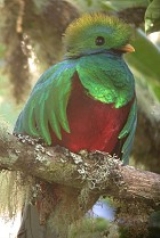
Quetzals are strikingly colored bird
s in the trogon
family (Trogonidae). They are found in forests and woodlands, especially in humid highlands, with the five species from the genus Pharomachrus being exclusively Neotropical, while the single Euptilotis
species is almost entirely restricted to western Mexico
. They are fairly large (all over 32 cm or 13 inches), slightly bigger than other trogon species. Quetzals have iridescent green or golden-green wing coverts, back, chest and head, and a red belly. They are strongly sexually dimorphic, and parts of the females' plumage
is brown or grey. These largely solitary birds feed on fruits, berries, insects and small vertebrate
s (e.g. frogs), and can, despite the bright plumage, be surprisingly difficult to see in their wooded habitats.
status.
quetzalli, "large brilliant tail feather" (American Heritage Dictionary) or "tail coverts of the quetzal" (Merriam–Webster's Collegiate Dictionary), from the Nahuatl root
quetz = "stand up" used to refer to an upstanding plume of feathers.
The word "quetzal" was originally used for just the Resplendent Quetzal
, Pharomachrus mocinno, the famous long-tailed quetzal of Central America
, which is the national bird and also the name of the currency
of Guatemala
. It still often refers to that bird specifically but now also names all the species of the genera Pharomachrus and Euptilotis.
Pharomachrus is from Ancient Greek
pharos, "mantle", and makros, "long", referring to the wing and tail coverts of the Resplendent Quetzal (the second h is unexplained).
Euptilotis neoxenus is related to Pharomachrus and is called the Eared Quetzal by some authorities, such as the American Ornithologists' Union
, but the Eared Trogon by others.
Bird
Birds are feathered, winged, bipedal, endothermic , egg-laying, vertebrate animals. Around 10,000 living species and 188 families makes them the most speciose class of tetrapod vertebrates. They inhabit ecosystems across the globe, from the Arctic to the Antarctic. Extant birds range in size from...
s in the trogon
Trogon
The trogons and quetzals are birds in the order Trogoniformes which contains only one family, the Trogonidae. The family contains 39 species in eight genera. The fossil record of the trogons dates back 49 million years to the mid-Eocene. They might constitute a member of the basal radiation of...
family (Trogonidae). They are found in forests and woodlands, especially in humid highlands, with the five species from the genus Pharomachrus being exclusively Neotropical, while the single Euptilotis
Eared Quetzal
The Eared Quetzal , also known as the Eared Trogon, is a near passerine bird in the trogon family, Trogonidae. It breeds in streamside pine-oak forests and canyons in the Sierra Madre Occidental of Mexico south to western Michoacán. It is sometimes seen as a vagrant to southeasternmost Arizona in...
species is almost entirely restricted to western Mexico
Mexico
The United Mexican States , commonly known as Mexico , is a federal constitutional republic in North America. It is bordered on the north by the United States; on the south and west by the Pacific Ocean; on the southeast by Guatemala, Belize, and the Caribbean Sea; and on the east by the Gulf of...
. They are fairly large (all over 32 cm or 13 inches), slightly bigger than other trogon species. Quetzals have iridescent green or golden-green wing coverts, back, chest and head, and a red belly. They are strongly sexually dimorphic, and parts of the females' plumage
Plumage
Plumage refers both to the layer of feathers that cover a bird and the pattern, colour, and arrangement of those feathers. The pattern and colours of plumage vary between species and subspecies and can also vary between different age classes, sexes, and season. Within species there can also be a...
is brown or grey. These largely solitary birds feed on fruits, berries, insects and small vertebrate
Vertebrate
Vertebrates are animals that are members of the subphylum Vertebrata . Vertebrates are the largest group of chordates, with currently about 58,000 species described. Vertebrates include the jawless fishes, bony fishes, sharks and rays, amphibians, reptiles, mammals, and birds...
s (e.g. frogs), and can, despite the bright plumage, be surprisingly difficult to see in their wooded habitats.
Conservation status
None of the Quetzal species are under immediate threat in the wild, although the Resplendent Quetzal is at Near ThreatenedNear Threatened
Near Threatened is a conservation status assigned to species or lower taxa that may be considered threatened with extinction in the near future, although it does not currently qualify for the threatened status...
status.
Etymology
The name "quetzal" is from NahuatlNahuatl
Nahuatl is thought to mean "a good, clear sound" This language name has several spellings, among them náhuatl , Naoatl, Nauatl, Nahuatl, Nawatl. In a back formation from the name of the language, the ethnic group of Nahuatl speakers are called Nahua...
quetzalli, "large brilliant tail feather" (American Heritage Dictionary) or "tail coverts of the quetzal" (Merriam–Webster's Collegiate Dictionary), from the Nahuatl root
Root (linguistics)
The root word is the primary lexical unit of a word, and of a word family , which carries the most significant aspects of semantic content and cannot be reduced into smaller constituents....
quetz = "stand up" used to refer to an upstanding plume of feathers.
The word "quetzal" was originally used for just the Resplendent Quetzal
Resplendent Quetzal
The Resplendent Quetzal, Pharomachrus mocinno, is a bird in the trogon family. It is found from southern Mexico to western Panama . It is well known for its colorful plumage. There are two subspecies, P. m. mocinno and P. m...
, Pharomachrus mocinno, the famous long-tailed quetzal of Central America
Central America
Central America is the central geographic region of the Americas. It is the southernmost, isthmian portion of the North American continent, which connects with South America on the southeast. When considered part of the unified continental model, it is considered a subcontinent...
, which is the national bird and also the name of the currency
Guatemalan quetzal
The quetzal is the currency of Guatemala. It is named after the national bird of Guatemala, the Resplendent Quetzal. In ancient Mayan culture, the quetzal bird's tail feathers were used as currency. It is divided into 100 cents, called centavos in standard Spanish or lenes in Guatemalan slang...
of Guatemala
Guatemala
Guatemala is a country in Central America bordered by Mexico to the north and west, the Pacific Ocean to the southwest, Belize to the northeast, the Caribbean to the east, and Honduras and El Salvador to the southeast...
. It still often refers to that bird specifically but now also names all the species of the genera Pharomachrus and Euptilotis.
Pharomachrus is from Ancient Greek
Ancient Greek
Ancient Greek is the stage of the Greek language in the periods spanning the times c. 9th–6th centuries BC, , c. 5th–4th centuries BC , and the c. 3rd century BC – 6th century AD of ancient Greece and the ancient world; being predated in the 2nd millennium BC by Mycenaean Greek...
pharos, "mantle", and makros, "long", referring to the wing and tail coverts of the Resplendent Quetzal (the second h is unexplained).
Species
- Genus Pharomachrus:
- Crested QuetzalCrested QuetzalThe Crested Quetzal is a species of bird in the Trogonidae family.It is found in Bolivia, Colombia, Ecuador, Peru, and Venezuela.Its natural habitat is subtropical or tropical moist montane forests.-References:...
, Pharomachrus antisianus. - Golden-headed QuetzalGolden-headed QuetzalThe Golden-Headed Quetzal is a colorful bird native to highlands forests in South America.- Description :Males and females are approximately the same size, having a total length of ca. 35 cm and a weight of 160 g. as adults. Adult males are iridescent green with a golden cast to their heads,...
, Pharomachrus auriceps. - White-tipped QuetzalWhite-tipped QuetzalThe White-tipped Quetzal is a species of bird in the Trogonidae family.It is found in Venezuela, Colombia, and Guyana. In Venezuela and Colombia, three separated ranges occur, all contiguous and on the northern coasts. Its natural habitat is subtropical or tropical moist montane...
, Pharomachrus fulgidus. - Resplendent QuetzalResplendent QuetzalThe Resplendent Quetzal, Pharomachrus mocinno, is a bird in the trogon family. It is found from southern Mexico to western Panama . It is well known for its colorful plumage. There are two subspecies, P. m. mocinno and P. m...
, Pharomachrus mocinno. - Pavonine QuetzalPavonine QuetzalThe Pavonine Quetzal is a species of bird in the Trogonidae family, the trogons. It is found in the Amazon Basin of the North Region, Brazil, Amazonian Colombia, Ecuador, Peru, and northern Bolivia; also regions of Venezuela....
, Pharomachrus pavoninus.
- Crested Quetzal
- Genus Euptilotis:
- Eared QuetzalEared QuetzalThe Eared Quetzal , also known as the Eared Trogon, is a near passerine bird in the trogon family, Trogonidae. It breeds in streamside pine-oak forests and canyons in the Sierra Madre Occidental of Mexico south to western Michoacán. It is sometimes seen as a vagrant to southeasternmost Arizona in...
, Euptilotis neoxenus.
- Eared Quetzal
Euptilotis neoxenus is related to Pharomachrus and is called the Eared Quetzal by some authorities, such as the American Ornithologists' Union
American Ornithologists' Union
The American Ornithologists' Union is an ornithological organization in the USA. Unlike the National Audubon Society, its members are primarily professional ornithologists rather than amateur birders...
, but the Eared Trogon by others.
See also
- QuetzalcoatlQuetzalcoatlQuetzalcoatl is a Mesoamerican deity whose name comes from the Nahuatl language and has the meaning of "feathered serpent". The worship of a feathered serpent deity is first documented in Teotihuacan in the first century BCE or first century CE...
- List of English words of Nahuatl origin
- List of Spanish words of Nahuatl origin
External links
- Mangoverde.com For images of four quetzal species, select "Trogons".
- Trogon videos, including quetzals, on the Internet Bird Collection
- A study about Quetzal, The Quetzal Description and Habitat