
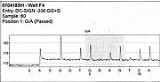
Pyrosequencing is a method of
DNA sequencingThe term DNA sequencing refers to sequencing methods for determining the order of the nucleotide bases—adenine, guanine, cytosine, and thymine—in a molecule of DNA....
(determining the order of nucleotides in DNA) based on the "sequencing by synthesis" principle. It differs from Sanger sequencing, relying on the detection of
pyrophosphateIn chemistry, the anion, the salts, and the esters of pyrophosphoric acid are called pyrophosphates. Pyrophosphates were originally prepared by heating phosphates: the prefix pyro- derived from Greek, means "fire" in this context. Pyrophosphates are good complexing agents and have many uses in...
release on nucleotide incorporation, rather than chain termination with
dideoxynucleotidesDideoxynucleotides, or ddNTPs, are nucleotides lacking a 3'-hydroxyl group on their deoxyribose sugar. Since deoxyribose already lacks a 2'-OH, dideoxyribose lacks hydroxyl groups at both its 2' and 3' carbons...
. The technique was developed by
Pål NyrénPål Nyrén, born 1955, is a biochemistry professor at the Royal Institute of Technology , Stockholm.-Career:*1999 Professor in Biochemistry, KTH, Stockholm*1997 Founder of the company Biotage AB...
and his student
Mostafa RonaghiMostafa Ronaghi, born 1968. is a molecular biologist, specializing in DNA sequencing methodology . He earned his Ph.D. from the Royal Institute of Technology in Sweden in 1998.He is currently the Chief Technology Officer and Senior Vice President at Illumina...
at the
Royal Institute of TechnologyThe Royal Institute of Technology is a university in Stockholm, Sweden. KTH was founded in 1827 as Sweden's first polytechnic and is with TKK in Espoo, depending on definition, Scandinavia's largest institution of higher education in technology and one of the leading technical universities in...
in Stockholm in 1996.
"Sequencing by synthesis" involves taking a single strand of the DNA to be sequenced and then synthesizing its complementary strand enzymatically.
Pyrosequencing is a method of
DNA sequencingThe term DNA sequencing refers to sequencing methods for determining the order of the nucleotide bases—adenine, guanine, cytosine, and thymine—in a molecule of DNA....
(determining the order of nucleotides in DNA) based on the "sequencing by synthesis" principle. It differs from Sanger sequencing, relying on the detection of
pyrophosphateIn chemistry, the anion, the salts, and the esters of pyrophosphoric acid are called pyrophosphates. Pyrophosphates were originally prepared by heating phosphates: the prefix pyro- derived from Greek, means "fire" in this context. Pyrophosphates are good complexing agents and have many uses in...
release on nucleotide incorporation, rather than chain termination with
dideoxynucleotidesDideoxynucleotides, or ddNTPs, are nucleotides lacking a 3'-hydroxyl group on their deoxyribose sugar. Since deoxyribose already lacks a 2'-OH, dideoxyribose lacks hydroxyl groups at both its 2' and 3' carbons...
. The technique was developed by
Pål NyrénPål Nyrén, born 1955, is a biochemistry professor at the Royal Institute of Technology , Stockholm.-Career:*1999 Professor in Biochemistry, KTH, Stockholm*1997 Founder of the company Biotage AB...
and his student
Mostafa RonaghiMostafa Ronaghi, born 1968. is a molecular biologist, specializing in DNA sequencing methodology . He earned his Ph.D. from the Royal Institute of Technology in Sweden in 1998.He is currently the Chief Technology Officer and Senior Vice President at Illumina...
at the
Royal Institute of TechnologyThe Royal Institute of Technology is a university in Stockholm, Sweden. KTH was founded in 1827 as Sweden's first polytechnic and is with TKK in Espoo, depending on definition, Scandinavia's largest institution of higher education in technology and one of the leading technical universities in...
in Stockholm in 1996.
Procedure
"Sequencing by synthesis" involves taking a single strand of the DNA to be sequenced and then synthesizing its complementary strand enzymatically. The Pyrosequencing method is based on detecting the activity of
DNA polymeraseA DNA polymerase is an enzyme that catalyzes the polymerization of deoxyribonucleotides into a DNA strand. DNA polymerases are best-known for their role in DNA replication, in which the polymerase "reads" an intact DNA strand as a template and uses it to synthesize the new strand...
(a DNA synthesizing enzyme) with another chemiluminescent
enzymeEnzymes are proteins that catalyze chemical reactions. In enzymatic reactions, the molecules at the beginning of the process are called substrates, and the enzyme converts them into different molecules, called the products. Almost all processes in a biological cell need enzymes to occur at...
. Essentially, the method allows sequencing of a single strand of
DNADeoxyribonucleic acid is a nucleic acid that contains the genetic instructions used in the development and functioning of all known living organisms and some viruses. The main role of DNA molecules is the long-term storage of information...
by synthesizing the complementary strand along it, one base pair at a time, and detecting which base was actually added at each step. The template DNA is immobilized, and solutions of A, C, G, and T nucleotides are added and removed after the reaction, sequentially. Light is produced only when the nucleotide solution complements the first unpaired base of the template. The sequence of solutions which produce chemiluminescent signals allows the determination of the sequence of the template.
ssDNA template is hybridized to a sequencing
primerPrimer can refer to:*Primer , a 1995 music album by the musical group Rockapella*Primer , a 2004 feature film written and directed by Shane Carruth...
and incubated with the enzymes
DNA polymeraseA DNA polymerase is an enzyme that catalyzes the polymerization of deoxyribonucleotides into a DNA strand. DNA polymerases are best-known for their role in DNA replication, in which the polymerase "reads" an intact DNA strand as a template and uses it to synthesize the new strand...
, ATP sulfurylase,
luciferaseLuciferase is a generic term for the class of oxidative enzymes used in bioluminescence and is distinct from a photoprotein. One famous example is the firefly luciferase from the firefly Photinus pyralis. Luciferase is a generic term for the class of oxidative enzymes used in bioluminescence and...
and
apyraseApyrase is a calcium-activated plasma membrane-bound enzyme that catalyses the hydrolysis of ATP to yield AMP and inorganic phosphate. Two isoenzymes are found in commercial preparations from S. tuberosum...
, and with the substrates adenosine 5´ phosphosulfate (APS) and
luciferinLuciferins are a class of light-emitting biological pigments found in organisms that causes bioluminescence. The term is used generically to refer to any light emitting molecule utilized by a luciferase or photoprotein.- Types :Luciferins are a class of small-molecule substrates each for their...
.
- The addition of one of the four deoxynucleotide triphosphates (dNTPs)(in the case of dATP we add dATPαS which is not a substrate for a luciferase) initiates the second step. DNA polymerase incorporates the correct, complementary dNTPs onto the template. This incorporation releases pyrophosphate
In chemistry, the anion, the salts, and the esters of pyrophosphoric acid are called pyrophosphates. Pyrophosphates were originally prepared by heating phosphates: the prefix pyro- derived from Greek, means "fire" in this context. Pyrophosphates are good complexing agents and have many uses in...
(PPi) stoichiometrically.
- ATP sulfurylase quantitatively converts PPi to ATP
Adenosine-5'-triphosphate is a multifunctional nucleotide that plays an important role in cell biology as a coenzyme, that is, the "molecular unit of currency" of intracellular energy transfer. ATP transports chemical energy within cells for metabolism...
in the presence of adenosine 5´ phosphosulfate. This ATP acts as fuel to the luciferase-mediated conversion of luciferin to oxyluciferin that generates visible light in amounts that are proportional to the amount of ATP. The light produced in the luciferase-catalyzed reaction is detected by a camera and analyzed in a program.
- Unincorporated nucleotides and ATP are degraded by the apyrase, and the reaction can restart with another nucleotide.
Currently, a limitation of the method is that the lengths of individual reads of DNA sequence are in the neighborhood of 300-500 nucleotides, shorter than the 800-1000 obtainable with chain termination methods (e.g. Sanger sequencing). This can make the process of genome assembly more difficult, particularly for sequence containing a large amount of repetitive DNA. As of 2007, pyrosequencing is most commonly used for resequencing or sequencing of genomes for which the sequence of a close relative is already available.
The templates for pyrosequencing can be made both by solid phase template preparation (Streptavidin coated magnetic beads) and enzymatic template preparation (Apyrase+Exonuclease).
Commercialization
The company
Pyrosequencing AB in Uppsala, Sweden commercialized machinery and reagents for sequencing short stretches of DNA using the pyrosequencing technique.
Pyrosequencing AB was renamed to
Biotage in 2003 which was acquired by Qiagen in 2008. Pyrosequencing technology was further licensed to
454 Life Sciences454 Life Sciences, a Roche company, is a biotechnology company based in Branford, Connecticut specializing in high-throughput DNA sequencing using a novel massively parallel sequencing-by-synthesis approach...
. 454 developed an array-based pyrosequencing technology which has emerged as a platform for large-scale DNA sequencing. Most notable are the applications for
genome sequencingGenome projects are scientific endeavours that ultimately aim to determine the complete genome sequence of an organism . The genome sequence for any organism requires the DNA sequences for each of the chromosomes in an organism to be determined...
and
metagenomicsMetagenomics is the study of metagenomes, genetic material recovered directly from environmental samples. The broad field may also be referred to as environmental genomics, ecogenomics or community genomics.Traditional microbiology and microbial genome sequencing rely upon cultivated clonal cultures...
.
GS FLX, the latest pyrosequencing platform by 454 Life Sciences (now owned by
Roche DiagnosticsRoche Diagnostics Division is a subsidiary of Hoffmann-La Roche which manufactures equipment and reagents for research and medical diagnostic applications. Internally, it is organized into five major business areas: Roche Applied Science, Roche Professional Diagnostics, Roche Diabetes Care, Roche...
), can generate 400 million nucleotide data in a 10 hour run with a single machine. Each run would cost about 5,000-7,000 USD, pushing de novo sequencing of mammalian genomes into the million dollar range.