


Pygopodidae

Encyclopedia
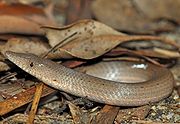
Pygopodidae is a family of squamates that have reduced or absent limbs and are related to the gecko
s. There are at least 35 species
in two subfamilies and eight genera
. They have unusually long, slender, bodies, giving them a strong resemblance to snake
s. Like both snakes and most geckos, they have no eyelids, but unlike snakes, they have external ear-holes and flat, non-forked tongues. They are native to Australia
and New Guinea
.
Pygopods have no fore-limbs at all, but they do possess vestigial hind limbs in the form of small, flattened, flaps. These may have some role in courtship and defensive behaviour, and may even aid in locomotion through vegetation. Some species are insectivorous
burrowing animals, but others are adapted to moving through dense spinifex
or other vegetation. Like the Geckos, Pygopods lay two eggs
in each clutch
and nest communally. Some nests have been found to have as many as 30 eggs. Also like the geckos, Pygopods have the ability to vocalise - emitting a high pitched squeak. Snakes are incapable of vocalising.
Pygopods can hear tones higher than any other reptiles. Individuals in the species Delma pax
can respond to a 60 decibel sound with a frequency of 11,100 Hz
, more than an octave
above the highest note on a standard piano
.
Gecko
Geckos are lizards belonging to the infraorder Gekkota, found in warm climates throughout the world. They range from 1.6 cm to 60 cm....
s. There are at least 35 species
Species
In biology, a species is one of the basic units of biological classification and a taxonomic rank. A species is often defined as a group of organisms capable of interbreeding and producing fertile offspring. While in many cases this definition is adequate, more precise or differing measures are...
in two subfamilies and eight genera
Genera
Genera is a commercial operating system and development environment for Lisp machines developed by Symbolics. It is essentially a fork of an earlier operating system originating on the MIT AI Lab's Lisp machines which Symbolics had used in common with LMI and Texas Instruments...
. They have unusually long, slender, bodies, giving them a strong resemblance to snake
Snake
Snakes are elongate, legless, carnivorous reptiles of the suborder Serpentes that can be distinguished from legless lizards by their lack of eyelids and external ears. Like all squamates, snakes are ectothermic, amniote vertebrates covered in overlapping scales...
s. Like both snakes and most geckos, they have no eyelids, but unlike snakes, they have external ear-holes and flat, non-forked tongues. They are native to Australia
Australia
Australia , officially the Commonwealth of Australia, is a country in the Southern Hemisphere comprising the mainland of the Australian continent, the island of Tasmania, and numerous smaller islands in the Indian and Pacific Oceans. It is the world's sixth-largest country by total area...
and New Guinea
New Guinea
New Guinea is the world's second largest island, after Greenland, covering a land area of 786,000 km2. Located in the southwest Pacific Ocean, it lies geographically to the east of the Malay Archipelago, with which it is sometimes included as part of a greater Indo-Australian Archipelago...
.
Pygopods have no fore-limbs at all, but they do possess vestigial hind limbs in the form of small, flattened, flaps. These may have some role in courtship and defensive behaviour, and may even aid in locomotion through vegetation. Some species are insectivorous
Insectivore
An insectivore is a type of carnivore with a diet that consists chiefly of insects and similar small creatures. An alternate term is entomophage, which also refers to the human practice of eating insects....
burrowing animals, but others are adapted to moving through dense spinifex
Spinifex (genus)
Spinifex is a genus of perennial coastal grasses. They are one of the most common plants that grow in sand dunes along the coasts of Australia, New Zealand and New Caledonia.. As they help stabilise the sand, these grasses are an important part of the entire sand dune ecosystem. Of the four species...
or other vegetation. Like the Geckos, Pygopods lay two eggs
Egg (biology)
An egg is an organic vessel in which an embryo first begins to develop. In most birds, reptiles, insects, molluscs, fish, and monotremes, an egg is the zygote, resulting from fertilization of the ovum, which is expelled from the body and permitted to develop outside the body until the developing...
in each clutch
Clutch (eggs)
A clutch of eggs refers to all the eggs produced by birds or reptiles, often at a single time, particularly those laid in a nest.In birds, destruction of a clutch by predators, , results in double-clutching...
and nest communally. Some nests have been found to have as many as 30 eggs. Also like the geckos, Pygopods have the ability to vocalise - emitting a high pitched squeak. Snakes are incapable of vocalising.
Pygopods can hear tones higher than any other reptiles. Individuals in the species Delma pax
Delma
Delma is a genus of lizards in the family Pygopodidae. It contains sixteen described species.- Species :Classification Genus Delma according to the :* Delma australis Kluge, 1974* Delma borea Kluge, 1974* Delma butleri Storr, 1987...
can respond to a 60 decibel sound with a frequency of 11,100 Hz
Hertz
The hertz is the SI unit of frequency defined as the number of cycles per second of a periodic phenomenon. One of its most common uses is the description of the sine wave, particularly those used in radio and audio applications....
, more than an octave
Octave
In music, an octave is the interval between one musical pitch and another with half or double its frequency. The octave relationship is a natural phenomenon that has been referred to as the "basic miracle of music", the use of which is "common in most musical systems"...
above the highest note on a standard piano
Eighth octave C
The musical note C8 is the C two full octaves above soprano high C. The note is one octave above the top of common musical keyboards, but the highest note of an 88-key piano...
.
Classification
FAMILY PYGOPODIDAE- Subfamily Pygopodinae
- Genus ParadelmaParadelmaThe genus Paradelma contains glossy brownish grey legless lizards, native to Australia.Species:* Paradelma orientalis -References:*...
(monotypicMonotypicIn biology, a monotypic taxon is a taxonomic group with only one biological type. The term's usage differs slightly between botany and zoology. The term monotypic has a separate use in conservation biology, monotypic habitat, regarding species habitat conversion eliminating biodiversity and...
) - Genus PygopusPygopusPygopus is a genus belonging to the family of Australian legless lizards. Members of this genus are also called Scalyfoot.Classification of the genus Pygopus*Pygopus lepidopodus .*Pygopus nigriceps ....
(3 species) - Genus DelmaDelmaDelma is a genus of lizards in the family Pygopodidae. It contains sixteen described species.- Species :Classification Genus Delma according to the :* Delma australis Kluge, 1974* Delma borea Kluge, 1974* Delma butleri Storr, 1987...
(16 species)
- Genus Paradelma
- Subfamily Lialisinae
- Tribe Lialisini
- Genus LialisLialisLialis is a genus of lizards in the family Pygopodidae. There are at least two member species in this genus....
(2 species)
- Genus Lialis
- Tribe Aprasiaini
- Subtribe Pletholaxini
- Genus PletholaxPletholaxPletholax is a genus of lizards in the family Pygopodidae.Genus Pletholax*Pletholax gracilis...
(monotypic)
- Genus Pletholax
- Subtribe Aprasiaini
- Genus OphidiocephalusOphidiocephalusOphidiocephalus is a genus of lizards in the family Pygopodidae.Genus Ophidiocephalus*Ophidiocephalus taeniatus...
(monotypic) - Genus AprasiaAprasiaAprasia is a genus of lizards in the family Pygopodidae.Genus Aprasia*Aprasia aurita*Aprasia haroldi*Aprasia inaurita*Aprasia parapulchella*Aprasia picturata*Aprasia pseudopulchella*Aprasia pulchella...
(11 species)
- Genus Ophidiocephalus
- Subtribe Pletholaxini
- Tribe Lialisini
See also
- Limbless vertebratesLimbless vertebratesMany vertebrates have evolved limbless forms. Reptiles have on a number of occasions evolved into limbless forms - snakes, amphisbaenia, and legless lizards...