

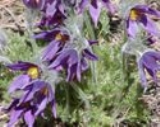
Pulsatilla vulgaris

Encyclopedia
Pulsatilla vulgaris belongs to the buttercup family (Ranunculaceae
), native to western, central and southern Europe
.
It grows to 15–30 cm high and when it is fruit-bearing up to 40 cm. The roots go deep into the soil (to 1 m). The finely-dissected leaves
are arranged in a rosette and appear with the bell-shaped flower in early spring.
It grows in sparsely wooded pine forests or meadows, often on a sunny sloping side with calcium-rich soil. It is also the county flower
of the English counties of Cambridgeshire
and Hertfordshire
. A large colony occurs on publicly accessible land in the Cotswolds, at the Gloucestershire Wildlife Trust
's Gloucestershire Pasqueflower Reserve.
It is the main ingredient in the French tonic hépatoum, taken for "crise de foie" and to help the production of bile.
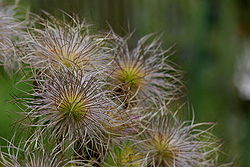 While the main variety of Pulsatilla vulgaris has purplish flowers, variants include red (Rubra) and white (Alba) forms.
Ranunculaceae
Ranunculaceae are a family of about 1700 species of flowering plants in about 60 genera, distributed worldwide....
), native to western, central and southern Europe
Europe
Europe is, by convention, one of the world's seven continents. Comprising the westernmost peninsula of Eurasia, Europe is generally 'divided' from Asia to its east by the watershed divides of the Ural and Caucasus Mountains, the Ural River, the Caspian and Black Seas, and the waterways connecting...
.
It grows to 15–30 cm high and when it is fruit-bearing up to 40 cm. The roots go deep into the soil (to 1 m). The finely-dissected leaves
Leaf
A leaf is an organ of a vascular plant, as defined in botanical terms, and in particular in plant morphology. Foliage is a mass noun that refers to leaves as a feature of plants....
are arranged in a rosette and appear with the bell-shaped flower in early spring.
It grows in sparsely wooded pine forests or meadows, often on a sunny sloping side with calcium-rich soil. It is also the county flower
County flowers of the United Kingdom
The following are the flowers selected for the historic counties of the United Kingdom in Plantlife's 2002 "County Flowers" campaign...
of the English counties of Cambridgeshire
Cambridgeshire
Cambridgeshire is a county in England, bordering Lincolnshire to the north, Norfolk to the northeast, Suffolk to the east, Essex and Hertfordshire to the south, and Bedfordshire and Northamptonshire to the west...
and Hertfordshire
Hertfordshire
Hertfordshire is a ceremonial and non-metropolitan county in the East region of England. The county town is Hertford.The county is one of the Home Counties and lies inland, bordered by Greater London , Buckinghamshire , Bedfordshire , Cambridgeshire and...
. A large colony occurs on publicly accessible land in the Cotswolds, at the Gloucestershire Wildlife Trust
Gloucestershire Wildlife Trust
The Gloucestershire Wildlife Trust is the Gloucestershire local partner in a conservation network of 47 Wildlife Trusts. The Wildlife Trusts are local charities with the specific aim of protecting the United Kingdom's natural heritage...
's Gloucestershire Pasqueflower Reserve.
It is the main ingredient in the French tonic hépatoum, taken for "crise de foie" and to help the production of bile.
Varieties
See also
- Pasque flowerPasque flowerThe genus Pulsatilla contains about 33 species of herbaceous perennials native to meadows and prairies of North America, Europe, and Asia. Common names include pasque flower , wind flower, prairie crocus, Easter Flower, and meadow anemone...
is the name of other species of genus Pulsatilla, as well.