

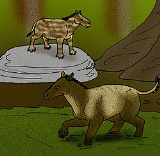
Propalaeotherium

Encyclopedia
Propalaeotherium was an early genus
of perissodactyl ancestral to the horse
endemic to Europe
and Asia
during the Middle Eocene.
Its name means "before Palaeotherium", as it is the ancestor of Palaeotherium
, another relative of early horses. Although they were descended from the earliest ancestral horse, Hyracotherium
, the Propaleotheres and Paleotheres were not the ancestors of the modern horse; their line died out around 34 million years ago, leaving no descendants.
Propalaeotherium was named by Paul Gervais
. It was assigned to Palaeotheriidae
by Hooker (1986).
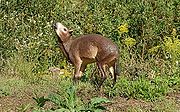
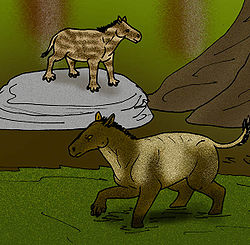 Propalaeotheres were small animals, ranging from 30–60 cm at the shoulder weighing just 10 kg (22 lb) They looked rather like very small tapirs. They had no hooves, having instead several small nail-like hooflets. They were herbivorous, and the amazingly well-preserved Messel
fossil
s show that they ate berries
, and leaf matter picked up from the forest floor.
and Ambulocetus
Genus
In biology, a genus is a low-level taxonomic rank used in the biological classification of living and fossil organisms, which is an example of definition by genus and differentia...
of perissodactyl ancestral to the horse
Horse
The horse is one of two extant subspecies of Equus ferus, or the wild horse. It is a single-hooved mammal belonging to the taxonomic family Equidae. The horse has evolved over the past 45 to 55 million years from a small multi-toed creature into the large, single-toed animal of today...
endemic to Europe
Europe
Europe is, by convention, one of the world's seven continents. Comprising the westernmost peninsula of Eurasia, Europe is generally 'divided' from Asia to its east by the watershed divides of the Ural and Caucasus Mountains, the Ural River, the Caspian and Black Seas, and the waterways connecting...
and Asia
Asia
Asia is the world's largest and most populous continent, located primarily in the eastern and northern hemispheres. It covers 8.7% of the Earth's total surface area and with approximately 3.879 billion people, it hosts 60% of the world's current human population...
during the Middle Eocene.
Its name means "before Palaeotherium", as it is the ancestor of Palaeotherium
Palaeotherium
Palaeotherium is an extinct genus of primitive perissodactyl ungulate. George Cuvier originally described them as being a kind of tapir, and as such, Palaeotherium is popularly reconstructed as a tapir-like animal...
, another relative of early horses. Although they were descended from the earliest ancestral horse, Hyracotherium
Hyracotherium
Hyracotherium , also known as Eohippus or the dawn horse, is an extinct genus of very small perissodactyl ungulates that lived in the woodlands of the northern hemisphere, with species ranging throughout Asia, Europe, and North America during the early Tertiary Period and the early to mid Eocene...
, the Propaleotheres and Paleotheres were not the ancestors of the modern horse; their line died out around 34 million years ago, leaving no descendants.
Propalaeotherium was named by Paul Gervais
Paul Gervais
For the Canadian parliamentarian see Paul Mullins GervaisPaul Gervais full name François Louis Paul Gervaise was a French palaeontologist and entomologist.-Biography:...
. It was assigned to Palaeotheriidae
Palaeotheriidae
Palaeotheres are an extinct group of herbivorous mammals related to tapirs and rhinoceros, and probably ancestral to horses. They ranged across Europe and Asia during the Eocene through Oligocene 55—28 Ma, existing for approximately ....
by Hooker (1986).
Description
Messel
Messel is a municipality in the district of Darmstadt-Dieburg in Hesse near Frankfurt am Main in Germany.The village is first mentioned, as Masilla, in the Lorsch codex.Messel was the property of the lords of Groschlag from ca. 1400 to 1799...
fossil
Fossil
Fossils are the preserved remains or traces of animals , plants, and other organisms from the remote past...
s show that they ate berries
Berry
The botanical definition of a berry is a fleshy fruit produced from a single ovary. Grapes are an example. The berry is the most common type of fleshy fruit in which the entire ovary wall ripens into an edible pericarp. They may have one or more carpels with a thin covering and fleshy interiors....
, and leaf matter picked up from the forest floor.
In popular culture
Propalaeotherium was featured in Walking With Beasts, where it is shown as a skittish foraging creature that is a prey item of GastornisGastornis
Gastornis is an extinct genus of large flightless bird that lived during the late Paleocene and Eocene epochs of the Cenozoic. It was named in 1855, after Gaston Planté, who had discovered the first fossils in Argile Plastique formation deposits at Meudon near Paris...
and Ambulocetus
Ambulocetus
Ambulocetus was an early cetacean that could walk as well as swim. It lived during early Eocene some 50-49 million years ago. It is a transitional fossil that shows how whales evolved from land-living mammals. The Ambulocetus fossils were found in Pakistan by anthropologist Johannes Thewissen...
See also
- List of mammals
- Evolution of the HorseEvolution of the horseThe evolution of the horse pertains to the phylogenetic ancestry of the modern horse from the small dog-sized, forest-dwelling Hyracotherium over geologic time scales...
- List of prehistoric mammals
- MammalMammalMammals are members of a class of air-breathing vertebrate animals characterised by the possession of endothermy, hair, three middle ear bones, and mammary glands functional in mothers with young...
- Mammal classificationMammal classificationMammalia is a class of animal within the Phylum Chordata. Mammal classification has been through several iterations since Carolus Linnaeus initially defined the class. Many earlier ideas have been completely abandoned by modern taxonomists, among these are the idea that bats are related to birds...