
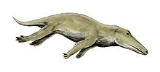
Ambulocetus was an early cetacean that could walk as well as swim. It lived during early
EoceneThe Eocene Epoch, lasting from about 56 to 34 million years ago , is a major division of the geologic timescale and the second epoch of the Paleogene Period in the Cenozoic Era. The Eocene spans the time from the end of the Palaeocene Epoch to the beginning of the Oligocene Epoch. The start of the...
some 50-49 million years ago. It is a
transitional fossilA transitional fossil is any fossilized remains of a lifeform that exhibits characteristics of two distinct taxonomic groups. A transitional fossil is the fossil of an organism near the branching point where major individual lineages diverge...
that shows how
whaleWhale is the common name for various marine mammals of the order Cetacea. The term whale sometimes refers to all cetaceans, but more often it excludes dolphins and porpoises, which belong to suborder Odontoceti . This suborder also includes the sperm whale, killer whale, pilot whale, and beluga...
s evolved from land-living
mammalMammals are members of a class of air-breathing vertebrate animals characterised by the possession of endothermy, hair, three middle ear bones, and mammary glands functional in mothers with young...
s. The
Ambulocetus fossils were found in
PakistanPakistan , officially the Islamic Republic of Pakistan is a sovereign state in South Asia. It has a coastline along the Arabian Sea and the Gulf of Oman in the south and is bordered by Afghanistan and Iran in the west, India in the east and China in the far northeast. In the north, Tajikistan...
by anthropologist Johannes Thewissen. When the animal was alive, Pakistan was a coastal region of India, which was then a large island in the
Indian OceanThe Indian Ocean is the third largest of the world's oceanic divisions, covering approximately 20% of the water on the Earth's surface. It is bounded on the north by the Indian Subcontinent and Arabian Peninsula ; on the west by eastern Africa; on the east by Indochina, the Sunda Islands, and...
.
Description
Having the appearance of a 3 meter (10-foot) long mammalian
crocodileA crocodile is any species belonging to the family Crocodylidae . The term can also be used more loosely to include all extant members of the order Crocodilia: i.e...
, it was clearly amphibious, as its back legs are better adapted for swimming than for walking on land, and it probably swam by undulating its back vertically, as
otterThe Otters are twelve species of semi-aquatic mammals which feed on fish and shellfish, and also other invertebrates, amphibians, birds and small mammals....
s and
whaleWhale is the common name for various marine mammals of the order Cetacea. The term whale sometimes refers to all cetaceans, but more often it excludes dolphins and porpoises, which belong to suborder Odontoceti . This suborder also includes the sperm whale, killer whale, pilot whale, and beluga...
s do. It has been speculated that Ambulocetids hunted like crocodiles, lurking in the shallows to snatch unsuspecting prey. Chemical analysis of its teeth shows that it was able to move between salt and fresh water.
Ambulocetus did not have external ears. To detect prey on land, they may have lowered their heads to the ground and felt for vibrations.
Scientists consider
Ambulocetus to be an early whale because it shares underwater adaptations with them: it had an adaptation in the
noseAnatomically, a nose is a protuberance in vertebrates that houses the nostrils, or nares, which admit and expel air for respiration in conjunction with the mouth. Behind the nose are the olfactory mucosa and the sinuses. Behind the nasal cavity, air next passes through the pharynx, shared with the...
that enabled it to swallow underwater, and its
periotic bonePeriotic bone is the single bone that surrounds the ear of mammals. It is formed from the fusion of the pro-otic, epiotic, and opisthotic bones.- External links :* http://www.encyclopedia.com/doc/1O8-perioticbone.html...
s had a structure like those of whales, enabling it to hear well underwater. In addition, its teeth are similar to those of early cetaceans.
In popular culture
Ambulocetus can be seen in the British series
Walking with BeastsWalking with Beasts is a 2001 six-part television documentary miniseries, produced by the BBC in the United Kingdom, narrated by Kenneth Branagh. In North America it has been retitled Walking with Prehistoric Beasts, and the original Discovery Channel broadcast was narrated by Stockard Channing...
. During chapter 1 it is said to have swum upstream from the coast, explaining why it is seen in
GermanyGermany , officially the Federal Republic of Germany , is a federal parliamentary republic in Europe. The country consists of 16 states while the capital and largest city is Berlin. Germany covers an area of 357,021 km2 and has a largely temperate seasonal climate...
, rather than its native
PakistanPakistan , officially the Islamic Republic of Pakistan is a sovereign state in South Asia. It has a coastline along the Arabian Sea and the Gulf of Oman in the south and is bordered by Afghanistan and Iran in the west, India in the east and China in the far northeast. In the north, Tajikistan...
. It is portrayed with sprawling
limbsA limb is a jointed, or prehensile , appendage of the human or other animal body....
like a
crocodileA crocodile is any species belonging to the family Crocodylidae . The term can also be used more loosely to include all extant members of the order Crocodilia: i.e...
, though it would have had erect (straight) limbs.
In the novel
Ice Hunt by American writer
James Rollins* For the American baseball pitcher, see Jim Czajkowski* For the American baseball shortstop, see Jimmy Rollins* For the 19th century American politician from Missouri, see James S. Rollins...
, live
Ambulocetus (called "
grendelGrendel is one of three antagonists, along with Grendel's mother and the dragon, in the Anglo-Saxon epic poem Beowulf . Grendel is usually depicted as a monster, though this is the subject of scholarly debate. In the poem, Grendel is feared by all but Beowulf.-Story:The poem Beowulf is contained in...
s") are found inside an Arctic iceberg.
It makes an appearance in the shows
National Geographic Evolutions: The Walking Whale.
See also
- Evolution of cetaceans
The cetaceans are marine mammal descendants of land mammals. Their terrestrial origins are indicated by:* Their need to breathe air from the surface;* The bones of their fins, which resemble the limbs of land mammals...
- NEOUCOM; the Ambulocetus is the unofficial school mascot of the Northeastern Ohio Universities College of Medicine. The man who discovered the "walking whale," Johannes Thewissen, is an anatomy professor at the medical school.
External links