


Pronucleus

Encyclopedia
Sperm
The term sperm is derived from the Greek word sperma and refers to the male reproductive cells. In the types of sexual reproduction known as anisogamy and oogamy, there is a marked difference in the size of the gametes with the smaller one being termed the "male" or sperm cell...
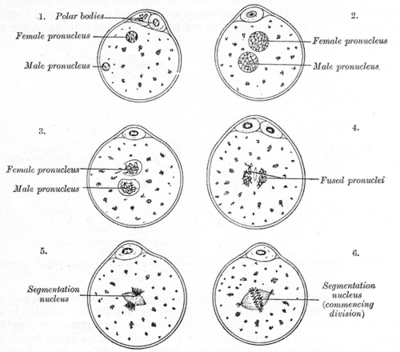
or an egg cell during the process of fertilization, after the sperm enters the ovum, but before they fuse. Sperm and egg cells are haploid
Ploidy
Ploidy is the number of sets of chromosomes in a biological cell.Human sex cells have one complete set of chromosomes from the male or female parent. Sex cells, also called gametes, combine to produce somatic cells. Somatic cells, therefore, have twice as many chromosomes. The haploid number is...
, meaning they carry half the number of chromosome
Chromosome
A chromosome is an organized structure of DNA and protein found in cells. It is a single piece of coiled DNA containing many genes, regulatory elements and other nucleotide sequences. Chromosomes also contain DNA-bound proteins, which serve to package the DNA and control its functions.Chromosomes...
s. When the pronucleus of a sperm fuses with the pronucleus of an egg, their chromosomes combine and become part of a single diploid nucleus in the resulting embryo
Embryo
An embryo is a multicellular diploid eukaryote in its earliest stage of development, from the time of first cell division until birth, hatching, or germination...
, containing a full set of chromosomes.
The appearance of two pronuclei is the first sign of successful fertilization as observed during in vitro fertilisation
In vitro fertilisation
In vitro fertilisation is a process by which egg cells are fertilised by sperm outside the body: in vitro. IVF is a major treatment in infertility when other methods of assisted reproductive technology have failed...
, and is usually observed 18 hours after insemination or ICSI. The zygote is then termed a two-pronuclear zygote (2PN). Two-pronuclear zygotes transitioning through 1PN or 3PN states tend to develop into poorer-quality embryos than ones who remain 2PN throughout development, and may be significant in embryo selection in IVF.