


Princeton Charter Club

Encyclopedia
Princeton University
Princeton University is a private research university located in Princeton, New Jersey, United States. The school is one of the eight universities of the Ivy League, and is one of the nine Colonial Colleges founded before the American Revolution....
's ten active undergraduate eating clubs located on or near Prospect Avenue in Princeton, New Jersey
Princeton, New Jersey
Princeton is a community located in Mercer County, New Jersey, United States. It is best known as the location of Princeton University, which has been sited in the community since 1756...
, United States
United States
The United States of America is a federal constitutional republic comprising fifty states and a federal district...
.
Club history
The Princeton Charter Club was organized in the fall of 1901 as Princeton's ninth eating club, with a Senior Section from the Class of 1902 and a Junior Section from the Class of 1903. The name Cloister was at first selected until it was discovered that Yale already had an institution of similar name. About that time the document known as the Charter for the College of New Jersey was found and presented to the University. On the suggestion of Professor McDonald, an honorary member, the name Charter was substituted for Cloister. Charter's current neighbor to the west, Cloister InnCloister Inn
Cloister Inn is one of the undergraduate eating clubs at Princeton University in Princeton, New Jersey, United States. Founded in 1912, Cloister occupies a neo-Gothic building on Prospect Avenue, between Cap and Gown Club and Charter Club. Cloister closed temporarily in 1972, becoming open to all...
, later took the discarded name.
A small building on Olden Street—known as the "Incubator" because several other clubs had started there while they waited for sufficient finances to buy or build a proper clubhouse—was leased and the furnishing paid for by subscriptions.
In the spring of 1903 the Club purchased three lots and a house on Prospect Avenue which constitutes three-quarters of the present property. The house was redesigned and enlarged under the supervision of an undergraduate member David Adler
David Adler
David Adler was a prolific architect, designing over 200 buildings...
of the 1904 Section, with the assistance of Professor Harris of the Faculty. The funds for the purchase of this property and the alterations to this second clubhouse were raised by the sale of nineteen $1,000 mortgage bonds.
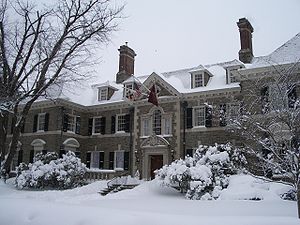
The so-called "Adler Clubhouse" would house Charter Club for a decade, until the present "Third Clubhouse", designed by noted architectural firm Mellor & Meigs was completed in the fall of 1914. In the intervening years, Charter had grown into an institution of no small renown known for its extravagant banquets. Additionally, Charter's real estate assets had grown. In early 1905, at least one adjacent lot was purchased. In the summer of 1905, a squash court was built behind the clubhouse. The expansion of the land holdings encouraged the membership and graduate section of Charter to build the Third Clubhouse, which was and is a far more imposing edifice than either the Adler Clubhouse or most of Charter's peer institutions. Today, Charter is widely regarded as having one of the nicest clubhouses on "The Street."
After the United States
United States
The United States of America is a federal constitutional republic comprising fifty states and a federal district...
entered World War I
World War I
World War I , which was predominantly called the World War or the Great War from its occurrence until 1939, and the First World War or World War I thereafter, was a major war centred in Europe that began on 28 July 1914 and lasted until 11 November 1918...
, Charter was temporarily closed due to reduced membership caused by widespread member enlistment in the armed forces. For a period of less than two years, between 1917 and 1919, the Charter clubhouse closed its doors, and Charter members left on campus received full membership privileges at Cottage Club. Charter lost seven members in the war, and their sacrifice is commemorated by a plaque located in the "Great Room."
Reopening in 1919, Charter quickly gained a reputation as a club personifying the era of the Roaring '20's. Known for its sophistication and its raucous bacchanalian moments, Charter Club carved a niche for itself on campus in the inter-war years. At the notorious section party of 1930, thirty Charter members famously consumed four entire barrels of beer in the town firehouse, and decided to ring the fire bell, an action which drew a University proctor and minor disciplinary repercussions from the University after the intervention of the Charter Board of Governors on behalf of their younger charges.
World War II
World War II
World War II, or the Second World War , was a global conflict lasting from 1939 to 1945, involving most of the world's nations—including all of the great powers—eventually forming two opposing military alliances: the Allies and the Axis...
saw Charter closing along with all of its peer institutions, as members almost universally went off to fight abroad. Charter greatly expanded its membership after the war, but disaster struck closer to home in 1949 when a fire spread rapidly through much of the first and second floors causing heavy damage. A fire marshal
Fire Marshal
A fire marshal, in the United States and Canada, is often a member of a fire department but may be part of a building department or a separate department altogether. Fire marshals' duties vary but usually include fire code enforcement and/or investigating fires for origin and cause...
summoned to the scene of the fire, on seeing the facade of Charter seemingly unaffected, declared famously, "I've never seen a building survive a fire like this, nothing's indestructible, but this place is damn close." Charter's membership has since often referred to it as "The Indestructible Charter Club," or simply "The Indestructible." As always, Charter recovered from this crisis as it has many in its history, throwing a famously lavish party to celebrate the completion of repairs and renovation in the spring of 1950.
Charter was known throughout the '50's and '60's for its hard partying ways—Charter parties were only rivaled at the time by those at perennial animal house Cannon Club. It is suspected, but not known, that at least one Charter member rode with members of Cap and Gown Club
Cap and Gown Club
Cap and Gown Club, founded in 1890, is an eating club at Princeton University, in Princeton, New Jersey, United States. Colloquially known as "Cap", the club is one of the "Big Four" eating clubs at Princeton . Members are selected through a selective process called bicker...
in the so-called Great Train Robbery of '63, in which the "dinky" train running from Princeton Junction into Princeton was forced to make a dramatic emergency stop after a car was seen on the tracks, at which point ersatz cowboys rode up to the train on horseback and carried off their dates who had been arriving for the weekend.
The greatest era of the Eating Clubs was beginning to fade by the late sixties, however, and looking to prop up stagnating membership figures, Charter announced that it would accept female members, over the objection of many members of the grad board, shortly after the University made the switch to coeducation
Coeducation
Mixed-sex education, also known as coeducation or co-education, is the integrated education of male and female persons in the same institution. It is the opposite of single-sex education...
. In 1977, Charter made the switch from bicker selectivity to sign-in openness in order to draw more members. The club remained financially stable throughout the 70's, 80's, and 90's, as six of its peers shut their doors permanently, no small accomplishment.
Throughout this tumultuous period, Charter never quite lost its carefree atmosphere and wild touch—best exemplified perhaps by the infamous Initiation Night of 1988. In 1988, Charter counted as members most of the Varsity Football Team, and many of the '89 section's officers were part of this particular group. It was some of these gridiron heroes who allegedly planned the raucous celebration of the admission of the new sophomore section which led to 45 members sent to McCosh Infirmary or Princeton Medical Center for alcohol-related reasons. The Princeton Borough Police quickly rounded up the Charter officer corps, and criminal charges were brought against the president and social chair, who were convicted of serving alcohol to minors, fined $500, and sentenced to 30 days in jail. The sentences were later overturned by a Mercer County Court judge, and the two undergraduate officers received probation and were ordered to perform community service. To prevent a similar occurrence, but also to commemorate forever this fateful night, Charter now conducts formal initiations a week after all the other eating clubs, and on what would otherwise be initiation night officially "goes dry", although unsubstantiated rumors of a third-floor "speakeasy" often abound in the lead-up to this night. Initiation Night '88 is generally considered to be, along with the Section Party of 1930, one of Charter's most infamous moments.
Charter is known for excellent food.
In February 2010, Charter Club led all sign in clubs with 118 first round sign-ins, compared to the 13 sign-ins of rival club Colonial. Currently, Charter and Terrace remain the most popular sign-in clubs on the street.
In the fall of 2010, Charter announced major modifications to its membership admission system, creating a "weighted sign-in" system that gives preference to sophomores adjudged to be more enthusiastic about the club, based on their involvement in club activities and attendance at events open to sophomores. In February 2011, operating under this new system, Charter was again the only sign in club to fill its sophomore section in the first round of sign-ins.
Notable alumni
- David AdlerDavid AdlerDavid Adler was a prolific architect, designing over 200 buildings...
(1904 Section), architect - Edmund WilsonEdmund WilsonEdmund Wilson was an American writer and literary and social critic and noted man of letters.-Early life:Wilson was born in Red Bank, New Jersey. His father, Edmund Wilson, Sr., was a lawyer and served as New Jersey Attorney General. Wilson attended The Hill School, a college preparatory...
(1916 Section), literary critic - José FerrerJosé FerrerJosé Vicente Ferrer de Otero y Cintrón , best known as José Ferrer, was a Puerto Rican actor, as well as a theater and film director...
(1933 Section), actorActorAn actor is a person who acts in a dramatic production and who works in film, television, theatre, or radio in that capacity...
and film directorFilm directorA film director is a person who directs the actors and film crew in filmmaking. They control a film's artistic and dramatic nathan roach, while guiding the technical crew and actors.-Responsibilities:... - Mason AndrewsMason AndrewsDr. Mason Andrews was the physician who delivered America's first in vitro baby, a president of the American Gynecological and Obstetrical Society and a visionary leader of the late 20th century renaissance of his home town. Dr...
(1940 Section), Physician - James StewartJames Stewart (actor)James Maitland Stewart was an American film and stage actor, known for his distinctive voice and his everyman persona. Over the course of his career, he starred in many films widely considered classics and was nominated for five Academy Awards, winning one in competition and receiving one Lifetime...
(1932 Section), actor - Bowie KuhnBowie KuhnBowie Kent Kuhn was an American lawyer and sports administrator who served as the fifth Commissioner of Major League Baseball from February 4, , to September 30,...
(1948 Section), former Major League BaseballMajor League BaseballMajor League Baseball is the highest level of professional baseball in the United States and Canada, consisting of teams that play in the National League and the American League...
Commissioner - Charles FriedCharles FriedCharles Fried is a prominent American jurist and lawyer. He served as United States Solicitor General from 1985 to 1989. He is currently a professor at Harvard Law School.-Early life and education:...
(1956 Section), Harvard Law professor and former Solicitor General. - Joel RosenmanJoel RosenmanJoel Rosenman , conceived and co-created the Woodstock Festival in 1969. Rosenman thought of the idea for the three-day concert when he and business partner John Roberts evaluated a recording studio proposal brought forward by Michael Lang and Artie Kornfeld...
(1963 Section), co-creator of the Woodstock FestivalWoodstock FestivalWoodstock Music & Art Fair was a music festival, billed as "An Aquarian Exposition: 3 Days of Peace & Music". It was held at Max Yasgur's 600-acre dairy farm in the Catskills near the hamlet of White Lake in the town of Bethel, New York, from August 15 to August 18, 1969... - Mitch DanielsMitch DanielsMitchell Elias "Mitch" Daniels, Jr. is the 49th and current Governor of the U.S. state of Indiana. A Republican, he began his first four-year term as governor on January 10, 2005, and was elected to his second term by an 18-point margin on November 4, 2008. Previously, he was the Director of the...
(1971 Section), Governor of Indiana - Alan GreeneAlan GreeneAlan "Al" Greene was an American diver who competed in the 1936 Summer Olympics.In 1936 he won the bronze medal in the 3 m springboard event.-References:...
(1981 Section), noted pediatrician and author - Joel AchenbachJoel AchenbachJoel Leroy Achenbach is an American staff writer for the Washington Post and the author of seven books, including A Hole at the Bottom of the Sea, The Grand Idea, Captured by Aliens, It Looks Like a President only Smaller, and three compilations of his former syndicated newspaper column "Why...
(1982 Section), writer - David DuchovnyDavid DuchovnyDavid William Duchovny is an American actor, writer and director. He has won Golden Globe awards for his work as FBI Special Agent Fox Mulder on The X-Files and as Hank Moody on Californication.-Early life:...
(1982 Section), actor