


Port of Tauranga

Encyclopedia
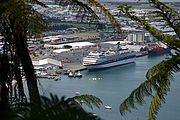
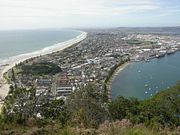
Port of Tauranga is the port of Tauranga
Tauranga
Tauranga is the most populous city in the Bay of Plenty region, in the North Island of New Zealand.It was settled by Europeans in the early 19th century and was constituted as a city in 1963...
, New Zealand
New Zealand
New Zealand is an island country in the south-western Pacific Ocean comprising two main landmasses and numerous smaller islands. The country is situated some east of Australia across the Tasman Sea, and roughly south of the Pacific island nations of New Caledonia, Fiji, and Tonga...
, the largest port in the country in terms of total cargo volume, and the second largest in terms of container throughput. with Port of Tauranga Ltd being the company operating it. This article is about both the company and the port of Tauranga itself.
The port is located in a natural harbour protected by Mount Maunganui
Mount Maunganui
Mount Maunganui is a town in the Bay of Plenty, New Zealand, located on a peninsula to the north of Tauranga. It was independent from Tauranga until the completion of the Tauranga Harbour Bridge in 1988....
and Matakana Island
Matakana Island
Matakana Island is located in the western Bay of Plenty in New Zealand's North Island. A long, flat island, it is in length but rarely more than wide. The island has been continuously populated for centuries by a number Māori tribes that are mostly associated with Ngai Te Rangi...
, and is the only natural harbour between Auckland and Wellington offering good shelter in all weather.
History
The facilities of the harbour were usable by shallow-water ships only until the late 1950s, when a study by the Wallingford Hydraulics Research Station, England, financed by the Tauranga Harbour Board, led to a major dredging program, which deepened the entry channel and the roadsteadRoadstead
A roadstead is a place outside a harbor where a ship can lie at anchor. It is an enclosed area with an opening to the sea, narrower than a bay or gulf. It has a surface that cannot be confused with an estuary. It can be created artificially by jetties or dikes...
s, with much of the spoil also used to reclaim areas of wharves along the eastern side of the harbour and create the new 80ha Sulphur Point port area. Between 1961 and 1978, the changes helped to improve maximum draught from 7.3m to 10.7m, increased the berthage length from 372 1843 and provided a major slipway/jetty. It also made the port into one of the major import-export hubs of the country.
Facilities
The port has a total of 15 berths, of which 12 are located on the Mount MaunganuiMount Maunganui
Mount Maunganui is a town in the Bay of Plenty, New Zealand, located on a peninsula to the north of Tauranga. It was independent from Tauranga until the completion of the Tauranga Harbour Bridge in 1988....
side of the harbour (general cargo such as wood, coal handling facilities, bulk liquids), while another 3 are located at the NZ$ 100 million Tauranga Terminal (containers
Containerization
Containerization is a system of freight transport based on a range of steel intermodal containers...
, including refrigerated freight) at Sulphur Point on the Tauranga side.
The facilities also include two cold stores of 20,000 and 9,000 tonnes, 2.5 hectares of covered storage, 27 hectares of paved container yard, and more than 90 hectares of reserve land for future facilities and storage. The port has five Liebherr container cranes, one of panamax size, three of post panamax and one super post panamax. The container facilities served a total of 486 container ships in the 2007 financial year, which is set to grow by another 52 ships per year, with the port landing a major contract with CMA CGM
CMA CGM
CMA CGM S.A. is a French container transportation and shipping company, headed by Jacques Saadé. It is the third largest container company in the world, using 200 shipping routes between 400 ports in 150 different countries...
in early 2008.
Port of Tauranga also operates an inland port
Inland port
The term inland port is used in two different but related ways to mean either a port on an inland waterway or an inland site carrying out some functions of a seaport.- As a port on an inland waterway :...
in Southdown, Auckland
Southdown, New Zealand
Southdown is an industrial suburb of Auckland City, New Zealand. The former main company in the suburb was the Southdown Freezing Works, part of a large industrial zone located near the main trunk railway at this point...
, and for $15 million has recently (March 2010) acquired another freight hub, Tapper Transport, located adjacent to the site, intending to expand their Auckland business by adding Tapper's 90,000 TEU
TEU
TEU may refer to:* Twenty-foot equivalent unit, a measure used for capacity in container transportation* Treaty on European Union, formal name of the Maastricht Treaty on the creation of the euro...
annual turnover to their existing business.
Company
Port of Tauranga Ltd was established in 1985, and has also established MetroPort Auckland in 1999, an inland portInland port
The term inland port is used in two different but related ways to mean either a port on an inland waterway or an inland site carrying out some functions of a seaport.- As a port on an inland waterway :...
service. The net profit for the year to 30 June 2006 was NZ$ 31 million, down 7.8%. Trading on the NZX
New Zealand Exchange
NZX Limited is a stock exchange located in Wellington, New Zealand. Since July 2005 it has been located in NZX Centre, the renovated Odlins building on the Wellington waterfront...
as one of the 50 largest listed companies of New Zealand, its market capitalisation is NZ$ 417 million (2 October 2007).
Several times in the late 2000s, Port of Tauranga has proposed to buy (or merge with) its larger rival Ports of Auckland
Ports of Auckland
Ports of Auckland Limited , the successor to the Auckland Harbour Board, is the company administering Auckland's commercial freight and cruise ship harbour facilities...
(POAL). While this has been rebuffed by POAL (which is owned by the Auckland Regional Council
Auckland Regional Council
The Auckland Regional Council was the regional council of the Auckland Region. Its predecessor the Auckland Regional Authority was formed in 1963 and became the ARC in 1989...
, rather than listed on the NZX), Port of Tauranga is still as of August 2008 insisting that a merger of various New Zealand ports is required to make them competitive to Australia, or risk becoming a country solely of reshipment ports. In turn Ports of Auckland has proposed to buy only the container business of Ports of Tauranga, something which Port of Tauranga chairman John Parker notes would add little value.
External links
- Port of Tauranga Limited (official port website)