
|
|
|
|
Tauranga
|
| |
|
| |
Tauranga is a port city located in the western Bay of Plenty region of the North Island of New Zealand, approximately south-east of Auckland. It has an urban population of
Tauranga is the largest city and urban area in the Bay of Plenty. Nationwide, Tauranga is currently New Zealand's fifth largest urban area. It is one of New Zealand's fastest growing regions, with a 14 percent increase in population between the 2001 census and the 2006 census.
The City of Tauranga was constituted in 1963.

Discussion
Ask a question about 'Tauranga'
Start a new discussion about 'Tauranga'
Answer questions from other users
|
Encyclopedia
Tauranga is a port city located in the western Bay of Plenty region of the North Island of New Zealand, approximately south-east of Auckland. It has an urban population of
Tauranga is the largest city and urban area in the Bay of Plenty. Nationwide, Tauranga is currently New Zealand's fifth largest urban area. It is one of New Zealand's fastest growing regions, with a 14 percent increase in population between the 2001 census and the 2006 census.
The City of Tauranga was constituted in 1963. It was renamed Tauranga District after the 1989 Local Body reforms, however the city was reproclaimed in 2004. The City of Tauranga includes the major suburbs/areas of Tauranga City's Central Business District, The Avenues, Matua, Tauriko (being built), Otumoetai, Bethlehem, Greerton, Ohauiti, Maungatapu and Welcome Bay, as well as the city's northern coastal strip of Mount Maunganui, Omanu, Arataki, Bayfair and Papamoa.
The name Tauranga comes from Maori, it roughly translates to "a sheltered anchorage".
Geography
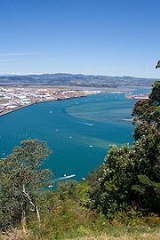
Tauranga is located around a large harbour which extends along the western Bay of Plenty, and is protected by Matakana Island and the extinct volcano of Mauao.
Situated along a faultline, Tauranga & the Bay of Plenty experience infrequent seismic activity, and there are a few volcanoes around the area (mainly dormant). The most notable of these are White Island and Mauao (Mount Maunganui), nicknamed "The Mount" by many locals).
Climate
Due to its sheltered position on the east coast, Tauranga enjoys a warm, dry climate. This has made it a popular location to retire to. During the summer months the population swells as the holidaymakers descend on the city, especially along the popular white coastal surf beaches from Mount Maunganui to Papamoa.
History
First settlers
The earliest known settlers arrived in Tauranga from the Takitimu and the Mataatua waka back in the 12th century. It was then named "Tauranga", which means the "landing place"..
Early trading
Traders in flax were active in the Bay of Plenty during the 1830s; some were transient, others married local women and settled permanently. The first permanent trader was James Farrow, who traveled to Tauranga in 1829, obtaining flax fibre for Australian merchants in exchange for muskets and gunpowder. Farrow acquired half an acre of land on 10 January 1838 at Otumoetai Pa from the chiefs Tupaea, Tangimoana and Te Omanu, the earliest authenticated land purchase in the Bay of Plenty.
Missionaries
During the 1820s, missionaries from the Bay of Islands visited the Tauranga district to obtain supplies of potatoes, pigs and flax. In 1840, a Catholic mission station was established. Bishop Pompallier was given land within the palisades of Otumoetai Pa for a church and a presbytery. The mission station closed in 1863 due to land wars in the Waikato district.
New Zealand land wars
The Tauranga Campaign took place in and around Tauranga from 21 January 1864 to 21 June 1864, during the land wars. The Battle of Gate Pa is the most well-known.
Modern age As of 2008, Tauranga is a fast growing city in New Zealand. The population at the was , meaning that the city has tripled in size in a little over 25 years. The population increase is due mostly to retirees settling in the city, and sun and surf seekers. It is also a popular lifestyle city. Although the population has increased dramatically, the city is proportionally underrepresented in businesses other than retail which is over-saturated, and the CBD reflects a city of less than half the population as that of Tauranga. This is mainly because of many outer suburb areas having shopping centres including Fraser Cove, Fashion Island and Palm Beach Plaza spreading retail dollars thin in the area as property values and rents are very high.
Under the Local Government (Tauranga City Council) Order 2003, Tauranga became (legally) a city for a second time from 1 March 2004.
Economy
Local industry
Much of the countryside surrounding Tauranga is horticultural land, used to grow a wide range of fresh produce for both domestic consumption and export. The area is particularly well known for growing tangelos (a grapefruit / tangerine cross), avocados, and kiwifruit. Recent years have seen the establishment of boutique vineyards and wineries.
The Port of Tauranga is New Zealand's largest export port, with brisk but seasonal shipping traffic. It is a regular stop for both container ships and luxury cruise liners.
Transport
Tauranga has many different options for transport. One of the main transportation methods in the City is using the local Bus. The Bay Hopper and the Go Bus are the most popular buses used.
The main transportation method in Tauranga is the Car. Everyday thousands of cars take to Tauranga's busy roads. The taxi, is another popular way for Tauranga locals to get around and Tauranga's City Airport provides daily domestic flights to all around the country.
Shopping
Shopping malls include Bayfair Shopping Centre and Palm Beach Plaza. Most of the city's shopping is suburban and located around the suburbs. Places include Fraser Cove Shopping, Bethlehem Shopping Centre, Fashion Island, Downtown the Mount, Brookfield, and Greeton Village. As of 2008, Tauranga CBD is undergoing renovations to attract more shoppers to the inner city.
Attractions
Greater Tauranga is a very popular retirement and tourism destination. It features many natural attractions and scenery.
Parks and Nature
Tauranga has many parks. One of the largest parks in the city is Memorial Park. Other parks in clude, Yatton Park, Kulim Park, Fergusson Park and the large Tauranga Domain.
Due to the temperate climate, outdoor activities are very popular in Tauranga, including golf, tramping (hiking), mountain biking and white water rafting. The Bay of Plenty coastline features miles of golden sandy beaches, and watersports are very popular pastimes. The most common include swimming, surfing, fishing, diving, kayaking & kitesurfing. Tourists also enjoy dolphin-watching on specially run boat trips.
Events The Montana Jazz Festival is one of the many that take place in Tauranga every Easter, with dozens of live acts, great food and excellent wine.
The New Years celebrations at the Mount in Mount Maunganui is one of Tauranga's
main events which brings swells of people from all around the country.
Population
Currently Tauranga is the ninth largest New Zealand city and the centre of the fifth largest urban area, recently taking over Dunedin, growing at a rate of 1.5% as of 2008.
In 1976, Tauranga was a medium-sized urban area, with a population of around 48,000 – smaller than Napier or Invercargill at that time.
The completion of a harbour bridge in 1988 brought Tauranga and ‘the Mount’ closer (they amalgamated in 1989) and has promoted growth in both parts of the enlarged city.
In 1996 Tauranga’s population was 82,092 and by 2006 it had reached 103,635.
In 2006, 17.4% of the population were 65 or over (compared to 12.3% nationally). But there are many in their teens and twenties. The city hosts four major head offices – Port of Tauranga, Zespri International, Ballance Agri-Nutrients Ltd and Trustpower.
Lifestyle
The coastal suburb Papamoa and neighbouring town Mount Maunganui are some of the more affluent areas around Tauranga. The region’s beaches attract swimmers, surfers, kayakers and kitesurfers throughout the year.
Accommodation options such as hotels, motels, holiday parks and lodges make the most of the coastal views.
Sports Tauranga has a large stadium complex in the Bayfair suburb, Baypark Stadium, built in 2001. It hosts Speedway events during summer and rugby matches in winter.
Housing
In recent years there has been a housing 'boom' which meant the huge increase of houses being built within Tauranga, especially in the largest suburb, Papamoa. Papamoa's huge growth has been due greatly to this boom and therefore made it the largest suburb in Tauranga. Some suburban areas within Papamoa that have been built up include The Gardens, Emerald Shores, Golden Sands, Palm Springs, and Tuihana. Although the Housing boom is officially over in Tauranga, construction is still occurring and suburbs are being built. These are The Papamoa Gateway Development, Papamoa Junction and Modena Beach
The main housing in Tauranga varies between suburbs, and range from wealthy beachfront mansions to older state houses in the lower income neighbourhoods. The most common type of housing is suburban houses with medium sized backyards. Many people live across from the beach. Tauranga is generally expensive when it comes to housing. As of 2008, the median for homes is around the $400,000 mark and vary from a low of around $200,000 to a high around $3 Million.
Education
Tauranga is home to the Bay of Plenty Polytechnic as well as a branch of the University of Waikato.
The main state secondary schools include:
Christian educational institutions in Tauranga include Bethlehem Campus, a college for both children and adults established in 1988; ,a state integrated Christian community school catering for Year 1 to 8 students and established in 1974; and , a Catholic college established in 2003.
Notable residents
Sister cities
See also
External links
|
| |
|
|