

Politics of Hong Kong

Encyclopedia
Politics of Hong Kong
takes place in a framework of a political system dominated by its constitutional document, the Basic Law of Hong Kong, its own legislature
, the Chief Executive
as the head of government
, and of a multi-party system
. Executive power
is exercised by the government.
On 1 July 1997, sovereignty of Hong Kong was transferred
to the People's Republic of China
(PRC), ending over one and a half centuries of British rule. Hong Kong became a Special Administrative Region (SAR) of the PRC with a high degree of autonomy in all matters except foreign affairs and defence, which are responsibilities of the PRC government. According to the Sino-British Joint Declaration
(1984) and the Basic Law
, Hong Kong will retain its political, economic, and judicial systems and unique way of life and continue to participate in international agreements and organisations as a dependent territory for at least 50 years after retrocession. For instance, the International Olympic Committee
recognises Hong Kong as a participating dependency under the name, "Hong Kong, China", separate from the delegation from the People's Republic of China
.
, Hong Kong has Special Administrative Region status, which provides constitutional guarantees for implementing the policy of "one country, two systems
". The government is economically liberal, but currently lacks universal suffrage
except for District Council
elections and Legislative council seats for geographical constituencies. The head of government (the Chief Executive of Hong Kong
) is elected indirectly through an electoral college
, the majority of whose members are appointed. The Basic Law
, Hong Kong's constitutional document, was approved in March 1990 by National People's Congress
of the PRC.
is the head of the special administrative region, and is also the highest ranking official in the Government of Hong Kong Special Administrative Region, and is the head of the executive branch. The Chief Executive is elected by an 800-member Election Committee drawn mostly from the voters in the functional constituencies but also from religious organisations and municipal and central government bodies. The Executive Council is entirely appointed by the Chief Executive.
(LegCo). The franchise for the other 30 seats is limited to about 180,000 voters in functional constituencies (composed of business and professional sectors).


, in such a way that the Government estimated would allow 1.6 million Mainland China
immigrants to enter Hong Kong within ten years. This caused widespread concerns among the public on the social and economic consequences.
While some in the legal sector advocated that the National People's Congress
(NPC) should be asked to amend the part of the Basic Law to redress the problem, the HKSAR Government decided to seek an interpretation to, rather than an amendment of, the relevant Basic Law provisions from the Standing Committee of the National People's Congress
(NPCSC). The NPCSC issued an interpretation in favour of the Hong Kong Government in June 1999, thereby overturning parts of the court decision. While the full powers of NPCSC to interpret the Basic Law is provided for in the Basic Law itself, some critics argues this undermines judicial independence
.
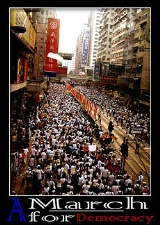
since the 1997 handover on the HKSAR establishment day
. However, it was only in 2003 when it drew large public attention by opposing the bill of the Article 23. It has become the annual platform for demanding universal suffrage, calling for observance and preservation civil liberties
such as free speech
, venting dissatisfaction with the Hong Kong Government or the Chief Executive, rallying against actions of the Pro-Beijing camp.
In 2003, the HKSAR Government proposed to implement Article 23 of the Basic Law by legislating against acts such as treason
, subversion, secession
and sedition
. However, there were concerns that the legislation would infringe human rights by introducing the mainland's concept of "national security" into the HKSAR. Together with the general dissatisfaction with the Tung administration, about 500,000 people participated in this protest. Article 23 enactment was "temporarily suspended".
stipulates that the ultimate goal is universal suffrage
; when and how to achieve that goal, however, remains open but controversial. Under the Basic Law, electoral law could be amended to allow for this as soon as 2007
(Hong Kong Basic Law Annex .1, Sect.7). Arguments over this issue seemed to be responsible for a series of Mainland Chinese newspapers commentaries in February 2004 which stated that power over Hong Kong was only fit for "patriots."
The interpretation of the NPCSC to Annex I and II of the Basic Law, promulgated on 6 April 2004, made it clear that the National People's Congress
' support is required over proposals to amend the electoral system under Basic Law. On 26 April 2004, the Standing Committee of National People's Congress denied the possibility of universal suffrage in 2007 (for the Chief Executive) and 2008 (for LegCo).
The NPCSC interpretation and decision were regarded as obstacles to the democratic development of Hong Kong by the democratic camp, and were criticised for lack of consultation with Hong Kong residents. On the other hand, the pro-government camp considered them to be in compliance with the legislative intent of the Basic Law and in line with the 'One country, two systems
' principle, and hoped that this would put an end to the controversies on development of political structure in Hong Kong.
In 2007 Chief Executive Sir Donald Tsang requested for Beijing to allow direct elections for the Chief Executive. He referred to a survey which said more than half of the citizens of Hong Kong wanted direct elections by 2012. However, he said waiting for 2017 may be the best way to get two-thirds of the support of Legislative Council. Donald Tsang announced that the NPC said it planned to allow the 2017 Chief Executive elections and the 2020 Legislative Council elections to take place by universal suffrage.
of the National People's Congress
exercised its right to interpret the Basic Law, and affirmed that the successor would only serve the remainder of the term. Many in Hong Kong saw this as an adverse impact on one country, two systems, as the Central People's Government
interpret the Basic Law to serve its need, that is, a two-year probation for Tsang, instead of a five-year term.
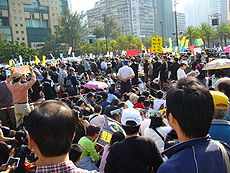 On 4 December 2005, people in Hong Kong demonstrated against Sir Donald Tsang
's proposed reform package, before a vote on 21 December. According to the organisers, an estimated 250,000 turned out into the streets. The police supplied a figure of 63,000, and Michael de Golyer of Baptist University estimated between 70,000 and 100,000.
The march has sent a strong message to hesitant pro-democracy legislators to follow public opinion. The pro-government camp claims to have collected 700,000 signatures on a petition backing Mr. Tsang's reform package. This number, however, is widely seen as too small to influence pro-democracy lawmakers. The Reform Package debate has seen the return of key political figure and former Chief Secretary Anson Chan
, raising speculations of a possible run up for the 2007 Chief Executive election, though she dismissed having a personal interest in standing for the next election.
In an attempt to win last minute votes from moderate pro-democracy lawmakers, the government amended its reform package on 19 December by proposing a gradual cut in the number of district council members appointed by the Chief Executive. Their number would be reduced from 102 to 68 by 2008. It would then be decided in 2011 whether to scrap the remaining seats in 2012 or in 2016.
The amendment has been seen as a reluctant response by Sir Donald Tsang to give satisfaction to the democratic demands made by demonstrators on 4 December. The move has been qualified "Too little, too late" by pan-democrats in general.
On 21 December 2005, the reform political reform package was vetoed by the pro-democracy lawmakers. Chief Secretary Rafael Hui
openly criticised pro-democracy Martin Lee
and Bishop Zen for blocking the proposed changes.
on 20 May, and nine Political Assistants on 22 May 2008. The posts were newly created, ostensibly to work closely with bureau secretaries and top civil servants in implementing the Chief Executive's policy blueprint and agenda in an executive-led government. Donald Tsang described the appointments as a milestone in the development of Hong Kong's political appointment system. Controversies arose with the disclosure of foreign passports and salaries. Pressure for disclosure continued to mount despite government insistence on the right of the individuals to privacy: on 10 June 2008, newly-appointed Undersecretaries and political assistants, who had previously argued were contractually forbidden from disclosing their remuneration, revealed their salaries. The Government news release stated that the appointees had "voluntarily disclosed their salaries, given the sustained public interest in the issue."
announced some "extraordinary measures for extraordinary times", giving a total of HK$11 billion in inflation relief to help families' finances. Of which, the Employee Retraining levy on the employment of Foreign domestic helpers
would be temporarily waived, at an estimated cost of $HK2 billion. It was intended that the levy would be waived for a two-year period on all helpers' employment contracts signed on or after 1 September 2008, but would not apply to ongoing contracts. The Immigration Department said it would not reimburse levies, which are prepaid half-yearly or yearly in advance. The announcement resulted in chaos and confusion, and uncertainty for the helpers as some employers deferred contracts or had dismissed helpers pending confirmation of the effective date, leaving helpers in limbo.
On 20 July, Secretary for Labour and Welfare
Matthew Cheung
announced the waiver commencement date would be brought forward by one month. The Immigration Department would relax its 14-day re-employment requirement for helpers whose contracts expired. On 30 July, the Executive Council
approved the measures. After widespread criticism of the situation, the government also conceded that maids having advanced renewal of contract would not be required to leave Hong Kong through the discretion exercised by the Director of Immigration
, and employers would benefit from the waiver simply by renewing the contract within the two-year period, admitting that some employers could benefit from the waiver for up to 4 years. The administration's poor handling of the matter came in for heavy criticism. The administrative credibility and competence were called into question by journals from all sides of the political spectrum, and by helpers and employers alike.
as deputy managing director and executive director of New World China Land
, subsidiary of New World Development
, was greeted with uproar amidst widespread public suspicion that job offer was a quid pro quo
for the favours he allegedly granted to NWD. Leung was seen to have been involved with the sale of the Hung Hom Peninsula HOS
public housing estate
to NWD at under-value in 2004.
After a 12-month 'sterilisation period' after retirement, Leung submitted an application to the government on 9 May for approval to take up employment with New World China Land. The Secretary for the Civil Service
, Denise Yue Chung-yee
, signed off on the approval for him to take up the job after his request passed through the vetting committee.
Controversies surrounded not only the suspicions of Leung's own conflict of interest, but also of the insensitivity of the committee which recommended the approval for him to take up his lucrative new job less than two years after his official retirement. New World argued that they hired Leung in good faith after government clearance.
On 15 August, the Civil Service Bureau
issued the report requested by Donald Tsang, where they admitted that they had neglected to consider Leung's role in the Hung Hom Peninsula affair. Donald Tsang asked the SCS to reassess the approval, and submit a report to him. New World Development announced in the early hours of 16 August that Leung had resigned from his post, without any compensation from either side or from the government, for the termination.
The next day, Donald Tsang confirmed that Denise Yue would not have to resign. He was satisfied with her apology and with the explanations offered by her. Tsang ordered a committee, of which Yue was to be a member, to be set up to perform a sweeping review of the system to process applications for former civil servants.
to trigger a by-election in response to the lack of progress in the move towards universal suffrage. They want to use the by-election as a de facto referendum for universal suffrage and the abolition of the functional constituencies
.

, the People's Republic of China has recognised ethnic Chinese people in Hong Kong as its citizens. The PRC issues Home Return Permit
s for them to enter mainland China
. Hong Kong issues the HKSAR passport through its Immigration Department. to all PRC citizens who are permanent residents of Hong Kong fitting the right of abode
rule.
The HKSAR passport is not the same as the ordinary PRC passport
, which is issued to residents of mainland China
. Only permanent residents of Hong Kong who are PRC citizens are eligible to apply. To acquire the status of permanent resident one has to have "ordinarily resided" in Hong Kong for a period of seven years and adopted Hong Kong as their permanent home. Therefore, citizenships rights enjoyed by residents of mainland China and residents Hong Kong are differentiated even though both hold the same citizenship.
Interestingly, new immigrants from mainland China (still possess Chinese Citizenship) to Hong Kong are denied from getting PRC passport from the mainland authorities, and are not eligible to apply for an HKSAR passport. They usually hold the Document of Identity
(DI) as the travel document, until the permanent resident status is obtained after seven years of residence.
Naturalisation as a PRC Citizen is common among ethnic Chinese people in Hong Kong who are not PRC Citizens. Some who have surrendered their PRC citizenship, usually those who have emigrated to foreign countries and have retained the permanent resident status, can apply for PRC citizenship at the Immigration Department, though they must renounce their original nationality in order to acquire the PRC citizenship.
Naturalisation of persons of non-Chinese ethnicity are rare because China does not allow dual citizenship and becoming a Chinese citizen requires the renouncement of other passports. A notable example is Michael Rowse
, a permanent resident of Hong Kong and the current Director-General of Investment Promotion of Hong Kong Government, naturalised and became a PRC citizen, for the offices of secretaries of the policy bureaux
are only open to PRC citizens.
In 2008, a row erupted over political appointees
. Five newly appointed Undersecretaries
declared that they were in the process of renouncing foreign citizenship as at 4 June 2008, citing public opinion
as an overriding factor, and one Assistant had initiated the renunciation process. This was done despite there being no legal or constitutional barrier for officials at this level of government to have foreign nationality.
(BN(O)) that Hong Kong British Dependent Territories citizens could apply for. Holders of the BN(O) passports, however, have no right of abode in the UK. See British nationality law and Hong Kong
for details.
British National (Overseas) status was given effect by the Hong Kong (British Nationality) Order 1986. Article 4(1) of the Order provided that on and after 1 July 1987, there would be a new form of British nationality, the holders of which would be known as British Nationals (Overseas). Article 4(2) of the Order provided that adults and minors who had a connection to Hong Kong were entitled to make an application to become British Nationals (Overseas) by registration.
Becoming a British National (Overseas) was therefore not an automatic or involuntary process and indeed many eligible people who had the requisite connection with Hong Kong never applied to become British Nationals (Overseas). Acquisition of the new status had to be voluntary and therefore a conscious act. To make it involuntary or automatic would have been contrary to the assurances given to the Chinese government which led to the words "eligible to" being used in paragraph (a) of the United Kingdom Memorandum to the Sino-British Joint Declaration
. The deadline for applications passed in 1997. Any person who failed to register as a British Nationals (Overseas) by 1 July 1997 and were eligible to become PRC citizens became solely PRC citizens on 1 July 1997. However, any person who would be rendered stateless by failure to register as a British Nationals (Overseas) automatically became a British Overseas citizen under article 6(1) of the Hong Kong (British Nationality) Order 1986.
After the Tiananmen Square protests of 1989
, people urged the British Government to grant full British citizenship to all Hong Kong BDTCs – but this request was never accepted. However, it was considered necessary to devise a British Nationality Selection Scheme
to enable some of the population to obtain British citizenship. The United Kingdom made provision to grant citizenship to 50,000 families whose presence was important to the future of Hong Kong under the British Nationality Act (Hong Kong) 1990.
After reunification, all PRC citizens with the right of abode in Hong Kong (holding Hong Kong permanent identity cards) are eligible to apply for the HKSAR passport issued by the Hong Kong Immigration Department. As the visa-free-visit destinations of the HKSAR passport are very similar with that of a BN(O) passport and the application fee for the former is much lower (see articles HKSAR passport
and British passport
for comparison and verification), the HKSAR passport is becoming more popular among residents of Hong Kong.
Hong Kong residents who were not born in Hong Kong (and had not naturalised as a BDTC) could only apply for the Certificate of identity
(CI) from the colonial government as travel document. They are not issued (by neither the British nor Chinese authorities) after handover. Former CI holders holding PRC Citizenship (e.g. born in mainland China or Macau) and are permanent residents of Hong Kong are now eligible for the HKSAR passports, making the HKSAR passports more popular.
Recent changes to India's Citizenship Act, 1955 (see Indian nationality law
) will also allow some children of Indian origin, born in Hong Kong after 7 January 2004, who have a solely BN(O) parent to automatically acquire British Overseas citizenship at birth under the provisions for reducing statelessness in article 6(2) or 6(3) of the Hong Kong (British Nationality) Order 1986. If they have acquired no other nationality after birth, they will be entitled to subsequently register for full British citizenship with right of abode in the UK.
Others include:
The Alliance for Universal Suffrage
is a grouping of 11 democratic parties and entities, including the Democratic Party.
Hong Kong
Hong Kong is one of two Special Administrative Regions of the People's Republic of China , the other being Macau. A city-state situated on China's south coast and enclosed by the Pearl River Delta and South China Sea, it is renowned for its expansive skyline and deep natural harbour...
takes place in a framework of a political system dominated by its constitutional document, the Basic Law of Hong Kong, its own legislature
Legislative Council of Hong Kong
The Legislative Council is the unicameral legislature of Hong Kong.-History:The Legislative Council of Hong Kong was set up in 1843 as a colonial legislature under British rule...
, the Chief Executive
Chief Executive of Hong Kong
The Chief Executive of Hong Kong is the President of the Executive Council of Hong Kong and head of the Government of the Hong Kong Special Administrative Region. The position was created to replace the Governor of Hong Kong, who was the head of the Hong Kong government during British rule...
as the head of government
Head of government
Head of government is the chief officer of the executive branch of a government, often presiding over a cabinet. In a parliamentary system, the head of government is often styled prime minister, chief minister, premier, etc...
, and of a multi-party system
Multi-party system
A multi-party system is a system in which multiple political parties have the capacity to gain control of government separately or in coalition, e.g.The Conservative-Liberal Democrat coalition in the United Kingdom formed in 2010. The effective number of parties in a multi-party system is normally...
. Executive power
Executive Power
Executive Power is Vince Flynn's fifth novel, and the fourth to feature Mitch Rapp, an American agent that works for the CIA as an operative for a covert counter terrorism unit called the "Orion Team."-Plot summary:...
is exercised by the government.
On 1 July 1997, sovereignty of Hong Kong was transferred
Transfer of the sovereignty of Hong Kong
The transfer of sovereignty over Hong Kong from the United Kingdom to the People's Republic of China, referred to as ‘the Return’ or ‘the Reunification’ by the Chinese and ‘the Handover’ by others, took place on 1 July 1997...
to the People's Republic of China
People's Republic of China
China , officially the People's Republic of China , is the most populous country in the world, with over 1.3 billion citizens. Located in East Asia, the country covers approximately 9.6 million square kilometres...
(PRC), ending over one and a half centuries of British rule. Hong Kong became a Special Administrative Region (SAR) of the PRC with a high degree of autonomy in all matters except foreign affairs and defence, which are responsibilities of the PRC government. According to the Sino-British Joint Declaration
Sino-British Joint Declaration
The Sino-British Joint Declaration, formally known as the Joint Declaration of the Government of the United Kingdom of Great Britain and Northern Ireland and the Government of the People's Republic of China on the Question of Hong Kong, was signed by the Prime Ministers, Zhao Ziyang and Margaret...
(1984) and the Basic Law
Hong Kong Basic Law
The Basic Law of the Hong Kong Special Administrative Region of the People's Republic of China, or simply Hong Kong Basic Law, serves as the constitutional document of the Hong Kong Special Administrative Region of the People's Republic of China...
, Hong Kong will retain its political, economic, and judicial systems and unique way of life and continue to participate in international agreements and organisations as a dependent territory for at least 50 years after retrocession. For instance, the International Olympic Committee
International Olympic Committee
The International Olympic Committee is an international corporation based in Lausanne, Switzerland, created by Pierre de Coubertin on 23 June 1894 with Demetrios Vikelas as its first president...
recognises Hong Kong as a participating dependency under the name, "Hong Kong, China", separate from the delegation from the People's Republic of China
People's Republic of China
China , officially the People's Republic of China , is the most populous country in the world, with over 1.3 billion citizens. Located in East Asia, the country covers approximately 9.6 million square kilometres...
.
Overview
In accordance with Article 31 of the Constitution of the People's Republic of ChinaConstitution of the People's Republic of China
The Constitution of the People's Republic of China is the highest law within the People's Republic of China. The current version was adopted by the 5th National People's Congress on December 4, 1982 with further revisions in 1988, 1993, 1999, and 2004. Three previous state constitutions—those of...
, Hong Kong has Special Administrative Region status, which provides constitutional guarantees for implementing the policy of "one country, two systems
One country, two systems
"One country, two systems" is an idea originally proposed by Deng Xiaoping, then Paramount Leader of the People's Republic of China , for the reunification of China during the early 1980s...
". The government is economically liberal, but currently lacks universal suffrage
Universal suffrage
Universal suffrage consists of the extension of the right to vote to adult citizens as a whole, though it may also mean extending said right to minors and non-citizens...
except for District Council
District Council of Hong Kong
The District Councils, formerly District Boards until 1999, are the local councils for the 18 Districts of Hong Kong. Under the supervision of Home Affairs Bureau of the Hong Kong Government, they are consultative bodies on district administration and affairs.- History :In 1982, under the...
elections and Legislative council seats for geographical constituencies. The head of government (the Chief Executive of Hong Kong
Chief Executive of Hong Kong
The Chief Executive of Hong Kong is the President of the Executive Council of Hong Kong and head of the Government of the Hong Kong Special Administrative Region. The position was created to replace the Governor of Hong Kong, who was the head of the Hong Kong government during British rule...
) is elected indirectly through an electoral college
Election Committee
The Election Committee is an 800-member electoral college in the politics of Hong Kong. It was established by Annex I of the Basic Law of Hong Kong. This article defines the method of electing the Chief Executive. It is renewed every five years when the sitting Chief Executive's term has expired...
, the majority of whose members are appointed. The Basic Law
Hong Kong Basic Law
The Basic Law of the Hong Kong Special Administrative Region of the People's Republic of China, or simply Hong Kong Basic Law, serves as the constitutional document of the Hong Kong Special Administrative Region of the People's Republic of China...
, Hong Kong's constitutional document, was approved in March 1990 by National People's Congress
National People's Congress
The National People's Congress , abbreviated NPC , is the highest state body and the only legislative house in the People's Republic of China. The National People's Congress is held in the Great Hall of the People, Beijing, capital of the People's Republic of China; with 2,987 members, it is the...
of the PRC.
Executive branch
The Chief ExecutiveChief Executive of Hong Kong
The Chief Executive of Hong Kong is the President of the Executive Council of Hong Kong and head of the Government of the Hong Kong Special Administrative Region. The position was created to replace the Governor of Hong Kong, who was the head of the Hong Kong government during British rule...
is the head of the special administrative region, and is also the highest ranking official in the Government of Hong Kong Special Administrative Region, and is the head of the executive branch. The Chief Executive is elected by an 800-member Election Committee drawn mostly from the voters in the functional constituencies but also from religious organisations and municipal and central government bodies. The Executive Council is entirely appointed by the Chief Executive.
Legislative branch
In accordance with Article 26 of the Basic Law of the Hong Kong Special Administrative Region, permanent residents of Hong Kong are eligible to vote in direct elections for the 30 seats representing geographical constituencies in the 60-seat, unicameral Legislative CouncilLegislative Council of Hong Kong
The Legislative Council is the unicameral legislature of Hong Kong.-History:The Legislative Council of Hong Kong was set up in 1843 as a colonial legislature under British rule...
(LegCo). The franchise for the other 30 seats is limited to about 180,000 voters in functional constituencies (composed of business and professional sectors).
Judicial branch
The Judiciary consists of a series of courts, of which the court of final adjudication is the Court of Final Appeal.Major political issues in recent years
Right of Abode
On 29 January 1999, the Court of Final Appeal, the highest judicial authority in Hong Kong interpreted several Articles of the Basic LawHong Kong Basic Law
The Basic Law of the Hong Kong Special Administrative Region of the People's Republic of China, or simply Hong Kong Basic Law, serves as the constitutional document of the Hong Kong Special Administrative Region of the People's Republic of China...
, in such a way that the Government estimated would allow 1.6 million Mainland China
Mainland China
Mainland China, the Chinese mainland or simply the mainland, is a geopolitical term that refers to the area under the jurisdiction of the People's Republic of China . According to the Taipei-based Mainland Affairs Council, the term excludes the PRC Special Administrative Regions of Hong Kong and...
immigrants to enter Hong Kong within ten years. This caused widespread concerns among the public on the social and economic consequences.
While some in the legal sector advocated that the National People's Congress
National People's Congress
The National People's Congress , abbreviated NPC , is the highest state body and the only legislative house in the People's Republic of China. The National People's Congress is held in the Great Hall of the People, Beijing, capital of the People's Republic of China; with 2,987 members, it is the...
(NPC) should be asked to amend the part of the Basic Law to redress the problem, the HKSAR Government decided to seek an interpretation to, rather than an amendment of, the relevant Basic Law provisions from the Standing Committee of the National People's Congress
Standing Committee of the National People's Congress
The Standing Committee of the National People's Congress is a committee of about 150 members of the National People's Congress of the People's Republic of China , which is convened between plenary sessions of the NPC. It has the constitutional authority to modify legislation within limits set by...
(NPCSC). The NPCSC issued an interpretation in favour of the Hong Kong Government in June 1999, thereby overturning parts of the court decision. While the full powers of NPCSC to interpret the Basic Law is provided for in the Basic Law itself, some critics argues this undermines judicial independence
Judicial independence
Judicial Independence is the idea that the judiciary needs to be kept away from the other branches of government...
.
1 July marches and Article 23
The Hong Kong 1 July March is an annual protest rally led by the Civil Human Rights FrontCivil Human Rights Front
Civil Human Rights Front or CHRF is an organization that focuses on the issues of Hong Kong politics and livelihood, affiliates almost all the pan-democratic camps in Hong Kong. Forty-eight NGOs and political groups have been involved in the organization as of January 2006...
since the 1997 handover on the HKSAR establishment day
Hong Kong Special Administrative Region Establishment Day
Hong Kong Special Administrative Region Establishment Day is celebrated every 1 July, in Hong Kong since 1997. The holiday commemorates the transfer of the sovereignty of Hong Kong from the United Kingdom to the People's Republic of China and the establishment of the Hong Kong Special...
. However, it was only in 2003 when it drew large public attention by opposing the bill of the Article 23. It has become the annual platform for demanding universal suffrage, calling for observance and preservation civil liberties
Civil liberties
Civil liberties are rights and freedoms that provide an individual specific rights such as the freedom from slavery and forced labour, freedom from torture and death, the right to liberty and security, right to a fair trial, the right to defend one's self, the right to own and bear arms, the right...
such as free speech
Freedom of speech
Freedom of speech is the freedom to speak freely without censorship. The term freedom of expression is sometimes used synonymously, but includes any act of seeking, receiving and imparting information or ideas, regardless of the medium used...
, venting dissatisfaction with the Hong Kong Government or the Chief Executive, rallying against actions of the Pro-Beijing camp.
In 2003, the HKSAR Government proposed to implement Article 23 of the Basic Law by legislating against acts such as treason
Treason
In law, treason is the crime that covers some of the more extreme acts against one's sovereign or nation. Historically, treason also covered the murder of specific social superiors, such as the murder of a husband by his wife. Treason against the king was known as high treason and treason against a...
, subversion, secession
Secession
Secession is the act of withdrawing from an organization, union, or especially a political entity. Threats of secession also can be a strategy for achieving more limited goals.-Secession theory:...
and sedition
Sedition
In law, sedition is overt conduct, such as speech and organization, that is deemed by the legal authority to tend toward insurrection against the established order. Sedition often includes subversion of a constitution and incitement of discontent to lawful authority. Sedition may include any...
. However, there were concerns that the legislation would infringe human rights by introducing the mainland's concept of "national security" into the HKSAR. Together with the general dissatisfaction with the Tung administration, about 500,000 people participated in this protest. Article 23 enactment was "temporarily suspended".
Universal suffrage
Towards the end of 2003, the focus of political controversy shifted to the dispute of how subsequent Chief Executives get elected. The Basic Law's Article 45Hong Kong Basic Law Article 45
Hong Kong Basic Law Article 45 is a controversial article in the Basic Law of Hong Kong. It states that the Chief executive should be chosen by universal suffrage as an eventual goal. Its speedy implementation is advocated by the Basic Law Article 45 Concern Group.-Contents of Article 45:Article...
stipulates that the ultimate goal is universal suffrage
Universal suffrage
Universal suffrage consists of the extension of the right to vote to adult citizens as a whole, though it may also mean extending said right to minors and non-citizens...
; when and how to achieve that goal, however, remains open but controversial. Under the Basic Law, electoral law could be amended to allow for this as soon as 2007
Hong Kong Chief Executive election, 2007
An election was held on 25 March 2007 to select the Chief Executive of Hong Kong at AsiaWorld-Expo. The third Chief Executive term began on 1 July 2007...
(Hong Kong Basic Law Annex .1, Sect.7). Arguments over this issue seemed to be responsible for a series of Mainland Chinese newspapers commentaries in February 2004 which stated that power over Hong Kong was only fit for "patriots."
The interpretation of the NPCSC to Annex I and II of the Basic Law, promulgated on 6 April 2004, made it clear that the National People's Congress
National People's Congress
The National People's Congress , abbreviated NPC , is the highest state body and the only legislative house in the People's Republic of China. The National People's Congress is held in the Great Hall of the People, Beijing, capital of the People's Republic of China; with 2,987 members, it is the...
' support is required over proposals to amend the electoral system under Basic Law. On 26 April 2004, the Standing Committee of National People's Congress denied the possibility of universal suffrage in 2007 (for the Chief Executive) and 2008 (for LegCo).
The NPCSC interpretation and decision were regarded as obstacles to the democratic development of Hong Kong by the democratic camp, and were criticised for lack of consultation with Hong Kong residents. On the other hand, the pro-government camp considered them to be in compliance with the legislative intent of the Basic Law and in line with the 'One country, two systems
One country, two systems
"One country, two systems" is an idea originally proposed by Deng Xiaoping, then Paramount Leader of the People's Republic of China , for the reunification of China during the early 1980s...
' principle, and hoped that this would put an end to the controversies on development of political structure in Hong Kong.
In 2007 Chief Executive Sir Donald Tsang requested for Beijing to allow direct elections for the Chief Executive. He referred to a survey which said more than half of the citizens of Hong Kong wanted direct elections by 2012. However, he said waiting for 2017 may be the best way to get two-thirds of the support of Legislative Council. Donald Tsang announced that the NPC said it planned to allow the 2017 Chief Executive elections and the 2020 Legislative Council elections to take place by universal suffrage.
Resignation of Tung Chee-hwa and interpretation of Basic Law
On 12 March 2005, the Chief Executive, Tung Chee-hwa, resigned. Immediately after Tung's resignation, there was dispute over the length of the term of the Chief Executive. To most local legal professionals, the length is obviously five years, under whatever circumstances. It should also be noted that the wording of the Basic Law on the term of the Chief Executive is substantially different from the articles in the PRC constitution concerning the length of term of the president, premier, etc. Nonetheless, legal experts from the mainland said it is a convention a successor will only serve the remainder of the term if the position is vacant because the predecessor resigned. The Standing CommitteeStanding Committee of the National People's Congress
The Standing Committee of the National People's Congress is a committee of about 150 members of the National People's Congress of the People's Republic of China , which is convened between plenary sessions of the NPC. It has the constitutional authority to modify legislation within limits set by...
of the National People's Congress
National People's Congress
The National People's Congress , abbreviated NPC , is the highest state body and the only legislative house in the People's Republic of China. The National People's Congress is held in the Great Hall of the People, Beijing, capital of the People's Republic of China; with 2,987 members, it is the...
exercised its right to interpret the Basic Law, and affirmed that the successor would only serve the remainder of the term. Many in Hong Kong saw this as an adverse impact on one country, two systems, as the Central People's Government
Central People's Government
The Central People's Government is the central government of the People's Republic of China in Beijing. According to the 1982 Constitution, "Central People's Government" is synonymous with the State Council.-History:...
interpret the Basic Law to serve its need, that is, a two-year probation for Tsang, instead of a five-year term.
Political reform package
Donald Tsang
Sir Donald Tsang Yam-kuen, GBM, KBE is the current Chief Executive and President of the Executive Council of the Government of Hong Kong....
's proposed reform package, before a vote on 21 December. According to the organisers, an estimated 250,000 turned out into the streets. The police supplied a figure of 63,000, and Michael de Golyer of Baptist University estimated between 70,000 and 100,000.
The march has sent a strong message to hesitant pro-democracy legislators to follow public opinion. The pro-government camp claims to have collected 700,000 signatures on a petition backing Mr. Tsang's reform package. This number, however, is widely seen as too small to influence pro-democracy lawmakers. The Reform Package debate has seen the return of key political figure and former Chief Secretary Anson Chan
Anson Chan
Anson Maria Elizabeth Chan Fang On-sang GBM GCMG CBE JP was a member of the Legislative Council of Hong Kong for Hong Kong Island, succeeding the late legislator Ma Lik....
, raising speculations of a possible run up for the 2007 Chief Executive election, though she dismissed having a personal interest in standing for the next election.
In an attempt to win last minute votes from moderate pro-democracy lawmakers, the government amended its reform package on 19 December by proposing a gradual cut in the number of district council members appointed by the Chief Executive. Their number would be reduced from 102 to 68 by 2008. It would then be decided in 2011 whether to scrap the remaining seats in 2012 or in 2016.
The amendment has been seen as a reluctant response by Sir Donald Tsang to give satisfaction to the democratic demands made by demonstrators on 4 December. The move has been qualified "Too little, too late" by pan-democrats in general.
On 21 December 2005, the reform political reform package was vetoed by the pro-democracy lawmakers. Chief Secretary Rafael Hui
Rafael Hui
Rafael Hui Si-yan, GBM GBS JP was the former Chief Secretary for Administration of Hong Kong and a former career civil servant. Hui has been dubbed "Old Master Hui" and "Fat Dragon" . Hui was appointed as a Justice of the Peace on 1986 and received the honour of Gold Bauhinia Star in 1998.Hui...
openly criticised pro-democracy Martin Lee
Martin Lee
Martin Lee , QC, SC, JP, was the founding chairman of the Democratic Party in Hong Kong. He was a directly-elected Member of the Legislative Council of Hong Kong for the Hong Kong Island geographical constituency...
and Bishop Zen for blocking the proposed changes.
Political Appointments System
The 24 non-civil-service positions under the political appointment system comprise 11 undersecretaries and 13 political assistants. The government named eight newly appointed UndersecretariesUndersecretary
An under secretary is an executive government official in many countries, frequently a career public servant, who typically acts as a senior administrator or second-in-command to a politically-appointed Cabinet Minister or other government official...
on 20 May, and nine Political Assistants on 22 May 2008. The posts were newly created, ostensibly to work closely with bureau secretaries and top civil servants in implementing the Chief Executive's policy blueprint and agenda in an executive-led government. Donald Tsang described the appointments as a milestone in the development of Hong Kong's political appointment system. Controversies arose with the disclosure of foreign passports and salaries. Pressure for disclosure continued to mount despite government insistence on the right of the individuals to privacy: on 10 June 2008, newly-appointed Undersecretaries and political assistants, who had previously argued were contractually forbidden from disclosing their remuneration, revealed their salaries. The Government news release stated that the appointees had "voluntarily disclosed their salaries, given the sustained public interest in the issue."
Inflation relief measures
On 16 July 2008, Donald TsangDonald Tsang
Sir Donald Tsang Yam-kuen, GBM, KBE is the current Chief Executive and President of the Executive Council of the Government of Hong Kong....
announced some "extraordinary measures for extraordinary times", giving a total of HK$11 billion in inflation relief to help families' finances. Of which, the Employee Retraining levy on the employment of Foreign domestic helpers
Foreign domestic helpers in Hong Kong
Foreign domestic helpers in Hong Kong are foreign domestic workers and housemaids employed by Hongkongers, typically families. They make up approximately 3% of the population of Hong Kong and an overwhelming majority of them are women...
would be temporarily waived, at an estimated cost of $HK2 billion. It was intended that the levy would be waived for a two-year period on all helpers' employment contracts signed on or after 1 September 2008, but would not apply to ongoing contracts. The Immigration Department said it would not reimburse levies, which are prepaid half-yearly or yearly in advance. The announcement resulted in chaos and confusion, and uncertainty for the helpers as some employers deferred contracts or had dismissed helpers pending confirmation of the effective date, leaving helpers in limbo.
On 20 July, Secretary for Labour and Welfare
Secretary for Labour and Welfare
The Secretary for Labour and Welfare of the Hong Kong Government is responsible for labour and social welfare policy in Hong Kong. The position was created in 2007 to replace portions of the previous portfolio of Secretary for Economic Development and Labour and welfare portion from Secretary for...
Matthew Cheung
Matthew Cheung
Matthew Cheung Kin-chung, GBS, JP is the Secretary for Labour and Welfare in the Hong Kong Government.Matthew Cheung served as civil servant in the Information Officer Grade of the government in 1972, and he transferred to the Administrative Service in 1979...
announced the waiver commencement date would be brought forward by one month. The Immigration Department would relax its 14-day re-employment requirement for helpers whose contracts expired. On 30 July, the Executive Council
Executive Council of Hong Kong
The Executive Council of Hong Kong is a core policy-making organ in the executive branch of the government of Hong Kong.. The Chief Executive of Hong Kong serves as its President.The Executive Council normally meets once a week...
approved the measures. After widespread criticism of the situation, the government also conceded that maids having advanced renewal of contract would not be required to leave Hong Kong through the discretion exercised by the Director of Immigration
Director of Immigration
The Director of Immigration is the head of the Immigration Department of the Hong Kong Government, which is responsible for immigration issues and controlling entry ports into Hong Kong.-List of Directors of Immigration:* J. Moore...
, and employers would benefit from the waiver simply by renewing the contract within the two-year period, admitting that some employers could benefit from the waiver for up to 4 years. The administration's poor handling of the matter came in for heavy criticism. The administrative credibility and competence were called into question by journals from all sides of the political spectrum, and by helpers and employers alike.
Leung Chin-man appointment
In August 2008, the appointment of Leung Chin-manLeung Chin-man
Leung Chin-man JP is a retired senior civil servant in the Government of Hong Kong the former Permanent Secretary for Housing, Planning and Lands.-Government career:...
as deputy managing director and executive director of New World China Land
New World China Land
New World China Land Limited is the Mainland China property flagship of Hong Kong's New World Development, owned by Dr. Cheng Yu-tung's family.It is incorporated in the Cayman Islands with limited liability. It is engaged in property development projects in Mainland China, including property...
, subsidiary of New World Development
New World Development
New World Development Company Limited , based in Hong Kong, is active in property, infrastructure, services and telecommunications. It was established in 1970 with Dr Ho Sin Hang as Chairman and Chow Chi Yuen as Director and General Manager...
, was greeted with uproar amidst widespread public suspicion that job offer was a quid pro quo
Quid pro quo
Quid pro quo most often means a more-or-less equal exchange or substitution of goods or services. English speakers often use the term to mean "a favour for a favour" and the phrases with almost identical meaning include: "give and take", "tit for tat", "this for that", and "you scratch my back,...
for the favours he allegedly granted to NWD. Leung was seen to have been involved with the sale of the Hung Hom Peninsula HOS
Home Ownership Scheme
The Home Ownership Scheme is a subsidized-sale programme of public housing in Hong Kong managed by the Hong Kong Housing Authority...
public housing estate
Public housing in Hong Kong
Public housing in Hong Kong is a set of mass housing programmes through which the Government of Hong Kong provides affordable housing for lower-income residents. It is a major component of housing in Hong Kong, with nearly half of the population now residing in some form of public housing...
to NWD at under-value in 2004.
After a 12-month 'sterilisation period' after retirement, Leung submitted an application to the government on 9 May for approval to take up employment with New World China Land. The Secretary for the Civil Service
Secretary for the Civil Service
The Secretary for the Civil Service is the head of the Civil Service Bureau in Hong Kong. Unlike other secretaries for bureaux, the Secretary for the Civil Service is filled by an administrative officer from the civil service, who may choose to return to the civil service when his term expires...
, Denise Yue Chung-yee
Denise Yue
Denise Yue Chung-yee GBS JP is a Hong Kong politician and Secretary for the Civil Service.-Education:Denise Yue graduated from the University of Hong Kong in 1974 and she attended Harvard University in 1988 obtaining an MPA during her civil service career....
, signed off on the approval for him to take up the job after his request passed through the vetting committee.
Controversies surrounded not only the suspicions of Leung's own conflict of interest, but also of the insensitivity of the committee which recommended the approval for him to take up his lucrative new job less than two years after his official retirement. New World argued that they hired Leung in good faith after government clearance.
On 15 August, the Civil Service Bureau
Civil Service Bureau
The Civil Service Bureau of Hong Kong is responsible for the formulation and implementation of policies on the management of the Hong Kong Civil Service. The primary role of the civil service is to serve the community....
issued the report requested by Donald Tsang, where they admitted that they had neglected to consider Leung's role in the Hung Hom Peninsula affair. Donald Tsang asked the SCS to reassess the approval, and submit a report to him. New World Development announced in the early hours of 16 August that Leung had resigned from his post, without any compensation from either side or from the government, for the termination.
The next day, Donald Tsang confirmed that Denise Yue would not have to resign. He was satisfied with her apology and with the explanations offered by her. Tsang ordered a committee, of which Yue was to be a member, to be set up to perform a sweeping review of the system to process applications for former civil servants.
May 2010 by-election
In January 2010, five pan-democrats resigned from the Legislative Council of Hong KongLegislative Council of Hong Kong
The Legislative Council is the unicameral legislature of Hong Kong.-History:The Legislative Council of Hong Kong was set up in 1843 as a colonial legislature under British rule...
to trigger a by-election in response to the lack of progress in the move towards universal suffrage. They want to use the by-election as a de facto referendum for universal suffrage and the abolition of the functional constituencies
Functional constituency
In the political systems of Hong Kong and Macau, a functional constituency is a professional or special interest group involved in the electoral process...
.
Other political issues since 1997
| Year | Event |
|---|---|
| 2001 | The Grand bauhinia medal being bestowed on Yeung Kwong Yeung Kwong Yeung Kwong, GBM is a Hong Kong Communist activist and murderer in the 1960s. He was awarded the Grand Bauhinia Medal in 2001, when the Hong Kong government was under chief executive Tung Chee-Hwa, who has close ties to the PRC government... , a leader of the Hong Kong 1967 Leftist Riots. |
| 2003 | Central and Wan Chai Reclamation controversy Harbour Fest controversy Harbour Fest The Hong Kong Harbour Fest , held from 17 October to 11 November 2003, was part of a HK$1 billion program to revive the economy of Hong Kong SAR after the SARS. It was a government underwritten event organised by InvestHK, under the auspices of the Economic Relaunch Working Group, in collaboration... |
| 2005 | The Link REIT IPO controversy Arrest of journalist Ching Cheong Ching Cheong Ching Cheong is a senior journalist with The Straits Times. He is best known for having been detained by the People's Republic of China on allegations of spying for Taiwan. He was imprisoned from April 2005 to February 2008, spending more than 1000 days in prison. Human rights advocates and... by the People's Republic of China People's Republic of China China , officially the People's Republic of China , is the most populous country in the world, with over 1.3 billion citizens. Located in East Asia, the country covers approximately 9.6 million square kilometres... on spying charges Ma Ying-jeou Ma Ying-jeou Ma Ying-jeou is the 12th term and current President of the Republic of China , commonly known as Taiwan, and the Chairman of the Kuomintang Party, also known as the Chinese Nationalist Party. He formerly served as Justice Minister from 1993 to 1996, Mayor of Taipei from 1998 to 2006, and Chairman... denied visa to enter Hong Kong |
| 2006 | Aborted proposal to grant development rights for the West Kowloon Cultural District West Kowloon Cultural District The West Kowloon Cultural District is a proposed and developing project to boost cultural and entertainment establishments at Hong Kong, SAR... to a single developer. Aborted proposal to introduce a Goods and Services Tax Goods and Services Tax (Hong Kong) Goods and Services Tax was a proposed Value Added Tax in Hong Kong. Consultation over a period of nine months was launched on 2006-07-19 and stirred considerable controversy.... Battle for conservation of Star Ferry Pier |
| 2007 | Battle for conservation of Queen's Pier. Hong Kong Institute of Education academic freedom controversy Hong Kong Institute of Education The Hong Kong Institute of Education is one of eight subsidised tertiary institutes under the University Grants Committee of Hong Kong. It is the only one dedicated to teacher education.... |
| 2009 | Johannes Chan Johannes Chan Johannes Chan Man-mun , SC is the Dean of the Faculty of Law for the University of Hong Kong. He is a practising barrister-at-law who specializes in human rights, constitutional and administrative law... Macau ban Consultation Document on the Methods for Selecting the Chief Executive and for Forming the LegCo in 2012 launched |
| 2010 | Hong Kong by-election, 2010 Goddess of Democracy Goddess of Democracy (Hong Kong) Hong Kong's Goddess of Democracy was inspired by the original 10-metre tall Goddess of Democracy erected by the Chinese pro-democracy movement in Tiananmen Square during May–June 1989.... controversies |
Chinese nationality
Before and after the handoverTransfer of the sovereignty of Hong Kong
The transfer of sovereignty over Hong Kong from the United Kingdom to the People's Republic of China, referred to as ‘the Return’ or ‘the Reunification’ by the Chinese and ‘the Handover’ by others, took place on 1 July 1997...
, the People's Republic of China has recognised ethnic Chinese people in Hong Kong as its citizens. The PRC issues Home Return Permit
Home Return Permit
A ‘Home Return Permit’ , also referred to as a ‘Home Visit Permit’ or ‘China Back Home Pass’ , is the colloquial name for the national identity document officially known as the Mainland Travel Permit for Hong Kong and Macao Residents issued to PRC citizens who are permanent residents of Hong Kong...
s for them to enter mainland China
Mainland China
Mainland China, the Chinese mainland or simply the mainland, is a geopolitical term that refers to the area under the jurisdiction of the People's Republic of China . According to the Taipei-based Mainland Affairs Council, the term excludes the PRC Special Administrative Regions of Hong Kong and...
. Hong Kong issues the HKSAR passport through its Immigration Department. to all PRC citizens who are permanent residents of Hong Kong fitting the right of abode
Right of abode
The right of abode is an individual's freedom from immigration control in a particular country. A person who has the right of abode in a country does not need permission from the government to enter the country and can live and work there without restriction....
rule.
The HKSAR passport is not the same as the ordinary PRC passport
People's Republic of China passport
The People's Republic of China passport , commonly referred to as the Chinese passport, is the passport issued to citizens of the People's Republic of China for international travel....
, which is issued to residents of mainland China
Mainland China
Mainland China, the Chinese mainland or simply the mainland, is a geopolitical term that refers to the area under the jurisdiction of the People's Republic of China . According to the Taipei-based Mainland Affairs Council, the term excludes the PRC Special Administrative Regions of Hong Kong and...
. Only permanent residents of Hong Kong who are PRC citizens are eligible to apply. To acquire the status of permanent resident one has to have "ordinarily resided" in Hong Kong for a period of seven years and adopted Hong Kong as their permanent home. Therefore, citizenships rights enjoyed by residents of mainland China and residents Hong Kong are differentiated even though both hold the same citizenship.
Interestingly, new immigrants from mainland China (still possess Chinese Citizenship) to Hong Kong are denied from getting PRC passport from the mainland authorities, and are not eligible to apply for an HKSAR passport. They usually hold the Document of Identity
Document of Identity
The Hong Kong Special Administrative Region Document of Identity for Visa Purposes is a biometric travel document issued by the Hong Kong Immigration Department to residents of Hong Kong who are unable obtain national passports...
(DI) as the travel document, until the permanent resident status is obtained after seven years of residence.
Naturalisation as a PRC Citizen is common among ethnic Chinese people in Hong Kong who are not PRC Citizens. Some who have surrendered their PRC citizenship, usually those who have emigrated to foreign countries and have retained the permanent resident status, can apply for PRC citizenship at the Immigration Department, though they must renounce their original nationality in order to acquire the PRC citizenship.
Naturalisation of persons of non-Chinese ethnicity are rare because China does not allow dual citizenship and becoming a Chinese citizen requires the renouncement of other passports. A notable example is Michael Rowse
Michael Rowse
Michael "Mike" John Treloar Rowse is a Hong Kong public figure. A naturalised citizen of the People's Republic of China, Rowse was the Director-General of InvestHK, a department of the Hong Kong Government....
, a permanent resident of Hong Kong and the current Director-General of Investment Promotion of Hong Kong Government, naturalised and became a PRC citizen, for the offices of secretaries of the policy bureaux
Government of Hong Kong
The Government of the Hong Kong Special Administrative Region of the People's Republic of China, commonly the Hong Kong Government, is led by the Chief Executive as Head of the Government, who is also the head of the Hong Kong SAR...
are only open to PRC citizens.
In 2008, a row erupted over political appointees
Political Appointments System
The Political Appointments System is a scheme introduced in 2008 by the Hong Kong Government to reinforce its ministerial team by superseding the Principal Officials Accountability System and inserting two layers of politically-appointed officials below the secretaries, who are political appointees...
. Five newly appointed Undersecretaries
Undersecretary
An under secretary is an executive government official in many countries, frequently a career public servant, who typically acts as a senior administrator or second-in-command to a politically-appointed Cabinet Minister or other government official...
declared that they were in the process of renouncing foreign citizenship as at 4 June 2008, citing public opinion
Public opinion
Public opinion is the aggregate of individual attitudes or beliefs held by the adult population. Public opinion can also be defined as the complex collection of opinions of many different people and the sum of all their views....
as an overriding factor, and one Assistant had initiated the renunciation process. This was done despite there being no legal or constitutional barrier for officials at this level of government to have foreign nationality.
British nationality
Hong Kong residents who were born in Hong Kong in the colonial era (about 3.5 million) could acquire the British Dependent Territories citizenship (BDTC). HK residents who were not born in Hong Kong could also naturalise as a BDTC before the handover. To allow them to retain the status of British national while preventing a possible flood of immigrants from Hong Kong, the United Kingdom created a new nationality status, British National (Overseas)British National (Overseas)
British National , commonly known as BN, is one of the major classes of British nationality under British nationality law. Holders of this nationality are British nationals and Commonwealth citizens, but not British Citizens...
(BN(O)) that Hong Kong British Dependent Territories citizens could apply for. Holders of the BN(O) passports, however, have no right of abode in the UK. See British nationality law and Hong Kong
British nationality law and Hong Kong
British nationality law as it pertains to Hong Kong has been unusual ever since Hong Kong became a British colony in 1842. From its beginning as a sparsely populated trading port to today's cosmopolitan international financial centre of over seven million people, the territory has attracted...
for details.
British National (Overseas) status was given effect by the Hong Kong (British Nationality) Order 1986. Article 4(1) of the Order provided that on and after 1 July 1987, there would be a new form of British nationality, the holders of which would be known as British Nationals (Overseas). Article 4(2) of the Order provided that adults and minors who had a connection to Hong Kong were entitled to make an application to become British Nationals (Overseas) by registration.
Becoming a British National (Overseas) was therefore not an automatic or involuntary process and indeed many eligible people who had the requisite connection with Hong Kong never applied to become British Nationals (Overseas). Acquisition of the new status had to be voluntary and therefore a conscious act. To make it involuntary or automatic would have been contrary to the assurances given to the Chinese government which led to the words "eligible to" being used in paragraph (a) of the United Kingdom Memorandum to the Sino-British Joint Declaration
Sino-British Joint Declaration
The Sino-British Joint Declaration, formally known as the Joint Declaration of the Government of the United Kingdom of Great Britain and Northern Ireland and the Government of the People's Republic of China on the Question of Hong Kong, was signed by the Prime Ministers, Zhao Ziyang and Margaret...
. The deadline for applications passed in 1997. Any person who failed to register as a British Nationals (Overseas) by 1 July 1997 and were eligible to become PRC citizens became solely PRC citizens on 1 July 1997. However, any person who would be rendered stateless by failure to register as a British Nationals (Overseas) automatically became a British Overseas citizen under article 6(1) of the Hong Kong (British Nationality) Order 1986.
After the Tiananmen Square protests of 1989
Tiananmen Square protests of 1989
The Tiananmen Square protests of 1989, also known as the June Fourth Incident in Chinese , were a series of demonstrations in and near Tiananmen Square in Beijing in the People's Republic of China beginning on 15 April 1989...
, people urged the British Government to grant full British citizenship to all Hong Kong BDTCs – but this request was never accepted. However, it was considered necessary to devise a British Nationality Selection Scheme
British Nationality Selection Scheme
The British Nationality Selection Scheme was a process used to grant British citizenship to selected persons in Hong Kong between 1990 and 1997.-Basis of the scheme:...
to enable some of the population to obtain British citizenship. The United Kingdom made provision to grant citizenship to 50,000 families whose presence was important to the future of Hong Kong under the British Nationality Act (Hong Kong) 1990.
After reunification, all PRC citizens with the right of abode in Hong Kong (holding Hong Kong permanent identity cards) are eligible to apply for the HKSAR passport issued by the Hong Kong Immigration Department. As the visa-free-visit destinations of the HKSAR passport are very similar with that of a BN(O) passport and the application fee for the former is much lower (see articles HKSAR passport
HKSAR Passport
The Hong Kong Special Administrative Region Passport is issued to permanent residents of Hong Kong who are citizens of the People's Republic of China...
and British passport
British passport
British passports may be issued to people holding any of the various forms of British nationality, and are used as evidence of the bearer's nationality and immigration status within the United Kingdom or the issuing state/territory.-Issuing:...
for comparison and verification), the HKSAR passport is becoming more popular among residents of Hong Kong.
Hong Kong residents who were not born in Hong Kong (and had not naturalised as a BDTC) could only apply for the Certificate of identity
Certificate of identity
A certificate of identity, sometimes called an alien's passport, is a travel document issued by states to stateless persons residing within their borders and foreign nationals who are unable to obtain a passport from their state of nationality. Some states also issue certificates of identity to...
(CI) from the colonial government as travel document. They are not issued (by neither the British nor Chinese authorities) after handover. Former CI holders holding PRC Citizenship (e.g. born in mainland China or Macau) and are permanent residents of Hong Kong are now eligible for the HKSAR passports, making the HKSAR passports more popular.
Recent changes to India's Citizenship Act, 1955 (see Indian nationality law
Indian nationality law
The Indian citizenship and nationality law and the Constitution of India provides single citizenship for the entire country. The provisions relating to citizenship at the commencement of the Constitution are contained in Articles 5 to 11 in Part II of the Constitution of India...
) will also allow some children of Indian origin, born in Hong Kong after 7 January 2004, who have a solely BN(O) parent to automatically acquire British Overseas citizenship at birth under the provisions for reducing statelessness in article 6(2) or 6(3) of the Hong Kong (British Nationality) Order 1986. If they have acquired no other nationality after birth, they will be entitled to subsequently register for full British citizenship with right of abode in the UK.
Political parties and elections
The four main political parties are as follows. Each holds a significant portion of LegCo. Thirteen members are registered as affiliated with the DAB, eight with the Democratic Party, five with the Civic Party, three with the Liberal Party and three with the League of Social Democrats. There are also many unofficial party members: politicians who are members of political parties but have not registered such status in their election applications. There are two major blocs: the democratic camp and the pro-government camp.- Civic PartyCivic PartyCivic Party is a liberal democratic political party in Hong Kong.The Civic Party is currently the third largest political party in the Legislative Council of Hong Kong, with five members securing seats in the 2008 Hong Kong Legislative Council elections...
(Kuan Hsin-chiKuan Hsin-chiKuan Hsin Chi is chairman of the Department of Government and Public Administration at the Chinese University of Hong Kong . He retired in 2006 but continues to teach political science part-time...
, chairman) - Democratic Alliance for the Betterment and Progress of Hong Kong (DAB) (Tam Yiu ChungTam Yiu ChungTam Yiu-chung, GBS, JP, is a member of the Legislative Council of Hong Kong, representing the New Territories West constituency. He was a member of the Executive Council from 1997 to 2002...
, chairman) - Democratic PartyDemocratic Party (Hong Kong)The Democratic Party is a pro-democracy political party in Hong Kong. It was established on 2 October 1994. The party is currently the second largest party in the Legislative Council, headed by Chairman Albert Ho Chun-yan and, following the November 2008 merger with the Frontier, had around 745...
(Albert HoAlbert HoAlbert Ho Chun-yan . He is currently secretary general of the Hong Kong Alliance in Support of Patriotic Democratic Movements in China and chairman of the Democratic Party. He is a solicitor and a member of the Legislative Council of Hong Kong....
, chairman) - League of Social DemocratsLeague of Social DemocratsThe League of Social Democrats or LSD is a radical pro-democratic political party in Hong Kong. Its declared purpose is to "take a clear-cut stand to defend the interests of the grassroots"...
(Raymond Wong, chairman) - Liberal PartyLiberal Party (Hong Kong)Liberal Party is a business-friendly liberal conservative political party in Hong Kong.-Party beliefs:The party is known for its conservative and business-friendly policies. Despite being a political party friendly with Beijing, it fits in the centre-right political spectrum...
(Miriam LauMiriam LauMiriam Lau Kin Yee, GBS, OBE, JP , former married name Miriam Lau Lau Kin Yee, is a member of the Legislative Council of Hong Kong , representing the transport industry functional constituency...
, chairman)
Others include:
- Association for Democracy and People's LivelihoodAssociation for Democracy and People's LivelihoodThe Hong Kong Association for Democracy and People's Livelihood is a pro-democracy political party in the Hong Kong. It was established on 26 October 1986. The current chairman of the party is Bruce Liu.-History:...
(Frederick Fung Kin-kee, chairman) - Citizens PartyCitizens Party (Hong Kong)Citizens Party is a small pro-democracy political party in the Hong Kong. It was founded by Christine Loh Kung-wai in May 1997. Since 2005, the party has been headed by Doctor Joe Wong....
(Alex Chan Kai-chung, chairperson) - The FrontierThe Frontier (Hong Kong)The Frontier was a relatively radical pro-democracy political group in the Hong Kong. It was established on 26 August 1996. The group was headed by former convenor Emily Lau Wai-hing since its establishment as a loose group of individual pro-democracy activists.On 23 November 2008, the Frontier...
(Emily Lau Wai-hing, convenor)
The Alliance for Universal Suffrage
Alliance for Universal Suffrage
The Alliance for Universal Suffrage is a coalition formed by 11 pro-democracy parties and groups in Hong Kong.It provides a single point of contact to interface with the governments of Hong Kong and China, especially to press for more democratic formulas for the Chief Executive election in 2017 and...
is a grouping of 11 democratic parties and entities, including the Democratic Party.
Political pressure groups and leaders
- Chinese General Chamber of Commerce
- Chinese Manufacturers' Association of Hong Kong
- Hong Kong Confederation of Trade UnionsConfederation of Trade UnionsConfederation of Trade Unions may mean:*Hong Kong Confederation of Trade Unions*Confederation of Trade Unions...
(Lau Chin-shek, President; Lee Cheuk-yan, General Secretary) - Federation of Hong Kong Industries
- Hong Kong Federation of StudentsHong Kong Federation of StudentsHong Kong Federation of Students is the biggest student organization in Hong Kong. It is formed by the students' union of 7 tertiary education institutions. It has 51,779 members as of March 2006...
- International ActionInternational ActionInternational Action is a small, non-violent, political group in Hong Kong campaigning a range of issues including social justice, human rights and democracy. The group was founded in 2004 and is made up of expatriate permanent residents and locals...
- Hong Kong Federation of Trade Unions (Cheng Yiu-tong, President)
- The Hong Kong Alliance in Support of Patriotic Democratic Movements in China (Szeto WahSzeto WahSzeto Wah was a politician of the pan-democracy camp of Hong Kong. He was formerly the chairman of The Hong Kong Alliance in Support of Patriotic Democratic Movements in China and a member of the Legislative Council from 1985 to 1997 and 1998 to 2004.Although the Hong Kong government prior to as...
, Chairman) - Hong Kong and Kowloon Trade Union Council
- Hong Kong General Chamber of Commerce
- Hong Kong Professional Teachers' Union(Cheung Man-kwong, President)
- Liberal Democratic Federation (Hu Fa-kuang, Chairman)
- Anson ChanAnson ChanAnson Maria Elizabeth Chan Fang On-sang GBM GCMG CBE JP was a member of the Legislative Council of Hong Kong for Hong Kong Island, succeeding the late legislator Ma Lik....
, Convener of her Core Group
See also
- Politics of the People's Republic of ChinaPolitics of the People's Republic of ChinaThe politics of the People's Republic of China take place in a framework of a single-party socialist republic. The leadership of the Communist Party is stated in the Constitution of the People's Republic of China...
- PRC United Front strategyPRC United Front strategyThe PRC United Front strategy is a series of coordinated efforts directed by the Communist Chinese Government centralized in Beijing to attain greater control over the city of Hong Kong. To accomplish this aim, a number of different strategies have been used since the 1980s...
- Foreign relations of Hong KongForeign relations of Hong KongHong Kong is a special administrative region of the People's Republic of China . Under the Basic Law of Hong Kong, its diplomatic relations and defence are the responsibility of the Central People's Government of the PRC. Nonetheless, Hong Kong has retained considerable autonomy in all other...
- One country, two systemsOne country, two systems"One country, two systems" is an idea originally proposed by Deng Xiaoping, then Paramount Leader of the People's Republic of China , for the reunification of China during the early 1980s...
- Principal Officials Accountability SystemPrincipal Officials Accountability SystemPrincipal Officials Accountability System , commonly referred to as the Ministerial system, sometimes the Accountability system, was introduced in Hong Kong by Chief Executive Tung Chee Hwa in July 2002...
- Political Appointments SystemPolitical Appointments SystemThe Political Appointments System is a scheme introduced in 2008 by the Hong Kong Government to reinforce its ministerial team by superseding the Principal Officials Accountability System and inserting two layers of politically-appointed officials below the secretaries, who are political appointees...
- District Council of Hong KongDistrict Council of Hong KongThe District Councils, formerly District Boards until 1999, are the local councils for the 18 Districts of Hong Kong. Under the supervision of Home Affairs Bureau of the Hong Kong Government, they are consultative bodies on district administration and affairs.- History :In 1982, under the...
Further reading
- Lam, Wai-Man; Chan, Ming K. (FRW), "Understanding the Political Culture of Hong Kong: The Paradox of Activism and Depoliticization", M.E. Sharpe, 2004. ISBN 076561314X