

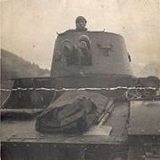
Polish 10th Motorized Cavalry Brigade

Encyclopedia
The 10th Cavalry Brigade was a Polish
military unit, the only fully operational Polish motorized infantry unit during the Invasion of Poland
of 1939, at the onset of World War II
. Commanded by Col. (later General) Stanisław Maczek, it is considered the only Polish World War II military unit not to lose a single battle.
The unit was organized in February 1937, partially as an experiment. It was to be a hybrid between a standard motorized infantry brigade and the French
concept of Division legere. As Polish cavalry
generals still had some doubts about the value of mechanized force, there was some opposition against reforming the standard horse-mounted cavalry into motorized units. Testing of the new unit was held in a specially created training ground near Kielce
, as well as in the Armoured Units Training School. The brigade was supposed to be a kind of emergency unit in the Commander-in-Chief’s reserve. Its task was to screen the areas of concentration of Polish troops, to close gaps made by enemy forces in Polish lines and to fight enemy mechanized units.
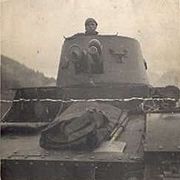 The first exercise in offensive action (1939) was considered a failure – the brigade proved to be insufficiently equipped in anti-tank ordinance to successfully counter enemy armoured units. It was also considered not versatile enough, especially when compared with a standard cavalry unit which had much better off-road capabilities and speed. Because of that, several changes in its structure were introduced, which were later copied during the formation of the Warsaw Armoured Cavalry Brigade. The commanding officer of the unit was Col. Stanisław Maczek and the chief of his staff was Maj. Franciszek Skibiński. It is to be noted that, despite being fully motorized, the brigade was still officially named "the 10th Cavalry Brigade". However, most of the sources refer to it as "Motorized" in order to distinguish the unit from its predecessors.
After the Invasion of Poland
in 1939, the brigade was attached to the Kraków Army
defending Lesser Poland
and Silesia
. Equipped with only light tanks and tankettes and without one artillery battery, which left the unit with only 8 heavier cannons, it went into battle during the first day of the German invasion of Poland. After the Battle of Jordanów
, Maczek's unit faced the entire German XVIII Corps of General Eugen Beyer
and successfully shielded the southern flank of the Polish forces, along the Beskides. Supported by several battalions of Border Guards and National Defence, the Polish motorized unit fought against two Panzer divisions (4th Light Division under von Hubicki
and 2nd Panzer Division
under Veiel
), as well as the 3rd Mountain Division
under Eduard Dietl
.
For five days Maczek’s brigade effectively slowed the German advance. Despite numerical and technical superiority, the German units' daily gain was no more than 10 kilometres. Polish soldiers took advantage of difficult, mountainous terrain, stopping German attacks and occasionally counter-attacking. However, after the front of the Kraków Army was broken to the north of brigade's position, it was pulled out from the front line. The brigade then fought as a screening unit, defending the bridges and fords in Lesser Poland
, until it arrived in Lwów and joined the city’s defenders. The unit was to form a mobile reserve during the battle for Lwów
and allow other Polish units to withdraw towards the Romanian Bridgehead
. However, the plan was made obsolete by the invasion of Poland by the Soviet Union
on September 17. After two days, Marshal of Poland
Edward Rydz-Śmigły ordered the brigade to cross the Hungarian
border.
Colonel Maczek’s brigade was interned in Hungary. The unit lost about half of its men, but was never defeated in open combat, gaining respect even from the enemy. The Germans called 10th Cavalry Brigade "Die Schwarze Brigade" – "The Black Brigade", because of the black jackets worn by Polish mechanized troops. However, it was not the end of its history. With the silent support of Hungarians, most of its soldiers managed to get to France, to join the Polish Army led by General Sikorski. They fought in France in 1940 as the 10th Armoured Cavalry Brigade. After France surrendered, the veterans of "The Black Brigade" went to Great Britain and became the core of the Polish 1st Armoured Division
.
Poland
Poland , officially the Republic of Poland , is a country in Central Europe bordered by Germany to the west; the Czech Republic and Slovakia to the south; Ukraine, Belarus and Lithuania to the east; and the Baltic Sea and Kaliningrad Oblast, a Russian exclave, to the north...
military unit, the only fully operational Polish motorized infantry unit during the Invasion of Poland
Invasion of Poland (1939)
The Invasion of Poland, also known as the September Campaign or 1939 Defensive War in Poland and the Poland Campaign in Germany, was an invasion of Poland by Germany, the Soviet Union, and a small Slovak contingent that marked the start of World War II in Europe...
of 1939, at the onset of World War II
World War II
World War II, or the Second World War , was a global conflict lasting from 1939 to 1945, involving most of the world's nations—including all of the great powers—eventually forming two opposing military alliances: the Allies and the Axis...
. Commanded by Col. (later General) Stanisław Maczek, it is considered the only Polish World War II military unit not to lose a single battle.
The unit was organized in February 1937, partially as an experiment. It was to be a hybrid between a standard motorized infantry brigade and the French
France
The French Republic , The French Republic , The French Republic , (commonly known as France , is a unitary semi-presidential republic in Western Europe with several overseas territories and islands located on other continents and in the Indian, Pacific, and Atlantic oceans. Metropolitan France...
concept of Division legere. As Polish cavalry
Polish cavalry
The Polish cavalry can trace its origins back to the days of Medieval mounted knights. Poland had always been a country of flatlands and fields and mounted forces operate well in this environment...
generals still had some doubts about the value of mechanized force, there was some opposition against reforming the standard horse-mounted cavalry into motorized units. Testing of the new unit was held in a specially created training ground near Kielce
Kielce
Kielce ) is a city in central Poland with 204,891 inhabitants . It is also the capital city of the Świętokrzyskie Voivodeship since 1999, previously in Kielce Voivodeship...
, as well as in the Armoured Units Training School. The brigade was supposed to be a kind of emergency unit in the Commander-in-Chief’s reserve. Its task was to screen the areas of concentration of Polish troops, to close gaps made by enemy forces in Polish lines and to fight enemy mechanized units.
After the Invasion of Poland
Invasion of Poland (1939)
The Invasion of Poland, also known as the September Campaign or 1939 Defensive War in Poland and the Poland Campaign in Germany, was an invasion of Poland by Germany, the Soviet Union, and a small Slovak contingent that marked the start of World War II in Europe...
in 1939, the brigade was attached to the Kraków Army
Kraków Army
Kraków Army was one of the Polish armies to take part in the Polish Defensive War of 1939. It was officially created on March 23, 1939 as the main pivot of Polish defence. It was commanded by Gen...
defending Lesser Poland
Lesser Poland
Lesser Poland is one of the historical regions of Poland, with its capital in the city of Kraków. It forms the southeastern corner of the country, and should not be confused with the modern Lesser Poland Voivodeship, which covers only a small, southern part of Lesser Poland...
and Silesia
Silesia
Silesia is a historical region of Central Europe located mostly in Poland, with smaller parts also in the Czech Republic, and Germany.Silesia is rich in mineral and natural resources, and includes several important industrial areas. Silesia's largest city and historical capital is Wrocław...
. Equipped with only light tanks and tankettes and without one artillery battery, which left the unit with only 8 heavier cannons, it went into battle during the first day of the German invasion of Poland. After the Battle of Jordanów
Battle of Jordanów
The Battle of Jordanów took place on 2 September 1939, during the Invasion of Poland and the opening stages of World War II. It was fought between the German XXII Panzer Corps of Gen. Paul Ludwig Ewald von Kleist and the Polish 10th Motorized Cavalry Brigade under Col...
, Maczek's unit faced the entire German XVIII Corps of General Eugen Beyer
Eugen Beyer
Eugen Beyer was an Austrian Feldmarschalleutnant in the 1930s and Wehrmacht General of the Infantry during the early years of the Second World War....
and successfully shielded the southern flank of the Polish forces, along the Beskides. Supported by several battalions of Border Guards and National Defence, the Polish motorized unit fought against two Panzer divisions (4th Light Division under von Hubicki
Alfred Ritter von Hubicki
Alfred Eduard Franz Ritter von Hubicki was a Hungarian born Austrian army officer who was a Panzer General in the German army during World War II.-World War I:...
and 2nd Panzer Division
German 2nd Panzer Division
The 2nd Panzer Division was created in 1935, and stationed in Austria after the Anschluss. It participated in the campaigns in Poland and France , and then returned to Poland for occupation duties . It took part in the Balkans campaign and then transferred to the Russian Front in September 1941...
under Veiel
Rudolf Veiel
Rudolf Veiel was a German General of the Panzertruppe during World War II.Veiel's first army service was noted as a Fahnenjunker in the Ulanen-Regiment 19 in April 1904. On 18 August 1905, he became a leutnant.At the beginning of World War I, Veiel was a commander of the Squadron in the...
), as well as the 3rd Mountain Division
German 3rd Mountain Division
The 3rd Mountain Division was a formation of the German Wehrmacht during World War II. It was created from the Austrian Army's 5th and 7th Divisions following the Anschluss in 1938.-History:...
under Eduard Dietl
Eduard Dietl
Eduard Dietl was a German general of World War II. He was born in Bad Aibling, Bavaria. He was also a recipient of the Knight's Cross of the Iron Cross with Oak Leaves and Swords...
.
For five days Maczek’s brigade effectively slowed the German advance. Despite numerical and technical superiority, the German units' daily gain was no more than 10 kilometres. Polish soldiers took advantage of difficult, mountainous terrain, stopping German attacks and occasionally counter-attacking. However, after the front of the Kraków Army was broken to the north of brigade's position, it was pulled out from the front line. The brigade then fought as a screening unit, defending the bridges and fords in Lesser Poland
Lesser Poland
Lesser Poland is one of the historical regions of Poland, with its capital in the city of Kraków. It forms the southeastern corner of the country, and should not be confused with the modern Lesser Poland Voivodeship, which covers only a small, southern part of Lesser Poland...
, until it arrived in Lwów and joined the city’s defenders. The unit was to form a mobile reserve during the battle for Lwów
Battle of Lwów (1939)
The Battle of Lwów was a battle for the control over the Polish city of Lwów between the Polish Army and the invading Wehrmacht and the Red Army...
and allow other Polish units to withdraw towards the Romanian Bridgehead
Romanian Bridgehead
The Romanian Bridgehead was an area in southeastern Poland, now located in Ukraine. During the Polish Defensive War of 1939 , on September 14 the Polish Commander in Chief Marshal of Poland Edward Rydz-Śmigły ordered all Polish troops fighting east of the Vistula to withdraw towards Lwów, and...
. However, the plan was made obsolete by the invasion of Poland by the Soviet Union
Soviet Union
The Soviet Union , officially the Union of Soviet Socialist Republics , was a constitutionally socialist state that existed in Eurasia between 1922 and 1991....
on September 17. After two days, Marshal of Poland
Marshal of Poland
Marshal of Poland is the highest rank in the Polish Army. It has been granted to only six officers. At present, this rank is equivalent to a Field Marshal or General of the Army in other NATO armies.-History:...
Edward Rydz-Śmigły ordered the brigade to cross the Hungarian
Hungary
Hungary , officially the Republic of Hungary , is a landlocked country in Central Europe. It is situated in the Carpathian Basin and is bordered by Slovakia to the north, Ukraine and Romania to the east, Serbia and Croatia to the south, Slovenia to the southwest and Austria to the west. The...
border.
Colonel Maczek’s brigade was interned in Hungary. The unit lost about half of its men, but was never defeated in open combat, gaining respect even from the enemy. The Germans called 10th Cavalry Brigade "Die Schwarze Brigade" – "The Black Brigade", because of the black jackets worn by Polish mechanized troops. However, it was not the end of its history. With the silent support of Hungarians, most of its soldiers managed to get to France, to join the Polish Army led by General Sikorski. They fought in France in 1940 as the 10th Armoured Cavalry Brigade. After France surrendered, the veterans of "The Black Brigade" went to Great Britain and became the core of the Polish 1st Armoured Division
Polish 1st Armoured Division
The Polish 1st Armoured Division was an Allied military unit during World War II, created in February 1942 at Duns in Scotland. At its peak it numbered approximately 16,000 soldiers...
.
OOB
| Regiment | Sub-units | Notes | |
| 10th Cavalry Brigade Stanisław Maczek |
10th Mounted Rifle Regiment Bokszczanin Janusz Bokszczanin Janusz Bokszczanin was a colonel of the Polish Army and one of the first Polish commanders of motorized troops.He joined the Russian imperial army in 1914, after the outbreak of World War I. In 1917 he was allowed to join the Polish 3rd Corps being formed in Russia. With it he reached Poland in... |
4 x motorized rifle squadrons 1 x HMG squadron 1 x AT platoon |
3 infantry and 1 HMG platoons each 12 x Ckm wz.30 Ckm wz.30 Ckm wz.30 is a Polish-made clone of the American Browning M1917 heavy machine gun... HMGs, 2 x 81mm mortars 3 x 37mm wz.36 Bofors AT guns |
| 24th Uhlan Regiment Dworak |
4 x motorized rifle squadrons 1 x HMG squadron 1 x AT platoon |
3 infantry and 1 HMG platoons each 12 x Ckm wz.30 Ckm wz.30 Ckm wz.30 is a Polish-made clone of the American Browning M1917 heavy machine gun... HMGs, 2 x 81mm mortars 3 x 37mm wz.36 Bofors AT guns |
|
| 16th Motorized Artillery Battalion Żmudziński |
1 x field artillery Field artillery Field artillery is a category of mobile artillery used to support armies in the field. These weapons are specialized for mobility, tactical proficiency, long range, short range and extremely long range target engagement.... battery Artillery battery In military organizations, an artillery battery is a unit of guns, mortars, rockets or missiles so grouped in order to facilitate better battlefield communication and command and control, as well as to provide dispersion for its constituent gunnery crews and their systems... 1 x howitzer Howitzer A howitzer is a type of artillery piece characterized by a relatively short barrel and the use of comparatively small propellant charges to propel projectiles at relatively high trajectories, with a steep angle of descent... battery |
4 x 75 mm wz.97 gun Canon de 75 modèle 1897 The French 75mm field gun was a quick-firing field artillery piece adopted in March 1898. Its official French designation was: Matériel de 75mm Mle 1897. It was commonly known as the French 75, simply the 75 and Soixante-Quinze .The French 75 is widely regarded as the first modern artillery piece... s 4 x 100 mm wz.14 Skoda howitzers |
|
| 101st Recce Tank Company Ziemski |
4 x 20 mm TKS TKS The TK and TKS were Polish tankettes during the Second World War.-Design and development:The TK tankette was a Polish design produced from 1931 that was based upon an improved chassis of the British Carden Loyd tankette. The TKS was an improved model with a new hull and a more powerful engine... 9 x TK3 |
||
| 121st Light Tank Company Rączkowski |
16 x Vickers E | ||
| Recce Tank Company Święcicki |
4 x TKS TKS The TK and TKS were Polish tankettes during the Second World War.-Design and development:The TK tankette was a Polish design produced from 1931 that was based upon an improved chassis of the British Carden Loyd tankette. The TKS was an improved model with a new hull and a more powerful engine... 9 x TKF |
||
| Anti-tank Company Moszczeński |
18 x 37 mm wz.36 Bofors Bofors 37 mm The Bofors 37 mm gun was an anti-tank gun designed by Swedish manufacturer Bofors in the early 1930s. Licensed copies were produced in a number of countries. The gun was used by some European armies during World War II, mainly at the early stage of the war.-Development history:The gun was... AT guns |
||
| 90th Motorized Engineering Battalion Dorant |
2 x engineering company | ||
| 71st Motorized AA Artillery Battery Zwil |
4 x 40 mm wz.36 Bofors Bofors 40 mm gun The Bofors 40 mm gun is an anti-aircraft autocannon designed by the Swedish defence firm of Bofors Defence... AA guns |
||