

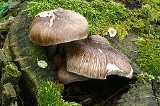
Pluteus

Encyclopedia
Pluteus is a large genus
of fungi with over 100 species. They are wood rotting saprobes with pink spore print
s and gills that are free from the stem
.
Pluteus means shed or penthouse.
Pluteus is separated from Volvariella
due to the lack of a volva
, and from Entoloma
by growing on wood and by microscopic features (Entolomas have angular spores).
, though most people rate their taste and consistency as average at best.
Pluteus cervinus is the best known species in Europe and North America.
Several species of this genus bruise blue and contain psilocybin
including Pluteus brunneidiscus
, Pluteus salicinus
, Pluteus cyanopus
, Pluteus glaucus
, Pluteus nigroviridis
, and Pluteus villosus
.
Genus
In biology, a genus is a low-level taxonomic rank used in the biological classification of living and fossil organisms, which is an example of definition by genus and differentia...
of fungi with over 100 species. They are wood rotting saprobes with pink spore print
Spore print
thumb|300px|right|Making a spore print of the mushroom Volvariella volvacea shown in composite: mushroom cap laid on white and dark paper; cap removed after 24 hours showing pinkish-tan spore print...
s and gills that are free from the stem
Stipe (mycology)
thumb|150px|right|Diagram of a [[basidiomycete]] stipe with an [[annulus |annulus]] and [[volva |volva]]In mycology a stipe refers to the stem or stalk-like feature supporting the cap of a mushroom. Like all tissues of the mushroom other than the hymenium, the stipe is composed of sterile hyphal...
.
Pluteus means shed or penthouse.
Characteristics of the genus
- These fungi grow on wood or wood remains.
- The spore powder is deep pink, soon giving a pink tint to the initially pale gills.
- The gills are free from the stipe.
- There is no volva or ring (exception: the rare recently reclassified North American species P. mammillatus, previously Chamaeota sphaerospora).
- Microscopically, they often have abundant, distinctive cystidiaCystidiumA cystidium is a relatively large cell found on the hymenium of a basidiomycete , often between clusters of basidia. Since cystidia have highly varied and distinct shapes that are often unique to a particular species or genus, they are a useful micromorphological characteristic in the...
. The spores are smooth and roughly egg-shaped.
Pluteus is separated from Volvariella
Volvariella
Volvariella is a genus of mushrooms with deep salmon pink gills and spore prints. They lack a ring, and have an Amanita-like volva at the stem base. Some species of Amanita look similar, but Amanita has white spores and often have a ring. Since the gills of young Volvariella are white at first,...
due to the lack of a volva
Volva (mycology)
The volva is a mycological term to describe a cup-like structure at the base of a mushroom that is a remnant of the universal veil. This macrofeature is important in wild mushroom identification due to it being an easily observed, taxonomically significant feature which frequently signifies a...
, and from Entoloma
Entoloma
Entoloma is a large genus of terrestrial pink-gilled mushrooms, with about 1000 species. They have a drab appearance, pink gills which are attached to the stem, a smooth thick cap, and angular spores. Most entolomas are saprobic...
by growing on wood and by microscopic features (Entolomas have angular spores).
Remarks on particular species
Some of these mushrooms are edible including P. petasatus and P. cervinusPluteus cervinus
Pluteus cervinus, also known as Pluteus atricapillus and commonly known as the deer shield or the deer or fawn mushroom, is a mushroom that belongs to the large genus Pluteus. It is found on rotten logs, roots and tree stumps and is widely distributed. It can also grow on sawdust and other wood...
, though most people rate their taste and consistency as average at best.
Pluteus cervinus is the best known species in Europe and North America.
Several species of this genus bruise blue and contain psilocybin
Psilocybin
Psilocybin is a naturally occurring psychedelic prodrug, with mind-altering effects similar to those of LSD and mescaline, after it is converted to psilocin. The effects can include altered thinking processes, perceptual distortions, an altered sense of time, and spiritual experiences, as well as...
including Pluteus brunneidiscus
Pluteus brunneidiscus
Pluteus brunneidiscus is a medicinal mushroom in the Pluteaceae family....
, Pluteus salicinus
Pluteus salicinus
Pluteus salicinus is a hallucinogenic mushroom which grows on wood and is widely distributed.- Description :*Cap: 2 — 5 cm in diameter, convex becoming broadly convex to plane, silver-gray to brownish-gray, often with blue or greenish tint in age, smooth, with tiny scales near the center, darker at...
, Pluteus cyanopus
Pluteus cyanopus
Pluteus cyanopus is a medicinal mushroom in the Pluteaceae family....
, Pluteus glaucus
Pluteus glaucus
Pluteus glaucus is a medicinal mushroom in the Pluteaceae family....
, Pluteus nigroviridis
Pluteus nigroviridis
Pluteus nigroviridis is a medicinal mushroom in the Pluteaceae family....
, and Pluteus villosus
Pluteus villosus
Pluteus villosus is a medicinal mushroom in the Pluteaceae family....
.