
All Topics  
Volvariella

 
Volvariella

   Email Print
   Bookmark   Link


Volvariella


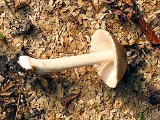
Volvariella is a genus
Genus

A genus is a low-level taxonomic rank used in the classification of living and fossil organisms. The taxonomic ranks are domain , kingdom , phylum, class , order , family , genus, and species....
 of mushroom
Mushroom

A mushroom is the fleshy, spore-bearing fruiting body of a fungus, typically produced above ground on soil or on its food source. The standard for the name "mushroom" is the cultivated white button mushroom, Agaricus bisporus, hence the word mushroom is most often applied to those fungi that have a stem , a cap , and gills on the unde...
s with pink gills and spore prints. They lack a ring, and have an Amanita-like volva at the stem base. Some species of Amanita
Amanita

The genus Amanita contains about 600 species of agarics including some of the most toxic known mushrooms found worldwide. This genus is responsible for approximately 95% of the fatalities resulting from mushroom poisoning, with the death cap accounting for about 50% on its own....
 look similar, but Amanita
Amanita

The genus Amanita contains about 600 species of agarics including some of the most toxic known mushrooms found worldwide. This genus is responsible for approximately 95% of the fatalities resulting from mushroom poisoning, with the death cap accounting for about 50% on its own....
 has white spores and often have a ring. Since the gills of young Volvariella are white at first, they are more easily mistaken for Amanita
Amanita

The genus Amanita contains about 600 species of agarics including some of the most toxic known mushrooms found worldwide. This genus is responsible for approximately 95% of the fatalities resulting from mushroom poisoning, with the death cap accounting for about 50% on its own....
.

Many sources list Volvariella as a member of the Pluteaceae
Pluteaceae

Pluteaceae is a Family of small to medium sized mushrooms which have free gill attachment and pink spores. Members of Pluteaceae can be mistaken for members of Entolomatacae but can be distinguished by their angled spores and attached gills....
 family, but recent DNA studies have revealed that Pluteus
Pluteus

Pluteus is a large genus of mushroom with over 100 species. They are wood rotting saprobes with pink spore prints and gills that are free from the stem....
 and Volvariella evolved separately and have very different DNA.


Discussion
Ask a question about 'Volvariella'
Start a new discussion about 'Volvariella'
Answer questions from other users
Full Discussion Forum


Recent Posts


Encyclopedia


Volvariella is a genus
Genus

A genus is a low-level taxonomic rank used in the classification of living and fossil organisms. The taxonomic ranks are domain , kingdom , phylum, class , order , family , genus, and species....
 of mushroom
Mushroom

A mushroom is the fleshy, spore-bearing fruiting body of a fungus, typically produced above ground on soil or on its food source. The standard for the name "mushroom" is the cultivated white button mushroom, Agaricus bisporus, hence the word mushroom is most often applied to those fungi that have a stem , a cap , and gills on the unde...
s with pink gills and spore prints. They lack a ring, and have an Amanita-like volva at the stem base. Some species of Amanita
Amanita

The genus Amanita contains about 600 species of agarics including some of the most toxic known mushrooms found worldwide. This genus is responsible for approximately 95% of the fatalities resulting from mushroom poisoning, with the death cap accounting for about 50% on its own....
 look similar, but Amanita
Amanita

The genus Amanita contains about 600 species of agarics including some of the most toxic known mushrooms found worldwide. This genus is responsible for approximately 95% of the fatalities resulting from mushroom poisoning, with the death cap accounting for about 50% on its own....
 has white spores and often have a ring. Since the gills of young Volvariella are white at first, they are more easily mistaken for Amanita
Amanita

The genus Amanita contains about 600 species of agarics including some of the most toxic known mushrooms found worldwide. This genus is responsible for approximately 95% of the fatalities resulting from mushroom poisoning, with the death cap accounting for about 50% on its own....
.

Many sources list Volvariella as a member of the Pluteaceae
Pluteaceae

Pluteaceae is a Family of small to medium sized mushrooms which have free gill attachment and pink spores. Members of Pluteaceae can be mistaken for members of Entolomatacae but can be distinguished by their angled spores and attached gills....
 family, but recent DNA studies have revealed that Pluteus
Pluteus

Pluteus is a large genus of mushroom with over 100 species. They are wood rotting saprobes with pink spore prints and gills that are free from the stem....
 and Volvariella evolved separately and have very different DNA. These studies show that Volvariella is very closely related to "schizophylloid" mushrooms like Schizophyllum commune
Schizophyllum commune

Schizophyllum commune is the world's most widely distributed mushroom, occurring on every continent except Antarctica. The gills, which produce basidiospores on their surface split when the mushroom dries out, earning this mushroom the common name Split Gill....
.

Some species of Volvariella are popular edibles in Europe, accounting for 16% of total production of cultivated mushrooms in the world.

Volvariella volvacea

Volvariella volvacea is a species of edible mushroom fungiculture throughout East Asia and Southeast Asia and used extensively in Asian cuisines....
, well known as the paddy straw mushroom, is cultured in rice straw in the Philippines
Philippines

The Philippines, officially known as the Republic of the Philippines, is a country in Southeast Asia with Manila as its capital city. It comprises 7,107 islands in the western Pacific Ocean....
 and Southeast Asia
Southeast Asia

Southeast Asia or Southeastern Asia is a subregion of Asia, consisting of the countries that are geographically south of China, east of India and north of Australia....
. This species also favours wood chip piles. Unfortunately, it is easy to mistake the death cap mushroom (Amanita phalloides), as well as some other Amanita
Amanita

The genus Amanita contains about 600 species of agarics including some of the most toxic known mushrooms found worldwide. This genus is responsible for approximately 95% of the fatalities resulting from mushroom poisoning, with the death cap accounting for about 50% on its own....
 species, for this edible species due to similarities in appearance. This mistake is the leading cause of lethal mushroom poisoning
Mushroom poisoning

Mushroom poisoning, also known as mycetism, refers to deleterious effects from ingestion of toxic substances present in a mushroom. These symptoms can vary from slight Gastrointestinal tract discomfort to death....
 in the United States
United States

The United States of America is a Federal government constitutional republic comprising U.S. state and a federal district. The country is situated mostly in central North America, where its Contiguous United States and Washington, D.C., the Capital districts and territories, lie between the Pacific Ocean and Atlantic Oceans, Borders of the U...
. Volvariella and Amanita cannot be distinguished in the early "button stage", that, for many, is considered the best stage to collect Volvariella for consumption. Like Amanita, the paddy straw mushroom has a volva, or universal veil, so called because it is a membrane that encapsulates the entire mushroom when it is young. This structure breaks apart as the mushroom expands, leaving parts that can be found at the base of the stalk as a cup-like structure.

List of Species

  • Volvariella bombycina
  • Edible Toxicity Icon
    Volvariella gloiocephala
    Volvariella gloiocephala

    Volvariella gloiocephala, also known as stubble rosegill, is a mushroom of the Pluteaceae family. It is sometimes considered to be a variety of Volvariella speciosa, which can be distinguished, however, by its white cap and non-striate margin....
  • Volvariella hypopithys
  • Volvariella jamaicensis
  • Volvariella lepiotospora
  • Volvariella peckii
  • Edible Toxicity Icon
    Volvariella speciosa
    Volvariella speciosa

    Volvariella speciosa is an edible agaric mushroom, similar in appearance to Amanita verna ....
  • Volvariella surrecta
  • Choice Toxicity Icon
    Volvariella volvacea
    Volvariella volvacea

    Volvariella volvacea is a species of edible mushroom fungiculture throughout East Asia and Southeast Asia and used extensively in Asian cuisines....