

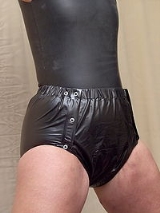
Plastic pants

Encyclopedia
Diaper
A nappy or a diaper is a kind of pant that allows one to defecate or urinate on oneself discreetly. When diapers become soiled, they require changing; this process is often performed by a second person such as a parent or caregiver...
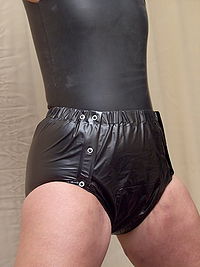
for the purpose of containing liquid or solid waste that may otherwise leak through the fabric. Today, "plastic pants" are usually made out of polyvinyl chloride
Polyvinyl chloride
Polyvinyl chloride, commonly abbreviated PVC, is a thermoplastic polymer. It is a vinyl polymer constructed of repeating vinyl groups having one hydrogen replaced by chloride. Polyvinyl chloride is the third most widely produced plastic, after polyethylene and polypropylene. PVC is widely used in...
(PVC) or polyurethane
Polyurethane
A polyurethane is any polymer composed of a chain of organic units joined by carbamate links. Polyurethane polymers are formed through step-growth polymerization, by reacting a monomer with another monomer in the presence of a catalyst.Polyurethanes are...
(PU) though, in some instances, the traditional latex
Latex
Latex is the stable dispersion of polymer microparticles in an aqueous medium. Latexes may be natural or synthetic.Latex as found in nature is a milky fluid found in 10% of all flowering plants . It is a complex emulsion consisting of proteins, alkaloids, starches, sugars, oils, tannins, resins,...
rubber is still used. The original nappy covers were made from oiled wool, which was naturally waterproof and stopped water escaping.
The availability of inexpensive, and easily worked, man-made waterproof materials in the last half-century has significantly improved the quality of life of those with continence
Urinary incontinence
Urinary incontinence is any involuntary leakage of urine. It is a common and distressing problem, which may have a profound impact on quality of life. Urinary incontinence almost always results from an underlying treatable medical condition but is under-reported to medical practitioners...
problems, and is an important contributory factor to changes in clothing style and freedom, especially for infants and menstruating
Menstruation
Menstruation is the shedding of the uterine lining . It occurs on a regular basis in sexually reproductive-age females of certain mammal species. This article focuses on human menstruation.-Overview:...
women.
History
At the turn of the 20th century oiled silk was used as a waterproofingWaterproofing
Waterproof or water-resistant describes objects relatively unaffected by water or resisting the ingress of water under specified conditions. Such items may be used in wet environments or under water to specified depths...
medium in clothing, but it was not until latex rubber was commercially available from the 1920s that the idea of wearing a protective garment became common. Ladies panties were worn with a waterproof latex crotch insert or a waterproof panel in the back of an underskirt
Underskirt
Underskirt may refer to the following:* Half slip, a modern undergarment worn by women beneath a dress or skirt to help it hang smoothly* Petticoat, an undergarment to be worn by women under a skirt, dress or sari...
to make coping with heavy periods
Menstruation
Menstruation is the shedding of the uterine lining . It occurs on a regular basis in sexually reproductive-age females of certain mammal species. This article focuses on human menstruation.-Overview:...
much easier and socially safer. Newly available latex pants for covering infants' nappies reduced the difficulties of nursing young children on long journeys, on special social occasions and overnight. Though still occasionally used today, latex rubber has significant drawbacks in these applications: it is easily damaged by rough handling and by oils, creams and ointments. It does not allow air to ventilate – so the skin of the wearer tends to become soggy after prolonged wear. It also makes a characteristic rustling noise when moved, which limits its use in situations where discretion is necessary.
During the 1950s, plastics – mainly PVC, but more recently polyurethane – increasingly replaced latex on account of their lower cost, ease of maintenance, ability to “breathe”, and lack of noise when handled. However, the history of these garments has influenced their modern names: “Rubber pants” and “Rubbers” are used commonly to mean waterproof pants of all kinds, even though they are typically now made of plastic rather than rubber.
The invention of superabsorbent polymer
Superabsorbent polymer
Superabsorbent polymers are polymers that can absorb and retain extremely large amounts of a liquid relative to their own mass....
s (for nappies and incontinence pads), and of blood-gelling polymers (for sanitary pads) displaced the traditional cloth or wood-pulp pads. Not only were these modern absorbent materials lighter and less bulky, but they became available as an “all-in-one” solution with its own integral waterproof plastic backing. This eliminated the need for separate waterproof underwear in many situations. Nevertheless, waterproof pants are still used as a second line of defense where absolute protection from leakage is crucial.-
Effectiveness
This dramatic change in the efficiency and usability of pads and nappies has contributed significantly to fashion. Until the late 1950s, infants of both sexes usually wore short dresses until they were ready for toilet training – thus avoiding the risks to clothing and hygiene of having top clothes in prolonged close contact with a damp nappy. Effective and easily obtainable waterproofing – whether integral with the pad or as separate pants – safely allows a child to be dressed in trousers. The decreased bulk of SAP-enhanced disposables allows a trimmer cut, so making the fit even neater as much of the bulk of cloth nappies has gone.In the same way, menstruating women nowadays may feel completely confident in close-fitting clothes of any design, thanks to the knowledge that, should the worst happen, any overflow will be safely contained. With improved medical technology and care, an increasing number of people now survive serious injury; however, head and spinal injuries frequently lead to continence management problems. Chronic disabling disease such as Multiple sclerosis
Multiple sclerosis
Multiple sclerosis is an inflammatory disease in which the fatty myelin sheaths around the axons of the brain and spinal cord are damaged, leading to demyelination and scarring as well as a broad spectrum of signs and symptoms...
can also lead to continence problems. For many such individuals, absorbent products and suitable protection are vital tools to grant the freedom and confidence, denied to earlier generations, to participate fully socially and in the workplace, with much reduced risk of embarrassment.