
All Topics  
Pinwheel Galaxy

 
Pinwheel Galaxy

   Email Print
   Bookmark   Link


Pinwheel Galaxy


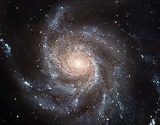
The Pinwheel Galaxy (also known as Messier 101 or NGC 5457) is a face-on spiral galaxy
Spiral galaxy

A spiral galaxy is a galaxy belonging to one of the three main galaxy morphological classification originally described by Edwin Hubble in his 1936 work ?The Realm of the Nebulae? and, as such, forms part of the Hubble sequence....
 about 27 million light-year
Light-year

A light-year or light year is a Units of measurement of length, equal to just under ten orders_of_magnitude_%28numbers%29#1012 kilometres....
s away in the constellation
Constellation

A constellation is a group of stars that appear to have a physical proximity in the sky. The stars in a constellation are often vastly distant from each other, but they appear close to each other from the perspective of Earth....
 Ursa Major
Ursa Major

Ursa Major is a constellation visible throughout the year in most of the northern hemisphere. Its name means the Great Bear in Latin. It is dominated by the widely recognized asterism known as the Big Dipper or Plough, which is a useful pointer toward north, and which has mythological significance in numerous world cultures....
.

It was discovered by Pierre Méchain
Pierre Méchain

Pierre Fran?ois Andr? M?chain was a France astronomer and surveying who, with Charles Messier, was a major contributor to the early study of deep sky objects and comets....
 on March 27, 1781, and he subsequently communicated his discovery to Charles Messier
Charles Messier

Charles Messier was a France astronomy most notable for publishing an astronomical catalog consisting of deep sky objects such as nebulae and star clusters that came to be known as the 103 "Messier objects"....
 who verified its position and added it to the Messier Catalogue as one of the final entries.

On February 28, 2006, NASA
NASA

The National Aeronautics and Space Administration is an agency of the Federal government of the United States, responsible for the nation's public list of space agencies....
 and the ESA released a very detailed image of Pinwheel Galaxy, which was the largest and most detailed image of a galaxy by Hubble Space Telescope
Hubble Space Telescope

The Hubble Space Telescope is a Space observatory that was carried into Low Earth orbit STS-31 in April 1990. It is named after the American astronomer Edwin Hubble....
 at the time.


Discussion
Ask a question about 'Pinwheel Galaxy'
Start a new discussion about 'Pinwheel Galaxy'
Answer questions from other users
Full Discussion Forum


Encyclopedia


The Pinwheel Galaxy (also known as Messier 101 or NGC 5457) is a face-on spiral galaxy
Spiral galaxy

A spiral galaxy is a galaxy belonging to one of the three main galaxy morphological classification originally described by Edwin Hubble in his 1936 work ?The Realm of the Nebulae? and, as such, forms part of the Hubble sequence....
 about 27 million light-year
Light-year

A light-year or light year is a Units of measurement of length, equal to just under ten orders_of_magnitude_%28numbers%29#1012 kilometres....
s away in the constellation
Constellation

A constellation is a group of stars that appear to have a physical proximity in the sky. The stars in a constellation are often vastly distant from each other, but they appear close to each other from the perspective of Earth....
 Ursa Major
Ursa Major

Ursa Major is a constellation visible throughout the year in most of the northern hemisphere. Its name means the Great Bear in Latin. It is dominated by the widely recognized asterism known as the Big Dipper or Plough, which is a useful pointer toward north, and which has mythological significance in numerous world cultures....
.

It was discovered by Pierre Méchain
Pierre Méchain

Pierre Fran?ois Andr? M?chain was a France astronomer and surveying who, with Charles Messier, was a major contributor to the early study of deep sky objects and comets....
 on March 27, 1781, and he subsequently communicated his discovery to Charles Messier
Charles Messier

Charles Messier was a France astronomy most notable for publishing an astronomical catalog consisting of deep sky objects such as nebulae and star clusters that came to be known as the 103 "Messier objects"....
 who verified its position and added it to the Messier Catalogue as one of the final entries.

On February 28, 2006, NASA
NASA

The National Aeronautics and Space Administration is an agency of the Federal government of the United States, responsible for the nation's public list of space agencies....
 and the ESA released a very detailed image of Pinwheel Galaxy, which was the largest and most detailed image of a galaxy by Hubble Space Telescope
Hubble Space Telescope

The Hubble Space Telescope is a Space observatory that was carried into Low Earth orbit STS-31 in April 1990. It is named after the American astronomer Edwin Hubble....
 at the time. The image was composed from 51 individual exposures, plus some extra ground-based photos.

Discovery

Pierre Méchain, the discoverer of M101, described it as a "nebula without star, very obscure and pretty large, 6' to 7' in diameter, between the left hand of Bootes and the tail of the great Bear. It is difficult to distinguish when one lits the [grating] wires."

William Herschel
William Herschel

Sir Frederick William Herschel, Fellow of the Royal Society Royal Guelphic Order was a German-born British astronomer and composer who became famous for discovering Uranus....
 noted in 1784 that "[M101] in my 7, 10, and 20-feet reflectors shewed a mottled kind of nebulosity, which I shall call resolvable; so that I expect my present telescope will, perhaps, render the stars visible of which I suppose them to be composed."

Lord Rosse observed M101 in his 72-inch Newtonian reflector
Newtonian telescope

The Newtonian telescope is a type of reflecting telescope invented by the British scientist Sir Isaac Newton , using a Curved mirror#Concave mirrors and a flat diagonal secondary mirror....
 during the second half of the 19th century. He was the first to make extensive note of the spiral structure and made several sketches.

To observe the spiral structure in modern instruments requires a fairly large instrument, very dark skies, and a low power eye piece.

Structure and composition


M101 is a relatively large galaxy compared to the Milky Way
Milky Way

The Milky Way, sometimes called simply the Galaxy, is the galaxy in which the Solar System is located. It is a barred spiral galaxy that is part of the Local Group of galaxies....
. With a diameter of 170,000 light-years it is nearly twice the size of the Milky Way. Less is known about the mass of M101. A frequently cited number is an equivalent mass of about 16 billion solar
Sun

The Sun , a G V star, is the star at the center of the Solar System. The Earth and other matter orbit the Sun, which by itself accounts for about 98.6% of the Solar System's mass....
 masses. That value is almost certainly too low, and probably stems from M101's low surface brightness. New insights in its HII regions and rotational velocities have put the number between 100 billion and 1 trillion suns.

Another remarkable property of this galaxy are its huge and extremely bright HII regions, of which a total of about 3000 can be seen on photographs. HII regions are places in galaxies that contain enormous clouds of high density hydrogen gas contracting under its own gravitational force. Eventually, when the localized hydrogen contracts enough for fusion processes to begin, stars are born. Consequently, HII regions are places that often contain large numbers of extremely bright and hot young stars giving them their characteristic blue color.

On photographs M101 can be seen to be asymmetrical on one side. It is thought that in the recent past (speaking in galactic terms) M101 underwent a near collision with another galaxy and the associated gravitational tidal forces caused the asymmetry. In addition, this encounter also amplifies the density waves in the spiral arms of M101. The amplification of these waves also leads to the compression of the interstellar hydrogen gas
Interstellar medium

In astronomy, the interstellar medium is the gas and cosmic dust that pervade interstellar space: the matter that exists between the stars within a galaxy....
, which then triggers strong star formation
Star formation

Star formation is the process by which dense parts of molecular clouds collapse into a ball of Plasma to form a star. As a branch of astronomy star formation includes the study of the interstellar medium and giant molecular clouds as precursors to the star formation process and the study of young stellar objects and planet formation as its i...
 activity.

Companion galaxies

M101 has five prominent companion galaxies: NGC 5204, NGC 5474
NGC 5474

NGC 5474 is a peculiar galaxy dwarf galaxy in the constellation Ursa Major. It is one of several companion galaxies of the Pinwheel Galaxy, a Grand design spiral galaxy....
, NGC 5477, NGC 5585, and Holmberg IV. As stated above, the gravitational interaction between M101 and its satellites may have triggered the formation of the grand design pattern in M101. M101 has also probably distorted the companion galaxy NGC 5474. M101 and its companion galaxies comprise most or possibly all of the M101 Group
M101 Group

The M101 Group is a loose group of galaxies located in Ursa Major. The group is named after the brightest galaxy in the group, the Pinwheel Galaxy ....
.

See also

  • Messier 74
    Messier 74

    Messier 74 is a face-on spiral galaxy in the constellation Pisces . The galaxy contains two clearly-defined spiral arms and is therefore used as an archetypal example of a Grand Design Spiral Galaxy....
     - a similar face-on spiral galaxy
  • Messier 83 - a similar face-on spiral galaxy that is sometimes referred to as the Southern Pinwheel Galaxy
  • Messier 99
    Messier 99

    Messier 99 is an unbarred spiral galaxy approximately 1 E23 m light-years away in the constellation Coma Berenices.The galaxy has a normal looking arm and an extended arm that is less tightly wound....
     - a similar face-on spiral galaxy
  • A Wrinkle in Time
    A Wrinkle in Time

    A Wrinkle in Time is a science fantasy novel by Madeleine L'Engle, first published in 1962. The book won a Newbery Medal, Sequoyah Book Award, and Lewis Carroll Shelf Award, and was runner-up for the Hans Christian Andersen Award....
     - features Uriel, a fictional planet in the Pinwheel Galaxy


External links