
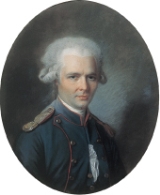
Pierre Ambroise François Choderlos de Laclos (pjɛʁ ɑ̃brwaːz ʃɔdɛʁlo də laklo; 18 October 1741 – 5 September 1803) was a French novelist, official and army general, best known for writing the
epistolary novelAn epistolary novel is a novel written as a series of documents. The usual form is letters, although diary entries, newspaper clippings and other documents are sometimes used. Recently, electronic "documents" such as recordings and radio, blogs, and e-mails have also come into use...
Les Liaisons dangereusesLes Liaisons dangereuses is a French epistolary novel by Choderlos de Laclos, first published in four volumes by Durand Neveu from March 23, 1782....
(
Dangerous Liaisons).
A unique case in French literature, he was for a long time considered to be as scandalous a writer as the
Marquis de SadeDonatien Alphonse François, Marquis de Sade was a French aristocrat, revolutionary politician, philosopher, and writer famous for his libertine sexuality and lifestyle...
or
Nicolas-Edme RétifNicolas-Edme Rétif or Nicolas-Edme Restif , also known as Rétif de la Bretonne, was a French novelist. The term retifisme for shoe fetishism was named after him.-Biography:...
. He was a military officer with no illusions about human relations, and an amateur writer; however, his initial plan was to "write a work which departed from the ordinary, which made a noise, and which would remain on earth after his death"; from this point of view he mostly attained his goals, with the fame of his masterwork
Les Liaisons dangereusesLes Liaisons dangereuses is a French epistolary novel by Choderlos de Laclos, first published in four volumes by Durand Neveu from March 23, 1782....
. It is one of the masterpieces of novelistic literature of the 18th century, which explores the amorous intrigues of the aristocracy. It has inspired a large number of critical and analytic commentaries, plays, and films.
Biography
Laclos was born in
AmiensAmiens is a city and commune in northern France, north of Paris and south-west of Lille. It is the capital of the Somme department in Picardy...
into a bourgeois family, and in 1760 was sent to the
École royale d'artillerie de La Fère, ancestor of the
École polytechniqueThe École Polytechnique is a state-run institution of higher education and research in Palaiseau, Essonne, France, near Paris. Polytechnique is renowned for its four year undergraduate/graduate Master's program...
. As a young lieutenant, he briefly served in a garrison at
La RochelleLa Rochelle is a city in western France and a seaport on the Bay of Biscay, a part of the Atlantic Ocean. It is the capital of the Charente-Maritime department.The city is connected to the Île de Ré by a bridge completed on 19 May 1988...
until the end of the Seven Years War (1763). Later he was assigned to
StrasbourgStrasbourg is the capital and principal city of the Alsace region in eastern France and is the official seat of the European Parliament. Located close to the border with Germany, it is the capital of the Bas-Rhin département. The city and the region of Alsace are historically German-speaking,...
(1765–1769),
GrenobleGrenoble is a city in southeastern France, at the foot of the French Alps where the river Drac joins the Isère. Located in the Rhône-Alpes region, Grenoble is the capital of the department of Isère...
(1769–1775) and
BesançonBesançon , is the capital and principal city of the Franche-Comté region in eastern France. It had a population of about 237,000 inhabitants in the metropolitan area in 2008...
(1775–1776).
Despite being promoted to captain (1771), Laclos grew increasingly bored with his artillery garrison duties and the company of the soldiers, and began to devote his free time to writing. His first works, several light poems, were published on the
Almanach des MusesL'Almanach des Muses was a poetry journal founded in 1765 by Sautreau de Marsy.Almanacs had known a great vogue during the second half of the 18th century. The aim of the Almanach des Muses was to go beyond what previous almanacs had attempted by presenting to its readership a selection of recent...
. Later he wrote an
Opéra-comiqueThe Opéra-Comique is a Parisian opera company, which was founded around 1714 by some of the popular theatres of the Parisian fairs. In 1762 the company was merged with, and for a time took the name of its chief rival the Comédie-Italienne at the Hôtel de Bourgogne, and was also called the...
,
Ernestine, inspired by a novel by Marie-Jeanne Riccoboni. Its premiere on 19 July 1777, in presence of Queen Marie-Antoinette, was a failure. In the same year he created a new artillery school in Valence, which was to include Napoleon among its students. At his return at Besançon in 1778, Laclos was promoted second captain of the Engineers. In this period he wrote several works, which showed his great admiration of
Jean-Jacques RousseauJean-Jacques Rousseau was a Genevan philosopher, writer, and composer of 18th-century Romanticism. His political philosophy influenced the French Revolution as well as the overall development of modern political, sociological and educational thought.His novel Émile: or, On Education is a treatise...
.
In 1779 he was sent to
Île-d'AixÎle-d'Aix is a commune in the Charente-Maritime department off the west coast of France. It occupies the territory of small island of Île d'Aix in the Atlantic. It is a popular place for tourist day-trips during the summer months.-Location:...
to assist Marc-René de Montalembert in the construction of fortifications there against the British. He however spent most of his time writing his new
epistolary novelAn epistolary novel is a novel written as a series of documents. The usual form is letters, although diary entries, newspaper clippings and other documents are sometimes used. Recently, electronic "documents" such as recordings and radio, blogs, and e-mails have also come into use...
,
Les Liaisons DangereusesLes Liaisons dangereuses is a French epistolary novel by Choderlos de Laclos.Les Liaisons dangereuses may also refer to:* Les liaisons dangereuses , a 1959 film adapted by Claude Brulé and directed by Roger Vadim...
, as well as a
Letter to Madame de Montalembert. When he asked for and was granted six months of vacation, he spent the time in
ParisParis is the capital and largest city in France, situated on the river Seine, in northern France, at the heart of the Île-de-France region...
writing.
Les Liaisons Dangereuses was published by Durand Neveu in four volumes on 23 March 1782, turning into a widespread success (1,000 copies sold in a month, an exceptional result for the times). Laclos was immediately ordered to return to his garrison in
BrittanyBrittany is a cultural and administrative region in the north-west of France. Previously a kingdom and then a duchy, Brittany was united to the Kingdom of France in 1532 as a province. Brittany has also been referred to as Less, Lesser or Little Britain...
; in 1783 he was sent to La Rochelle to collaborate in the construction of the new arsenal. Here he met Marie-Soulange Duperré, 18 years his junior, whom he would marry in 1786. The following year he began a project of numbering Paris' streets.
In 1788 Laclos left the army, entering the service of Louis Philippe, Duke of Orléans, for whom, after the outbreak of the
French RevolutionThe French Revolution , sometimes distinguished as the 'Great French Revolution' , was a period of radical social and political upheaval in France and Europe. The absolute monarchy that had ruled France for centuries collapsed in three years...
, he carried forward with intense diplomatic activity. Captured by the Republic ideals, he left the Duke to obtain a place as commissar in the Ministry of War. His reorganization has been credited as having a role in the Revolutionary Army victory in the
Battle of ValmyThe Battle of Valmy was the first major victory by the army of France during the French Revolution. The action took place on 20 September 1792 as Prussian troops commanded by the Duke of Brunswick attempted to march on Paris...
. Later, after the desertion of general
Charles François DumouriezCharles-François du Périer Dumouriez was a French general during the French Revolutionary Wars. He shared the victory at Valmy with General François Christophe Kellermann, but later deserted the Revolutionary Army and became a royalist intriguer during the reign of Napoleon.-Early life:Dumouriez...
, he was however arrested as "Orleaniste", being freed after the
Thermidorian ReactionThe Thermidorian Reaction was a revolt in the French Revolution against the excesses of the Reign of Terror. It was triggered by a vote of the Committee of Public Safety to execute Maximilien Robespierre, Antoine Louis Léon de Saint-Just de Richebourg and several other leading members of the Terror...
.
He thenceforth spent some time in ballistic studies, which led him to the invention of the modern artillery
shellA shell is a payload-carrying projectile, which, as opposed to shot, contains an explosive or other filling, though modern usage sometimes includes large solid projectiles properly termed shot . Solid shot may contain a pyrotechnic compound if a tracer or spotting charge is used...
. In 1795 he requested of the
Committee of Public SafetyThe Committee of Public Safety , created in April 1793 by the National Convention and then restructured in July 1793, formed the de facto executive government in France during the Reign of Terror , a stage of the French Revolution...
reintegration in the army, which was ignored. His attempts to obtain a diplomatic position and to found a bank were also unsuccessful. Eventually, Laclos met the young general and recent First Consul, Napoleon Bonaparte, and joined his party. On 16 January 1800 he was reinstated in the Army as Brigadier General in the
Armée du RhinThe Army of the Rhine is the overall name for one of the main French Revolutionary armies, that operated in the German theater along the River Rhine...
, taking part in the Battle of Biberach.
Made commander-in-chief of Reserve Artillery in Italy (1803), Laclos died shortly afterward in the former convent of St.
Francis of AssisiSaint Francis of Assisi was an Italian Catholic friar and preacher. He founded the men's Franciscan Order, the women’s Order of St. Clare, and the lay Third Order of Saint Francis. St...
at
TarantoTaranto is a coastal city in Apulia, Southern Italy. It is the capital of the Province of Taranto and is an important commercial port as well as the main Italian naval base....
, probably of
dysenteryDysentery is an inflammatory disorder of the intestine, especially of the colon, that results in severe diarrhea containing mucus and/or blood in the faeces with fever and abdominal pain. If left untreated, dysentery can be fatal.There are differences between dysentery and normal bloody diarrhoea...
and
malariaMalaria is a mosquito-borne infectious disease of humans and other animals caused by eukaryotic protists of the genus Plasmodium. The disease results from the multiplication of Plasmodium parasites within red blood cells, causing symptoms that typically include fever and headache, in severe cases...
. He was buried in the fort still bearing his name (
Forte de Laclos) in the Isola di San Paolo near the city, built under his direction. Following the restoration of the
House of BourbonThe House of Bourbon is a European royal house, a branch of the Capetian dynasty . Bourbon kings first ruled Navarre and France in the 16th century. By the 18th century, members of the Bourbon dynasty also held thrones in Spain, Naples, Sicily, and Parma...
in southern Italy, his burial tomb was destroyed; it is believed that his bones were tossed into the sea.
Further reading
- The Dangerous Memoir of Citizen Sade (2000) by A. C. H. Smith
A C.H. Smith is a British novelist and playwright from Kew. He was educated at Hampton Grammar School and Cambridge , where he read Modern Languages. Since 1960 his home has been in Bristol...
(A biographical novelThe biographical novel is a genre of novel which provides a fictional and usually entertaining account of a person's life. This kind of novel concentrates on the experiences a person had during his lifetime, the people he met and the incidents which occurred are detailed and sometimes...
, an account of the period of the Terror in the French Revolution, told by two writers who were incarcerated together and loathed each other: Laclos and the Marquis de SadeDonatien Alphonse François, Marquis de Sade was a French aristocrat, revolutionary politician, philosopher, and writer famous for his libertine sexuality and lifestyle...
.)
Sources