
All Topics  
Phnom Bakheng

 
Phnom Bakheng

   Email Print
   Bookmark   Link


Phnom Bakheng


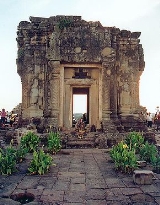
Phnom Bakheng at Angkor
Angkor

Angkor is a name conventionally applied to the region of Cambodia serving as the seat of the Khmer empire that flourished from approximately the ninth century to the fifteenth century A.D....
, Cambodia
Cambodia

The Kingdom of Cambodia is a country in South East Asia with a population of over 13 million people. The kingdom's capital and largest city is Phnom Penh....
, is a Hindu temple in the form of a temple mountain
Architecture of Cambodia

The period of Angkor is the period from approximately the latter half of the 8th century A.D. to the first half of the 15th century. If precise dates are required, the beginning may be set in 802 A.D., when the Khmer people King Jayavarman II pronounced himself universal monarch and declared independence from Java, and the end may be set i...
. Dedicated to Shiva
Shiva

Shiva: is a major Hinduism god, and one aspect of Trimurti. In the Shaiva tradition of Hinduism, Shiva is seen as the supreme God. In the Smarta tradition, he is one of panchadeva....
, it was built at the end of the 9th century, during the reign of King Yasovarman
Yasovarman

Yasovarman I was an Khmer Empire king who reigned from AD 889-910....
 (889-910 A.D.). Located atop a hill, it is nowadays a popular tourist spot for sunset views of the much bigger temple Angkor Wat
Angkor Wat

Angkor Wat , is a temple complex at Angkor, Cambodia, built for the king Suryavarman II in the early 12th century as his state temple and capital city....
, which lies amid the jungle about 1.5 km to the southeast. The large number of visitors makes Phnom Bakheng one of the most threatened monuments of Angkor.


Discussion
Ask a question about 'Phnom Bakheng'
Start a new discussion about 'Phnom Bakheng'
Answer questions from other users
Full Discussion Forum


Encyclopedia


Phnom Bakheng at Angkor
Angkor

Angkor is a name conventionally applied to the region of Cambodia serving as the seat of the Khmer empire that flourished from approximately the ninth century to the fifteenth century A.D....
, Cambodia
Cambodia

The Kingdom of Cambodia is a country in South East Asia with a population of over 13 million people. The kingdom's capital and largest city is Phnom Penh....
, is a Hindu temple in the form of a temple mountain
Architecture of Cambodia

The period of Angkor is the period from approximately the latter half of the 8th century A.D. to the first half of the 15th century. If precise dates are required, the beginning may be set in 802 A.D., when the Khmer people King Jayavarman II pronounced himself universal monarch and declared independence from Java, and the end may be set i...
. Dedicated to Shiva
Shiva

Shiva: is a major Hinduism god, and one aspect of Trimurti. In the Shaiva tradition of Hinduism, Shiva is seen as the supreme God. In the Smarta tradition, he is one of panchadeva....
, it was built at the end of the 9th century, during the reign of King Yasovarman
Yasovarman

Yasovarman I was an Khmer Empire king who reigned from AD 889-910....
 (889-910 A.D.). Located atop a hill, it is nowadays a popular tourist spot for sunset views of the much bigger temple Angkor Wat
Angkor Wat

Angkor Wat , is a temple complex at Angkor, Cambodia, built for the king Suryavarman II in the early 12th century as his state temple and capital city....
, which lies amid the jungle about 1.5 km to the southeast. The large number of visitors makes Phnom Bakheng one of the most threatened monuments of Angkor.

Constructed more than two centuries before Angkor Wat, Phnom Bakheng was in its day the principal temple of the Angkor region, historians believe. It was the architectural centerpiece of a new capital, Yasodharapura, that Yasovarman built when he moved the court from the capital Hariharalaya
Hariharalaya

Hariharalaya was an ancient city and capital of the Khmer empire located near Siem Reap, Cambodia in an area now called Roluos. Today, all that remains of the city are the ruins of several royal temples: Preah Ko, the Bakong, Lolei....
 in the Roluos
Roluos

Roluos is a khum of Svay Chek District in Banteay Meanchey in north-western Cambodia...
 area located to the southeast.

An inscription dated 1052 A.D. and found at the Sdok Kak Thom temple in present-day Thailand
Thailand

The Kingdom of Thailand is an independent country that lies in the heart of Southeast Asia. It is bordered to the north by Laos and Myanmar, to the east by Laos and Cambodia, to the south by the Gulf of Thailand and Malaysia, and to the west by the Andaman Sea and Myanmar....
 states in Sanskrit
Sanskrit

Sanskrit is a historical Indo-Aryan language, one of the liturgical languages of Hinduism and Buddhism, and one of the 22 official languages of India....
: "When Sri Yasovardhana became king under the name of Yasovarman, the able Vamasiva continued as his guru. By the king's order, he set up a linga on Sri Yasodharagiri, a mountain equal in beauty to the king of mountains." Scholars believe that this passage refers to the consecration of the Phnom Bakheng temple approximately a century and a half earlier.

Surrounding the mount and temple, labor teams built an outer moat measuring about four kilometers square and 200 meters wide; its southwest sections are still visible from the air. The new city probably lay largely within the confines of this moat. A smaller inner moat measuring 650 by 436 meters was also constructed. Avenues radiated out in the four cardinal directions from the mount. A causeway ran in a northwest-southeast orientation from the old capital area to the east section of the new capital's outer moat and then, turning to an east-west orientation, connected directly to the east entrance of the temple.

Phnom Bakheng is a symbolic representation of Mount Meru, home of the Hindu gods, a status emphasized by the temple’s location atop a steep hill. The temple faces east, measures 76 meters square at its base and is built in a pyramid form of six tiers. At the top level, five sandstone sanctuaries, in various states of repair, stand in a quincunx
Architecture of Cambodia

The period of Angkor is the period from approximately the latter half of the 8th century A.D. to the first half of the 15th century. If precise dates are required, the beginning may be set in 802 A.D., when the Khmer people King Jayavarman II pronounced himself universal monarch and declared independence from Java, and the end may be set i...
 pattern--one in the center and one at each corner of the level’s square. Originally, 108 small towers were arrayed around the temple at ground level and on various of its tiers; most of them have collapsed.

Phnom Bakheng is one of three hilltop temples in the Angkor region that are attributed to Yasovarman's reign. The other two are Phnom Krom
Phnom Krom

Phnom Krom is a hilltop temple in Angkor, Cambodia. The temple was built at the end of the 9th century, during the reign of King Yasovarman . Located 12 kilometers southwest of Siem Reap, it is a Hindu shrine dedicated to Shiva, Vishnu and Brahma ....
 to the south near the Tonle Sap
Tonlé Sap

The Tonl? Sap , i.e., large body of water is a combined lake and river system of huge importance to Cambodia. It is the largest freshwater lake in South East Asia and is an ecological hot spot that was designated as a UNESCO biosphere in 1997....
 lake, and Phnom Bok
Phnom Bok

Phnom Bok is a temple in Angkor, the area of Cambodia that was capital of the Khmer Empire. Built during the reign of King Yasovarman , the temple stands atop a hill northeast of the East Baray, the huge Angkorian reservoir that is now dry....
, northeast of the East Baray
East Baray

The East Baray is a now-dry Architecture of Cambodia#Barays and Srahs, or artificial body of water, at Angkor, Cambodia, oriented east-west and located just east of the walled city Angkor Thom....
 reservoir.

Following Angkor's rediscovery by the outside world in the mid-19th Century, decades passed before archeologists grasped Phnom Bakheng's historical significance. For many years, scholars' consensus view was that the Bayon
Bayon

The Bayon is a well-known and richly decorated Khmer Empire temple at Angkor in Cambodia. Built in the late 12th century or early 13th century as the official state temple of the Mahayana Buddhist King Jayavarman VII, the Bayon stands at the centre of Jayavarman's capital, Angkor Thom....
, the temple located at the center of Angkor Thom
Angkor Thom

Angkor Thom was the last and most enduring capital city of the Khmer empire. It was established in the late twelfth century by king Jayavarman VII....
 city, was the edifice to which the Sdok Kak Thom inscription referred. Later work identified the Bayon as a Buddhist site, built almost three centuries later than originally thought, in the late 12th Century, and Phnom Bakheng as King Yasovarman's state temple.

See also

  • Angkor
    Angkor

    Angkor is a name conventionally applied to the region of Cambodia serving as the seat of the Khmer empire that flourished from approximately the ninth century to the fifteenth century A.D....
  • Architecture of Cambodia
    Architecture of Cambodia

    The period of Angkor is the period from approximately the latter half of the 8th century A.D. to the first half of the 15th century. If precise dates are required, the beginning may be set in 802 A.D., when the Khmer people King Jayavarman II pronounced himself universal monarch and declared independence from Java, and the end may be set i...