
All Topics  
Philip Sidney

 
Philip Sidney

   Email Print
   Bookmark   Link


Philip Sidney


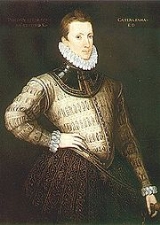
Sir Philip Sidney (30 November 1554 – 17 October 1586) became one of the Elizabethan Age's
Elizabethan era

The Elizabethan era is associated with Elizabeth I of England's reign and is often considered to be the Golden Age in History of England. It was the height of the English Renaissance and saw the flowering of English poetry and English literature....
 most prominent figures. Famous in his day in England
England

native_name =|conventional_long_name = England|common_name = England|image_flag = Flag of England.svg|image_coat = England COA.svg|symbol_type = Royal Coat of Arms...
 as a poet
Poet

A poet is a person who writes poetry....
, courtier
Courtier

A courtier is a person who attends the noble court of a monarch or other Executive . Historically the court was the centre of government as well as the Official residence of the monarch, and social and political life were often completely mixed together....
 and soldier
Soldier

A soldier is a general English term that refers to a land component of national armed forces.In most societies of the world, "soldier" is also a general term for any member of the land forces including Commissioned officer and non-commissioned officers....
, he remains known as the author of Astrophel and Stella
Astrophel and Stella

Likely composed in the 1580s by Philip Sidney, Astrophel and Stella is the first of the famous English sonnet sequences, and contains 108 sonnets and 11 songs....
 (1581, pub. 1591), The Defence of Poetry (or An Apology for Poetry
An Apology for Poetry

Sir Philip Sidney wrote An Apology for Poetry in 1581, and it was published in 1595, after his death.Sidney wrote the Apology before 1583....
, 1581, pub. 1595), and The Countess of Pembroke's Arcadia
Countess of Pembroke's Arcadia

The Countess of Pembroke's Arcadia, also known simply as The Arcadia, is a long prose work by Sir Philip Sidney written towards the end of the sixteenth century, and later published in several versions....
 (1580, pub. 1590).

at Penshurst
Penshurst

Penshurst is a village and civil parish in the Sevenoaks District of Kent, England. The parish is located on the northern slopes of the Weald, west of Tonbridge....
, Kent
Kent

Kent is a Counties of England in southeast England, and is one of the home counties. It borders East Sussex, Surrey and Greater London and has a defined boundary with Essex in the middle of the River Thames estuary....
, he was the eldest son of Sir Henry Sidney
Henry Sidney

Sir Henry Sidney , lord deputy of Ireland, was the eldest son of Sir William Sidney of Penshurst, a prominent politician and courtier during the reigns of Henry VIII of England and Edward VI of England, from both of whom he received extensive grants of land, including the manor of Penshurst in Kent, which became the principal residence of th...
 and Lady Mary Dudley.


Discussion
Ask a question about 'Philip Sidney'
Start a new discussion about 'Philip Sidney'
Answer questions from other users
Full Discussion Forum


Encyclopedia


Sir Philip Sidney (30 November 1554 – 17 October 1586) became one of the Elizabethan Age's
Elizabethan era

The Elizabethan era is associated with Elizabeth I of England's reign and is often considered to be the Golden Age in History of England. It was the height of the English Renaissance and saw the flowering of English poetry and English literature....
 most prominent figures. Famous in his day in England
England

native_name =|conventional_long_name = England|common_name = England|image_flag = Flag of England.svg|image_coat = England COA.svg|symbol_type = Royal Coat of Arms...
 as a poet
Poet

A poet is a person who writes poetry....
, courtier
Courtier

A courtier is a person who attends the noble court of a monarch or other Executive . Historically the court was the centre of government as well as the Official residence of the monarch, and social and political life were often completely mixed together....
 and soldier
Soldier

A soldier is a general English term that refers to a land component of national armed forces.In most societies of the world, "soldier" is also a general term for any member of the land forces including Commissioned officer and non-commissioned officers....
, he remains known as the author of Astrophel and Stella
Astrophel and Stella

Likely composed in the 1580s by Philip Sidney, Astrophel and Stella is the first of the famous English sonnet sequences, and contains 108 sonnets and 11 songs....
 (1581, pub. 1591), The Defence of Poetry (or An Apology for Poetry
An Apology for Poetry

Sir Philip Sidney wrote An Apology for Poetry in 1581, and it was published in 1595, after his death.Sidney wrote the Apology before 1583....
, 1581, pub. 1595), and The Countess of Pembroke's Arcadia
Countess of Pembroke's Arcadia

The Countess of Pembroke's Arcadia, also known simply as The Arcadia, is a long prose work by Sir Philip Sidney written towards the end of the sixteenth century, and later published in several versions....
 (1580, pub. 1590).

Life and family

Born at Penshurst
Penshurst

Penshurst is a village and civil parish in the Sevenoaks District of Kent, England. The parish is located on the northern slopes of the Weald, west of Tonbridge....
, Kent
Kent

Kent is a Counties of England in southeast England, and is one of the home counties. It borders East Sussex, Surrey and Greater London and has a defined boundary with Essex in the middle of the River Thames estuary....
, he was the eldest son of Sir Henry Sidney
Henry Sidney

Sir Henry Sidney , lord deputy of Ireland, was the eldest son of Sir William Sidney of Penshurst, a prominent politician and courtier during the reigns of Henry VIII of England and Edward VI of England, from both of whom he received extensive grants of land, including the manor of Penshurst in Kent, which became the principal residence of th...
 and Lady Mary Dudley. His mother was the daughter of John Dudley, 1st Duke of Northumberland
John Dudley, 1st Duke of Northumberland

John Dudley, 1st Duke of Northumberland was a Tudor dynasty general, admiral and politician, who de facto ruled England in the latter half of Edward VI of England's reign....
, and the sister of Robert Dudley, 1st Earl of Leicester
Robert Dudley, 1st Earl of Leicester

Robert Dudley, 1st Earl of Leicester was the long-standing favourite of Elizabeth I of England. He was appointed Master of the Horse on her accession in November 1558, and a Privy Councillor in October 1562....
. His younger sister, Mary Sidney
Mary Sidney

Mary Herbert, Countess of Pembroke n?e Mary Sidney , was one of the first England women to achieve a major reputation for her literary works, translations and literary patronage....
, married Henry Herbert, 2nd Earl of Pembroke
Henry Herbert, 2nd Earl of Pembroke

Henry Herbert, 2nd Earl of Pembroke Order of the Garter was a statesman of the Elizabethan era. He was the son of William Herbert, 1st Earl of Pembroke and Anne Herbert, Countess of Pembroke....
. Mary Sidney, whom upon her marriage became the Countess of Pembroke, was a writer, translator and literary patron. Sidney dedicated his longest work, the Arcadia, to her. After her brother's death, Mary Sidney Herbert reworked the Arcadia, now known as The Countess of Pembroke's Arcadia.

Philip was educated at Shrewsbury School
Shrewsbury School

Shrewsbury School is a Independent School located in Shrewsbury, Shropshire, Shropshire, England. It is one of the original nine English public schools as defined by the Public Schools Act 1868, and is now a member of the Headmasters' and Headmistresses' Conference....
 and Christ Church
Christ Church, Oxford

Christ Church , is one of the largest Colleges of the University of Oxford of the University of Oxford in England. As well as being a college, Christ Church is also the cathedral church of the diocese of Oxford, namely Christ Church Cathedral, Oxford....
, Oxford. He was much travelled and highly learned. In 1572, he travelled to France as part of the embassy to negotiate a marriage between Elizabeth I
Elizabeth I of England

Elizabeth I was List of English monarchs and Queen of Ireland from 17 November 1558 until her death. Sometimes called The Virgin Queen, Gloriana, or Good Queen Bess, Elizabeth was the fifth and last monarch of the House of Tudor....
 and the Duc D'Alençon. He spent the next several years in mainland Europe, moving through Germany
Germany

Germany , officially the Federal Republic of Germany , is a country in Central Europe. It is bordered to the north by the North Sea, Denmark, and the Baltic Sea; to the east by Poland and the Czech Republic; to the south by Austria and Switzerland; and to the west by France, Luxembourg, Belgium, and the Netherlands....
, Italy
Italy

Italy , officially the Italian Republic , is a country located on the Italian Peninsula in Southern Europe and on the two largest islands in the Mediterranean Sea, Sicily and Sardinia....
, Poland
Poland

Poland , officially the Republic of Poland , is a country in Central Europe. Poland is bordered by Germany to the west; the Czech Republic and Slovakia to the south; Ukraine, Belarus and Lithuania to the east; and the Baltic Sea and Kaliningrad Oblast, a Russian Enclave and exclave, to the north....
, and Austria
Austria

Austria , officially the Republic of Austria , is a landlocked country in Central Europe. It borders both Germany and the Czech Republic to the north, Slovakia and Hungary to the east, Slovenia and Italy to the south, and Switzerland and Liechtenstein to the west....
. On these travels, he met a number of prominent European intellectuals and politicians.

Returning to England in 1575, Sidney met Penelope Devereaux, the future Lady Rich; though much younger, she would inspire his famous sonnet sequence of the 1580s, Astrophel and Stella
Astrophel and Stella

Likely composed in the 1580s by Philip Sidney, Astrophel and Stella is the first of the famous English sonnet sequences, and contains 108 sonnets and 11 songs....
.
Her father, the Earl of Essex
Earl of Essex

Earl of Essex is a title that has been held by several families and individuals, of which the best-known and most closely associated with the title was Robert Devereux, 2nd Earl of Essex ....
, is said to have planned to marry his daughter to Sidney, but he died in 1576. In England, Sidney occupied himself with politics and art. He defended his father's administration of Ireland in a lengthy document. More seriously, he quarrelled with Edward de Vere, 17th Earl of Oxford
Edward de Vere, 17th Earl of Oxford

Edward de Vere, 17th Earl of Oxford was an Elizabethan era courtier, playwright, poet, sportsman, patron of numerous writers, and sponsor of at least two acting companies, Oxford's Men and Oxford's Boys, and a company of musicians....
, probably because of Sidney's opposition to the French marriage, which de Vere championed. In the aftermath of this episode, Sidney challenged de Vere to a duel, which Elizabeth forbade. He then wrote a lengthy letter to the Queen detailing the foolishness of the French marriage. Characteristically, Elizabeth bristled at his presumption, and Sidney prudently retired from court.

His artistic contacts were more peaceful and more significant for his lasting fame. During his absence from court, he wrote the first draft of The Arcadia and A Defense of Poetry. Somewhat earlier, he had met Edmund Spenser
Edmund Spenser

Edmund Spenser was an important England poet best known for The Faerie Queene, an epic poem celebrating, through fantastical allegory, the Tudor dynasty and Elizabeth I....
, who dedicated the Shepheardes Calendar
The Shepheardes Calender

The Shepheardes Calender was Edmund Spenser's first major poetic work, published in 1579. In emulation of Virgil's first work, the Eclogues, Spenser wrote this series of pastorals to begin his career....
 to him. Other literary contacts included membership, along with his friends and fellow poets Fulke Greville
Fulke Greville, 1st Baron Brooke

Fulke Greville, 1st Baron Brooke, de jure 13th Baron Latimer and 5th Baron Willoughby de Broke , known before 1621 as Sir Fulke Greville, was an Elizabethan era poet, dramatist, and statesman....
, Edward Dyer
Edward Dyer

Sir Edward Dyer was an England courtier and poet....
, Edmund Spenser
Edmund Spenser

Edmund Spenser was an important England poet best known for The Faerie Queene, an epic poem celebrating, through fantastical allegory, the Tudor dynasty and Elizabeth I....
 and Gabriel Harvey
Gabriel Harvey

Gabriel Harvey was an England writer. Harvey was a notable scholar, though his reputation suffered from his quarrel with Thomas Nashe. Henry Morley, writing in the Fortnightly Review , brought evidence from Harvey's Latin language writings showing that he was distinguished by quite other qualities than the pedantry and conceit usually as...
, of the (possibly fictitious) 'Areopagus', a humanist endeavour to classicize English verse.

Sidney had returned to court by the middle of 1581. That same year Penelope Devereaux was married, apparently against her will, to Lord Rich. Sidney was knighted in 1583. An early arrangement to marry Anne Cecil, daughter of Sir William Cecil
William Cecil, 1st Baron Burghley

William Cecil, 1st Baron Burghley , Knight_of_the_Garter was an England statesman, the chief advisor and good friend of Elizabeth I of England for most of her reign , twice Secretary of State and Lord High Treasurer from 1572....
 and eventual wife of de Vere, had fallen through in 1571. In 1583, he married Frances
Frances Walsingham

Frances Walsingham 1569 - 13 February 1631) was an English people countess during the Tudor period and Stuart periods.She was the only child of Sir Francis Walsingham, spymaster for Queen Elizabeth I, and Ursula St....
, teenage daughter of Sir Francis Walsingham
Francis Walsingham

Sir Francis Walsingham is usually remembered as the "spymaster" of Queen regnant Elizabeth I of England. Walsingham is frequently cited as one of the earliest practitioners of modern intelligence both for espionage and for domestic security....
. The next year, he met Giordano Bruno
Giordano Bruno

Giordano Bruno, born Filippo Bruno , was an Italy philosopher best-known as a proponent of heliocentrism and the infinity of the universe. In addition to his cosmological writings, he also wrote extensive works on the art of memory, a loosely-organized group of mnemonic techniques and principles....
 who subsequently dedicated two books to Sidney.

Both through his family heritage and his personal experience (he was in Walsingham's house in Paris during the St. Bartholomew's Day Massacre
St. Bartholomew's Day massacre

The St. Bartholomew's Day massacre in 1572 was a targeted group of assassinations, followed by a wave of Roman Catholic mob violence, both directed against the Huguenots , during the French Wars of Religion....
), Sidney was a keenly militant Protestant. In the 1570s, he had persuaded John Casimir
John Casimir

John Casimir may refer to:*John II Casimir of Poland *Johann Casimir of Simmern *John Casimir, Duke of Saxe-Coburg *John Casimir *John Casimir, Count Palatine of Kleeburg , father of Karl X Gustav of Sweden...
 to consider proposals for a united Protestant effort against the Roman Catholic Church
Roman Catholic Church

The Roman Catholic Church, officially known as the Catholic Church is the world's largest Christianity Ecclesia , representing over half of all Christians and one-sixth of the world population....
 and Spain
Spain

Spain or the Kingdom of Spain , is a country located in Southern Europe on the Iberian Peninsula.The Spanish constitution does not establish any official denomination of the country, even though Espa?a , Estado espa?ol and Naci?n espa?ola are used interchangeably....
. In the early 1580s, he argued unsuccessfully for an assault on Spain
Spain

Spain or the Kingdom of Spain , is a country located in Southern Europe on the Iberian Peninsula.The Spanish constitution does not establish any official denomination of the country, even though Espa?a , Estado espa?ol and Naci?n espa?ola are used interchangeably....
 itself. In 1585, his enthusiasm for the Protestant struggle was given a free rein when he was appointed governor of Flushing
Flushing, Netherlands

Vlissingen , or Flushing in English, is a municipality and a city in the southwestern Netherlands on the former island of Walcheren. With its strategic location between the Scheldt river and the North Sea, Vlissingen has been an important harbour for centuries....
 in the Netherlands
Netherlands

The Netherlands is a country that is part of the Kingdom of the Netherlands. It is a parliamentary democratic constitutional monarchy. The Netherlands is located in North-West Europe, and bordered by the North Sea to the north and west, Belgium to the south, and Germany to the east....
. In the Netherlands, he consistently urged boldness on his superior, his uncle the Earl of Leicester
Earl of Leicester

The title Earl of Leicester was created in the 12th century in the Peerage of England , and is currently a title in the Peerage of the United Kingdom, created in 1837....
. He conducted a successful raid on Spanish forces near Axel
Axel (Netherlands)

Axel is a town in the Netherlands province of Zeeland. It is a part of the municipality of Terneuzen, and lies about 31 km southeast of Vlissingen....
 in July, 1586.

Later that year, he joined Sir John Norris
John Norreys

Sir John Norreys frequently referred to as John Norris was an English soldier of a Berkshire family of court gentry, son of Henry Norris, 1st Baron Norreys a life-long friend of Elizabeth I of England....
 in the Battle of Zutphen
Battle of Zutphen

The Battle of Zutphen was a confrontation of the Eighty Years' War on September 22, 1586, in Zutphen, the Netherlands. It was fought between Dutch rebels of protestant faith, aided by England, against the country's Spain government soldiers....
. During the siege, he was shot in the thigh and died twenty-six days later. According to story, while lying wounded he gave his water-bottle to another wounded soldier, saying, "Thy necessity is yet greater than mine". This became possibly the most famous story about Sir Phillip, intended to illustrate his noble character.

Sidney's body was returned to London and interred in St. Paul's Cathedral
St Paul's Cathedral

St Paul's Cathedral is the Anglicanism cathedral on Ludgate Hill, in the City of London, and the seat of the Bishop of London. The present building dates from the 17th century and is generally reckoned to be London's fifth St Paul's Cathedral, although the number is higher if every major medieval reconstruction is counted as a new cathedr...
 on 16 February 1587. Already during his own lifetime, but even more after his death, he had become for many English people the very epitome of a courtier: learned and politic, but at the same time generous, brave, and impulsive. Never more than a marginal figure in the politics of his time, he was memorialized as the flower of English manhood in Edmund Spenser
Edmund Spenser

Edmund Spenser was an important England poet best known for The Faerie Queene, an epic poem celebrating, through fantastical allegory, the Tudor dynasty and Elizabeth I....
's Astrophel, one of the greatest English Renaissance elegies.

An early biography of Sidney was written by his friend and schoolfellow, Fulke Greville
Fulke Greville, 1st Baron Brooke

Fulke Greville, 1st Baron Brooke, de jure 13th Baron Latimer and 5th Baron Willoughby de Broke , known before 1621 as Sir Fulke Greville, was an Elizabethan era poet, dramatist, and statesman....
.

The Rye House
Rye House Plot

The Rye House Plot of 1683 was a plan to assassinate King Charles II of England and his brother James II of England. Historians vary in their assessment of the degree to which details of the conspiracy were finalized....
 conspirator, Algernon Sydney
Algernon Sydney

Algernon Sydney or Sidney was an England politician, political theorist, and opponent of King Charles II of England, who became involved in a plot against the King and was executed for treason....
, was Sir Philip's great-nephew.

In Zutphen, the Netherlands a street has been named after Sir Philip. A statue for him can be found in the park at the Coehoornsingel, where the English soldiers who fell in the Battle of Zutphen were also temporarily buried. A memorial at the location where he was mortally wounded by the Spanish can be found at the entrance of a footpath at the Warnsveldseweg, southeast of the Catholic cemetery.

Works

  • The Lady of May — This is one of Sidney's lesser-known works, a masque
    Masque

    The masque was a form of festive Noble court entertainment which flourished in sixteenth and early seventeenth century Europe, though it was developed earlier in Italy, in forms including the intermedio....
     written and performed for Queen Elizabeth in 1578 or 1579.
  • Astrophel and Stella
    Astrophel and Stella

    Likely composed in the 1580s by Philip Sidney, Astrophel and Stella is the first of the famous English sonnet sequences, and contains 108 sonnets and 11 songs....
     — The first of the famous English sonnet
    Sonnet

    The sonnet is one of the Poetry that can be found in lyric poetry from Europe.The term "sonnet" derives from the Occitan word sonet and the Italian language word sonetto, both meaning "little song"....
     sequences, Astrophel and Stella was probably composed in the early 1580s. The sonnets were well-circulated in manuscript before the first (apparently pirated) edition was printed in 1591; only in 1598 did an authorised edition reach the press. The sequence was a watershed in English Renaissance
    Renaissance

    The Renaissance was a cultural movement that spanned roughly the 14th to the 17th century, beginning in Italy in the late Middle Ages and later spreading to the rest of Europe....
     poetry. In it, Sidney partially nativised the key features of his Italian
    Italy

    Italy , officially the Italian Republic , is a country located on the Italian Peninsula in Southern Europe and on the two largest islands in the Mediterranean Sea, Sicily and Sardinia....
     model, Petrarch
    Petrarch

    Francesco Petrarca , known in English language as Petrarch, was an Italy scholar, poet and one of the earliest Renaissance humanism. Petrarch is often popularly called the "Father of Humanism"....
    : variation of emotion from poem to poem, with the attendant sense of an ongoing, but partly obscure, narrative; the philosophical trappings; the musings on the act of poetic creation itself. His experiments with rhyme scheme
    Rhyme scheme

    A rhyme scheme is the pattern of rhyming lines in a poem or song. It is usually referred to by using Letter s to indicate which lines rhyme. In other words, it is the pattern of end rhymes or lines....
     were no less notable; they served to free the English sonnet from the strict rhyming requirements of the Italian form.
  • The Countess of Pembroke's Arcadia — The Arcadia, by far Sidney's most ambitious work, was as significant in its own way as his sonnets. The work is a romance
    Romance (genre)

    As a literary genre of high culture, romance or chivalric romance refers to a style of heroic prose and Verse narrative that was particularly current in aristocratic literature of Middle Ages and Early Modern Europe, that narrated fantastic stories about the marvellous adventures of a chivalrous, heroic knight, often of super-human ab...
     that combines pastoral
    Pastoral

    Pastoral, as an adjective, refers to the lifestyle of shepherds and pastoralists, moving livestock around larger areas of land according to seasons and availability of water and food....
     elements with a mood derived from the Hellenistic
    Hellenistic civilization

    File:Diadochen1.pngHellenistic civilization represents the zenith of Ancient Greece influence in the Classical Antiquity from 323 BC to about 146 BC ....
     model of Heliodorus
    Heliodorus

    Heliodorus is a Greek name meaning "Gift of the Sun". Several persons named Heliodorus are known to us from ancient times, the best known of which are:...
    . In the work, that is, a highly idealized version of the shepherd's life adjoins (not always naturally) with stories of joust
    Jousting

    Jousting is a sport played by two armored combatants mounted on horses. It consists of wiktionary:martial competition between two mounted knights using a variety of weapons, usually in sets of three per weapon , often as part of a Tournament ....
    s, political treachery, kidnapping
    Kidnapping

    In criminal law, kidnapping is the taking away or asportation of a person against the person's will, usually to hold the person in false imprisonment, a confinement without legal authority....
    s, battle
    Battle

    Generally, a battle is a conceptual component in the hierarchy of combat in warfare between two or more armed forces, wherein each group will seek to defeat the others within the scope of a military campaign, and are well defined in duration, area and force commitment....
    s, and rape
    Rape

    Rape, also referred to as sexual assault, is an assault by a person involving sexual intercourse with or sexual penetration of another person without that person's consent....
    s. As published in the sixteenth century, the narrative follows the Greek
    Greek literature

    Greek literature refers to those writings autochthonic to the areas of Greeks influence, typically though not necessarily in one of the Greek dialects, throughout the whole period in which the Greek language people have existed....
     model: stories are nested within each other, and different story-lines are intertwined. The work enjoyed great popularity for more than a century after its publication. William Shakespeare
    William Shakespeare

    William Shakespeare was an English people poet and playwright, widely regarded as the greatest writer in the English language and the world's preeminent dramatist....
     borrowed from it for the Gloucester
    Gloucester

    Gloucester is a city status in the United Kingdom, Non-metropolitan district and county town of Gloucestershire in the South West England region of England....
     subplot of King Lear
    King Lear

    King Lear is a tragedy by William Shakespeare, believed to have been written between 1603 and 1606, and is considered one of his greatest works....
    ; parts of it were also dramatized by John Day
    John Day (dramatist)

    John Day was an England dramatist of the Elizabethan era and Literature_in_English#Jacobean_literature periods....
     and James Shirley
    James Shirley

    James Shirley , was an England dramatist.He belonged to the great period of English dramatic literature, but, in Charles Lamb words, he "claims a place among the worthies of this period, not so much for any transcendent genius in himself, as that he was the last of a great race, all of whom spoke nearly the same language and had a set of...
    . According to a widely-told story, King Charles I
    Charles I of England

    Charles I was List of English monarchs, List of monarchs of Scotland and King of Ireland from 27 March 1625 until his capital punishment on 30 January 1649....
     quoted lines from the book as he mounted the scaffold to be executed; Samuel Richardson
    Samuel Richardson

    Samuel Richardson was an 18th-century England writer and Printer . He is best known for his three epistolary novels: Pamela , Clarissa and The History of Sir Charles Grandison ....
     named the heroine of his first novel after Sidney's Pamela. Arcadia exists in two significantly different versions. Sidney wrote an early version (The Old Arcadia) during a stay at Mary Herbert
    Mary Sidney

    Mary Herbert, Countess of Pembroke n?e Mary Sidney , was one of the first England women to achieve a major reputation for her literary works, translations and literary patronage....
    's house; this version is narrated in a straightforward, sequential manner. Later, Sidney began to revise the work on a more ambitious plan, with much more backstory about the princes, and a much more complicated story line, with many more characters. He completed most of the first three books, but the project was unfinished at the time of his death--the third book breaks off in the middle of a swordfight. There were several early editions of the book. Fulke Greville published the revised version alone, in 1590. The Countess of Pembroke, Sidney's sister, published a version in 1593, which pasted the last two books of the first version onto the first three books of the revision. In the 1621 version, Sir William Alexander provided a bridge to bring the two stories back into agreement. It was known in this cobbled-together fashion until the discovery, in the early twentieth century, of the earlier version.
  • An Apology for Poetry
    An Apology for Poetry

    Sir Philip Sidney wrote An Apology for Poetry in 1581, and it was published in 1595, after his death.Sidney wrote the Apology before 1583....
     (also known as A Defence of Poesie and The Defence of Poetry) — Sidney wrote the Defence before 1583. It is generally believed that he was at least partly motivated by Stephen Gosson
    Stephen Gosson

    Stephen Gosson , was an England satirist.He was baptized at St George's church, Canterbury, on 17 April 1554. He entered Corpus Christi College, Oxford, 1572, and on leaving the university in 1576 he went to London....
    , a former playwright who dedicated his attack on the English stage, The School of Abuse, to Sidney in 1579, but Sidney primarily addresses more general objections to poetry, such as those of Plato. In his essay, Sidney integrates a number of classical and Italian precepts on fiction
    Fiction

    Fiction is an imaginative form of narrative, one of the four basic rhetorical modes. Although the word fiction is derived from the Latin fingo, fingere, finxi, fictum, "to form, create", works of fiction need not be entirely imaginary and may include real people, places, and events....
    . The essence of his defense is that poetry, by combining the liveliness of history
    HIStory

    HIStory: Past, Present and Future, Book I is a double album by Michael Jackson, released on June 20, 1995, and is Jackson's ninth. The first disc, named "HIStory Begins" consists of a selection of Jackson's greatest hits from the singer's past fifteen years, while the second, named "HIStory Continues" features new songs, with the...
     with the ethic
    Ethics

    Ethics is a word for a philosophy that encompasses proper conduct and good living. It is significantly broader than the common conception of ethics as the analyzing of right and wrong....
    al focus of philosophy
    Philosophy

    Philosophy is the study of general problems concerning matters such as existence, knowledge, truth, beauty, justice, validity, mind, and language....
    , is more effective than either history or philosophy in rousing its readers to virtue. The work also offers important comments on Edmund Spenser
    Edmund Spenser

    Edmund Spenser was an important England poet best known for The Faerie Queene, an epic poem celebrating, through fantastical allegory, the Tudor dynasty and Elizabeth I....
     and the Elizabethan stage.


Further reading

Books
  • Craig, D. H. "A Hybrid Growth: Sidney's Theory of Poetry in An Apology for Poetry." Essential Articles for the Study of Sir Philip Sidney. Ed. Arthur F. Kinney. Hamden: Archon Books, 1986.
  • Davies, Norman. Europe: A History
    Europe: A History

    Europe: A History is a narrative history book by Norman Davies.As Davies notes in the Preface, the book contains little that is original....
    . London: Pimlico, 1997.
  • Frye, Northrup. Words With Power: Being a Second Study of the Bible and Literature. Toronto: Penguin Books, 1992.
  • Garrett, Martin. Ed. Sidney: the Critical Heritage. London: Routledge, 1996.
  • Greville, Fulke.Life of the Renowned Sir Philip Sidney. London, 1652.
  • Hale, John. The Civilization of Europe in the Renaissance. New York: Atheeum, 1994.
  • Jasinski, James. Sourcebook on Rhetoric: Key Concepts in Contemporary Rhetorical Studies. Thousand Oaks: Sage Publications, 2001.
  • Kimbrough, Robert. Sir Philip Sidney. New York: Twayne Publishers, Inc., 1971.
  • Leitch, Vincent B., Ed. The Norton Anthology of Theory and Criticism. New York: W. W. Norton & Company, Inc., 2001.
  • Lewis, C. S. English Literature in the Sixteenth Century, Excluding Drama. Oxford: Oxford University Press, 1954.
  • Robertson, Jean. "Philip Sidney." In The Spenser Encyclopedia. eds. A. C. Hamilton et al. Toronto: University of Toronto Press, 1990.
  • Shelley, Percy Bysshe. "A Defence of Poetry." In Shelley’s Poetry and Prose: A Norton Critical Edition. 2nd ed. Eds. Donald H. Reiman and Neil Fraistat. New York: W. W. Norton & Company, 2002.
  • Sidney, Philip. A Defence of Poesie and Poems. London: Cassell and Company, 1891.
  • The Cambridge History of English and American Literature. Volume 3. Cambridge: Cambridge University Press, 1910.


Articles
  • Acheson, Kathy. "'': Anti-Theatricality and Gender in Early Modern Closet Drama by Women." Early Modern Literary Studies 6.3 (January, 2001): 7.1-16. 21 October 2005.
  • Bear, R. S. ". In Renascence Editions. 21 October 2005.
  • Griffiths, Matthew. . 25 November 2005.
  • Harvey, Elizabeth D. . In The Johns Hopkins Guide to Literary Theory & Criticism. 25 November 2005.
  • Knauss, Daniel, Philip. ., Master's Thesis submitted to the Faculty of the North Carolina State University
    North Carolina State University

    North Carolina State University at Raleigh is a public university, coeducational, extensive research university located in Raleigh, North Carolina, United States....
    . 25 November 2005.
  • Maley, Willy. 8 November 2005
  • Mitsi, Efterpi. In Early Modern Literary Studies. 9 November 2004.
  • Pask, Kevin. 25 November 2005.
  • Staff. , Poets' Graves
    Poets' Graves

    Poets' Graves is an on-line database of the last resting places of poets. The site is regularly archived by the British Library so that it remains available to future researchers....
    . Accessed 26 May 2008


Other
  • Stump, Donald (ed). , Saint Louis University
    Saint Louis University

    Saint Louis University is a private, co-educational Jesuit university located in St. Louis, Missouri, Missouri. Founded in 1818 by the Most Reverend Louis Guillaume Valentin Du Bourg SLU is the oldest university west of the Mississippi River....
    . Accessed 26 May 2008. "This site is the largest collection of bibliographic references on Sidney in existence. It includes all the items originally published in Sir Philip Sidney: An Annotated Bibliography of Texts and Criticism, 1554-1984 (New York: G.K. Hall, Macmillan 1994) as well updates from 1985 to the present."


External Links