

Phascolarctidae

Encyclopedia
Phascolarctidae is a family of marsupials of the order Diprotodontia
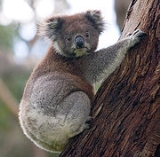
, consisting of only one extant species, the Koala
, six well known fossil species, with another 5 less well known fossil species, and 2 fossil species whose taxonomy is debatable but is put in this group. The closest relatives of the Phascolarctidae are the wombat
s, which comprise the family Vombatidae.
The family of the Phascolarctidae dates back to the Middle Miocene
.
Diprotodontia
Diprotodontia is a large order of about 120 marsupial mammals including the kangaroos, wallabies, possums, koala, wombats, and many others. Extinct diprotodonts include the rhinoceros-sized Diprotodon, and Thylacoleo, the so-called "marsupial lion"....
, consisting of only one extant species, the Koala
Koala
The koala is an arboreal herbivorous marsupial native to Australia, and the only extant representative of the family Phascolarctidae....
, six well known fossil species, with another 5 less well known fossil species, and 2 fossil species whose taxonomy is debatable but is put in this group. The closest relatives of the Phascolarctidae are the wombat
Wombat
Wombats are Australian marsupials; they are short-legged, muscular quadrupeds, approximately in length with a short, stubby tail. They are adaptable in their habitat tolerances, and are found in forested, mountainous, and heathland areas of south-eastern Australia, including Tasmania, as well as...
s, which comprise the family Vombatidae.
The family of the Phascolarctidae dates back to the Middle Miocene
Middle Miocene
The Middle Miocene is a sub-epoch of the Miocene Epoch made up of two stages: the Langhian and Serravallian stages. The Middle Miocene is preceded by the Early Miocene....
.
Classification
Family Phascolarctidae- ?Genus †Cundokoala
- †Cundokoala yorkensis
- Genus †Nimiokoala
- †Riversleigh Rainforest KoalaRiversleigh Rainforest KoalaThe Riversleigh Rainforest Koala is an extinct species of marsupial, closely related to the modern Koala, that lived 10-16 million years ago in the middle Miocene of Queensland. It probably had a diet of leaves similar to that of the modern species, but whether it specialized on eucalypt leaves is...
- Nimiokoala greystanesi
- †Riversleigh Rainforest Koala
- Genus †InvictokoalaInvictokoalaInvictokoala is an extinct genus of Koala from the middle Pleistocene of central-eastern Queensland, Australia. The holotype was found during cave excavations at Mount Etna. It was first named by Gilbert J. Price and Scott A. Hocknull in 2011 and the type species is Invictokoala monticola....
- †Invictokoala monticola
- Genus †Madakoala
- †Madakoala robustus
- †Madakoala wellsi
- †Madakoala devisi
- Genus †LitokoalaLitokoalaLitokoala is an extinct genus of marsupial, and along with Nimiokoala are closely related to the modern Koala. The three genera may have diverged at an earlier date, although the drying of the continent and the expansion of Eucalyptus forests towards the late Miocene may have delayed the evolution...
- †Litokoala garyjohnstoni
- †Litokoala kutjamarpensis
- †Litokoala kanunkaensis
- Genus †Koobor
- †Koobor jimbarrati
- †Koobor notabilis
- Genus †Perikoala
- †Perikoala palankarinnica
- †Perikoala robustus
- Genus PhascolarctosPhascolarctosThe genus Phascolarctos consists of 3 species, of which only one is alive today. The largest species was P. stirtoni that lived in the Pleistocene epoch...
- †Phascolarctos maris
- KoalaKoalaThe koala is an arboreal herbivorous marsupial native to Australia, and the only extant representative of the family Phascolarctidae....
- Phascolarctos cinereus - †Giant KoalaGiant KoalaThe Giant Koala was an arboreal marsupial which existed in Australia during the Pleistocene epoch. Phascolarctos stirtoni was about one third larger than the contemporary Koala, and has had an estimated weight of , which is the same weight as a large contemporary male Koala...
- Phascolarctos stirtoni