
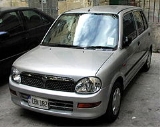
The
Perodua Kelisa was a
city carA city car is a small car intended for use primarily in an urban area.City cars are sold worldwide and most automotive industry manufacturers have one or two in their line-up. In North-America city cars are often referred to simply as "subcompacts" alongside the superminis. These kind of cars...
manufactured by
Malaysian automaker
PeroduaThe ' , usually abbreviated to Perodua , is Malaysia's second largest automobile manufacturer after Proton. It was established in 1992 and launched their first car, the Perodua Kancil in August 1994. 'M2’ was refers to the codename which was used when the project to establish Perodua was still Top...
from 2001 to 2007. The car was an unofficial successor to the
Perodua KancilThe Perodua Kancil was a city car manufactured by Malaysian automobile manufacturer Perodua from August 1994 to 2009. The car is essentially a badge-engineered 3rd generation Daihatsu Mira.- Overview :The Kancil was Perodua's first car after its founding in 1992...
, but was offered by Perodua alongside the Kancil until both models were replaced by the
Perodua VivaThe Perodua Viva is a city car manufactured by Malaysian automaker Perodua since May 10, 2007. It was originally planned to be the replacement of Perodua's current city cars - the Perodua Kancil and the Perodua Kelisa. Once launched, Perodua decided to market it as a Kelisa replacement only, and...
in 2007.
The
Perodua Kelisa was a
city carA city car is a small car intended for use primarily in an urban area.City cars are sold worldwide and most automotive industry manufacturers have one or two in their line-up. In North-America city cars are often referred to simply as "subcompacts" alongside the superminis. These kind of cars...
manufactured by
Malaysian automaker
PeroduaThe ' , usually abbreviated to Perodua , is Malaysia's second largest automobile manufacturer after Proton. It was established in 1992 and launched their first car, the Perodua Kancil in August 1994. 'M2’ was refers to the codename which was used when the project to establish Perodua was still Top...
from 2001 to 2007. The car was an unofficial successor to the
Perodua KancilThe Perodua Kancil was a city car manufactured by Malaysian automobile manufacturer Perodua from August 1994 to 2009. The car is essentially a badge-engineered 3rd generation Daihatsu Mira.- Overview :The Kancil was Perodua's first car after its founding in 1992...
, but was offered by Perodua alongside the Kancil until both models were replaced by the
Perodua VivaThe Perodua Viva is a city car manufactured by Malaysian automaker Perodua since May 10, 2007. It was originally planned to be the replacement of Perodua's current city cars - the Perodua Kancil and the Perodua Kelisa. Once launched, Perodua decided to market it as a Kelisa replacement only, and...
in 2007.
History
The Kelisa was, in all its releases, based on a fifth generation
Daihatsu MiraThe Daihatsu Mira , is a kei car-type vehicle built by the Japanese car maker Daihatsu. It comes with a variety of options and chassis variations, with the latest variant having four models: "Mira", "Mira AVY", "Mira Gino" and "Mira VAN"...
(L500), and is named after the
ArowanaArowanas are freshwater bony fish of the family Osteoglossidae, also known as bonytongues. In this family of fishes, the head is bony and the elongate body is covered by large, heavy scales, with a mosaic pattern of canals. The dorsal and the anal fins have soft rays and are long based, while the...
fish native to Malaysia (
ikan kelisa). The Kelisa was made available in two iterations: The first, which debuted in 2001, was intended to bear similarities to the 1999
Perodua KancilThe Perodua Kancil was a city car manufactured by Malaysian automobile manufacturer Perodua from August 1994 to 2009. The car is essentially a badge-engineered 3rd generation Daihatsu Mira.- Overview :The Kancil was Perodua's first car after its founding in 1992...
at the front, including the headlights and grille; the second iteration, introduced in 2002, was given a minor facelift to feature modified and lower profile bumpers, and a grille that extended wider to reach the headlights. The second iteration would go on to replace the original Kelisa outright in the Perodua lineup. The Kelisa was popular amongst Malaysian drivers for its relatively good
power-to-weight ratioPower-to-weight ratio is a calculation commonly applied to engines and mobile power sources to enable the comparison of one unit or design to another. Power-to-weight ratio is a measurement of actual performance of any engine or power sources...
, affordable price and low fuel consumption.
The Kelisa was released in several "special" editions. A limited-edition Kelisa, based on the original variant, prominently sports two-toned colored paintwork and minor interior modifications. Later, the interior of the second Kelisa was given a few modifications and the exterior a modern Metallic Pearl Jade finish—a light double metallic colour—which Perodua marketed under the name
Kelisa Imago.
As Perodua has sold its vehicles to the
United KingdomThe United Kingdom of Great Britain and Northern IrelandIn the United Kingdom and Dependencies, other languages have been officially recognised as legitimate autochthonous languages under the European Charter for Regional or Minority Languages...
since 1997, the Kelisa was introduced into the country in January 2002 as a replacement to the
NippaThe Perodua Kancil was a city car manufactured by Malaysian automobile manufacturer Perodua from August 1994 to 2009. The car is essentially a badge-engineered 3rd generation Daihatsu Mira.- Overview :The Kancil was Perodua's first car after its founding in 1992...
, a rebadged Kancil, and like its predecessor was the cheapest new car on sale in the United Kingdom, starting at just over £5,000.
Production and marketing of the Kelisa, along with the Kancil, was officially halted following the release of the
Perodua VivaThe Perodua Viva is a city car manufactured by Malaysian automaker Perodua since May 10, 2007. It was originally planned to be the replacement of Perodua's current city cars - the Perodua Kancil and the Perodua Kelisa. Once launched, Perodua decided to market it as a Kelisa replacement only, and...
in May 2007. Due to similarities in size and vehicle model they are derived from, the Viva is intended to succeed the Kelisa and the Kancil, both of which had been in production for 6 years and 13 years, respectively.
Performance and equipment
The Kelisa range includes three models: the entry level EX, the GXi and the automatic EZi. It has a maximum speed of 97 mi/h and can achieve about 68 miles per gallon. The Kelisa has a three-cylinder 989 cc petrol DOHC 12-valve engine (EJ-DE engine) with electronic fuel injection system. A smaller three-cylinder 847 cc petrol engine is also available. Selected Kelisa models also came with built-in
BluetoothBluetooth is a proprietary open wireless technology standard for exchanging data over short distances from fixed and mobile devices, creating personal area networks with high levels of security...
technology.
In media
In the second series of
Top Gear,
James MayJames Daniel May is an English television presenter, journalist and writer. He is best known for his role as co-presenter of the award-winning motoring programme Top Gear alongside Jeremy Clarkson and Richard Hammond....
drove the Kelisa and was generally impressed with the car, even likening it to the original
MiniThe Mini is a small car that was made by the British Motor Corporation and its successors from 1959 until 2000. The original is considered a British icon of the 1960s, and its space-saving front-wheel-drive layout influenced a generation of car-makers...
.
However, in
Jeremy ClarksonJeremy Charles Robert Clarkson is an English broadcaster, journalist and writer who specialises in motoring. He is best known for his role on the BBC TV show Top Gear along with co-presenters Richard Hammond and James May...
's 2005 DVD "Heaven and Hell", he bought a brand new Perodua Kelisa and destroyed it by blowing it up in an effort to highlight aesthetic frustrations with the design. In 2007, Clarkson described it as the worst in the world, "its name was like a disease and suggested it was built in jungles by people who wear leaves for shoes". His comments drew criticism from the Malaysian government.
External links