
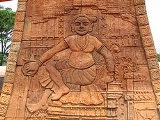
Kerala Varma Pazhassi Raja, popularly known as the
Lion of Kerala, hailed from
Padinjare Kovilakam and was the king of the Kottayam Royal family (near modern day
ThalasseryThalassery, also known as Tellicherry, is a city on the Malabar Coast of Kerala, India. This is the second largest city of North Malabar. It is 21 km from the district headquarters, Kannur. The name Tellicherry is the anglicized form of Thalassery. Thalassery municipality has a population...
,
Kannur districtKannur District கண்ணூர் is one of the 14 districts in the state of Kerala, India. The town of Kannur is the district headquarters, and gives the district its name. The old name Cannanore is the anglicised form of the Malayalam name Kannur. Kannur District is bounded by Kasaragod District to the...
) of the Malabar region in the present day area of
KeralaKerala , is a state located in southwestern India. The state was created in 1956 on linguistc basis, bringing together those places where Malayalam formed the principal language...
,
IndiaIndia, officially the Republic of India , is a country in South Asia. It is the seventh-largest country by geographical area, the second-most populous country, and the most populous democracy in the world. Bounded by the Indian Ocean on the south, the Arabian Sea on the west, and the Bay of Bengal...
, during the last decades of the
18th centuryThe 18th century lasted from 1701 to 1800 in the Gregorian calendar, in accordance with the Anno Domini/Common Era numbering system.However, Western historians sometimes specifically define the 18th century otherwise for the purposes of their work...
.
He achieved the title
Veera (brave) when he fought a guerilla war against British occupation with the able help of his loyal Kurichiyar tribe.
Kerala Varma Pazhassi Raja was born in
Padinjare Kovilakam, which was the western branch of
Kottayam Royal family.
Kerala Varma Pazhassi Raja, popularly known as the
Lion of Kerala, hailed from
Padinjare Kovilakam and was the king of the Kottayam Royal family (near modern day
ThalasseryThalassery, also known as Tellicherry, is a city on the Malabar Coast of Kerala, India. This is the second largest city of North Malabar. It is 21 km from the district headquarters, Kannur. The name Tellicherry is the anglicized form of Thalassery. Thalassery municipality has a population...
,
Kannur districtKannur District கண்ணூர் is one of the 14 districts in the state of Kerala, India. The town of Kannur is the district headquarters, and gives the district its name. The old name Cannanore is the anglicised form of the Malayalam name Kannur. Kannur District is bounded by Kasaragod District to the...
) of the Malabar region in the present day area of
KeralaKerala , is a state located in southwestern India. The state was created in 1956 on linguistc basis, bringing together those places where Malayalam formed the principal language...
,
IndiaIndia, officially the Republic of India , is a country in South Asia. It is the seventh-largest country by geographical area, the second-most populous country, and the most populous democracy in the world. Bounded by the Indian Ocean on the south, the Arabian Sea on the west, and the Bay of Bengal...
, during the last decades of the
18th centuryThe 18th century lasted from 1701 to 1800 in the Gregorian calendar, in accordance with the Anno Domini/Common Era numbering system.However, Western historians sometimes specifically define the 18th century otherwise for the purposes of their work...
.
He achieved the title
Veera (brave) when he fought a guerilla war against British occupation with the able help of his loyal Kurichiyar tribe.
Kingdom of Pazhassi Raja
Kerala Varma Pazhassi Raja was born in
Padinjare Kovilakam, which was the western branch of
Kottayam Royal family. Kottayam kingdom covered the present day Wayanad area and was divided in to
Nadukal(divisions) and placed under
NairNair , is the name of a Hindu Forward caste from the Southern Indian state of Kerala. They are a Kshatriya caste belonging to the Nagavanshi order...
cheiftains for administration.
MananthavadyMananthavady is a small town on the banks of Mananthavady Puzha a tributary of the Kabini River in the Wayanad district of Kerala, India.This area was once ruled by the Pazhassi dynasty and the tomb of Pazhassi Raja is an important heritage site located in the heart of the town. This is also the...
was the capital of this kingdom.
Revolt against British
The late 18th century was a time of wars for the British. The Americans had declared
IndependenceThe American Revolution is the political upheaval during the last half of the 18th century in which thirteen of Britain's colonies in North America at first rejected the governance of the Parliament of Great Britain, and later the British monarchy itself, to become the sovereign United States of...
from the British in 1776 and the
French RevolutionThe French Revolution was a period of political and social upheaval and radical change in the history of France, during which the French governmental structure, previously an absolute monarchy with feudal privileges for the aristocracy and Catholic clergy, underwent radical change to forms based...
happened between 1789 and 1799. King George III ruled Britain while
George WashingtonGeorge Washington was the commander of the Continental Army in the American Revolutionary War and served as the first President of the United States of America...
was the President of
United StatesThe United States of America is a federal constitutional republic comprising fifty states and a federal district...
in the 1790s. In
South AsiaSouth Asia, also known as Southern Asia, is the southern region of the Asian continent, which comprises the sub-Himalayan countries and, for some authorities , also includes the adjoining countries on the west and the east...
, at that time, the
Maratha Marāthā has three related usages: within the Marathi speaking region it describes the dominant Maratha caste or to the Maratha and Kunbi castes together; outside Maharashtra it can refer to the entire regional population of Marathi-speaking people; historically, it describes the Maratha empire...
s and
Tipu SultanSultan Fateh Ali Tipu November 1750, Devanahalli – 4 May 1799, Srirangapattana), also known as the Tiger of Mysore, was the de facto ruler of the Islamic Kingdom of Mysore from 1782 until his own demise in 1799. He was the first son of Hyder Ali by his second wife, Fatima or Fakhr-un-nissa...
of
MysoreMysore is the second-largest city in the state of Karnataka, India. It is the headquarters of the Mysore district and the Mysore division and lies about southwest of Bangalore, the capital of Karnataka. The name Mysore is an anglicised version of Mahishūru, which means the abode of Mahisha...
were fighting the British. It was at this time that Pazhassi Raja revolted against the British in present day
KeralaKerala , is a state located in southwestern India. The state was created in 1956 on linguistc basis, bringing together those places where Malayalam formed the principal language...
.
Reasons
When
KeralaKerala , is a state located in southwestern India. The state was created in 1956 on linguistc basis, bringing together those places where Malayalam formed the principal language...
was ruled from Mysore by Tipu and Haider, their officers used to collect taxes directly from the farmers bypassing the land lords, but the British changed this and decided to collect taxes directly from the Kings and Nair Lords. The amount fixed as tax by the British was unreasonable and people did not have the capacity to pay that much. Faced with revolts from people, the kings were unable to collect the taxes.
After Tipu left, the British ignored Pazhassi Raja and gave the land to his uncle on lease. This insult also helped in triggering the revolt. Pazhassi Raja stopped collecting taxes and this upset the British. Since the king was popular, they could not do anything but stop collecting tax for a year, but to add more insult, they extended the lease given to his uncle for another five years. On June 28, 1795, Pazhassi Raja challenged the British by stopping all tax collection and giving refuge to people who were considered revolutionaries by the British.
The Army was deployed under Lt. Gordon tried to arrest the king in his palace, but he had already escaped. The British negotiated with him and allowed him to return, but another misunderstanding caused him to flee again to the mountains of Wynad.
Showing that there are no permanent enemies or friends, he sought the help from
MysoreMysore is the second-largest city in the state of Karnataka, India. It is the headquarters of the Mysore district and the Mysore division and lies about southwest of Bangalore, the capital of Karnataka. The name Mysore is an anglicised version of Mahishūru, which means the abode of Mahisha...
, from the same people he helped the British fight. The year 1797 saw a series of revolts resulting in the loss of lives for many British soldiers and they were forced to withdraw. With an army of thousands of Nairs and
KurichiyasThe Kurichiyas are a matrilineal tribe of Kerala, India.Traditionally, members of this tribe have lived in relative isolation in the Wayanad Hills. The Kurichiyas are divided into matrilineal clans known as kulam....
, Pazhassi inflicted such defeat on the British that they were forced to retreat and negotiate. The lease with his uncle was canceled and Pazhassi agreed to live peacefully with the British.
In 1799, after the fall of Srirangapatnam, the British decide to take over Wynad which Pazhassi claimed as his own. The peace treaty was broken and with an army of Nairs and
KurichiyasThe Kurichiyas are a matrilineal tribe of Kerala, India.Traditionally, members of this tribe have lived in relative isolation in the Wayanad Hills. The Kurichiyas are divided into matrilineal clans known as kulam....
, Pazhassi decided to wage a guerilla war from the mountains of Wynad. The fighting started in June 1800, and the British strategy was to isolate Pazhassi from his Southern Malabar supporters. They succeeded and Pazhassi was left roaming in the forests with his wife and few supporters.
His supporters like Chuzhali
Nambiar-Communities:The name Nambiar applies to several Hindu communities from South India:-Kerala:*Nambiar - a title used by certain clans of Nair caste from the north Malabar region of Kerala....
, Peruvayal Nambiar and Kannavathu Shankaran Nambiar were caught and hanged, but this did not halt Pazhassi. In 1802 Edachena Kungan
NairNair , is the name of a Hindu Forward caste from the Southern Indian state of Kerala. They are a Kshatriya caste belonging to the Nagavanshi order...
and Thalakkal Chanthu captured
Panamaram Panamaram is a village in Wayanad district in the state of Kerala, India.-Demographics: India census, Panamaram had a population of 11651 with 5891 males and 5760 females.-Panamaram River:...
Fort and killed the 25 British soldiers there and this victory brought a new vigor to the resistance movement.
An increase in tax at this stage upset the local population which rose in revolt. The Pazhassi soldiers made use of this and inflicted more damage on the British. Besides this the British troops caught diseases and it looked like they were in deep trouble..
Confrontation with the British
The potent cause of the revolt was the unpopular and unjust revenue policy followed by the occupying foreign
British East India CompanyThe East India Company was an early English joint-stock company that was formed initially for pursuing trade with the East Indies, but that ended up trading mainly with the Indian subcontinent and China...
in
MalabarMalabar is a region of southern India, lying between the Western Ghats and the Arabian Sea. The name is thought to be derived from the Malayalam word Mala and Persian word Bar or Bar from Arabic language....
. He stopped all collections of revenue. The Raja further threatened to cut down all the
black pepperBlack pepper is a flowering vine in the family Piperaceae, cultivated for its fruit, which is usually dried and used as a spice and seasoning. The fruit, known as a peppercorn when dried, is a small drupe approximately five millimetres in diameter, dark red when fully mature, containing a single...
vines if the Company's officers persisted in revenue collection.
In April 1796, an unsuccessful effort was made by the British to capture the Raja in his own palace at Pazhassi.
On December 18, the British Commissioner issued a proclamation forbidding the people to assemble or to assist the Pazhassi Raja and warning them that if they did so, they would be considered as irreconcilable enemies of the Company and that their property would be confiscated.On December 30, a futile attempt was made to reconcile the differences between the Raja and the Company. On 8 January 1797, Pazhassi Raja's Nairs launched daring attack on the havildar's guard stationed at Pazhassi and the whole party except one man was killed. In the battles fought on three successive days, 9th, 10th and 11 March 1797, the detachment made by the Company forces was overpowered by the swords, spears, bows and arrows of Pazhassi Raja's Nairs. As the situation was full of perils, a reconciliation with the Pazhassi Raja became a matter of political expediency.
After South Canara and other parts of South India were occupied after battle of Seringapatnam in 1799, Pazhassi Raja raised the standard of opposition a second time and ; shook for a while the very foundations of occupying British power .
Colonel Stevenson's efforts early in 1801 cut off the pazhassi Raja from his adherents by May the British troops had made much headway and with every port both above and below the ghats in British hands and the whole Nairs disarmed, the Pazhassi Raja became a wanderer in the jungles accompanied by his wife and immediate attendants.
On May 24, 1804, Colonel Macleod issued a proclamation warning the people that they would be treated as rebels if they failed to furnish information about rebel movements and if they helped the Pazhassi troops with arms, ammunition or provisions. Finally the proclamation of June 16 offered rewards for the apprehension of Pazhassi - Raja, two other members of his family and his principal lieutenants and declared their estates and properties confiscated from that date.
Death
Thomas Harvey Babar, a young British officer came as the sub collector of Thalassery in 1804 and was assigned the responsibility of suppressing the Pazhassi revolution. In April, he issued a directive making it illegal for the local population to help the revolutionaries and he also mandated that the British should be informed about the movements of the revolutionaries. On June 16, a reward was announced for the capture of Pazhassi and his commanders and soon
Thalakkal ChanthuThalakkal Chandu was an archer and the commander-in-chief of the Kurichya soldiers of the Pazhassi Raja who fought the British forces in the Wayanad jungles in the early period of the 18th century.
The rebellion on October 11, 1802 by a group of tribal soldiers comprising 175 Kurichya...
was captured..
On November 1st 1805, Baber took direct charge of the operations and on November 30th Pazhassi Raja was surrounded and by the British army was shot dead. The Raja's body was cremated with "customary honours". With the death of Pazhassi Raja, the resistance movement in north Kerala came to an end.
His body was taken back with respect by the British and cremated, but his death bought an end to the resistance movement. The other leaders either committed suicide or left the country.
Puralimala between Mattannur and
Muzhakkunnu Muzhakkunnu is a village in Kannur district in the Indian state of Kerala.-Demographics: India census, Muzhakkunnu had a population of 21117 with 10298 males and 10819 females....
was the center of Pazhassi revolt (1793-97; 1800-1805).
In popular culture
HariharanHariharan is a renowned Malayali film director. His movies mainly revolved around the cultural and relational aspects of a typical Kerala society. His notable works include Oru Vadakkan Veeragatha and Nakhakshathangal which won him national acclaim...
directed a Malayalam film
Pazhassi RajaPazhassi Raja is a Indian multilingual biopic magnum opus film directed by T. Hariharan, and written by M.T. Vasudevan Nair. It stars Mammootty in the titular role, and R. Sarathkumar, Thilakan, Kanika Subramaniam, Padmapriya, Manoj K...
in which
MammoottyMammootty is an award winning Indian actor who works mainly in Malayalam Cinema. During a career spanning more than quarter of a century, he has acted in more than 300 films as lead actor, and has been successful in both mainstream and parallel cinema.Mammootty received many major awards for his...
appears in the title role. The film was released on october 16th 2009.
External links