


Paul Poiret

Encyclopedia

Early life and career
Poiret was born on 20 April 1879 to a cloth merchant in the poor neighborhood of Les HallesLes Halles
Les Halles is an area of Paris, France, located in the 1er arrondissement, just south of the fashionable rue Montorgueil. It is named for the large central wholesale marketplace, which was demolished in 1971, to be replaced with an underground modern shopping precinct, the Forum des Halles...
, Paris. His parents, in an effort to rid him of his natural pride, apprenticed him to an umbrella maker. There, he collected scraps of silk left over from the cutting of umbrella patterns, and fashioned clothes for a doll that one of his sisters had given him. While a teenager, Poiret took his sketches to Madeleine Cheruit
Madeleine Chéruit
Madeleine Chéruit was a Parisian couturier.Trained in the 1880s at the couture house Raudnitz, Chéruit was a Parisian designer who, like Lelong and Louise Boulanger, transformed high fashion into the reality of ready-to-wear. She refined the excessiveness of couture for her aristocratic Parisian...
, a prominent dressmaker, who purchased a dozen from him. Poiret continued to sell his drawings, eventually to major Parisian couture houses, until he was hired by Jacques Doucet
Jacques Doucet (fashion designer)
Jacques Doucet was a French fashion designer, known for his elegant dresses, made with flimsy translucent materials in superimposing pastel colors....
in 1896. His first design, a red cloth cape, sold 400 copies. Poiret later moved to the House of Worth
House of Worth
The House of Worth is a Haute Couture fashion house founded in the 1850s by Charles Frederick Worth. Today the house is owned by Shaneel Enterprises, entrepreneurs of Indian descent, based in the UK...
, where he was responsible for designing simple, practical dresses. The "brazen modernity of his designs," however, proved too much for Worth's conservative clientele. When Poiret presented the Russian Princess Bariatinsky with a Confucius coat with an innovative kimono-like cut, for instance, she exclaimed, "What a horror! When there are low fellows who run after our sledges and annoy us, we have their heads cut off, and we put them in sacks just like that."
Poiret's influence expands
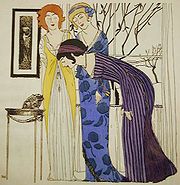
Poiret established his own house in 1903, and made his name with the controversial kimono coat. He designed flamboyant window displays and threw legendary parties to draw attention to his work; his instinct for marketing and branding was unmatched by any previous designer. In 1909, he was so famous that H. H. Asquith
H. H. Asquith
Herbert Henry Asquith, 1st Earl of Oxford and Asquith, KG, PC, KC served as the Liberal Prime Minister of the United Kingdom from 1908 to 1916...
invited him to show his designs at 10 Downing Street
10 Downing Street
10 Downing Street, colloquially known in the United Kingdom as "Number 10", is the headquarters of Her Majesty's Government and the official residence and office of the First Lord of the Treasury, who is now always the Prime Minister....
. The cheapest garment at the exhibition was 30 guineas, double the annual salary of a scullery maid.
Poiret's house expanded to encompass furniture, decor, and fragrance in addition to clothing. In 1911, he introduced “Parfums de Rosine,” named after his daughter, becoming the first couturier to launch a signature fragrance linked to a design house. On 24 June 1911 Poiret unveiled “Parfums de Rosine" in a flamboyant manner. A grand soiree was held at his palatial home, a costume ball attended by the cream of Parisian society and the artistic world. Poiret fancifully christened the event “la mille et deuxième nuit,” the thousand and second night, inspired by the fantasy of sultans’ harems. Gardens were illuminated by lanterns, set with tents, and live tropical birds. Madame Poiret herself lounged in a golden cage luxuriating in opulence. Poiret was the reigning sultan, gifting each guest with a bottle of his new fragrance creation, appropriately named to befit the occasion, “Nuit Persane.” His marketing strategy played out as entertainment became a sensation and the talk of Paris. A second scent debuted in 1912, “Le Minaret,” again emphasizing the harem theme.
In 1911, photographer Edward Steichen
Edward Steichen
Edward J. Steichen was an American photographer, painter, and art gallery and museum curator. He was the most frequently featured photographer in Alfred Stieglitz' groundbreaking magazine Camera Work during its run from 1903 to 1917. Steichen also contributed the logo design and a custom typeface...
was "dared" by Lucien Vogel, the publisher of Jardin des Modes and La Gazette du Bon Ton, to promote fashion as a fine art by the use of photography. Steichen then took photos of gowns designed by Poiret. These photographs were published in the April 1911 issue of the magazine Art et Décoration. According to Jesse Alexander, This is "...now considered to be the first ever modern fashion photography
Fashion photography
Fashion photography is a genre of photography devoted to displaying clothing and other fashion items. Fashion photography is most often conducted for advertisements or fashion magazines such as Vogue, Vanity Fair, or Elle...
shoot. That is, photographing the garments in such a way as to convey a sense of their physical quality as well as their formal appearance, as opposed to simply illustrating the object."
He launched the Ecole Martine, named for his second daughter, to provide artistically inclined, working-class girls with trade skills and income.
Collapse of the Poiret fashion house
During World War I, Poiret left his fashion house to serve the military by streamlining uniform production. When Poiret returned after being discharged in 1919, the house was on the brink of bankruptcy. New designers like Chanel were producing simple, sleek clothes that relied on excellent workmanship. In comparison, Poiret's elaborate designs seemed dowdy and poorly manufactured. (Though Poiret's designs were groundbreaking, his construction was not—he aimed only for his dresses to "read beautifully from afar.") Poiret was suddenly out of fashion, in debt, and lacking support from his business partners, and he soon left his fashion house. In 1929, the house itself was closed, and its leftover clothes were sold by the kilogram as rags. When Poiret died in 1944, his genius had been forgotten.His road to poverty led him in odd jobs as a street painter trying to sell drawings to the customers of Paris' cafes. At one time it was even discussed in the 'Chambre syndicale de la Haute Couture' to provide a monthly allowance to help him, an idea rejected by the Worths (at that time at holding the presidency of that body). Only the help of his friend Elsa Schiaparelli prevented his name from encountering complete oblivion, and it was Schiaparelli that paid for Poiret's burial.Aesthetic

Hobble skirt
A hobble skirt is a skirt with a narrow enough hem to significantly impede the wearer's stride, thus earning its name. A knee-long corset is also used to achieve this effect...
s, "harem" pantaloons, and "lampshade" tunics, Poiret's major contribution to fashion was his development of an approach to dressmaking centered on draping, a radical departure from the tailoring and pattern-making of the past. Poiret was influenced by antique and regional dress, and favored clothing cut along straight lines and constructed of rectangles. The structural simplicity of his clothing represented a "pivotal moment in the emergence of modernism" generally, and "effectively established the paradigm of modern fashion, irrevocably changing the direction of costume history.
Personal life
In 1905, Poiret married Denise Boulet, a provincial girl; they would later have five children together. Denise, a slender and youthful woman, was Poiret's muse and the prototype of la garçonneFlapper
Flapper in the 1920s was a term applied to a "new breed" of young Western women who wore short skirts, bobbed their hair, listened to jazz, and flaunted their disdain for what was then considered acceptable behavior...
. In 1913, Poiret told Vogue, "My wife is the inspiration for all my creations; she is the expression of all my ideals." The two later were divorced, in a proceeding that was far from amicable.
Poiret was notorious for throwing lavish parties and plays featuring his designs. For one of his famous parties, on 24 June 1911, "The Thousand and Second Night" (based on The Arabian Nights), he required his over 300 guests to dress in Oriental costuming. Improperly dressed guests were requested to either outfit themselves in some of Poiret's 'Persian
Iran
Iran , officially the Islamic Republic of Iran , is a country in Southern and Western Asia. The name "Iran" has been in use natively since the Sassanian era and came into use internationally in 1935, before which the country was known to the Western world as Persia...
' outfits or to leave.