
The
City of Pasay is one of the cities and municipalities that make up
Metro ManilaMetropolitan Manila , the National Capital Region , or simply Metro Manila, is the metropolitan region encompassing the City of Manila and its surrounding areas in the Philippines...
in the
PhilippinesThe Philippines , officially known as the Republic of the Philippines , is a country in Southeast Asia in the western Pacific Ocean. To its north across the Luzon Strait lies Taiwan. West across the South China Sea sits Vietnam...
. It is bordered on the north by the country's capital,
ManilaManila is the capital of the Philippines. It is one of the sixteen cities forming Metro Manila.Manila is located on the eastern shores of Manila Bay and is bordered by Navotas and Caloocan to the north, Quezon City to the northeast, San Juan and Mandaluyong to the east, Makati on the southeast,...
, to the northeast by
Makati CityThe City of Makati is one of the 17 cities that make up Metro Manila, one of the most populous metropolitan areas in the world. Makati is the financial center of the Philippines and one of the major financial, commercial and economic hubs in Asia...
, to the east by
Taguig CityTaguig is a city in Metro Manila in the Philippines. From a thriving fishing community along the shores of Laguna de Bay, it is now an important residential, commercial and industrial center...
, and
Parañaque CityThe City of Parañaque , or simply Parañaque , is one of the cities and municipalities that make up Metro Manila in the Philippines....
to the south.
Pasay City was one of the original four cities of Metro Manila. Due to its proximity to Manila, it quickly became an urban town during the American Period.
Etymology and Early History
There are many conjectures as to the origin of the name "Pasay".
In one version, the name of the municipality came from the wail of a brokenhearted swain. Jose and Paz were in love with each other and were intent on a life together, but Jose's father was a mere tenant of the
hacienda of Paz's father. For this reason, their love was forbidden and Jose was ordered to stay away from Paz. Unable to bear her misfortune, Paz died.
At her funeral, the elite came to mourn and pray as Jose watched from a distance. As soon as everyone left, Jose dug a tunnel into the earth to be with Paz. Once joined, he let out a sharp and anguished cry
"Paz-ay!" In sorrow and regret, the parents of Paz named their hacienda
Paz-ay. In time, the town came to be known simply as
Pasay.
Historians have another explanation for the origin of the name of the city. It is said that back in the day, Pasay was thick with
pasaw, a plant with an exotic aroma. It was said that a
SpanishThe Spanish are citizens of the Kingdom of Spain. Within Spain, there are also a number of vigorous nationalisms and regionalisms, reflecting the country's complex history....
botanist, Antonio Pineda, frequented a place called Basal in the vicinity of to gather
pasaw.
The version deemed to be most credible is that
Pasay was named after a princess of the Namayan Kingdom,
Dayang-dayang Pasay. The Namayan Kingdom was a confederation of
barangayA barangay is the smallest administrative division in the Philippines and is the native Filipino term for a village, district or ward...
s that began to peak in 1175 and extended from Manila Bay to Laguna de Bay. Dayang-dayang Pasay inherited the lands now comprising the territories of Culi-culi, Pasay and
BaclaranBaclaran is a barangay located on the border of Parañaque and Pasay in Metro Manila, Philippines.The area is well-known for the National Shrine of Our Mother of Perpetual Help also known as the Redemptorist Church or Baclaran Church, dedicated to Our Mother of Perpetual Help. There is also a...
. The royal capital of the kingdom was built in
SapaSapa may refer to:* Sapë, a town in Albania* Roman Catholic Diocese of Sapë, one of six such diocese of Albania* SAPA - the national news agency of South Africa* Sapa Group, a Swedish-based aluminium company...
, known today as
Santa AnaSanta Ana is a district of the City of Manila in the Philippines, located at the southeast banks of the Pasig River, bounded on the northeast by Mandaluyong City, Makati City to the east, southwest is the Manila district of Paco, and to the west, Pandacan....
.
The natives brought their products to the capital of Namayan. Trading flourished during the 12th to the 14th centuries. Merchants from
ChinaChinese civilization may refer to:* China for more general discussion of the country.* Chinese culture* Greater China, the transnational community of ethnic Chinese.* History of China* Sinosphere, the area historically affected by Chinese culture...
, Moluccas, Java,
BorneoBorneo is the third largest island in the world and is located north of Java Island, Indonesia, at the geographic centre of Maritime Southeast Asia....
,
SumatraSumatra is an island in western Indonesia, westernmost of the Sunda Islands. It is the largest island entirely in Indonesia , and the sixth largest island in the world at 473,481 km2 with a population of 50,365,538...
,
IndiaIndia , officially the Republic of India , is a country in South Asia. It is the seventh-largest country by geographical area, the second-most populous country with over 1.2 billion people, and the most populous democracy in the world...
, Siam, and
CambodiaCambodia , officially known as the Kingdom of Cambodia, is a country located in the southern portion of the Indochina Peninsula in Southeast Asia...
came to trade with the natives.
Pasay's name may also have originated from the
SpanishSpanish , also known as Castilian , is a Romance language in the Ibero-Romance group that evolved from several languages and dialects in central-northern Iberia around the 9th century and gradually spread with the expansion of the Kingdom of Castile into central and southern Iberia during the...
Paso hay meaning
there is a pass. This referred to the paths cleared among the grass leading to the southern portions from
ManilaManila is the capital of the Philippines. It is one of the sixteen cities forming Metro Manila.Manila is located on the eastern shores of Manila Bay and is bordered by Navotas and Caloocan to the north, Quezon City to the northeast, San Juan and Mandaluyong to the east, Makati on the southeast,...
.
In 1727, the name of the Pasay settlement was changed to Pineda in honor of Don Cornelio Pineda, a Spanish horticulturist who requested for
guardias civiles for protection from bandits. The name Pineda, along with Pasay, was used as the name of the place until the early 20th century.
Spanish Time
Pasay was originally a
barrioBarrio is a Spanish word meaning district or neighborhood.-Usage:In its formal usage in English, barrios are generally considered cohesive places, sharing, for example, a church and traditions such as feast days...
of Maalat (present-day
Malate, ManilaMalate is an old district of the city of Manila in Metro Manila, the Philippines. The district is located at the southern end of the city of Manila, bordered by Pasay City to the south, by Manila Bay to the west, by the district of Ermita to the north and by the districts of Paco and San Andres to...
). On May 19, 1571, Legaspi took formal possession of Maynila in the name of the Spanish king. For 250 years, the Islands were put under the administration of the Viceroy of Mexico but it was the friars that held the reins.
Of the many religious orders that came, it was the Augustinians who would figure predominantly in the evangelization of Pasay. The parish was placed under the wings of the old capital, Sta. Ana de Sapa, under the jurisdiction of the Franciscan fathers. In 1727, the Augustinian Order took over Pasay and was attached to the Nuestra Señora de los Remedios parish of Malate. It was also during that year that Pasay's name was changed to Pineda in honor of Don Cornelio Pineda, a Spanish horticulturist.
A room reserved in heaven served as the inspiration for native converts to donate their possession to the church. It is said that Dayangdayang Pasay donated her vast estate to the Augustinians on her deathbed. Most of Pasay went into friar lands, if not by donation by purchase. Many natives were forced to let go of their properties to cope with the stringent colonial impositions.
In 1862, a number of prominent citizens of Pasay sent a petition to the civil and ecclesiastical authorities asking that they be allowed to manage their own political and religious affairs. On December 2, 1863 upon the recommendation of Archbishop Gregorio Martinez of Sta. Cruz, Pasay became a Pueblo.
The opening of the
Suez CanalThe Suez Canal , also known by the nickname "The Highway to India", is an artificial sea-level waterway in Egypt, connecting the Mediterranean Sea and the Red Sea. Opened in November 1869 after 10 years of construction work, it allows water transportation between Europe and Asia without navigation...
in 1869 led many Spaniards to this part of the world. The new arrivals carried with them ideas and ideals that led to the political and social reforms. Times were good and Filipinos were delighted but the Spaniards and friars considered the liberal learnings as seeds of heresy. Democratic reforms ended with the liberal regime collapse in Madrid. There were wholesale executions and much innocent blood was spilled.
Pasay produced numerous heroes during the Philippine-Spanish War. Katipunan, a revolutionary movement was founded by
Andres BonifacioAndrés Bonifacio y de Castro was a Filipino nationalist and revolutionary. He was a founder and later Supremo of the Katipunan movement which sought the independence of the Philippines from Spanish colonial rule and started the Philippine Revolution...
and a chapter of the movement was organized by Pascual Villanueva, Jacinto Ignacio, Valentin Ignacio in Pasay. Several women also fought for the cause of the Katipunan including Marcela Marcelo.
The execution of Dr.
Jose RizalJosé Protacio Rizal Mercado y Alonso Realonda , was a Filipino polymath, patriot and the most prominent advocate for reform in the Philippines during the Spanish colonial era. He is regarded as the foremost Filipino patriot and is listed as one of the national heroes of the Philippines by...
, author of the seditious novels
Noli Me TangereNoli me tangere, meaning "don't touch me" / "touch me not", is the Latin version of words spoken, according to , by Jesus to Mary Magdalene when she recognizes him after his resurrection....
and
El FilibusterismoEl filibusterismo , also known by its English alternate title The Reign of Greed, is the second novel written by Philippine national hero José Rizal. It is the sequel to Noli Me Tangere and like the first book, was written in Spanish. It was first published in 1891 in Ghent, Belgium...
, sealed the fate of Spain forever in the Philippines. Rizal's death inspired the natives with revolutionary pride and fervor.
But just when the Filipinos thought they could gain freedom from one colonial ruler, they were on the verge of falling under the yoke of still another. On February 25, 1898,
Theodore RooseveltTheodore "Teddy" Roosevelt was the 26th President of the United States . He is noted for his exuberant personality, range of interests and achievements, and his leadership of the Progressive Movement, as well as his "cowboy" persona and robust masculinity...
instructed Commodore
George DeweyGeorge Dewey was an admiral of the United States Navy. He is best known for his victory at the Battle of Manila Bay during the Spanish-American War...
of the American Asiatic Squadron to make
Hong KongHong Kong is one of two Special Administrative Regions of the People's Republic of China , the other being Macau. A city-state situated on China's south coast and enclosed by the Pearl River Delta and South China Sea, it is renowned for its expansive skyline and deep natural harbour...
his base of operations. Thus, Dewey, with his squadron would, at his signal, "proceed with offensive operations in the Philippines."
War was declared on April 25, and Dewey steamed into
Manila BayManila Bay is a natural harbor which serves the Port of Manila , in the Philippines.The bay is considered to be one of the best natural harbors in Southeast Asia and one of the finest in the world...
on the night of April 30. With a few well-directed shots, the American squadron destroyed the Spanish flotilla without the loss of a single life.
Gen.
Emilio AguinaldoEmilio Aguinaldo y Famy was a Filipino general, politician, and independence leader. He played an instrumental role during the Philippines' revolution against Spain, and the subsequent Philippine-American War or War of Philippine Independence that resisted American occupation...
declared independence of a new Philippine republic on June 12, 1898. He issued decrees providing political reorganization in the country. With this, Don Catalino became Pasay's first presidente municipal.
Pasay was made the command outpost of the Primera Zona de Manila under Gen. Mariano Noriel but Gen. Merritt appealed that the Pasay outpost turned over to the Americans so that they could be closer to the Spanish lines. On July 29, Noriel, thinking Americans were allies, left Pasay allowing American General Greene to transfer. When Intramuros was finally captured, the Filipinos were denied entry in the walled city. Since then, tension simmered between Filipino and American troops. Both sides were assigned respective zones but neither observed boundary lines. On the night of February 4, 1899, four Filipinos crossed the American line. Shots were exchanged. The Philippine Insurrection had begun.
On May 19, 1899, General Noriel was given command again of Pasay. In June, Noriel together with General Ricarte almost defeated the American forces had they exploited the exhaustion of the enemy in the Battle of Las Piñas. Instead their forces were attacked by American reinforcements and bombarded by warships. The assault forced them to abandon Pasay. Thus, at the beginning of the Philippine-American War, Pasay was occupied by American Forces.
American Period
The war between the Filipinos and Americans ended officially on July 4, 1902, and to the surprise of the vanquished, the victors buckled down to bring to fruition McKinley's original version of training Filipinos to run their own government.
With one generation, the United States helped the Filipinos grow. Political progress was rapid. A vigorous health campaign was started to rid the islands of cholera, bubonic plague, and small pox. Hospitals were built. Artisan wells were dug to halt various water-borne diseases. On August 23, 1901 the United States Army transport Thomas docked at Manila Bay carrying six hundred American schoolteachers. As for public works, roads increased from 990 miles when the Americans first came to 13,000 miles of road half of which are first class and all-weather network.
On June 1, 1901, the town of Pasay (then called Pineda) was incorporated from
ManilaManila, also formerly known as Tondo, was a historical province in the Philippines, encompassing the former Kingdom of Tondo and Kingdom of Maynila. In 1898, it included the City of Manila and 23 other municipalities. It was incorporated into the Province of Rizal in 1901.-Cities and...
to the
[Province of RizalRizal is a province located in the CALABARZON , just 16 kilometers east of Manila. The province was named after the country's national hero, José Rizal. Rizal Governor Casimiro A. Ynares III on June 17, 2008 announced the transfer of the Capitol from Pasig. Its P 270-million capitol building,...
. Antonio Dancel was appointed provincial governor and Pascual Villanueva as municipal president. On August 4, 1901, a resolution was passed petitioning that the original name of Pasay be returned. Before the year ended the Philippine Commission approved the petition. Two years later, on October 12, 1903, the pueblo of Malibay was annexed to Pasay. With a population of 8,100 in 1903, Pasay was placed under fourth-class category together with 9 other municipalities.
Friar lands were turned into subdivisions. Soon the Pasay Real Estate Company offered friar lands as residential lots for sale or for lease to foreign investors.
Postal, telegraph, and telephone lines were installed and branches of Philippine Savings Bank were established. In 1907 a first-class road from Pasay to Camp Nichols was completed. Others were repaired including the old Avenida Mexico now called the Taft Avenue extension. Transportation services improved. Among the buses plying routes to Pasay were Pasay Transportation, Raymundo Transportation, Try-tran, and Halili Transit. By 1908, tranvia (electric car) lines linked Pasay to Intramuros, Escolta, San Miguel, San Sebastian, and San Juan. Automobiles took to the streets, testing their maximum 20KPH speed on three new avenues (Rizal, Taft, and Ayala). Marvel after marvel continued to fascinate the Pasayeños.
On April 11, 1914, Pasay entered the Aviation Age. Miss Cora Wong, a nurse at the Chinese General Hospital became the first woman in the Philippines to fly as a passenger on a flight with Tom Gunn in a Curtiss seaplane off Pasay Beach.
Real estate was cheap. Much of the bayside area beyond Luneta was swamp but American ex-soldiers were quick to seize the opportunity to develop it for residential purposes. By 1918, Pasay had a population of 18,697 because of the exodus of prominent Filipino families and government officials to this seaside town including Manuel L. Quezon.
World War IIWorld War II, or the Second World War , was a global conflict lasting from 1939 to 1945, involving most of the world's nations—including all of the great powers—eventually forming two opposing military alliances: the Allies and the Axis...
came and on December 26, 1941, McArthur issued a proclamation declaring Manila and it suburbs (Caloocan,
Quezon CityQuezon City is the former capital and the most populous city in the Philippines. Located on the island of Luzon, Quezon City is one of the cities and municipalities that make up Metro Manila, the National Capital Region. The city was named after Manuel L...
, San Juan City, Mandaluyong, Makati, and Pasay) an open city. On New Year's Day 1942, Pres.
Manuel L. QuezonManuel Luis Quezón y Molina served as president of the Commonwealth of the Philippines from 1935 to 1944. He was the first Filipino to head a government of the Philippines...
, while in
CorregidorCorregidor Island, locally called Isla ng Corregidor, is a lofty island located at the entrance of Manila Bay in southwestern part of Luzon Island in the Philippines. Due to this location, Corregidor was fortified with several coastal artillery and ammunition magazines to defend the entrance of...
, called his secretary
Jorge VargasJorge Vargas may refer to:*Jorge B. Vargas , Filipino lawyer and youth advocate*Jorge Vargas González, Chilean politician, mayor of Pichilemu 1997-2007*Jorge Alberto Vargas, Ecuadorian football player*Jorge Francisco Vargas, Chilean footballer...
and appointed him by executive order "the Mayor of Greater Manila" which included Pasay. The mayor of Pasay was then Rufino Mateo, governing a town of more than 55,161 people.
During the WWII many Pasayeños joined in the fight against the Japanese. Jose P. Maibag, born and bred in Pasay, laid out underground networking. Carlos Mendoza, a resident of Barrio San Roque, together with 14 others, formed a mobile broadcasting station called "The Voice of Juan dela Cruz." Unfortunately on July 11, 1942 Japanese military police pounced the group. Carling Mendoza, alias Juan de la Cruz" and other members of the group were brought to the old Bilibid Prison and suffered the kind of torture they talked about on radio.
Pasay had to redo the signs all over town. Tagalog was ordered to prevail over English. The national language became a core subject in the secondary school curriculum. Nippongo was taught in all levels. Pasay was to prepare for the Second Republic.
On October 14, 1943,
JapanJapan is an island nation in East Asia. Located in the Pacific Ocean, it lies to the east of the Sea of Japan, China, North Korea, South Korea and Russia, stretching from the Sea of Okhotsk in the north to the East China Sea and Taiwan in the south...
proclaimed the Second Philippine Republic. Meantime, food had become so scarce that prices soared. Pasay folks began to move away from the city.
In October 1944, word came that Gen.
Douglas MacArthurGeneral of the Army Douglas MacArthur was an American general and field marshal of the Philippine Army. He was a Chief of Staff of the United States Army during the 1930s and played a prominent role in the Pacific theater during World War II. He received the Medal of Honor for his service in the...
had landed in
LeyteLeyte is a province of the Philippines located in the Eastern Visayas region. Its capital is Tacloban City and occupies the northern three-quarters of the Leyte Island. Leyte is located west of Samar Island, north of Southern Leyte and south of Biliran...
. In the middle of February, Pasay was to witness the ultimate holocaust yet. Pasay and its neighbors
ErmitaErmita is a district of Manila, Philippines located halfway between Intramuros and Malate.-History:Ermita was founded in the late 16th century...
,
MalateMalate is an old district of the city of Manila in Metro Manila, the Philippines. The district is located at the southern end of the city of Manila, bordered by Pasay City to the south, by Manila Bay to the west, by the district of Ermita to the north and by the districts of Paco and San Andres to...
,
PacoPaco, is a district of Manila, Philippines. It is located south of Pasig River, and San Miguel, west of Santa Ana, southwest of Pandacan, north of Malate, northwest of San Andres, and east of Ermita. According to the 2000 census, it has a population of 64,184 people in 13,438 households...
,
PandacanPandacan is a district of the City of Manila in the Philippines, located south of the banks of the Pasig River and belongs under the 6th congressional district of Manila, divided into thirty eight barangays that includes Zone 90 to Zone 95 and barangays 833 to 872.-Profile:Based on a year 2000...
, Singalong would hear day and night, the shelling at the mouth of the Manila Bay from across Pasig River.
Pasay was both witness and victim. In the final days before they lost Greater Manila, the Japanese burned houses and sacked the town. And when the embers cooled, then, and only then, did the Filipinos realize, in shock, that their city was gone forever.
Third Republic
On February 27, 1945, General MacArthur turned over the government to President
Sergio OsmeñaSergio Osmeña y Suico was a Filipino politician who served as the 4th President of the Philippines from 1944 to 1946. He was Vice President under Manuel L. Quezon, and rose to the presidency upon Quezon's death in 1944, being the oldest Philippine president to hold office at age 65...
. One of Osmeña's first acts was to dissolve the Greater Manila Complex. Caloocan, San Juan, Mandaluyong, Makati, Pasay, and Paranaque were returned to their original province of Rizal. He then appointed Juan S. Salcedo, born in Pasay in 1904, as Director of Philippine Health, and then as executive officer of the Philippine Rehabilitation Administration in charge of national recovery from the devastation wrought by the Japanese occupation.
The postwar reconstruction period was a very trying one for the Pasayeños as they began to pick up the pieces of their shattered lives. Osmeña appointed Adolfo Santos as prewar vice-mayor of Pasay, in place of incumbent Moises San Juan who died during the war.
Ignacio Santos Diaz, congressman from the first district of Pasay, pushed for the conversion of the town into a city and it to be named after Rizal. The Diaz bill was signed into law by President Roxas on June 21, 1947. Rizal City with population of 88,738 was inaugurated with Mateo Rufino as Mayor.
Rizal was off to a good start with revenues of P472,835 as of June, 1948. There was just one hitch; the residents could not get themselves to call their city by its new name. After two years, eight months, and twelve days of trying the force of habit continued to prevail. Pasay Congressman Eulogio Rodriguez, Jr. filed a bill returning the city to its original name. On May 3, 1950, President Elpidio Quirino, once a resident of Pasay himself, signed into law the bill approved by Congress.
It was also in the 1940s when houses of faith started rising in different parts of Pasay to help people heal their bruised souls. Among them were the Church of Our Lady of Sorrows, the Libreria de San Pablo Catholic Women's League, Caritas, the nutrition center, and the grotto of Our Lady of Lourdes.
In 1951, two parishes were established - the Parish of San Isidro Labrador and the Parish of San Rafael.
On June 14, 1955, Pasay City regained its power to choose its leader. Pablo Cuneta ran against one-time Mayor Adolfo Santos and became the city's first elected mayor. In 1959, he campaigned again and won against his former vice-mayor, Ruperto Galvez.
On December 30, 1965, Ferdinand E. Marcos occupied Malacañang Palace as the new President of the Philippines, with Fernando Lopez, a resident of Pasay, as Vice-President. From that moment Imelda Romualdez Marcos became involved in national affairs. On the northern boundary of Pasay, she started filling the waterfront on Manila Bay to build the Cultural Center which was a world-class arts complex. She would add three more architectural showpieces on reclaimed land in Pasay: the Folk Arts, Film Center, and the Convention Center.
While the First Lady was busy changing Manila's skyline, President Marcos was using his new presidential powers to create a police state for eventual dictatorship.
In 1967, Jovito Claudio won for the mayoralty race against Pablo Cuneta.
In 1969, Marcos ran for reelection and claimed a margin of one million seven hundred votes over his opponent Sergio Osmeña, Jr. Marcos paid for his campaign in several ways: by printing more money and causing runaway inflation. So obvious was the election fraud that Marcos became the target of unprecedented contempt of students and the opposition.
In the following year, an assassination attempt occurred in Pasay. A Crazed Bolivian surrealist painter lunged at Pope Paul VI with a knife grazing his chest.
In 1971, Cuneta became mayor once more of the 206,283 Pasayeños. It was the time of crisis since the Maoist New People's Army was getting stronger in the countryside. The government bureaucracy was corrupt, nepotistic, and inept. Anarchy ruled the streets. The nation shuddered with fear in the face of its own implosion.
New Society
On September 21, 1972 Marcos signed Proclamation No. 1081 placing the nation under martial law on the grounds of growing threat of Communism, natural clamities and rising violence which included a string of bombings and the staged assassination plot on his Defense Secretary, Juan Ponce Enrile.
Mayors in Greater Manila, including Pablo Cuneta of Pasay were called to Malacañang and asked to join the government party, the Kilusang Bagong Lipunan and nobody dared to refuse the President.
On December 7, 1972, an assassin tried to kill Imelda Marcos. The event took place in Pasay, on live television. While Mrs. Marcos was distributing prizes to the winners of the National Beautification and Cleanliness contest. She suffered some wounds and broken nails but on the whole she emerged unscathed from that close encounter.
On the second anniversary of martial law, Marcos issued Presidential Decree No. 557, returning to every barrio in the country the barangays. Not long after the decree had been put into effect, the Metropolitan Manila Commission and the Department of Local Government instructed Pasay to create its own barangays. Mayor Cuneta created 487 barangays. Upon the firm suggestion of Secretary Jose Roño of the Department of Local Government, the number of barangays was trimmed down to two hundred.
On November 7, 1975 Marcos appointed the First Lady as governor of Metro Manila, a new federation created by Presidential Decree No 824. The federation consolidated 13 towns and 4 cities including Pasay.
By 1977 an air of stability seemed to settle on the cities and the countryside. The GNP posted an annual increase of 7%, unemployment dropped, foreign investment doubled, and a sense of law and order existed. But it would take time for people to realize the high prize they had to pay for the New Society. An estimated six thousand political prisoners had been silenced in jail, including Ninoy Aquino. Bodies disappeared without a trace. More importantly, Marcos's main justification for martial law - to curb Communist threat - had in fact had the opposite way.
On August 21, 1983,
Benigno Aquino, Jr.Benigno Simeon "Ninoy" Aquino, Jr. was a Filipino Senator and a former Governor of Tarlac. Aquino, together with Gerry Roxas and Jovito Salonga, formed the leadership of the opposition to the Marcos regime in the years leading to the imposition of martial law in the Philippines...
, an opposition senator to Marcos, was assassinated in the
Manila International AirportThe Ninoy Aquino International Airport or NAIA , also known as Manila International Airport , is the airport serving the general area of Manila and its surrounding metropolitan area...
upon his return from his exile in
BostonBoston is the capital of and largest city in Massachusetts, and is one of the oldest cities in the United States. The largest city in New England, Boston is regarded as the unofficial "Capital of New England" for its economic and cultural impact on the entire New England region. The city proper had...
, USA.
People Power
The killing of Aquino had serious repercussions. Suddenly, violently, Philippine politics entered an uncertain new era. Posters lined the Metropolis calling for the resignation of Marcos. But Marcos remained cocky. Confident as ever, he called for a snap election. He thought there was no way he could be beaten, but the opposition proved him wrong. Marcos had to pull out all his dirty tricks win the election.
When the Batasang Pambansa proclaimed Marcos as the winner, the people paid no heed. The Catholic bishops publicly condemned the election. People went on a nationwide disobedience movement. Defense Minister
Juan Ponce EnrileJuan Ponce Enrile is a Filipino politician. As a protege of President Ferdinand Marcos, he served as Justice Secretary and then Defense Secretary under the Marcos regime. He later became one of the leaders of the 1986 People Power Movement that drove Marcos from power...
and Marcos's own cousin, Lt. Gen.
Fidel V. RamosFidel "Eddie" Valdez Ramos , popularly known as FVR, was the 12th President of the Philippines from 1992 to 1998. During his six years in office, Ramos was widely credited and admired by many for revitalizing and renewing international confidence in the Philippine economy.Prior to his election as...
deputy chief of the Armed Forces of the Philippines, broke away from Marcos. As the rebels barricaded inside two military camps, Archbishop Jaime Cardinal Sin called upon the people to protect the maverick soldiers. Hundreds of thousands of Filipinos responded and poured onto the streets and converged on the highway called EDSA. And as the "People Power" revolution evolved from February 22 to 25, 1986, history not only opened a new window for a nation long shoved to its shadowed corridors but also gave its people a common weal and pride to chart its own destiny.
The People Power Revolution put
Corazon AquinoMaria Corazon Sumulong Cojuangco-Aquino was the 11th President of the Philippines and the first woman to hold that office in Philippine history. She is best remembered for leading the 1986 People Power Revolution, which toppled Ferdinand Marcos and restored democracy in the Philippines...
into office, without an official count of the votes. Mrs. Aquino directed immediate reorganization of local governments. Cuneta relinquished his post and Aquino appointed Eduardo Calixto was appointed as officer-in-charge of Pasay City. In the 1988 local elections Cuneta won and was reelected in 1992.
Pasay Today
In the middle of 1997, Vice Mayor Wenceslao Trinidad took over the reins of government from an ailing Mayor Pablo Cuneta. Cuneta has been in the driver's seat for thirty-seven years. Between 1949 when he was appointed city mayor by President Elpidio Quirino, and 1997, only twice - for a total of about eight years - was the incumbent at City Hall, Pasay's repository of political power, a man other than Cuneta.
Dr. Jovito O. Claudio assumed office as Pasay City's Chief Executive in 1998 after winning the local elections. He carried out his duties and responsibilities as City Mayor until it was cut short due to failing health. His term of office lasted for only two (2) years. And because of this a Recall Election was held in the City where Mr. Wenceslao "Pewee" Trinidad was proclaimed as the City Chief Executive.
Providing the basic necessities alone of the swelling population is a huge task. Pasay has long exceeded the limits of its ability accommodate the influx of migrants. In terms of meeting the people's health requirements, Pasay has been up to the task. The Pasay City General Hospital, founded in 1977, has been in a progress leap—from a simple two-story squat building on P. Burgos Street into an imposing people's health caretaker at its new building. In line with the national government's policy, Pasay City places education first on its list of priorities. In pursuit of the national goal of nation building, it maintains a local educational system that promotes a close tie-up between the public and private sector.
On May 21, 2006,
SM Mall of AsiaSM Mall of Asia is a shopping mall owned and developed by SM Prime Holdings, the largest mall developer and owner in the Philippines. SM Mall of Asia is the 2nd largest mall in the Philippines after SM City North EDSA, 3rd largest shopping mall in Asia and the 4th largest shopping mall in the world...
was opened in
Bay CityBay City is the name for the reclamation area located east of Roxas Boulevard on Manila Bay in Metro Manila, the Philippines. The area is split between Pasay City on the north side and Parañaque City on the south side....
as then the 2nd largest mall in the Philippines.
Location
In terms of area, Pasay City is the third smallest political subdivision in the National Capital Region. It is adjacent to the City of Manila and is bounded to the south by Parañaque, to the northeast by Makati and Taguig and to the west by Manila Bay. The city is located at latitude 14° 32' and longitude 121° 00'.
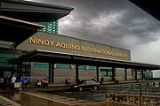
The City has a total land area of 18.50 square kilometers of which 5.5050 square kilometer is the City proper, 9.5 square kilometers is being occupied by the Civil Aeronautics Administration (CAA) complex, which include the
Ninoy Aquino International AirportThe Ninoy Aquino International Airport or NAIA , also known as Manila International Airport , is the airport serving the general area of Manila and its surrounding metropolitan area...
(NAIA) and the Villamor Air Base and the rest of the reclamation area with 4.00 square kilometers. Thus, among the local government in the region, Pasay has the greater area devoted to utilities covering 51.35% of its total land area or 9.50 square kilometers. The City is known for its entertainment - business-restaurants, coffee shops, and clubs, particularly those located along
Roxas BoulevardRoxas Boulevard is a boulevard in Metro Manila, and an eight-lane arterial road that connects the center of Manila with Pasay City, Parañaque City. It is one of the major arteries in the city's metropolitan network, designated as Radial Road 1...
, facing Manila Bay. A large part of Metro Manila's "tourist belt" is located in the City. Pasay is composed of seven (7) districts, divided into twenty (20) Zones, with a total of 201 Barangays. Zone 19, Covering Barangays 178 and 191, is the largest among the zones with an area of 5.10 square kilometers. Zone 1, on the other hand, is the smallest covering Barangays 1 to 3 and 14 to 17 with an area of 100,000 square meters (0.1 km².).
Most of the attractions in the city are on the CCP (
Cultural Center of the PhilippinesThe Cultural Center of the Philippines is a government-owned and controlled corporation established to preserve, develop and promote arts and culture in the Philippines. The CCP was established through Executive Order No. 30 s. 1966 by President Ferdinand Marcos...
) Complex, on which the massive main CCP building,
Philippine International Convention CenterThe Philippine International Convention Center is a convention center located in the Cultural Center of the Philippines complex in Pasay City, Metro Manila, Philippines...
(PICC),
Tanghalang Francisco Balagtas (formerly Folk Arts Theater),
Manila Film Center,
Coconut PalaceThe Coconut Palace, also known as Tahanang Pilipino , is the official residence and principal workplace of the Vice President of the Philippines. Located at the CCP Complex, in Pasay, south of the centre of Manila, it was commissioned by former First Lady Imelda Marcos for Pope John Paul II's visit...
, Product Development and Design Center of the Philippines (PDDCP),
Philippine Trade Training Center (PTTC),
World Trade Center-Metro Manila (WTCMM),
Cuneta AstrodomeCuneta Astrodome is an indoor sporting arena located in Pasay, Philippines. It is better known as the home of the Philippine Basketball Association from 1993, when it left the PhilSports Arena, then known as the ULTRA, until 1998...
, and theme parks such as
Star City,
Nayong Pilipino, and
Boom na Boom are all located. Terminal 2 and the recently opened Terminal 3 of the
Ninoy Aquino International AirportThe Ninoy Aquino International Airport or NAIA , also known as Manila International Airport , is the airport serving the general area of Manila and its surrounding metropolitan area...
, as well as the terminal of the
Manila Domestic AirportThe Ninoy Aquino International Airport or NAIA , also known as Manila International Airport , is the airport serving the general area of Manila and its surrounding metropolitan area...
is located in Pasay City.
Villamor AirbaseVillamor Air Base is home of the Philippine Air Force. It is chiefly used as an air base for PAF transport and helicopter flights. It is also the military base that the Philippine president uses when departing for foreign or domestic trips abroad, though foreign departures are mostly done at the...
of the Philippine Air Force is also located here.
Other national government offices could be found in Pasay: Department of Foreign Affairs (DFA), Senate of the Philippines, the Philippine Department of Trade and Industry's export promotions agency - the Center for International Trade Expositions and Missions (CITEM) - located in the International Trade Complex's Golden Shell Pavilion, and the Overseas Workers Welfare Administration (OWWA). The main office of the Philippine National Bank, led by its president taipan Lucio Tan, is located in the City.
Pasay City is home to the headquarters of the SM Group of Companies and the
SM Mall of AsiaSM Mall of Asia is a shopping mall owned and developed by SM Prime Holdings, the largest mall developer and owner in the Philippines. SM Mall of Asia is the 2nd largest mall in the Philippines after SM City North EDSA, 3rd largest shopping mall in Asia and the 4th largest shopping mall in the world...
, touted as the biggest mall in Asia which opened on May 21, 2006. Also interesting is a budding strip of restaurants at the corner of EDSA Extension and Pres. Diosdado Macapagal Ave. It will also be the house of booming call center business industry in the Philippines due to vast land space available located in the reclamation area.
Economy
Philippine AirlinesPhilippine Airlines, Inc. operating as Philippine Airlines, is a flag carrier of the Philippines. Headquartered in the Philippine National Bank Financial Center in Pasay City, the airline was founded in 1941 and is the first and oldest commercial airline in Asia operating under its original name...
is headquartered in the
Philippine National BankThe Philippine National Bank is one of the largest banks in the Philippines, ranking fourth in terms of assets...
Financial Center beside the World Trade Center Manila in Pasay City.
Spirit of Manila AirlinesSpirit of Manila Airlines Corporation, operating as Spirit of Manila Airlines, is a low-cost airline based in Roxas Sea Front Garden in Pasay City, Philippines. Its main base is Diosdado Macapagal International Airport.The airlines adopts the slogan: "I am going home" as its...
has its headquarters in Roxas Sea Front Garden in Pasay City.
Cebu PacificCebu Air, Inc., operating as Cebu Pacific Air, is based on the grounds of Ninoy Aquino International Airport , Pasay City, Metro Manila, the Philippines. It offers scheduled flights to both domestic and international destinations...
and
Interisland AirlinesInterisland Airlines is an airline based in Ninoy Aquino International Airport in Pasay City, Manila, the Philippines. It operates domestic scheduled services and passenger and cargo domestic and international charter services. Its main base is Ninoy Aquino International Airport,...
have their headquarters on the grounds of
Ninoy Aquino International AirportThe Ninoy Aquino International Airport or NAIA , also known as Manila International Airport , is the airport serving the general area of Manila and its surrounding metropolitan area...
and in Pasay City.
Landmarks
- Bay City
Bay City is the name for the reclamation area located east of Roxas Boulevard on Manila Bay in Metro Manila, the Philippines. The area is split between Pasay City on the north side and Parañaque City on the south side....
- Blue Wave Macapagal
- SM Mall of Asia
SM Mall of Asia is a shopping mall owned and developed by SM Prime Holdings, the largest mall developer and owner in the Philippines. SM Mall of Asia is the 2nd largest mall in the Philippines after SM City North EDSA, 3rd largest shopping mall in Asia and the 4th largest shopping mall in the world...
- CCP Complex
- Cultural Center of the Philippines
The Cultural Center of the Philippines is a government-owned and controlled corporation established to preserve, develop and promote arts and culture in the Philippines. The CCP was established through Executive Order No. 30 s. 1966 by President Ferdinand Marcos...
- Folk Arts Theater
- Manila Film Center
- Philippine International Convention Center
The Philippine International Convention Center is a convention center located in the Cultural Center of the Philippines complex in Pasay City, Metro Manila, Philippines...
- Aliw Theater
- Boom na Boom
- Star City
- Coconut Palace
The Coconut Palace, also known as Tahanang Pilipino , is the official residence and principal workplace of the Vice President of the Philippines. Located at the CCP Complex, in Pasay, south of the centre of Manila, it was commissioned by former First Lady Imelda Marcos for Pope John Paul II's visit...
- Cuneta Astrodome
Cuneta Astrodome is an indoor sporting arena located in Pasay, Philippines. It is better known as the home of the Philippine Basketball Association from 1993, when it left the PhilSports Arena, then known as the ULTRA, until 1998...
- Nayong Pilipino
- Newport City
Newport City is a 25-hectare area set next to the Villamor golf course and Terminal 3 of the Ninoy Aquino International Airport in Metro Manila, Philippines. It was developed by Megaworld Corporation under its subsidiary Megaworld Newport Property Holdings, Inc...
- Resorts World Manila
Resorts World Manila is a luxury casino resort, located in Newport City, across the Ninoy Aquino International Airport Terminal 3, in Manila, Philippines. The resort is a joint venture between AGI and Genting Hong Kong...
- Ninoy Aquino International Airport
The Ninoy Aquino International Airport or NAIA , also known as Manila International Airport , is the airport serving the general area of Manila and its surrounding metropolitan area...
- Villamor Air Base
- World Trade Center Metro Manila
The World Trade Center Metro Manila in the Financial Center Area of Pasay City in the Philippines is a private corporation owned by the Manila Exposition Complex and the ICCP Group of Companies . Established in January 1990, it is managed by the World Trade Center Management, Inc...
Catholic Churches
- Archdiocesan Shrine of Jesus, The Way, The Truth And The Life - Bay City (near SM Mall of Asia)
- Mary, Comforter of The Afflicted Parish - Maricaban
- Our Lady of Fatima Parish
Our Lady of Fatima Parish is the northernmost and largest freguesia in Macau Peninsula, Macau. It has an area of and a population of 126,000, which constitutes about 40.3% of the peninsula's land mass and one-third of the population. It consists mostly of land reclaimed from the sea. It was...
- Don Carlos Village
- Our Lady of Sorrows Parish - 2130 F.B. Harrison St.
- Our Lady of The Airways Parish - NAIA
- Our Lady of The Blessed Sacrament Parish - Kalayaan Village
- San Isidro Parish - 1830 Taft Avenue
- San Juan Nepomuceno Parish - Malibay
- San Roque Parish - Cabrera St.
- San Rafael Parish - 2645 Park Avenue
- Santa Clara de Montefalco Parish - 2360 P. Burgos St., Libertad
- Shrine of St. Therese of The Child Jesus - Villamor Air Base/Newport City
Iglesia ni Cristo Chapels
- Locale Congregation of Malibay - Apelo Cruz St., Malibay
- Locale Congregation of Pasay - F.B. Harrison St.
- Locale Congregation of Proprietarios - Proprietarios St., Cartimar
Shopping Malls
- Cartimar Shopping Center
- Empire Centre - formerly called Saver Square
- HK Sun Plaza
- Metropoint Mall
- Pasay City Mall and Public Market
- SM Mall of Asia
SM Mall of Asia is a shopping mall owned and developed by SM Prime Holdings, the largest mall developer and owner in the Philippines. SM Mall of Asia is the 2nd largest mall in the Philippines after SM City North EDSA, 3rd largest shopping mall in Asia and the 4th largest shopping mall in the world...
- Welcome Plaza - formerly called Masagana
Hotels
- The Heritage Hotel Manila
- Marriott Hotel
- Remington Hotel
- Maxim's Hotel
- Sofitel Philippine Plaza Hotel
- Trader's Hotel
- Midas Hotel and Casino
- The Newport Residences
Hospitals
- Castillo Interhospital Specialist
- Manila Adventist Medical Center
The Manila Adventist Medical Center, , is an acute care, tertiary, non-stock, non-profit, and self-supporting private hospital that is located with in Pasay City of Metro Manila, Philippines. It was established on 1929 by a missionary doctor - Horace Hall...
- Mira Mar Hospital
- Miraculous Medal Hospital
- Pasay City General Hospital
- Philippine Air Force General Hospital
- San Juan De Dios Hospital
- Sto. Nino Hospital
Public Primary
- East District
- Apelo Cruz Elementary School
- Juan Sumulong Elementary School
- Marcela Marcelo Elementary School
- Padre Zamora Elementary School
- Timoteo Paez Elementary School
- North District
- Bernabe Elementary School
- Epifanio delos Santos Elementary School
- Padre Burgos Elementary School
- Rafael Palma Elementary School
- South District
- Don Carlos Village Elementary School
- Kalayaan Elementary School
- Maricaban Elementary School
- Rivera Village Elementary School
- Villamor Airbase Elementary School
- West District
- Andres Bonifacio Elementary School
- Cuneta Elementary School
- Gotamco Elementary School
- Jose Rizal Elementary School
- P. Villanueva Elementary School
- Philippine School for the Deaf http://www.deped.gov.ph/e_posts.asp?id=600
Public Secondary
- Kalayaan National High School
- Pasay City East High School
- Pasay City North High School
Pasay City North High School is a school in Pasay City, Philippines. It was established in 1969. Its principal is Ms. Aida W. Beltran. It is located in the EDSES Compound in Pasay City. Its name can be abbreviated as PCNHS....
- Pasay City Science High School
- Pasay City South High School
- Pasay City West High School
Pasay City West High School is a public school in Pasay City, Philippines. The principal is Dr. Myrna Sarmiento. It is located at Pasadeña street F.B. Harrison Pasay City. This school is the largest schools in Pasay City and has won major awards in different international competitions...
- Philippine School for the Deaf http://www.deped.gov.ph/e_posts.asp?id=600
Public Tertiary
Private Primary and Secondary
- Apolinario Mabini High School (Arellano University)
- Betty's Vermillion Academy
- Blessed Elena Academy
- Gideon Academy
- Golden Treasure Baptist Academy
- Grace Christian Community School
- Great Beginnings Preschool
- Integrated Montessori Center, Inc.
- Interfaith Kindergarten School, Inc.
- Jose Abad Santos High School(Arellano University)
- Mahatma Gandhi International School
Mahatma Gandhi International School established in 2002 is an international school authorized to offer the International Baccalaureate Diploma Programme....
- Pasay Alliance Christian School
- Pasay City Academy (Pasay City Adventist Academy)
- Pasay Pre-Schoolers Tutorial and Learning Center
- Philippine Pasay Chung Hua Academy
- Rizal City School
- San Isidro Catholic School
San Isidro Catholic School is a Roman Catholic private school in Pasay City, the Philippines that teaches high school as well as elementary studentsBoy Scouts of the Philippines...
- San Jose Kindergarten School
- San Juan Nepomuceno School, Inc.
- Southeastern College - Elementary and High School Departments
- St. Gabriel Preschool
- St. Mary of the Steps School
- St. Mary's Academy - Pasay
St. Mary's Academy – Pasay is a private, co-educational catholic school in the city of Pasay in the Philippines. It is a Marian-Ignacian educational institution providing Catholic education which promotes "a solid foundation in Christian faith and the readiness to serve the Church and to the...
- St. Therese of the Child Jesus & of the Holy Face School
- Sta. Clara Parish School
Private Tertiary
- Air Link International Aviation School
- Arellano University -Pasay
- Arellano University School of Law
The Arellano University School of Law is the law school of Arellano University. The school was housed in the Arellano University – Apolinario Mabini Campus and is located in Pasay. Since its establishment from 1938, the school graduated many leading figures in the political history of the...
- Asian Institute of Maritime Studies
The Asian Institute of Maritime Studies is a merchant marine college in Pasay City, Philippines that provides highly technical learning in terms of maritime education. It is one of the top performing maritime schools in the Philippines. It was founded in 1993 by Capt. Wilijado P...
- Datamex Computer College - Pasay
- Flight school International
- International Electronics and Technical Institute Inc.
- Lacson College
- Manila Adventist Medical Center and Colleges
The Manila Adventist Medical Center and Colleges, Inc. is a private coeducational Christian tertiary health sciences institution. The campus is located adjacent to its own private hospital the Manila Adventist Medical Center within the city of Pasay, Metro Manila, Philippines. Both the colleges and...
- Manila Tytana Colleges (formerly Manila Doctors College
The Manila Doctors College is a privately owned and operated educational institution that offers academic degrees and certificate courses related to allied medical services and liberal arts and sciences. MDC was founded in 1975 as the School of Nursing for the Manila Doctors Hospital. The college...
)
- Metro Business Computer College - Pasay
- Philippine Law School
- San Juan de Dios Educational Foundation, Inc.
San Juan de Dios Educational Foundation, Inc. is a private, non-stock, non-profit, joint institute of education and tertiary health sciences operating as a college and hospital within the City of Pasay, Philippines. Both the colleges and hospital are run by the Daughters of Charity.-History:The...
- Southeastern College
- Wesleyan College of Manila
Airport
The city shares the location of the
Ninoy Aquino International AirportThe Ninoy Aquino International Airport or NAIA , also known as Manila International Airport , is the airport serving the general area of Manila and its surrounding metropolitan area...
with
Parañaque CityThe City of Parañaque , or simply Parañaque , is one of the cities and municipalities that make up Metro Manila in the Philippines....
. Three terminals are located within the city.
- Terminal 2 (Centennial) - NAIA Road
- Terminal 3 (New) - Andrews Avenue (adjacent to Villamor Air Base)
- Domestic Terminal - Domestic Road
Rail
This city has 2 railways. The following railways are:
LRT Yellow LineThe Manila LRT Yellow Line is the first metro line of the Manila Light Rail Transit System. Presently, the line contains twenty-two stations and runs over twenty point seven kilometers of fully elevated track...
and
MRT Blue LineThe Metro Rail Transit is Metro Manila's third rapid transit line. It forms part of the Strong Republic Transit System, which includes the Manila Light Rail Transit System. The line operates under the name Metrostar Express and is colored blue on rail maps.The line is located along the Epifanio de...
. The depot of LRT 1 is located along Airport Road near
Ninoy Aquino International AirportThe Ninoy Aquino International Airport or NAIA , also known as Manila International Airport , is the airport serving the general area of Manila and its surrounding metropolitan area...
.
This city has 5 Railway Stations. The following are:
MRT 3The Metro Rail Transit is Metro Manila's third rapid transit line. It forms part of the Strong Republic Transit System, which includes the Manila Light Rail Transit System. The line operates under the name Metrostar Express and is colored blue on rail maps.The line is located along the Epifanio de...
: (with 1 Station)
- Taft Avenue
Taft Avenue MRT Station is a station on the Manila MRT Blue Line , and is the only MRT station in Pasay City. Like all other MRT stations, Taft Avenue is above-ground, although it is the only station that is at grade, lying directly on flat ground...
(Interchange with Yellow Line)
LRT 1The Manila LRT Yellow Line is the first metro line of the Manila Light Rail Transit System. Presently, the line contains twenty-two stations and runs over twenty point seven kilometers of fully elevated track...
: (with 4 Stations)
- Gil Puyat
Gil Puyat LRT Station is a station on the Manila LRT Yellow Line . Like all other LRT-1 stations, Gil Puyat station station is above-ground. The station is located in Pasay City and is named because the station lies immediately above Gil Puyat Avenue...
- Libertad
Libertad LRT Station is a light-rail-transportation station located in Pasay City, Philippines. It is a stop on the Manila LRT Yellow Line . Like all other of Manila's LRT-1 stations, Libertad Station is above-ground. The station is located in Pasay City at the corner of Taft Avenue and Antonio...
- EDSA
EDSA LRT Station is a station on the Manila LRT Yellow Line . Like all other LRT-1 stations, EDSA station is above-ground. The station is located on the intersection of Taft Avenue and Epifanio de los Santos Avenue, or EDSA, one of Metro Manila's main thoroughfares...
(Interchange with MRT Blue Line)
- Baclaran
Baclaran LRT Station is a station on the Manila LRT Yellow Line . The station is located on the last stretches of Taft Avenue, in the Pasay City portion of Baclaran, and, like all other stations on the LRT-1, Baclaran station is above-ground on viaduct...
Road Network
Pasay City is accessible through these following major roads:
- Andrews Avenue (Ninoy Aquino International Airport
The Ninoy Aquino International Airport or NAIA , also known as Manila International Airport , is the airport serving the general area of Manila and its surrounding metropolitan area...
Terminal 3)
- Antonio Arnaiz Avenue (formerly called Pasay Road)
- Diosdado Macapagal Boulevard
Diosdado Macapagal Boulevard is a modern eight-lane road parallel to Roxas Boulevard running from CCP Complex, Pasay City to Marina Subdivision, Parañaque City, both in Metro Manila. It was named after former President Diosdado Macapagal. It is located in the reclamation areas...
(Located in Reclamation AreaBay City is the name for the reclamation area located east of Roxas Boulevard on Manila Bay in Metro Manila, the Philippines. The area is split between Pasay City on the north side and Parañaque City on the south side....
)
- Epifanio de los Santos Avenue
Epifanio de los Santos Avenue , formerly known as Highway 54, is the main circumferential road and highway of Metro Manila in the Philippines. It is an important commuting artery between the northern and southern parts of the metropolitan area...
(EDSA) (C-4)
- Gil Puyat Avenue (formerly called Buendia Avenue) (C-3)
- Roxas Boulevard
Roxas Boulevard is a boulevard in Metro Manila, and an eight-lane arterial road that connects the center of Manila with Pasay City, Parañaque City. It is one of the major arteries in the city's metropolitan network, designated as Radial Road 1...
(R-1)
- Taft Avenue
Taft Avenue is a major street in Metro Manila. It crosses through two major cities of the metro: Manila and Pasay City.-Direction:Taft Avenue starts from Quirino Avenue in Pasay City, then transversing northeast to EDSA, then north to Antonio Arnaiz Avenue , Gil Puyat Avenue , Pedro Gil , and the...
(R-2)
- Ninoy Aquino Avenue (Ninoy Aquino International Airport
The Ninoy Aquino International Airport or NAIA , also known as Manila International Airport , is the airport serving the general area of Manila and its surrounding metropolitan area...
Terminal 1)
- NAIA Road (formerly called MIA Road) (Ninoy Aquino International Airport
The Ninoy Aquino International Airport or NAIA , also known as Manila International Airport , is the airport serving the general area of Manila and its surrounding metropolitan area...
Terminal 2)
Expressways:
- Metro Manila Skyway
The Metro Manila Skyway is an elevated highway crossing over much of the existing South Luzon Expressway as of the moment. It is located within the Metro Manila portion of the SLEX and crosses through Makati City, Pasay City, Parañaque City, and Muntinlupa City. The Skyway begins in Barangay San...
(R-3)
- NAIA Expressway
The NAIA Expressway is a elevated Expressway that runs from Metro Manila Skyway to Sales Road near Ninoy Aquino International Airport Terminal 3. This elevated expressway project is divided into 4 packages. This is also the first airport expressway in the Philippines. It is located within Pasay...
- South Luzon Expressway
The South Luzon Expressway ', which is formerly called the South Superhighway ', and officially known as Radial Road 3 or R-3, is a network of three expressways that connects Metro Manila to the provinces of the CALABARZON region in the Philippines...
(SLEX) (R-3)
City council (2010-2013)
| Position |
Name |
| Mayor |
Antonio Calixto |
| Vice Mayor |
Marlon Pesebre |
CongresswomanThe House of Representatives of the Philippines is the lower chamber of the...
|
Imelda Calixto-Rubiano |
| 1st District |
| Councilors |
Mary Grace B. Santos |
| Richard M. Advincula |
| Lexter N. Ibay |
| Eduardo I. advincula |
| Albert C. Alvina |
| Pinky Lyn I. Francisco |
| 2nd District |
| Councilors |
Reynaldo Padua |
| Edita V. Vergel De Dios |
| Reana N. Ibay |
| Ian P. Vendivel |
| Bryan Kristiann P. Bayona |
| Arvin G. Tolentino |
Important Government Offices
- Civil Aviation Authority of the Philippines
- Department of Foreign Affairs
The Philippines' Department of Foreign Affairs is the executive department of the Philippine government tasked to contribute to the enhancement of national security and the protection of the territorial integrity and national sovereignty, to participate in the national endeavor of sustaining...
- Government Service Insurance System
The Government Service Insurance System is a government-owned and -controlled corporation in the Republic of the Philippines. Created by Commonwealth Act No...
(GSIS)
- Manila International Airport Authority (MIAA) - Operator of Ninoy Aquino International Airport.
- Overseas Workers Welfare Administration (OWWA http://www.owwa.gov.ph)
- Senate of the Philippines
The Senate of the Philippines is the upper chamber of the bicameral legislature of the Philippines, the Congress of the Philippines...
- Located at GSIS Building.
- Vice President of the Philippines
-Description:The Vice-President is the first in the Philippine line of succession, assuming the Presidency upon the death, resignation, or removal by impeachment and subsequent conviction of the incumbent. The position was abolished by Martial Law in 1972, and was not included in the original text...
- Located at PNB HeadquartersThe Philippine National Bank is one of the largest banks in the Philippines, ranking fourth in terms of assets...
- Embassy of Japan in the Philippines http://www.ph.emb-japan.go.jp/
- Embassy of the United States, Manila - Annex
- United States Department of Veterans Affairs
The United States Department of Veterans Affairs is a government-run military veteran benefit system with Cabinet-level status. It is the United States government’s second largest department, after the United States Department of Defense...
(Manila Regional Office http://www2.va.gov/directory/guide/facility.asp?ID=681) - the only foreign office of the US Department of Veterans Affairs.
Sister cities
JecheonJecheon is a city in Chungcheongbuk-do , South Korea. The city is a major railway junction , served by the Jungang, Chungbuk and Taebaek Lines. Jecheon has scenic surroundings and several tourist spots like the Uirimji Reservoir, Cheongpung Lake and Cheongpung Cultural Properties Complex...
,
South KoreaThe Republic of Korea , , is a sovereign state in East Asia, located on the southern portion of the Korean Peninsula. It is neighbored by the People's Republic of China to the west, Japan to the east, North Korea to the north, and the East China Sea and Republic of China to the south...
Union City, CaliforniaUnion City is a city in Alameda County, California, United States. It was incorporated in 1959, combining the communities of Alvarado and Decoto. Alvarado was the original county seat of Alameda County, and the site of the first county courthouse is a California Historical Landmark . The city...
External links