
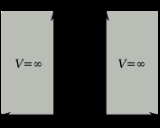
In
quantum mechanicsQuantum mechanics, also known as quantum physics or quantum theory, is a branch of physics providing a mathematical description of much of the dual particle-like and wave-like behavior and interactions of energy and matter. It departs from classical mechanics primarily at the atomic and subatomic...
, the
particle in a box model (also known as the
infinite potential well or the
infinite square well) describes a particle free to move in a small space surrounded by impenetrable barriers. The model is mainly used as a hypothetical example to illustrate the differences between
classicalWhat "classical physics" refers to depends on the context. When discussing special relativity, it refers to the Newtonian physics which preceded relativity, i.e. the branches of physics based on principles developed before the rise of relativity and quantum mechanics...
and quantum systems. In classical systems, for example a ball trapped inside a heavy box, the particle can move at any speed within the box and it is no more likely to be found at one position than another. However, when the well becomes very narrow (on the scale of a few nanometers), quantum effects become important. The particle may only occupy certain positive energy levels. Likewise, it can never have zero energy, meaning that the particle can never "sit still". Additionally, it is more likely to be found at certain positions than at others, depending on its energy level. The particle may never be detected at certain positions, known as spatial nodes.
The particle in a box model provides one of the very few problems in quantum mechanics which can be solved analytically, without approximations. This means that the observable properties of the particle (such as its energy and position) are related to the mass of the particle and the width of the well by simple mathematical expressions. Due to its simplicity, the model allows insight into quantum effects without the need for complicated mathematics. It is one of the first quantum mechanics problems taught in undergraduate physics courses, and it is commonly used as an approximation for more complicated quantum systems. See also: the
history of quantum mechanicsThe history of quantum mechanics, as it interlaces with the history of quantum chemistry, began essentially with a number of different scientific discoveries: the 1838 discovery of cathode rays by Michael Faraday; the 1859-1860 winter statement of the black body radiation problem by Gustav...
.
One-dimensional solution
The simplest form of the particle in a box model considers a one-dimensional system. Here, the particle may only move backwards and forwards along a straight line with impenetrable barriers at either end.
The walls of a one-dimensional box may be visualised as regions of space with an infinitely large
potential energyIn physics, potential energy is the energy stored in a body or in a system due to its position in a force field or due to its configuration. The SI unit of measure for energy and work is the Joule...
. Conversely, the interior of the box has a constant, zero potential energy. This means that no forces act upon the particle inside the box and it can move freely in that region. However, infinitely large
forceIn physics, a force is any influence that causes an object to undergo a change in speed, a change in direction, or a change in shape. In other words, a force is that which can cause an object with mass to change its velocity , i.e., to accelerate, or which can cause a flexible object to deform...
s repel the particle if it touches the walls of the box, preventing it from escaping. The potential energy in this model is given as

where

is the length of the box and

is the position of the particle within the box.
Wavefunctions
In quantum mechanics, the
wavefunctionNot to be confused with the related concept of the Wave equationA wave function or wavefunction is a probability amplitude in quantum mechanics describing the quantum state of a particle and how it behaves. Typically, its values are complex numbers and, for a single particle, it is a function of...
gives the most fundamental description of the behavior of a particle; the measurable properties of the particle (such as its position, momentum and energy) may all be derived from the wavefunction.
The wavefunction

can be found by solving the
Schrödinger equationThe Schrödinger equation was formulated in 1926 by Austrian physicist Erwin Schrödinger. Used in physics , it is an equation that describes how the quantum state of a physical system changes in time....
for the system

where

is the reduced Planck constant,

is the
massMass can be defined as a quantitive measure of the resistance an object has to change in its velocity.In physics, mass commonly refers to any of the following three properties of matter, which have been shown experimentally to be equivalent:...
of the particle,

is the
imaginary unitIn mathematics, the imaginary unit allows the real number system ℝ to be extended to the complex number system ℂ, which in turn provides at least one root for every polynomial . The imaginary unit is denoted by , , or the Greek...
and

is time.
Inside the box, no forces act upon the particle, which means that the part of the wavefunction inside the box oscillates through space and time with the same form as a
free particleIn physics, a free particle is a particle that, in some sense, is not bound. In classical physics, this means the particle is present in a "field-free" space.-Classical Free Particle:The classical free particle is characterized simply by a fixed velocity...
:

where

and

are arbitrary
complex numberA complex number is a number consisting of a real part and an imaginary part. Complex numbers extend the idea of the one-dimensional number line to the two-dimensional complex plane by using the number line for the real part and adding a vertical axis to plot the imaginary part...
s. The frequency of the oscillations through space and time are given by the
wavenumberIn the physical sciences, the wavenumber is a property of a wave, its spatial frequency, that is proportional to the reciprocal of the wavelength. It is also the magnitude of the wave vector...

and the
angular frequencyIn physics, angular frequency ω is a scalar measure of rotation rate. Angular frequency is the magnitude of the vector quantity angular velocity...

respectively. These are both related to the total energy of the particle by the expression

which is known as the
dispersion relationIn physics and electrical engineering, dispersion most often refers to frequency-dependent effects in wave propagation. Note, however, that there are several other uses of the word "dispersion" in the physical sciences....
for a free particle.
The size (or
amplitudeAmplitude is the magnitude of change in the oscillating variable with each oscillation within an oscillating system. For example, sound waves in air are oscillations in atmospheric pressure and their amplitudes are proportional to the change in pressure during one oscillation...
) of the wavefunction at a given position is related to the probability of finding a particle there by

. The wavefunction must therefore vanish everywhere beyond the edges of the box. Also, the amplitude of the wavefunction may not "jump" abruptly from one point to the next. These two conditions are only satisfied by wavefunctions with the form

where

is a positive, whole number. The wavenumber is restricted to certain, specific values given by

where

is the size of the box. Negative values of

are neglected, since they give wavefunctions identical to the positive

solutions except for a physically unimportant sign change.
Finally, the unknown constant

may be found by normalizing the wavefunction so that the total probability density of finding the particle in the system is 1. It follows that

Thus,
A may be any complex number with
absolute valueIn mathematics, the absolute value |a| of a real number a is the numerical value of a without regard to its sign. So, for example, the absolute value of 3 is 3, and the absolute value of -3 is also 3...
√(2/L); these different values of
A yield the same physical state, so
A = √(2/L) can be selected to simplify.
Energy levels
The energies which correspond with each of the permitted wavenumbers may be written as

.
The energy levels increase with

, meaning that high energy levels are separated from each other by a greater amount than low energy levels are. The lowest possible energy for the particle (its
zero-point energyZero-point energy is the lowest possible energy that a quantum mechanical physical system may have; it is the energy of its ground state. All quantum mechanical systems undergo fluctuations even in their ground state and have an associated zero-point energy, a consequence of their wave-like nature...
) is found in state 1, which is given by

The particle, therefore, always has a positive energy. This contrasts with classical systems, where the particle can have zero energy by resting motionless at the bottom of the box. This can be explained in terms of the
uncertainty principleIn quantum mechanics, the Heisenberg uncertainty principle states a fundamental limit on the accuracy with which certain pairs of physical properties of a particle, such as position and momentum, can be simultaneously known...
, which states that the product of the uncertainties in the position and momentum of a particle is limited by

It can be shown that the uncertainty in the position of the particle is proportional to the width of the box. Thus, the uncertainty in momentum is roughly inversely proportional to the width of the box. The kinetic energy of a particle is given by

, and hence the minimum kinetic energy of the particle in a box is inversely proportional to the mass and the square of the well width, in qualitative agreement with the calculation above.
Spatial location
In classical physics, the particle can be detected anywhere in the box with equal probability. In quantum mechanics, however, the probability density for finding a particle at a given position is derived from the wavefunction as

For the particle in a box, the probability density for finding the particle at a given position depends upon its state, and is given by

Thus, for any value of
n greater than one, there are regions within the box for which

, indicating that
spatial nodes exist at which the particle cannot be found.
In quantum mechanics, the average, or expectation value of the position of a particle is given by

For the steady state particle in a box, it can be shown that the average position is always

, regardless of the state of the particle. For a superposition of states, the expectation value of the position will change based on the cross term which is proportional to

.
Higher-dimensional boxes
If a particle is trapped in a two-dimensional box, it may freely move in the

and

-directions, between barriers separated by lengths

and

respectively. Using a similar approach to that of the one-dimensional box, it can be shown that the wavefunctions and energies are given respectively by

,

,
where the two-dimensional wavevector is given by

.
For a three dimensional box, the solutions are

,

,
where the three-dimensional wavevector is given by

.
An interesting feature of the above solutions is that when two or more of the lengths are the same (e.g.

), there are multiple wavefunctions corresponding to the same total energy. For example the wavefunction with

has the same energy as the wavefunction with

. This situation is called
degeneracyIn physics, two or more different quantum states are said to be degenerate if they are all at the same energy level. Statistically this means that they are all equally probable of being filled, and in Quantum Mechanics it is represented mathematically by the Hamiltonian for the system having more...
and for the case where exactly two degenerate wavefunctions have the same energy that energy level is said to be
doubly degenerate. Degeneracy results from symmetry in the system. For the above case two of the lengths are equal so the system is symmetric with respect to a 90° rotation.
Applications
Because of its mathematical simplicity, the particle in a box model is used to find approximate solutions for more complex physical systems in which a particle is trapped in a narrow region of low
electric potentialIn classical electromagnetism, the electric potential at a point within a defined space is equal to the electric potential energy at that location divided by the charge there...
between two high potential barriers. These
quantum wellA quantum well is a potential well with only discrete energy values.One technology to create quantization is to confine particles, which were originally free to move in three dimensions, to two dimensions, forcing them to occupy a planar region...
systems are particularly important in
optoelectronicsOptoelectronics is the study and application of electronic devices that source, detect and control light, usually considered a sub-field of photonics. In this context, light often includes invisible forms of radiation such as gamma rays, X-rays, ultraviolet and infrared, in addition to visible light...
, and are used in devices such as the
quantum well laserA quantum well laser is a laser diode in which the active region of the device is so narrow that quantum confinement occurs. The wavelength of the light emitted by a quantum well laser is determined by the width of the active region rather than just the bandgap of the material from which it is...
, the
quantum well infrared photodetectorA quantum well infrared photodetector , is an infrared photodetector made from semiconductor materials which contain one or more quantum wells. These can be integrated together with electronics and optics to make infrared cameras for thermography. A very common well material is gallium arsenide,...
and the
quantum-confined Stark effectThe quantum-confined Stark effect describes the effect of an external electric field upon the light absorption spectrum or emission spectrum of a quantum well . In the absence of an external electric field, electrons and holes within the quantum well may only occupy states within a discrete set...
modulator.
Relativistic Effects
The probability density does not go to zero at the nodes if relativistic effects are taken into account.
See also
- Finite potential well
The finite potential well is a concept from quantum mechanics. It is an extension of the infinite potential well, in which a particle is confined to a box, but one which has finite potential walls. Unlike the infinite potential well, there is a probability associated with the particle being found...
- Delta function potential
- Gas in a box
In quantum mechanics, the results of the quantum particle in a box can be used to look at the equilibrium situation for a quantum ideal gas in a box which is a box containing a large number of molecules which do not interact with each other except for instantaneous thermalizing collisions...
- Particle in a ring
In quantum mechanics, the case of a particle in a one-dimensional ring is similar to the particle in a box. The Schrödinger equation for a free particle which is restricted to a ring is...
- Particle in a spherically symmetric potential
- Quantum harmonic oscillator
The quantum harmonic oscillator is the quantum-mechanical analog of the classical harmonic oscillator. Because an arbitrary potential can be approximated as a harmonic potential at the vicinity of a stable equilibrium point, it is one of the most important model systems in quantum mechanics...
- Delta potential well (QM)
The delta potential is a potential that gives rise to many interesting results in quantum mechanics. It consists of a time-independent Schrödinger equation for a particle in a potential well defined by a Dirac delta function in one dimension....
- Semicircle potential well
- Configuration integral (statistical mechanics)
External links