
All Topics  
Paper chromatography


   Email Print
   Bookmark   Link


Paper chromatography


Paper chromatography is an analytical
Analytical chemistry

Analytical chemistry is the study of the chemical composition of natural and artificial materials. Unlike other major sub disciplines of chemistry such as inorganic chemistry and organic chemistry, analytical chemistry is not restricted to any particular type of chemical compound or chemical reaction....
 technique for separating and identifying mixtures that are or can be colored, especially pigment
Pigment

A pigment is a material that changes the color of light it Reflection as the result of selective color absorption. This physical process differs from fluorescence, phosphorescence, and other forms of luminescence, in which the material itself emits light....
s. This can also be used in secondary or primary colors in ink experiments. This method has been largely replaced by thin layer chromatography
Thin layer chromatography

Thin layer chromatography is a chromatography technique used to separate mixtures. Thin layer chromatography is performed on a sheet of glass, plastic, or aluminum foil, which is coated with the a thin layer of adsorbent material, usually silica gel, aluminium oxide, or cellulose....
, however it is still a powerful teaching tool. Two-way paper chromatography, also called two-dimensional chromatography, involves using two solvents and rotating the paper 90° in between.


Discussion
Ask a question about 'Paper chromatography'
Start a new discussion about 'Paper chromatography'
Answer questions from other users
Full Discussion Forum


Recent Posts


Encyclopedia


Paper chromatography is an analytical
Analytical chemistry

Analytical chemistry is the study of the chemical composition of natural and artificial materials. Unlike other major sub disciplines of chemistry such as inorganic chemistry and organic chemistry, analytical chemistry is not restricted to any particular type of chemical compound or chemical reaction....
 technique for separating and identifying mixtures that are or can be colored, especially pigment
Pigment

A pigment is a material that changes the color of light it Reflection as the result of selective color absorption. This physical process differs from fluorescence, phosphorescence, and other forms of luminescence, in which the material itself emits light....
s. This can also be used in secondary or primary colors in ink experiments. This method has been largely replaced by thin layer chromatography
Thin layer chromatography

Thin layer chromatography is a chromatography technique used to separate mixtures. Thin layer chromatography is performed on a sheet of glass, plastic, or aluminum foil, which is coated with the a thin layer of adsorbent material, usually silica gel, aluminium oxide, or cellulose....
, however it is still a powerful teaching tool. Two-way paper chromatography, also called two-dimensional chromatography, involves using two solvents and rotating the paper 90° in between. This is useful for separating complex mixtures of similar compounds, for example, amino acids.

Technique

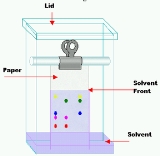
A small concentrated spot of solution that contains the sample of the solute is applied to a strip of chromatography paper about two centimeters away from the base of the plate, usually using a capillary tube for maximum precision. This sample is absorbed onto the paper and may form interactions with it. Any substance that reacts or bonds with the paper cannot be measured using this technique. The paper is then dipped in to a suitable solvent, such as ethanol or water, taking care that the spot is above the surface of the solvent, and placed in a sealed container. The solvent moves up the paper by capillary action, which occurs as a result of the attraction of the solvent molecules to the paper,also this can be explained as differential adsorption
Adsorption

Adsorption is a process that occurs when a gas or liquid solute accumulates on the surface of a solid or a liquid , forming a film of molecules or atoms ....
 of the solute components into the solvent. As the solvent rises through the paper it meets and dissolves the sample mixture, which will then travel up the paper with the solvent solute sample. Different compounds in the sample mixture travel at different rates due to differences in solubility in the solvent, and due to differences in their attraction to the fibers in the paper. Paper chromatography takes anywhere from several minutes to several hours. In some cases, paper chromatography does not separate pigments completely; this occurs when two substances appear to have the same values in a particular solvent. In these cases, two-way chromatography is used to separate the multiple-pigment spots.

Ascending Chromatography

In this method, the solvent is in pool at the bottom of the vessel in which the paper is supported.It rises up the paper by capillary action against the force of gravity.

Descending Chromatography

In this method, the solvent is kept in a trough at the top of the chamber and is allowed to flow down the paper. The liquid moves down by capillary action as well as by the gravitational force. In this case, the flow is more rapid as compared to the ascending method. Because of this rapid speed, the chromatography is completed in a comparatively shorter time. The apparatus needed for this case is more sophisticated. The developing solvent is placed in a trough at the top which is usually made up of an inert material. The paper is then suspended in the solvent. Substances that cannot be separated by ascending method, can be separated by the above descending method.

Analysis

After development, the spots corresponding to different compounds may be located by their color, ultraviolet
Ultraviolet

Ultraviolet light is electromagnetic radiation with a wavelength shorter than that of visible light, but longer than x-rays, in the range 400 nanometer to 10 nm, and energies from 3 Electron volt to 124 eV....
 light, ninhydrin
Ninhydrin

Ninhydrin is a chemical used to detect ammonia or primary and secondary amines. When reacting with these free amines, a deep blue or purple color known as Ruhemann's purple is evolved....
 (Triketohydrindane hydrate) or by treatment with iodine
Iodine

Iodine , is a chemical element that has the symbol I and atomic number 53. Naturally-occurring iodine is a single isotope with 74 neutrons....
 vapors. The paper remaining after the experiment is known as the Chromatogram.The components which have been separated differ in their retention factor i.e Ratio of distance traveled from the spot
Spot

The common noun or verb spot has many meanings in English.Otherwise, Spot or SPOT may refer to:...
 or origin
Origin

Origin is a word meaning "beginning." In this sense, it may refer to:*Origin , the beginning, starting-point, cause, or ultimate source, from which a thing is derived;...
 by the solute component to that of the distance traveled from the spot
Spot

The common noun or verb spot has many meanings in English.Otherwise, Spot or SPOT may refer to:...
 or origin
Origin

Origin is a word meaning "beginning." In this sense, it may refer to:*Origin , the beginning, starting-point, cause, or ultimate source, from which a thing is derived;...
 by the solvent. Retention Factor can never be greater than one. To calculate Rf, use the following: Distance traveled by sample/ distance traveled by solvent.

The final chromatogram can be compared with other known mixture chromatograms to identify sample mixes using the Rf value in an experiment. The retention values found can be compared to known values, and from that conclusions can be drawn. and such

Chromatography as art

Chromatography can be used as an art alternative because of certain colors that it creates, but paper chromatography rarely produces decipherable colors if executed incorrectly. Sometimes, chromatographic results may start with undesirable "leafy" colors, but if done correctly and completely, magnificent hues can be produced.

Rƒ value

Rƒ value may be defined as the ratio of the distance travelled by the substance to the distance travelled by the solvent. Rƒ values are usually expressed as a fraction of two decimal places but it was suggested by Smith that a percentage figure should be used instead. If Rƒ value of a solution is zero, the solute remains in the stationary phase and thus it is immobile. If Rƒ value = 1 then the solute has no affinity for the stationary phase and travels with the solvent front.