

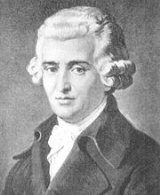
Papa Haydn

Encyclopedia
The composer Joseph Haydn
is sometimes given the nickname "Papa" Haydn. The practice began in the composer's lifetime, and has continued to some extent to the present day.
, or boss, for a reasonably large group of musicians. Haydn's authority was evidently rather benevolent, as he often interceded with Prince Eszterházy
on behalf of musicians who had gotten in trouble. The tale of the Farewell Symphony
attests to Haydn's willingness to act on behalf of his subordinates. The practice of calling Haydn "Papa" became increasingly plausible as Haydn's 30-plus years of service in the Eszterházy court went by; with each year, he would have become increasingly older than the average musician serving under him.
In his old age, Haydn remarked to Georg August Griesinger
regarding his late, younger friend Wolfgang Amadeus Mozart
that Mozart had called him "Papa".
and string quartet
. While Haydn did not invent either genre, his work is considered important enough in establishing these genres that the labels "Father of the Symphony" and "Father of the String Quartet" are often attached to him. Even in his own lifetime, this perspective was prevalent. In 1797, the Tonkünstler-Societät of Vienna passed the resolution to make him a life member, "by virtue of his extraordinary merit as the father and reformer of the noble art of music."

Because music education materials still tend to reflect 19th century sources, the term is well known to musicians.
The following rhyme goes with the first bars of the Surprise Symphony, based on a tune commonly known today as Twinkle, Twinkle, Little Star:
Joseph Haydn
Franz Joseph Haydn , known as Joseph Haydn , was an Austrian composer, one of the most prolific and prominent composers of the Classical period. He is often called the "Father of the Symphony" and "Father of the String Quartet" because of his important contributions to these forms...
is sometimes given the nickname "Papa" Haydn. The practice began in the composer's lifetime, and has continued to some extent to the present day.
"Papa" as a term of affection
After 1766 at the Eszterházy court, Haydn was the KapellmeisterKapellmeister
Kapellmeister is a German word designating a person in charge of music-making. The word is a compound, consisting of the roots Kapelle and Meister . The words Kapelle and Meister derive from the Latin: capella and magister...
, or boss, for a reasonably large group of musicians. Haydn's authority was evidently rather benevolent, as he often interceded with Prince Eszterházy
Nikolaus Esterházy
Nikolaus Esterházy was a Hungarian prince, a member of the famous Esterházy family. His building of palaces, extravagant clothing, and taste for opera and other grand musical productions led to his being given the title "the Magnificent"...
on behalf of musicians who had gotten in trouble. The tale of the Farewell Symphony
Symphony No. 45 (Haydn)
Symphony No. 45 in F-sharp minor, known as the "Farewell" Symphony , was composed by Joseph Haydn in 1772....
attests to Haydn's willingness to act on behalf of his subordinates. The practice of calling Haydn "Papa" became increasingly plausible as Haydn's 30-plus years of service in the Eszterházy court went by; with each year, he would have become increasingly older than the average musician serving under him.
In his old age, Haydn remarked to Georg August Griesinger
Georg August Griesinger
Georg August von Griesinger was a tutor and diplomat resident in Vienna during the late 18th and 19th centuries. He is remembered for his friendships with the composers Joseph Haydn and Ludwig van Beethoven, and for the biography he wrote of Haydn....
regarding his late, younger friend Wolfgang Amadeus Mozart
Wolfgang Amadeus Mozart
Wolfgang Amadeus Mozart , baptismal name Johannes Chrysostomus Wolfgangus Theophilus Mozart , was a prolific and influential composer of the Classical era. He composed over 600 works, many acknowledged as pinnacles of symphonic, concertante, chamber, piano, operatic, and choral music...
that Mozart had called him "Papa".
"Papa" as founder
Another sense of the term "Papa Haydn" comes from his role in the history of classical music, notably in the development of the symphonySymphony
A symphony is an extended musical composition in Western classical music, scored almost always for orchestra. A symphony usually contains at least one movement or episode composed according to the sonata principle...
and string quartet
String quartet
A string quartet is a musical ensemble of four string players – usually two violin players, a violist and a cellist – or a piece written to be performed by such a group...
. While Haydn did not invent either genre, his work is considered important enough in establishing these genres that the labels "Father of the Symphony" and "Father of the String Quartet" are often attached to him. Even in his own lifetime, this perspective was prevalent. In 1797, the Tonkünstler-Societät of Vienna passed the resolution to make him a life member, "by virtue of his extraordinary merit as the father and reformer of the noble art of music."
"Papa" as caricature
With the rise of acclaim for Haydn's music during the 20th century, scholars and critics became rather leery of the term, and saw it as a distortion of the composer's work. For example, Jens Peter Larsen wrote (1980) in the New Grove encyclopedia:Because music education materials still tend to reflect 19th century sources, the term is well known to musicians.
The following rhyme goes with the first bars of the Surprise Symphony, based on a tune commonly known today as Twinkle, Twinkle, Little Star:
- Papa Haydn's dead and gone
- but his memory lingers on.
- When his heart was filled with bliss
- he wrote merry tunes like this.
Sources
- The quotation from Jens Peter Larsen is from the 1980 edition of the New Grove. Larsen's article was published separately as The New Grove: Haydn, Norton, New York, 1982.
- The New Grove's current article on Haydn (by Webster and Feder, not by Larsen) includes other material on the term "Papa Haydn".
- Deutsch, Otto Erich (1965) Mozart: A Documentary Biography. Stanford, CA: Stanford University Press.