

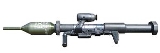
Panzerfaust 3

Encyclopedia
The Panzerfaust 3 is a modern and disposable recoilless RPG anti-tank weapon developed between 1978 and 1985 and put into service by the Bundeswehr
in 1992. It was first ordered in 1973 to provide West German infantry
with an effective weapon against contemporary Soviet armour thereby replacing West Germany's aging PzF 44 Lanze
rocket launchers.
and a reusable firing and sighting unit. The projectile consists of a shaped-charge warhead filled with Amatol/Syndril
and a shaft including the propulsion unit.
The Panzerfaust 3 can be fired from enclosed spaces since it does not have a significant backblast; The rear of the tube, filled with plastic granulate, minimises the blast effect by the so-called recoilless countermass principle. The booster propellant for the projectile in its tube is ignited by a bolt via a spring mechanism. Once ejected from the launcher, the projectile coasts a safe distance and then the rocket motor is ignited boosting it to its maximum speed, after which it coasts until impact.
As safety precautions, the built-in fuse for the warhead is released by a safety mechanism. This arms the warhead after a flight distance of approximately five meters. Once armed, the warhead will detonate on impact, and as a safety when the rocket's propellant runs out. This safeguards against live ammunition staying around and causing hazards to all in the future.
The Panzerfaust 3's name dates back to the Panzerfaust
used by the German army
in World War II
, which consisted of a small, disposable preloaded launch tube firing a high explosive anti-tank warhead, operated by a single soldier.
In consequence, the improved PzF 3-T replaced the original model in the late 1990s, introducing a dual hollow charge "tandem" warhead to defeat explosive reactive armour. This means that the spike projecting from the warhead itself also contains an explosive charge to set off the reactive armour and free the path to the real armour for the main warhead. The latest incarnation of the Panzerfaust 3, the PzF 3-IT-600, can be fired from ranges up to 600 meters thanks to an advanced computer-assisted sighting and targeting mechanism.
As of 2005, there were two additional models in the development or testing stage, both relying on smaller and therefore lighter warheads. Those were the RGW (Rückstoßfreie Granatwaffe, Recoilless Grenade Weapon — which would make it just like the original in name and operation.) in calibres
60 and 90 millimetres. Both new weapons are expected to help facilitate the transition in German military doctrine
from preparation for major tank battles to urban and low-level warfare.
warhead
)
s, lightly armoured vehicles & soft target
s
project. Essentially this is a computer controlled aiming sight with range finder. It is meant to cope with the fact that some soldiers have a hard time handling the regular sight, as its scope is quite complex to the untrained eye. Also, it increases the weapon's effective range to 600 m (1,968.5 ft) against moving and stationary targets. Dynarange is already in service with the Royal Netherlands Marine Corps.
Bundeswehr
The Bundeswehr consists of the unified armed forces of Germany and their civil administration and procurement authorities...
in 1992. It was first ordered in 1973 to provide West German infantry
Infantry
Infantrymen are soldiers who are specifically trained for the role of fighting on foot to engage the enemy face to face and have historically borne the brunt of the casualties of combat in wars. As the oldest branch of combat arms, they are the backbone of armies...
with an effective weapon against contemporary Soviet armour thereby replacing West Germany's aging PzF 44 Lanze
PzF 44
The PzF 44 2A1 is a recoilless anti-tank weapon developed around 1960 and put into service by the Bundeswehr shortly thereafter. It was developed to provide West German infantry with a modern replacement for the Bazooka that they had previously used...
rocket launchers.
Principle
The Panzerfaust 3 consists of a disposable launcher tube holding the projectileProjectile
A projectile is any object projected into space by the exertion of a force. Although a thrown baseball is technically a projectile too, the term more commonly refers to a weapon....
and a reusable firing and sighting unit. The projectile consists of a shaped-charge warhead filled with Amatol/Syndril
Amatol
Amatol is a highly explosive material made from a mixture of TNT and ammonium nitrate. Its name originates from the words ammonium and toluene...
and a shaft including the propulsion unit.
The Panzerfaust 3 can be fired from enclosed spaces since it does not have a significant backblast; The rear of the tube, filled with plastic granulate, minimises the blast effect by the so-called recoilless countermass principle. The booster propellant for the projectile in its tube is ignited by a bolt via a spring mechanism. Once ejected from the launcher, the projectile coasts a safe distance and then the rocket motor is ignited boosting it to its maximum speed, after which it coasts until impact.
As safety precautions, the built-in fuse for the warhead is released by a safety mechanism. This arms the warhead after a flight distance of approximately five meters. Once armed, the warhead will detonate on impact, and as a safety when the rocket's propellant runs out. This safeguards against live ammunition staying around and causing hazards to all in the future.
The Panzerfaust 3's name dates back to the Panzerfaust
Panzerfaust
The Panzerfaust was an inexpensive, recoilless German anti-tank weapon of World War II. It consisted of a small, disposable preloaded launch tube firing a high explosive anti-tank warhead, operated by a single soldier...
used by the German army
Army
An army An army An army (from Latin arma "arms, weapons" via Old French armée, "armed" (feminine), in the broadest sense, is the land-based military of a nation or state. It may also include other branches of the military such as the air force via means of aviation corps...
in World War II
World War II
World War II, or the Second World War , was a global conflict lasting from 1939 to 1945, involving most of the world's nations—including all of the great powers—eventually forming two opposing military alliances: the Allies and the Axis...
, which consisted of a small, disposable preloaded launch tube firing a high explosive anti-tank warhead, operated by a single soldier.
History
The main drawback is that it has only a single shot and soldiers have to get dangerously close to penetrate heavily armoured targets. Many soldiers also found it very heavy and cumbersome, and its firing mechanism and tube tended to get damaged and jam under battlefield conditions. In addition, the rocket warhead itself was found to be ineffective against heavy armour and armour of newer types and had to be redesigned.In consequence, the improved PzF 3-T replaced the original model in the late 1990s, introducing a dual hollow charge "tandem" warhead to defeat explosive reactive armour. This means that the spike projecting from the warhead itself also contains an explosive charge to set off the reactive armour and free the path to the real armour for the main warhead. The latest incarnation of the Panzerfaust 3, the PzF 3-IT-600, can be fired from ranges up to 600 meters thanks to an advanced computer-assisted sighting and targeting mechanism.
As of 2005, there were two additional models in the development or testing stage, both relying on smaller and therefore lighter warheads. Those were the RGW (Rückstoßfreie Granatwaffe, Recoilless Grenade Weapon — which would make it just like the original in name and operation.) in calibres
Caliber
In guns including firearms, caliber or calibre is the approximate internal diameter of the barrel in relation to the diameter of the projectile used in it....
60 and 90 millimetres. Both new weapons are expected to help facilitate the transition in German military doctrine
Military doctrine
Military doctrine is the concise expression of how military forces contribute to campaigns, major operations, battles, and engagements.It is a guide to action, not hard and fast rules. Doctrine provides a common frame of reference across the military...
from preparation for major tank battles to urban and low-level warfare.
Specifications
There are three different versions of the Panzerfaust 3:PzF 3
Standard Anti-tank version with hollow chargeShaped charge
A shaped charge is an explosive charge shaped to focus the effect of the explosive's energy. Various types are used to cut and form metal, to initiate nuclear weapons, to penetrate armor, and in the oil and gas industry...
warhead
Warhead
The term warhead refers to the explosive material and detonator that is delivered by a missile, rocket, or torpedo.- Etymology :During the early development of naval torpedoes, they could be equipped with an inert payload that was intended for use during training, test firing and exercises. This...
- Calibre:
- Launcher: 60 mm (2.4 in)
- warhead: 110 mm (4.3 in)
- Weight:
- fire-ready weapon: 15.2 kilogram
- warhead: 3.9 kilogram
- spare rounds: 12.9 kilogram
- Length: 1200 millimetre
- Muzzle velocity: 160 m/s
- Highest possible speed: 243 m/s
- Sights: telescope sights (can be reused)
- Maximum effective range:
- Stationary targets: 400 m (1,312.3 ft)
- Moving targets: 300 m (984.3 ft)
- Minimum effective range: 20 m (65.6 ft)
- Penetration capability:
- Rolled homogeneous armourRolled homogeneous armourRolled homogeneous armour is a type of steel which is used to armour vehicles.-Composition:Armoured steel must be hard yet impervious to shock in order to resist high velocity metal projectiles. Steel with these characteristics is produced by processing cast steel billets of appropriate size and...
(RHA): 700 mm (27.6 in) - ConcreteConcreteConcrete is a composite construction material, composed of cement and other cementitious materials such as fly ash and slag cement, aggregate , water and chemical admixtures.The word concrete comes from the Latin word...
: 1600 millimetre
- Rolled homogeneous armour
- Manufacturer: Dynamit-Nobel, Germany
PzF 3-IT
Improved Anti-tank version with tandem hollow charge warhead (designed to penetrate reactive armourReactive armour
Reactive armour is a type of vehicle armour that reacts in some way to the impact of a weapon to reduce the damage done to the vehicle being protected. It is most effective in protecting against shaped charges and specially hardened long rod penetrators...
)
- Calibre:
- Launcher: 60 mm (2.4 in)
- warhead: 110 mm (4.3 in)
- Weight:
- fire-ready weapon: 15.6 kilogram
- warhead: 3.9 kilogram
- spare rounds: 13.3 kilogram
- Length: 1200 millimetre
- Muzzle velocity: 152 m/s
- Highest possible speed: 220 m/s
- Sights: telescope sights (can be reused)
- Maximum effective range:
- Stationary targets: 400 m (1,312.3 ft)
- Moving targets: 300 m (984.3 ft) (600 m (1,968.5 ft) with DYNARANGE sight)
- Minimum effective range: 20 m (65.6 ft)
- Penetration capability:
- RHA: 900 mm (35.4 in)
- Manufacturer: Dynamit-Nobel, Germany
PzF 3 Bunkerfaust
Designed for use against hardened bunkerBunker
A military bunker is a hardened shelter, often buried partly or fully underground, designed to protect the inhabitants from falling bombs or other attacks...
s, lightly armoured vehicles & soft target
Soft target
Soft target is a military term referring to unarmored/undefended targets needing to be destroyed. For example, a soft target would be an automobile, a house, or assembly of people while a hard target could be a main battle tank or a well defended installation...
s
- Calibre:
- Launcher: 60 mm (2.4 in)
- warhead: 110 mm (4.3 in)
- Weight:
- fire-ready weapon: 15.6 kilogram
- warhead: 3.9 kilogram
- spare rounds: 13.3 kilogram
- Length: 1200 millimetre
- Muzzle velocity: 149 m/s
- Highest possible speed: 212 m/s
- Sights: telescope sights (can be reused)
- Maximum effective range: 300 m (984.3 ft)
- Minimum effective range: 20 m (65.6 ft)
- Manufacturer: Dynamit-Nobel, Germany
- Penetration capacity:
- RHA: 110 mm (4.3 in)
- Concrete: 360 mm (14.2 in)
- Sandbags: 1300 millimetre
Aiming/Firing Device
The regular firing platform has a purely optical sight, weighing 2.3 kg (5.1 lb). All ranges listed in the article are for the optical sight. A new sight called Dynarange is currently being procured as part of the German Infantryman of the FutureIdZ
Infanterist der Zukunft is the German Bundeswehr's program as part of the Future Soldier project. It is a modular, integrated fighting system designed to provide significant lethality, survivability, mobility, battle command, and training to the German infantryman...
project. Essentially this is a computer controlled aiming sight with range finder. It is meant to cope with the fact that some soldiers have a hard time handling the regular sight, as its scope is quite complex to the untrained eye. Also, it increases the weapon's effective range to 600 m (1,968.5 ft) against moving and stationary targets. Dynarange is already in service with the Royal Netherlands Marine Corps.