

Opel Manta

Encyclopedia
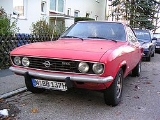
The Opel Manta was a rear-wheel-drive sports coupé
motor vehicle built by Opel
, from 1970 to 1988.
on which it was based. A competitor to the Ford Capri
, it was a two-door "three-box" coupé, and featured distinctive round tail lights, quite similar to those on the Opel GT
and which in fact were used on the GT in 1973, its final model year. In the UK market, the first Manta was sold only as an Opel: there was no Vauxhall
-branded Manta (or Ascona) until after the launch, in 1975, of the Manta B1 and Ascona B. (In the UK the Ford Capri
niche was till 1975 contested, with only limited success, by Vauxhall's Firenza
, based on the by now aging Vauxhall Viva
.)
The sales approach for the Opel line in the U.S. Market was equally odd. The Manta A was one of only a few Opel models sold in the U.S. Market. Opels were imported by GM and sold through Buick dealerships and not their own dealership network, so they were limited in what makes and models they could sell here. Other Opel models sold in the U.S. market were the 1956–61 the Rekord P1 and Rekord P2, the Kadett A (1964–66), Kadett B (1967–71), GT (1969–73), Manta / Ascona A (1971–75). The Ascona A, was the saloon version of the Manta A chassis and was sold in the U.S. under the 1900 name as a 2 door and 4 door saloon and 2 door "Sport Wagon". The only difference between the Ascona and Manta was exterior sheet metal, glass and trim. The frame, all the mechanicals, dash, front seats, and many other parts were shared between the cars. The Manta was even sold in 1971 and 1972, as the 1900 Sport Coupe, not the Manta. In 1973 the Manta nameplate was added to the U.S.-spec Mantas, but the Asconas kept the 1900 badge throughout their model life. The last year GM imported European made Opels into the United States, under their marquee, was 1975. In that year the only Opels imported were the Manta and Ascona A.
The Manta was normally equipped with a 1.6–1.9 litre CIH engines, although in Europe a small 1.2 litre motor was offered. All Mantas sold in the U.S. had the 1.9L and larger heavy duty radiator (an option on European models). It came with either a 4 speed manual or an optional 3-speed TH-180 automatic. The Manta was known to be one of the best handling cars in its class and went on to win a large number of rallies in Europe and the United States.
In the U.S. Market, there was a sport model known as the Rallye from 1971-74. The "Rallye" model was overall an appearance and gauge package, the most noticeable difference was the addition of a Black Hood and on 1970-73 models addition of fog lamps. Mechanically the only difference was the gear ratio in the models with manual transmissions, and the Rallye model came with standard stiffer suspension, tighter turning radius, and very aggressive front caster adjustments. Both had dual rear sway bars, providing the best in class handling.
In 1973 and 1974 there was also the "Luxus" model which included "refinements" like corduroy seats, colour-coded interiors (blue or burgundy), and faux wood panelling. The only special edition Manta ever produced for the U.S. market was the "Blue Max" in 1973, this amounted to a blue 1973 Luxus model, with a unique dark blue vinyl roof, mechanical sunroof, and automatic transmission.
In 1975, All Manta and 1900 models were equipped with the Bosch L-Jetronic fuel injection in the United States due to emission regulations. Yet in Europe this feature was only available on the high end GT/E Models, which also sported fog lamps and a lower front spoiler, which was not offered on any of the U.S. Spec Manta models. Also of note is that the 1974–75 Opel Manta Models sported large aluminium 5 mph (8 km/h) bumpers to comply with U.S. crash standards of the time; the European Mantas did not receive the large bumpers.
With the Deutsche Mark becoming stronger, and with other costs also rising, US imports of Opels ended in 1975. Instead, the Isuzu Gemini
version of the T-car
was imported from Japan and sold by Buick
dealers as the "Opel by Isuzu", later "Buick Opel". The Opel name was last used in the US in 1979.
The European market had a number of different versions of their own. Most were basic trim packages, the most popular being the "Berlinetta", which was similar to the "Luxus" but included rubber trim on the bumpers (standard on all 1973 U.S. Opel Mantas), vinyl roof, and other misc. features. The one major exception being in 1975 Opel offered the GT/E and a number of special editions based on the GT/E. The GT/E was a fuel injected version of the European 1.9L and the performance figures were very impressive for the time. Most notable special editions models based on the GT/E were the "Black Magic" (with black and plaid interior), and the "Swinger" edition in white with an equally odd interior choice.
The Turbomanta is the rarer of the two. Production was a total of 33 cars ever made, whereas the 5 of them were the prototypes, and the ones used for public relations.
The Turbomanta is actually a 1973 SR with a 1.9 litre "S" spec engine, originally putting out 90 bhp. The British company "Broadspeed" was chosen to build the turbo cars, and eventually started building 5 left hand drive cars for the German Opel AG. These cars were meant only as prototypes. Broadspeed came up with a somewhat special solution, and used a combination of a Holset 3LDG turbocharger, and a carburettor mounted inside a big plenum chamber. The engine itself was fitted with a thicker copper head gasket, and as such the compression ratio was lowered to 7.6:1. The outcome was a 1.9 litre engine which put out a staggering 156 bhp, and more impressive was the acceleration. 0–60 was done in only 7.6 seconds, faster than most "supercars" at the time like the Porsche 911. All 5 cars were in GM "signalgelb" sunflower yellow, and had a large black stripe on the side, where a sign said "TURBOMANTA". The downside to this was fuel consumption. The turbocharger had halved the economy of the car, and building it was also a thing that cost a lot. Therefore Opel closed the project, leaving the 5 cars as the total production number. However a British engineer at the D.O.T (Dealer Opel Team, which was the British importer and builder of Opel cars in Britain) was so enthusiastic about the cars that he had D.O.T. build an additional 28 cars. The cars were all based on the 1974 Berlinetta model, which was the luxury model, with a full gauge pack, automatic transmission, and alloy wheels. All 28 cars were black, with vinyl roofing. The only thing identifying that the car was indeed a Turbo Manta was a small sign at the rear quarter of the rear wings saying "turbo". Very few of these cars still remain today. the car also had great handling
The TE2800 was a totally different project. Actually the TE2800 wasn't really an Opel as Opel had nothing to do with the project. A Belgian company called Transeurop Engineering also wanted to up the engine power of the Manta A. Opel had previously tried a 6 cylinder engine layout already in 1971 and 72, but with no success. The cars were rendered too expensive to build, and the market was overwhelmed at the time with big engine cars. But Transeurop Engineering did not agree. They basically took a 2.8 litre CIH type engine from the Opel Commodore 2.8GS model and fitted it into the engine bay of the Manta 1.9SR. A lot of problems occurred. The radiator, the bonnet, the entire front end of the car, the rear axle, the transmission, it all needed to be changed. To solve this fast Transeurop Engineering tried to get Opel to join the project using Opels earlier experiences with the transformation, but with no luck. Even worse Opel didn't even want the Opel brand on the cars, if the project ever became a success. Transeurop Engineering therefore turned to Opel's number one tuner of the time Steinmetz. Steinmetz supplied the new fibreglass bonnet with a large bulk on it to give room to the engine, a set of widened arches, and a special front bumper integrated with the lower front spoiler, to make room for the dramatically changes that needed to be made to the cars front end construction. Several of this was cut out and replaced with other parts being mounted further to the ground to give room for the radiator. A closed radiator system was installed so that the radiator had a water tank in the engine bay (like we know it from modern cars today). The engine was still the 2.8 litre unit from the Commodore GS and this was originally fitted with 2 Zenith carburettors. The output was 142 bhp, and with the Commodore four-speed manual gearbox and a 3,18:1 rear axle the car went from 0–60 mph in just 7.5 seconds. A total of 79 cars were made and sold through Steinmetz in Germany branded not as an Opel but as a TE2800. All Opel brands was removed from the cars and replaced by the logo "TE".
Steinmets offered a tune-up for rally and motorsport use. The tuneup consisted of porting and flowing the head, higher compression ratio, a race spec camshaft, and triple carburettors, giving the car a total of up to 230 bhp.
No doubt that the TE2800 is the fastest Manta A ever made, even though officially it isn't an Opel. It could outrun cars like the 911 Carrera of 1973 and the BMW2002 turbo from 1973, even though those cars had more engine power. The low weight of the Manta bodyshell, and the combination of the right gear ratios, was what gave the car its success. Unfortunately Opel was right though. The cars were too expensive costing almost twice the price of a 105 bhp GT/E in 1975. Very few of these cars exist today, as most were used in rally and motorsport events.
, but the overall design was influenced by the 1975 Chevrolet Monza
. The Manta had more "sporty" styling, including a droop-snoot nose not seen on the Ascona, although it was standard, on the UK version of the Ascona, the Vauxhall Cavalier
. There was still no "Vauxhall Manta", with the car remaining an Opel in the UK. However, a Vauxhall Cavalier was available with the same coupé bodyshell.
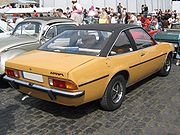 Engines were available ranging from the small 1,2 litre OHV engine, the 1,6 litre CIH and the 1,9 litre CIH. Also in 1976 the GT/E engine from the Manta A series was adapted into the Manta B programme spawning the GT/E Manta B series. In 1979 the GT/E had the engine replaced with the new 2,0 litre CIH and with a new designed Bosch L injection system. Power output was now 110 bhp. The 1.9 litre engine gave way to the 2,0 litre S engine which was aspirated by a Varajet II carburettor. This engine was the most used engine by Opel at the time, and was to be found in several Opel Rekord cars.
In 1977, a three-door hatchback version appeared to complement the existing two-door booted car. This shape was also not unique, being available on the Vauxhall Cavalier Sports Hatch variant.
Both Manta versions received a facelift in 1982, which included a plastic front spoiler, sideskirts for the GT/E and GSi models, a small wing at the rear and quadruple air intakes on the grille. Also the 1.2, 1.6 and 1.9 litre engines were discontinued and replaced by the 1.3 litre OHC engine, the 1.8 litre OHC and the 2.0 litre S and E CIH engines. The GT/E was renamed and was called the GSi from 1983 (except in the UK where the GT/E name continued).
Production of the Manta continued well after the equivalent Ascona and Cavalier were replaced by a front wheel drive model "Ascona C". In 1982 the 1,8 litre OHC engine from the Ascona was fitted in the Manta B making a more economical Manta B to drive. It could run 14 km per litre and use unleaded fuel. The 1,8 was very popular and was in production for 5 years (1982–1987). The 2,0S models where discontinued in 1984 and only the GSi was available with the "large" engine (GT/E in the UK). In 1986 Opel released the last Manta B model the Exclusive (1987 in the UK), giving it all of the best in equipment. Recaro seats with red cloth, grey leather like interior and the full bodypack known from the i200 models. This consisted of twin round headlights in a plastic cover, frontspoiler and rear lower spoiler from Irmscher
, sideskirts and the known 3 split rear spoiler of the Manta 400 (producing 80 kg (176 lb) of weight on the rear at 200 km/h). In the UK, the Exclusive GT/E models were available in colours such as Dolphin Grey with matching dark grey cloth seats with red piping. These also had the quad headlights, front spoiler but a rear bumper which housed the number plate, coupled with a black plastic strip between the rear light clusters. The rear spoiler was similar to the standard GT/E. Opel finally ceased the production of the Manta B in 1988, only producing the GSi exclusive the last 2 years (GT/E in the UK). Sales continued in 1989 until the Manta was replaced by the Opel Calibra
(known as the "Vauxhall Calibra" in the UK).
Today, these cars are hard to find in an original, good condition; consequently the value has risen considerably over the last few years. It has again become popular, because of its good looks and well-respected handling.
Opel joined forces with German tuner Irmscher
and Cosworth
in Britain, to make the 400. Cosworth was given the task to develop a 16 valve 2 cam head for the CIH spec engine block, and Irmscher
who earlier in 1977 and 78 had proven that they knew their way around an Opel building the i2800, was to design the exterior and interior of the cars. The results were not bad. Opel however had problems with the engine. The first idea of using a 2.0 litre engine and then using the 16 valve head from Cosworth simply did not give enough power. The problem was that the heads had already been built, so the heads were made to fit on the CIH type 4 cylinder engine block. So they built an unusual engine using a 2.0 litre engine block with an overbore and larger pistons, a crankshaft from the 2.3 litre diesel engine of same type (CIH) and ended with a 2.4 litre engine block. Mounting the 16 valve head on this gave a massive output, and the opportunity to make several tune-ups for the rally drivers.
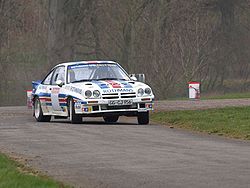 Opel delivered the first 23 specimens in 1981 which were recognizable by the 2 slot front grille (1982, 83, and 84 models had 4 slot grilles). The cars were delivered as both street cars and factory tuned rally cars. The streetcars known as Phase 1 cars, were luxury versions of the known Manta B Coupé. Although all the changes to give the body more strength were still implemented, the cars were delivered with all kinds of exclusive packaging. Recaro
seats with big Opel badges on the cloth, Irmscher
leather steering wheel, and even front light washers were mounted. The cars were all delivered in Arctic White colour, with White Ronal lightweight 7x15" alloys. The engine was fitted with a Bosch
LE injection system and power output was 144 bhp. The Phase 2 however was quite different. It had large extended arches front and rear made of exotic materials like carbon and kevlar to keep the weight down, lightweight doors, bonnet, spoilers and windows. The wheels were still from Ronal but now measuring 8x15" front and 10x15" rear. The engine output was 230 bhp using a set of 48 mm (1.9 in) DCOE style carburettors, and the cars could be delivered with different gearboxes from ZF and with different rear axle options like LSD. Phase 3 which is also a term used when talking about the i400's was not a factory tune-up. Many racers of the time had their garages tune up the engine even further. Some made it across the 300 bhp mark and even today, engines can be tuned to deliver just over 340 bhp still naturally aspirated.
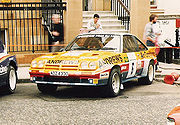 The Manta 400 was produced in a total of 245 specimens following the homologation
regulations by FISA
(today FIA). But the i400 also spawned some other "i" models. The i200 which basically was a GSi model Manta B was made in 700 specimens and is still today considered a collector's item. The i200 used a tuned 2.0E engine delivering 125 bhp. The i240 which is rarer was only produced in 300 specimens and was fitted with the i400 engine block but using a normal 8 valve cast iron head from the 2.0E engine delivering 136 bhp.
Also Irmscher
themselves tried building the Manta with their own specs. The reason they were used for the 400 project was that in 1977 they had taken a 1977 Manta B 1,9S and put in a 2,8 litre H spec engine from the Opel Admiral of that time. Success was limited though and the cars were on display in the 1977 Geneva car show. The cars had been painted in some special colours giving it the nickname "Paradiesvogel" (Bird of Paradise) because of the rainbow like colour theme on the cars. However they did produce 28 specimens with the 2.8H engine delivering 150 bhp and 220 newton metre. The cars are considered extremely rare today.
After the success of the 400 (and i200/240) Irmscher
once again tried the 6 cylinder layout. This time producing the most powerful Manta B ever released on the public market, the Irmscher i300. In 1985 Irmscher
bought 29 400 cars from Opel, which were on stock. The cars had no gearbox or engine but were fitted with the Phase 2 equipment. Irmscher
installed the new 3.0 litre LE engine from the Monza and Senator models, which delivered 176 PS and 232 newton metre. Power was transmitted to a big Getrag 265 gearbox, onto a 3,18:1 LSD rear axle, giving the car some awesome specifications. 0-60 mph was over with in just 8 seconds flat and the car topped out at 225 km/h (140 mph) making it the fastest street Manta ever built. If not for the big 1980s fuel crisis being at its worst at that time, several are sure that Opel would have adapted the idea and built a series of 6-cylinder Mantas. But instead they chose to build the economically more affordable Manta B with a 1.8 litre alloy head OHC style engine in 1985.
.
Coupé
A coupé or coupe is a closed car body style , the precise definition of which varies from manufacturer to manufacturer, and over time...
motor vehicle built by Opel
Opel
Adam Opel AG, generally shortened to Opel, is a German automobile company founded by Adam Opel in 1862. Opel has been building automobiles since 1899, and became an Aktiengesellschaft in 1929...
, from 1970 to 1988.
1970–75: Opel Manta A
The Manta A was released in September 1970, two months ahead of the then new Opel AsconaOpel Ascona
The Opel Ascona was a mid-sized car produced by Opel. It had three generations produced from 1970 to 1988. In motorsport, the Ascona 400 rally car driven by Walter Röhrl won the World Rally Championship drivers' title in the 1982 season....
on which it was based. A competitor to the Ford Capri
Ford Capri
Ford Capri was a name used by the Ford Motor Company for three different automobile models. The Ford Consul Capri coupé was produced by Ford of Britain between 1961 and 1964. The Ford Capri coupé was produced by Ford of Europe from 1969 to 1986...
, it was a two-door "three-box" coupé, and featured distinctive round tail lights, quite similar to those on the Opel GT
Opel GT
The Opel GT is a two-seat sports car first presented as a styling exercise in 1965 at the Paris and Frankfurt motor shows, and introduced as a production model late in 1968 by Opel, a German subsidiary of General Motors...
and which in fact were used on the GT in 1973, its final model year. In the UK market, the first Manta was sold only as an Opel: there was no Vauxhall
Vauxhall Motors
Vauxhall Motors is a British automotive company owned by General Motors and headquartered in Luton. It was founded in 1857 as a pump and marine engine manufacturer, began manufacturing cars in 1903 and was acquired by GM in 1925. It has been the second-largest selling car brand in the UK for...
-branded Manta (or Ascona) until after the launch, in 1975, of the Manta B1 and Ascona B. (In the UK the Ford Capri
Ford Capri
Ford Capri was a name used by the Ford Motor Company for three different automobile models. The Ford Consul Capri coupé was produced by Ford of Britain between 1961 and 1964. The Ford Capri coupé was produced by Ford of Europe from 1969 to 1986...
niche was till 1975 contested, with only limited success, by Vauxhall's Firenza
Vauxhall Firenza
The Firenza is a model of car offered by Vauxhall Motors from May 1971 till 1975. It was a development of the Viva, but had a distinctive coupé body style and only two doors....
, based on the by now aging Vauxhall Viva
Vauxhall Viva
The Viva was a small family car produced by Vauxhall Motors in a succession of three versions between 1963 and 1979. These were known as the HA, the HB and the HC series....
.)
The sales approach for the Opel line in the U.S. Market was equally odd. The Manta A was one of only a few Opel models sold in the U.S. Market. Opels were imported by GM and sold through Buick dealerships and not their own dealership network, so they were limited in what makes and models they could sell here. Other Opel models sold in the U.S. market were the 1956–61 the Rekord P1 and Rekord P2, the Kadett A (1964–66), Kadett B (1967–71), GT (1969–73), Manta / Ascona A (1971–75). The Ascona A, was the saloon version of the Manta A chassis and was sold in the U.S. under the 1900 name as a 2 door and 4 door saloon and 2 door "Sport Wagon". The only difference between the Ascona and Manta was exterior sheet metal, glass and trim. The frame, all the mechanicals, dash, front seats, and many other parts were shared between the cars. The Manta was even sold in 1971 and 1972, as the 1900 Sport Coupe, not the Manta. In 1973 the Manta nameplate was added to the U.S.-spec Mantas, but the Asconas kept the 1900 badge throughout their model life. The last year GM imported European made Opels into the United States, under their marquee, was 1975. In that year the only Opels imported were the Manta and Ascona A.
The Manta was normally equipped with a 1.6–1.9 litre CIH engines, although in Europe a small 1.2 litre motor was offered. All Mantas sold in the U.S. had the 1.9L and larger heavy duty radiator (an option on European models). It came with either a 4 speed manual or an optional 3-speed TH-180 automatic. The Manta was known to be one of the best handling cars in its class and went on to win a large number of rallies in Europe and the United States.
In the U.S. Market, there was a sport model known as the Rallye from 1971-74. The "Rallye" model was overall an appearance and gauge package, the most noticeable difference was the addition of a Black Hood and on 1970-73 models addition of fog lamps. Mechanically the only difference was the gear ratio in the models with manual transmissions, and the Rallye model came with standard stiffer suspension, tighter turning radius, and very aggressive front caster adjustments. Both had dual rear sway bars, providing the best in class handling.
In 1973 and 1974 there was also the "Luxus" model which included "refinements" like corduroy seats, colour-coded interiors (blue or burgundy), and faux wood panelling. The only special edition Manta ever produced for the U.S. market was the "Blue Max" in 1973, this amounted to a blue 1973 Luxus model, with a unique dark blue vinyl roof, mechanical sunroof, and automatic transmission.
In 1975, All Manta and 1900 models were equipped with the Bosch L-Jetronic fuel injection in the United States due to emission regulations. Yet in Europe this feature was only available on the high end GT/E Models, which also sported fog lamps and a lower front spoiler, which was not offered on any of the U.S. Spec Manta models. Also of note is that the 1974–75 Opel Manta Models sported large aluminium 5 mph (8 km/h) bumpers to comply with U.S. crash standards of the time; the European Mantas did not receive the large bumpers.
With the Deutsche Mark becoming stronger, and with other costs also rising, US imports of Opels ended in 1975. Instead, the Isuzu Gemini
Isuzu Gemini
General Motors sought a replacement for their world car T-body Kadett / Gemini, and this time, instead of building one design on several continents, they decided to build a world car in one location and export it to several continents...
version of the T-car
GM T platform
The General Motors T-car was an automobile platform designation for subcompact cars. It was the 1970s' most prolific world car program. The original T-cars were all rear-wheel drive unibody cars....
was imported from Japan and sold by Buick
Buick
Buick is a premium brand of General Motors . Buick models are sold in the United States, Canada, Mexico, China, Taiwan, and Israel, with China being its largest market. Buick holds the distinction as the oldest active American make...
dealers as the "Opel by Isuzu", later "Buick Opel". The Opel name was last used in the US in 1979.
The European market had a number of different versions of their own. Most were basic trim packages, the most popular being the "Berlinetta", which was similar to the "Luxus" but included rubber trim on the bumpers (standard on all 1973 U.S. Opel Mantas), vinyl roof, and other misc. features. The one major exception being in 1975 Opel offered the GT/E and a number of special editions based on the GT/E. The GT/E was a fuel injected version of the European 1.9L and the performance figures were very impressive for the time. Most notable special editions models based on the GT/E were the "Black Magic" (with black and plaid interior), and the "Swinger" edition in white with an equally odd interior choice.
Special Opel Manta A-series cars
There were two different special models made of the Manta A. The primary objective was to up the power of the car. Both projects started approximately at the same time (around 1972–73). There was the Turbomanta and the TE2800.The Turbomanta is the rarer of the two. Production was a total of 33 cars ever made, whereas the 5 of them were the prototypes, and the ones used for public relations.
The Turbomanta is actually a 1973 SR with a 1.9 litre "S" spec engine, originally putting out 90 bhp. The British company "Broadspeed" was chosen to build the turbo cars, and eventually started building 5 left hand drive cars for the German Opel AG. These cars were meant only as prototypes. Broadspeed came up with a somewhat special solution, and used a combination of a Holset 3LDG turbocharger, and a carburettor mounted inside a big plenum chamber. The engine itself was fitted with a thicker copper head gasket, and as such the compression ratio was lowered to 7.6:1. The outcome was a 1.9 litre engine which put out a staggering 156 bhp, and more impressive was the acceleration. 0–60 was done in only 7.6 seconds, faster than most "supercars" at the time like the Porsche 911. All 5 cars were in GM "signalgelb" sunflower yellow, and had a large black stripe on the side, where a sign said "TURBOMANTA". The downside to this was fuel consumption. The turbocharger had halved the economy of the car, and building it was also a thing that cost a lot. Therefore Opel closed the project, leaving the 5 cars as the total production number. However a British engineer at the D.O.T (Dealer Opel Team, which was the British importer and builder of Opel cars in Britain) was so enthusiastic about the cars that he had D.O.T. build an additional 28 cars. The cars were all based on the 1974 Berlinetta model, which was the luxury model, with a full gauge pack, automatic transmission, and alloy wheels. All 28 cars were black, with vinyl roofing. The only thing identifying that the car was indeed a Turbo Manta was a small sign at the rear quarter of the rear wings saying "turbo". Very few of these cars still remain today. the car also had great handling
The TE2800 was a totally different project. Actually the TE2800 wasn't really an Opel as Opel had nothing to do with the project. A Belgian company called Transeurop Engineering also wanted to up the engine power of the Manta A. Opel had previously tried a 6 cylinder engine layout already in 1971 and 72, but with no success. The cars were rendered too expensive to build, and the market was overwhelmed at the time with big engine cars. But Transeurop Engineering did not agree. They basically took a 2.8 litre CIH type engine from the Opel Commodore 2.8GS model and fitted it into the engine bay of the Manta 1.9SR. A lot of problems occurred. The radiator, the bonnet, the entire front end of the car, the rear axle, the transmission, it all needed to be changed. To solve this fast Transeurop Engineering tried to get Opel to join the project using Opels earlier experiences with the transformation, but with no luck. Even worse Opel didn't even want the Opel brand on the cars, if the project ever became a success. Transeurop Engineering therefore turned to Opel's number one tuner of the time Steinmetz. Steinmetz supplied the new fibreglass bonnet with a large bulk on it to give room to the engine, a set of widened arches, and a special front bumper integrated with the lower front spoiler, to make room for the dramatically changes that needed to be made to the cars front end construction. Several of this was cut out and replaced with other parts being mounted further to the ground to give room for the radiator. A closed radiator system was installed so that the radiator had a water tank in the engine bay (like we know it from modern cars today). The engine was still the 2.8 litre unit from the Commodore GS and this was originally fitted with 2 Zenith carburettors. The output was 142 bhp, and with the Commodore four-speed manual gearbox and a 3,18:1 rear axle the car went from 0–60 mph in just 7.5 seconds. A total of 79 cars were made and sold through Steinmetz in Germany branded not as an Opel but as a TE2800. All Opel brands was removed from the cars and replaced by the logo "TE".
Steinmets offered a tune-up for rally and motorsport use. The tuneup consisted of porting and flowing the head, higher compression ratio, a race spec camshaft, and triple carburettors, giving the car a total of up to 230 bhp.
No doubt that the TE2800 is the fastest Manta A ever made, even though officially it isn't an Opel. It could outrun cars like the 911 Carrera of 1973 and the BMW2002 turbo from 1973, even though those cars had more engine power. The low weight of the Manta bodyshell, and the combination of the right gear ratios, was what gave the car its success. Unfortunately Opel was right though. The cars were too expensive costing almost twice the price of a 105 bhp GT/E in 1975. Very few of these cars exist today, as most were used in rally and motorsport events.
1975–88: Opel Manta B
The second car to use the Manta name was launched in August 1975. This two-door "three-box" car was mechanically based directly on the then newly redesigned Opel AsconaOpel Ascona
The Opel Ascona was a mid-sized car produced by Opel. It had three generations produced from 1970 to 1988. In motorsport, the Ascona 400 rally car driven by Walter Röhrl won the World Rally Championship drivers' title in the 1982 season....
, but the overall design was influenced by the 1975 Chevrolet Monza
Chevrolet Monza
The Chevrolet Monza is a subcompact, four-passenger automobile produced by the Chevrolet division of General Motors for the 1975–1980 model years. The Monza is based on the Chevrolet Vega, sharing its wheelbase, width and 140 CID inline-4 engine...
. The Manta had more "sporty" styling, including a droop-snoot nose not seen on the Ascona, although it was standard, on the UK version of the Ascona, the Vauxhall Cavalier
Vauxhall Cavalier
The Vauxhall Cavalier is a large family car sold primarily in the UK by Vauxhall Motors, the British division of General Motors , from 1975 to 1995...
. There was still no "Vauxhall Manta", with the car remaining an Opel in the UK. However, a Vauxhall Cavalier was available with the same coupé bodyshell.
In 1977, a three-door hatchback version appeared to complement the existing two-door booted car. This shape was also not unique, being available on the Vauxhall Cavalier Sports Hatch variant.
Both Manta versions received a facelift in 1982, which included a plastic front spoiler, sideskirts for the GT/E and GSi models, a small wing at the rear and quadruple air intakes on the grille. Also the 1.2, 1.6 and 1.9 litre engines were discontinued and replaced by the 1.3 litre OHC engine, the 1.8 litre OHC and the 2.0 litre S and E CIH engines. The GT/E was renamed and was called the GSi from 1983 (except in the UK where the GT/E name continued).
Production of the Manta continued well after the equivalent Ascona and Cavalier were replaced by a front wheel drive model "Ascona C". In 1982 the 1,8 litre OHC engine from the Ascona was fitted in the Manta B making a more economical Manta B to drive. It could run 14 km per litre and use unleaded fuel. The 1,8 was very popular and was in production for 5 years (1982–1987). The 2,0S models where discontinued in 1984 and only the GSi was available with the "large" engine (GT/E in the UK). In 1986 Opel released the last Manta B model the Exclusive (1987 in the UK), giving it all of the best in equipment. Recaro seats with red cloth, grey leather like interior and the full bodypack known from the i200 models. This consisted of twin round headlights in a plastic cover, frontspoiler and rear lower spoiler from Irmscher
Irmscher
Irmscher Automobilbau GmbH & Co. KG is a German automobile tuning and manufacturing company specialising in Opel and recently Peugeot cars....
, sideskirts and the known 3 split rear spoiler of the Manta 400 (producing 80 kg (176 lb) of weight on the rear at 200 km/h). In the UK, the Exclusive GT/E models were available in colours such as Dolphin Grey with matching dark grey cloth seats with red piping. These also had the quad headlights, front spoiler but a rear bumper which housed the number plate, coupled with a black plastic strip between the rear light clusters. The rear spoiler was similar to the standard GT/E. Opel finally ceased the production of the Manta B in 1988, only producing the GSi exclusive the last 2 years (GT/E in the UK). Sales continued in 1989 until the Manta was replaced by the Opel Calibra
Opel Calibra
The Opel Calibra, also known as the Vauxhall Calibra in the United Kingdom, the Chevrolet Calibra in South America, and the Holden Calibra in Australia and New Zealand is a sports car engineered and produced by German automaker Opel between 1989 and 1997, but sold until 1999 in the UK...
(known as the "Vauxhall Calibra" in the UK).
Today, these cars are hard to find in an original, good condition; consequently the value has risen considerably over the last few years. It has again become popular, because of its good looks and well-respected handling.
Rally and special versions
In 1979 work began on a rally-spec Opel. Both the Ascona B and the Manta B were used for this. Although the Ascona 400 model was the most successful of the two, largely due to better weight distribution, the fact still remains that the Manta 400 was a remarkable car.Opel joined forces with German tuner Irmscher
Irmscher
Irmscher Automobilbau GmbH & Co. KG is a German automobile tuning and manufacturing company specialising in Opel and recently Peugeot cars....
and Cosworth
Cosworth
Cosworth is a high performance engineering company founded in London in 1958, specialising in engines and electronics for automobile racing , mainstream automotive and defence industries...
in Britain, to make the 400. Cosworth was given the task to develop a 16 valve 2 cam head for the CIH spec engine block, and Irmscher
Irmscher
Irmscher Automobilbau GmbH & Co. KG is a German automobile tuning and manufacturing company specialising in Opel and recently Peugeot cars....
who earlier in 1977 and 78 had proven that they knew their way around an Opel building the i2800, was to design the exterior and interior of the cars. The results were not bad. Opel however had problems with the engine. The first idea of using a 2.0 litre engine and then using the 16 valve head from Cosworth simply did not give enough power. The problem was that the heads had already been built, so the heads were made to fit on the CIH type 4 cylinder engine block. So they built an unusual engine using a 2.0 litre engine block with an overbore and larger pistons, a crankshaft from the 2.3 litre diesel engine of same type (CIH) and ended with a 2.4 litre engine block. Mounting the 16 valve head on this gave a massive output, and the opportunity to make several tune-ups for the rally drivers.
Recaro
RECARO GmbH & Co. KG, commonly known as Recaro, is a German company based in Kirchheim unter Teck in the vicinity of Stuttgart, known for their automobile bucket seats...
seats with big Opel badges on the cloth, Irmscher
Irmscher
Irmscher Automobilbau GmbH & Co. KG is a German automobile tuning and manufacturing company specialising in Opel and recently Peugeot cars....
leather steering wheel, and even front light washers were mounted. The cars were all delivered in Arctic White colour, with White Ronal lightweight 7x15" alloys. The engine was fitted with a Bosch
Robert Bosch GmbH
Robert Bosch GmbH is a multinational engineering and electronics company headquartered in Gerlingen, near Stuttgart, Germany. It is the world's largest supplier of automotive components...
LE injection system and power output was 144 bhp. The Phase 2 however was quite different. It had large extended arches front and rear made of exotic materials like carbon and kevlar to keep the weight down, lightweight doors, bonnet, spoilers and windows. The wheels were still from Ronal but now measuring 8x15" front and 10x15" rear. The engine output was 230 bhp using a set of 48 mm (1.9 in) DCOE style carburettors, and the cars could be delivered with different gearboxes from ZF and with different rear axle options like LSD. Phase 3 which is also a term used when talking about the i400's was not a factory tune-up. Many racers of the time had their garages tune up the engine even further. Some made it across the 300 bhp mark and even today, engines can be tuned to deliver just over 340 bhp still naturally aspirated.
Homologation
Homologation is a technical term, derived from the Greek homologeo for "to agree", which is generally used in English to signify the granting of approval by an official authority...
regulations by FISA
Fédération Internationale du Sport Automobile
The Fédération Internationale du Sport Automobile was the governing body for motor racing events. The organisation's origins date from 1922, when the Fédération Internationale de l'Automobile delegated the organisation of automobile racing to the CSI , an autonomous committee that would later...
(today FIA). But the i400 also spawned some other "i" models. The i200 which basically was a GSi model Manta B was made in 700 specimens and is still today considered a collector's item. The i200 used a tuned 2.0E engine delivering 125 bhp. The i240 which is rarer was only produced in 300 specimens and was fitted with the i400 engine block but using a normal 8 valve cast iron head from the 2.0E engine delivering 136 bhp.
Also Irmscher
Irmscher
Irmscher Automobilbau GmbH & Co. KG is a German automobile tuning and manufacturing company specialising in Opel and recently Peugeot cars....
themselves tried building the Manta with their own specs. The reason they were used for the 400 project was that in 1977 they had taken a 1977 Manta B 1,9S and put in a 2,8 litre H spec engine from the Opel Admiral of that time. Success was limited though and the cars were on display in the 1977 Geneva car show. The cars had been painted in some special colours giving it the nickname "Paradiesvogel" (Bird of Paradise) because of the rainbow like colour theme on the cars. However they did produce 28 specimens with the 2.8H engine delivering 150 bhp and 220 newton metre. The cars are considered extremely rare today.
After the success of the 400 (and i200/240) Irmscher
Irmscher
Irmscher Automobilbau GmbH & Co. KG is a German automobile tuning and manufacturing company specialising in Opel and recently Peugeot cars....
once again tried the 6 cylinder layout. This time producing the most powerful Manta B ever released on the public market, the Irmscher i300. In 1985 Irmscher
Irmscher
Irmscher Automobilbau GmbH & Co. KG is a German automobile tuning and manufacturing company specialising in Opel and recently Peugeot cars....
bought 29 400 cars from Opel, which were on stock. The cars had no gearbox or engine but were fitted with the Phase 2 equipment. Irmscher
Irmscher
Irmscher Automobilbau GmbH & Co. KG is a German automobile tuning and manufacturing company specialising in Opel and recently Peugeot cars....
installed the new 3.0 litre LE engine from the Monza and Senator models, which delivered 176 PS and 232 newton metre. Power was transmitted to a big Getrag 265 gearbox, onto a 3,18:1 LSD rear axle, giving the car some awesome specifications. 0-60 mph was over with in just 8 seconds flat and the car topped out at 225 km/h (140 mph) making it the fastest street Manta ever built. If not for the big 1980s fuel crisis being at its worst at that time, several are sure that Opel would have adapted the idea and built a series of 6-cylinder Mantas. But instead they chose to build the economically more affordable Manta B with a 1.8 litre alloy head OHC style engine in 1985.
Convertible versions
Vauxhall, from 1978 until 1979, offered the Cavalier Coupe in convertible format called the Centaur. Only 118 of these were made and less than 30 are believed to survive as of 2007. About a quarter of these conversions were built using a Manta, rather than Vauxhall basis. The cars were developed by Magraw Engineering and sold through Vauxhall dealerships on behalf of CrayfordCrayford Engineering
Crayford Engineering was an automobile coachbuilder based in Westerham, Kent, England and formed in 1962 by David McMullan and Jeffrey Smith. In the 1970s, a subdivision within the company, called Crayford Auto Developments, Ltd., was established for automobiles...
.