

Nuba Mountains

Encyclopedia
Sudan
Sudan , officially the Republic of the Sudan , is a country in North Africa, sometimes considered part of the Middle East politically. It is bordered by Egypt to the north, the Red Sea to the northeast, Eritrea and Ethiopia to the east, South Sudan to the south, the Central African Republic to the...
. The area is home to a group of indigenous ethnic groups known collectively as the Nuba peoples. In the 18th century, Nuba Mountains became home to the kingdom of Taqali
Taqali
Taqali was a state in the Nuba Hills, in modern day central Sudan. Unlike the surrounding Kordofan the uplands of the hills were quite moist and suitable to agriculture and a dense population. The state was centred upon the Taqali Massif the highest part of the hills in the northeast of the...
that controlled the hills of the mountains until their defeat by Mahdi Muhammad Ahmad
Muhammad Ahmad
Muhammad Ahmad bin Abd Allah was a religious leader of the Samaniyya order in Sudan who, on June 29, 1881, proclaimed himself as the Mahdi or messianic redeemer of the Islamic faith...
. After the Mahdi's defeat by the British, Taqali was restored as a client state. Infiltration of the Messiria tribe of Baggara Arabs has been influential in modern conflicts.
Geography
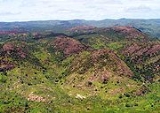
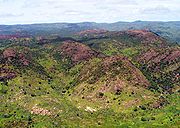
The mountains cover an area roughly 40 miles (64.4 km) wide by 90 miles (144.8 km) long, and are 1500 to 3000 feet (914.4 m) higher in elevation than the surrounding plain. The mountains stretch for some 48,000 square kilometres (19,000 square miles). The climate is semi-aridArid
A region is said to be arid when it is characterized by a severe lack of available water, to the extent of hindering or even preventing the growth and development of plant and animal life...
with under 800 mm of rain per year on average, but lush and green compared with most nearby areas. There are almost no roads in the Nuba Mountains; most villages there are connected by ancient paths that cannot be reached by motor vehicles. The rainy season extends from mid-May to mid-October, and annual rainfall ranges from 400 to 800 millimeters (16.4 to 32.8 in), allowing grazing and seasonal rain-fed agriculture.
Status
The region stayed under the control of the central government and the Comprehensive Peace AgreementComprehensive Peace Agreement
The Comprehensive Peace Agreement , also known as the Naivasha Agreement, was a set of agreements culminating in January 2005 that were signed between the Sudan People's Liberation Movement and the Government of Sudan...
did not give the Nuba Mountains the right to join South Sudan
South Sudan
South Sudan , officially the Republic of South Sudan, is a landlocked country located in the Sahel region of northeastern Africa. It is also part of the North Africa UN sub-region. Its current capital is Juba, which is also its largest city; the capital city is planned to be moved to the more...
in its vote for independence in 2011. Residents of Nuba Mountains were required to hold ill-defined "popular consultations" to determine their future. Not only Nuba Mountains but whole South Kordofan state would be eligible to vote, essentially to accommodate the Messiria. Additionally, the Sudanese government maintained heavy military presence in the region and even prospective "popular consultations" were seen likely to be barred. The ambiguous situation and fears of future communal violence invoked concerns that South Kordofan could be the "next Darfur
Darfur conflict
The Darfur Conflict was a guerrilla conflict or civil war centered on the Darfur region of Sudan. It began in February 2003 when the Sudan Liberation Movement/Army and Justice and Equality Movement groups in Darfur took up arms, accusing the Sudanese government of oppressing non-Arab Sudanese in...
".
As of June 2011, South Kordofan governor Ahmed Haroun
Ahmed Haroun
Ahmed Mohammed Haroun is one of three Sudanese men wanted by the International Criminal Court for war crimes and crimes against humanity in Darfur...
had suspended the process of popular consultations and conflict
Sudan–SPLM-N conflict (2011)
The Sudan–SPLM-N conflict is an ongoing conflict in 2011 between the Army of Sudan and the Sudanese Revolutionary Front, particularly the Sudan People's Liberation Movement-North , a northern affiliate of the Sudan People's Liberation Army/Movement in South Sudan...
between Sudan People's Armed Forces and Nuba fighters of the SPLM
Sudan People's Liberation Movement (northern sector)
Sudan People's Liberation Movement , also known as SPLM-North, is a banned political party in the Republic of Sudan. It is currently actively primarily in the states of Blue Nile and South Kordofan, where its armed branch, the Southern People's Liberation Army North is engaged in an active...
followed.
External links
- The Nuba Mountains Homepage
- The Nuba Survival Association
- Varhola, Christopher H. - Cows, Korans, and Kalashnikovs: The Multiple Dimensions of Conflict in the Nuba Mountains of Central Sudan Department of Anthropology, The Catholic University of America, September 2002.
- Nubawatch: "Nuba Mountains: The Beginning" January 9, 2011.