
Home      Discussion      Topics      Dictionary      Almanac
Signup       Login
Northern Fur Seal

Northern Fur Seal

Overview
The Northern Fur Seal, Callorhinus ursinus, is an eared seal
Eared Seal
The eared seals or otariids are marine mammals in the family Otariidae, one of three groupings of Pinnipeds. They comprise 16 species in seven genera commonly known either as sea lions or fur seals, distinct from true seals and the Walrus...

 found along the north Pacific Ocean
Pacific Ocean
The Pacific Ocean is the largest of the Earth's oceanic divisions. Its name is derived from the Latin name Tepre Pacificum, "peaceful sea", bestowed upon it by the Portuguese explorer Ferdinand Magellan. It extends from the Arctic in the north to Antarctica in the south, bounded by Asia and...

, the Bering Sea
Bering Sea
The Bering Sea is a body of water in the Pacific Ocean that comprises a deep water basin, which then rises through a narrow slope into the shallower water above the continental shelves....

 and the Sea of Okhotsk
Sea of Okhotsk
The Sea of Okhotsk is a part of the western Pacific Ocean, lying between the Kamchatka Peninsula on the east, the Kuril Islands on the southeast, the island of Hokkaidō to the far south, the island of Sakhalin along the west, and a long stretch of eastern Siberian coast along the west and north...

. It is the largest member of the fur seal subfamily (Arctocephalinae) and the only species in the genus Callorhinus.


Northern fur seals have extreme sexual dimorphism
Sexual dimorphism
Sexual dimorphism is the systematic difference in form between individuals of different sex in the same species. Examples include colour , size, and the presence or absence of parts of the body used in courtship displays or fights, such as ornamental feathers, horns, antlers or tusks.-Examples:In...

, with males being 30–40% longer and more than 4.5 times heavier than adult females. The head is foreshortened in both sexes because of the very short down-curved muzzle, and small nose, which extends slightly beyond the mouth in females and moderately in males.
Discussion
Ask a question about 'Northern Fur Seal'
Start a new discussion about 'Northern Fur Seal'
Answer questions from other users
Full Discussion Forum
 
Encyclopedia
The Northern Fur Seal, Callorhinus ursinus, is an eared seal
Eared Seal
The eared seals or otariids are marine mammals in the family Otariidae, one of three groupings of Pinnipeds. They comprise 16 species in seven genera commonly known either as sea lions or fur seals, distinct from true seals and the Walrus...

 found along the north Pacific Ocean
Pacific Ocean
The Pacific Ocean is the largest of the Earth's oceanic divisions. Its name is derived from the Latin name Tepre Pacificum, "peaceful sea", bestowed upon it by the Portuguese explorer Ferdinand Magellan. It extends from the Arctic in the north to Antarctica in the south, bounded by Asia and...

, the Bering Sea
Bering Sea
The Bering Sea is a body of water in the Pacific Ocean that comprises a deep water basin, which then rises through a narrow slope into the shallower water above the continental shelves....

 and the Sea of Okhotsk
Sea of Okhotsk
The Sea of Okhotsk is a part of the western Pacific Ocean, lying between the Kamchatka Peninsula on the east, the Kuril Islands on the southeast, the island of Hokkaidō to the far south, the island of Sakhalin along the west, and a long stretch of eastern Siberian coast along the west and north...

. It is the largest member of the fur seal subfamily (Arctocephalinae) and the only species in the genus Callorhinus.

Physical description


Northern fur seals have extreme sexual dimorphism
Sexual dimorphism
Sexual dimorphism is the systematic difference in form between individuals of different sex in the same species. Examples include colour , size, and the presence or absence of parts of the body used in courtship displays or fights, such as ornamental feathers, horns, antlers or tusks.-Examples:In...

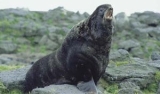
, with males being 30–40% longer and more than 4.5 times heavier than adult females. The head is foreshortened in both sexes because of the very short down-curved muzzle, and small nose, which extends slightly beyond the mouth in females and moderately in males. The pelage is thick and luxuriant, with a dense underfur that is a creamy color. The underfur is obscured by the longer guard hairs, although it is partially-visible when the animals are wet. Features of both fore and hind flippers are unique and diagnostic of the species. Fur is absent on the top of the fore flippers and there is an abrupt "clean shaven line" across the wrist where the fur ends. The hind flippers are proportionately the longest in any otariid because of extremely long, cartilaginous extensions on all of the toes. There are small claws on digits 2–4, well back from the flap-like end of each digit. The ear pinna
Pinna
The pinna is the visible part of the ear that resides outside of the head .-Purpose:...

e are long and conspicuous, and naked of dark fur at the tips in older animals. The mystacial vibrissae can be very long, and regularly extend beyond the ears. Adults have all white vibrissae, juveniles and subadults have a mixture of white and black vibrissae, including some that have dark bases and white ends, and pups and yearlings have all-black vibrissae. The eyes are proportionately large and conspicuous, especially on females, subadults, and juveniles.

Adult males are stocky in build, and have an enlarged neck that is thick and wide. A mane of coarse longer guard hairs extends from the top of the head to the shoulders and covers the nape, neck, chest, and upper back. While the skull of adult males is large and robust for their overall size, the head appears short because of the combination of a short muzzle, and the back of the head behind the ear pinnae being obscured by the enlarged neck. Adult males have an abrupt forehead formed by the elevation of the crown from development of the sagittal crest, and thicker fur of the mane on the top of the head.

Canine teeth are much longer and have a greater diameter in adult males than those found on adult females, and this relationship holds to a lesser extent at all ages.


Adult females, subadults and juveniles, are moderate in build. It is difficult to distinguish the sexes until about age 5. The body is modest in size and the neck, chest, and shoulders are sized in proportion with the torso. Adult females and subadults have more complex and variable coloration than adult males. They are dark-silver-gray to charcoal above. The flanks, chest, sides, and underside of the neck, often forming a chevron pattern in this area, are cream to tan with rusty tones. There are variable cream to rust-colored areas on the sides and top of the muzzle, chin, and as a "brush stroke" running backwards under the eye. In contrast, adult males are medium gray to black, or reddish to dark brown all over. The mane can have variable amounts of silver-gray or yellowish tinting on the guard hairs. Pups are blackish at birth, with variable oval areas of buff on the sides, in the axillary area, and on the chin and sides of the muzzle. After 3–4 months, pups molt to the color of adult females and subadults.

Males can be as large as 2.1 m and 270 kg. Females can be up to 1.5 m and 50 kg or more. Newborns weigh 5.4–6 kg, and are 60–65 cm long.

The teeth are haplodont, i.e. sharp, conical and mostly single-rooted, as is common with carnivorous marine mammals adapted to tearing fish flesh. As with most Caniforms, the upper canines are prominent. The dental formula of the adult is:

Range


The northern fur seal is found in the north Pacific – its southernmost reach is a line that runs roughly from the southern tip of Japan
Japan
is an island country in East Asia. Located in the Pacific Ocean, it lies to the east of the Sea of Japan, People's Republic of China, North Korea, South Korea and Russia, stretching from the Sea of Okhotsk in the north to the East China Sea and Taiwan in the south...

 to the southern tip of the Baja California peninsula
Baja California Peninsula
The Baja California peninsula is a peninsula in western Mexico. It extends some 1250 km from Mexicali, Baja California, in the north to Cabo San Lucas, Baja California Sur, in the south, separating the Pacific Ocean from the Gulf of California...

, the Sea of Okhotsk
Sea of Okhotsk
The Sea of Okhotsk is a part of the western Pacific Ocean, lying between the Kamchatka Peninsula on the east, the Kuril Islands on the southeast, the island of Hokkaidō to the far south, the island of Sakhalin along the west, and a long stretch of eastern Siberian coast along the west and north...

 and the Bering Sea
Bering Sea
The Bering Sea is a body of water in the Pacific Ocean that comprises a deep water basin, which then rises through a narrow slope into the shallower water above the continental shelves....

. There are estimated to be around 1.1 million Northern Fur Seals across the range, of which roughly one half breeds on the Pribilof Islands
Pribilof Islands
The Pribilof Islands are a group of four volcanic islands, part of the US state of Alaska, lying in the Bering Sea, about 200 miles north of Unalaska and 200 miles southwest of Cape Newenham, the nearest point on the North American mainland...

 in the east Bering Sea. Another 200–250,000 breed on the Commander Islands in the west Bering Sea and some 100,000 breed on Tyuleni Island off the coast of Sakhalin
Sakhalin
Sakhalin , also Saghalien, is a large elongated island in the North Pacific, lying between 45°50' and 54°24' N. It is part of Russia and is its largest island, administered as part of Sakhalin Oblast. The indigenous peoples of the island are the Sakhalin Ainu, Oroks, and Nivkhs...

 in the southwest Sea of Okhotsk and another 60–70,000 in the central Kuril Islands
Kuril Islands
The Kuril Islands or Kurile Islands in Russia's Sakhalin Oblast region, is a volcanic archipelago that stretches approximately northeast from Hokkaidō, Japan, to Kamchatka, Russia, separating the Sea of Okhotsk from the North Pacific Ocean...

 in Russia. Smaller rookeries (around 5,000 animals) are found on Bogoslof Island in the Aleutian Chain and San Miguel Island
San Miguel Island
San Miguel Island is the westernmost of California's Channel Islands and the sixth-largest of the eight at , including offshore islands and rocks. Prince Island, off the northeastern coast, measures in area. The island, at its furthest extent, is long and wide...

 in the Channel Island group off the coast of California
California
California is the most populous state in the United States, and the third largest by area. California is the second most populous sub-national entity in the Americas, behind only São Paulo, Brazil...

. During the winter months, northern fur seals display a net movement southward, with animals from Russian rookeries regularly entering Japanese and Korean waters in the Sea of Japan
Sea of Japan
The Sea of Japan is a marginal sea of the western Pacific Ocean, bordered by Japan, South Korea, North Korea and Russia. It is referred to in North Korea as the Korea East Sea and in South Korea as the East Sea. Like the Mediterranean Sea, it has almost no tides due to its nearly complete enclosure...

 and Alaskan animals moving along the central and eastern Pacific as far as Baja California.

The northern fur seal's range overlaps almost exactly with that of Steller sea lions, with which they occasionally cohabit reproductive rookeries, notably in the Kurils, the Commander Islands and Tyuleni Island. The only other fur seal found in the northern hemisphere is the Guadalupe Fur Seal
Guadalupe Fur Seal
The Guadalupe Fur Seal is a fur seal. It is one of six members of the Arctocephalus genus. Sealers reduced the population to just a few dozen by the late 19th century, but the species had recovered to 10,000 in number by the late 1990s...

 which overlaps slightly with the northern fur seal's range in California.

Ecology


Fur seals are opportunistic feeders, primarily feeding on pelagic fish
Pelagic fish
Pelagic fish live in the water column of coastal, ocean and lake waters, but not on the bottom of the sea or the lake. They can be contrasted with demersal fish, which do live on or near the bottom, and reef fish which are associated with coral reefs....

 and squid depending on local availability. Identified fish prey include hake
Hake
The term hake refers to fish in either of:* family Gadidae * family Merlucciidae .An old European source mentions a hake that was transplanted from the coast of Ireland to Cape Cod...

, anchovy
Anchovy
The anchovies are a family of small, common salt-water forage fish. There are about 140 species in 16 genera, found in the Atlantic, Indian, and Pacific Oceans. Anchovies are usually classified as an oily fish.-Description:...

, herring
Herring
Herring are relatively small oily fish of the genus Clupea found in the shallow, temperate waters of the North Pacific and the North Atlantic oceans, including the Baltic Sea. Two species of Clupea are currently recognized, the Atlantic herring and the Pacific herring , each of which may be...

, sand lance
Sand lance
A sand lance or sandlance is a fish belonging to the family Ammodytidae. Several species of sand lance are commonly known as "sand eels" or "sandeels", though they are not related to true eels. Another variant name is launce, and all names of the fish are references to its slender body and...

, capelin
Capelin
The capelin or caplin, Mallotus villosus, is a small forage fish of the smelt family found in the Atlantic and Arctic oceans. In summer, it grazes on dense swarms of plankton at the edge of the ice shelf. Larger capelin also eat a great deal of krill and other crustaceans...

, pollock
Pollock
Pollock is the common name used for either of the two species of marine fish in the Pollachius genus. Both P. pollachius and P. virens are commonly referred to as pollock. Other names for P...

, mackerel
Mackerel
Mackerel is a common name applied to a number of different species of fish, mostly, but not exclusively, from the family Scombridae. They may be found in all tropical and temperate seas. Most live offshore in the oceanic environment but a few, like the Spanish mackerel , enter bays and can be...

 and smelt. Their feeding behavior is primarily solitary.

Northern fur seals are preyed upon primarily by shark
Shark
Sharks are a type of fish with a full cartilaginous skeleton and a highly streamlined body. The earliest known sharks date from more than 420 million years ago, before the time of the dinosaurs....

s and orca
Orca
The Killer Whale or Orca , or less commonly, Blackfish, is the largest species of the dolphin family. Most people think that they are whales, but they are actually dolphins. They are called killer whales often because they sometimes hunt whales for food...

s. Occasionally, very young animals will be eaten by Steller sea lions. Occasional predation on live pups by arctic fox
Arctic fox
The Arctic Fox , also known as the White Fox or Snow Fox, is a small fox native to cold Arctic regions of the Northern Hemisphere and is common throughout the Arctic tundra biome...

es has also been observed.

Due to very high densities of pups on reproductive rookeries and the early age at which mothers begin their foraging trips, mortality can be relatively high. Consequently, pup carcasses are important in enriching the diet of many scavengers, in particular gulls and arctic foxes.

Reproductive behavior


Animals aggregate on traditional breeding grounds (rookeries) in May. Generally older males (10 years and older) return first and compete for prime breeding spots on the rookeries. They will remain on the rookery fasting throughout the duration of the breeding season. The females come somewhat later and give birth shortly thereafter. Like all other otariids, northern fur seals are polygynous, with some males breeding with up to 50 females in a single breeding season. Unlike Steller sea lions, with whom they share habitat and some breeding sites, Northern fur seals are possessive of individual females in their harem, often aggressively competing with neighboring males for females. Deaths of females as a consequence of 'tug-of-war's have been recorded, though the males themselves are rarely seriously injured. Young males unable to acquire and maintain a territory of a harem typically aggregate in neighboring "haulouts
Hauling-out
Hauling-out is the behaviour, especially associated with pinnipeds , of temporarily leaving the water between periods of foraging activity for sites on land or ice. Hauling-out is necessary in seals for mating and giving birth, but not all haul-out sites are for reproduction...

" occasionally making incursions into the reproductive sections of the rookery in an attempt to displace an older male.


After remaining with their pups for the first eight to ten days of their life, females begin foraging trips lasting up to a week. These trips last for about four months before weaning, which happens abruptly, typically in October. Most of the animals on a rookery enter the water and disperse towards the end of November, typically migrating southward. Breeding site fidelity is generally high for fur seals females, though young males might disperse to other existing rookeries, or occasionally found new haulouts.

Peak mating occurs somewhat later than peak birthing from late June to late July. As with many other otariids, the fertilized egg undergoes delayed implantation: after the blastocyst stage occurs, development halts and implantantion occurs four months after fertilization. In total, gestation lasts for approximately one year, such that the pups born in a given summer are the product of the previous year's breeding cycle.

Status


Recently there has been increased concern about the status of fur seal populations, particularly in the Pribilof Islands, where there has been a roughly 50% decrease in pup-production since the 1970s and a continuing drop in pup production of about 6–7% per year. This has caused them to be listed as "vulnerable" under the U.S. Endangered Species Act
Endangered Species Act
The Endangered Species Act of 1973 is the most wide-ranging of the dozens of United States environmental laws passed in the 1970s...

 and has led to an intensified research program into their behavioral and foraging ecology. Possible causes are increased predation
Predation
In ecology, predation describes a biological interaction where a predator feeds on its prey, . Predators may or may not kill their prey prior to feeding on them, but the act of predation always results in the death of the prey...

 by orcas, competition with fisheries and climate change
Climate change
Climate change is a change in the statistical distribution of weather over periods of time that range from decades to millions of years. It can be a change in the average weather or a change in the distribution of weather events around an average...

 effects, but there is, to date, no scientific consensus. The IUCN (2008) lists the species as globally threatened under the category "vulnerable".

Fur trade


Northern fur seals have been a staple food of native northeast Asian and Alaskan Inuit peoples for thousands of years. The arrival of Europeans to Kamchatka and Alaska
Alaska
Alaska is the largest state of the United States of America by area; it is situated in the northwest extremity of the North American continent, with Canada to the east, the Arctic Ocean to the north, and the Pacific Ocean to the west and south, with Russia further west across the Bering Strait...

 in the 17th and 18th centuries, first from Russia and later from North America, was followed by a highly extractive commercial fur trade. The commercial fur trade was accelerated in 1786, when Gavriil Pribylov discovered St. George Island
St. George Island (Alaska)
St. George Island is one of the Pribilof Islands of the state of Alaska, USA, in the Bering Sea off the western coast of the state. The island has a land area of 90 km² and a population of about 100 people, all living in its only community, the city of St...

, a key rookery
Rookery
A rookery is a colony of breeding animals. The term Rookery has also been used as a name for dense slum housing in nineteenth-century cities, and especially London....

 of the seals. An estimated 2.5 million seals were killed from 1786 to 1867. This trade led to a decline in fur seal numbers. Restrictions were first placed on fur seal harvest on the Pribilof Islands
Pribilof Islands
The Pribilof Islands are a group of four volcanic islands, part of the US state of Alaska, lying in the Bering Sea, about 200 miles north of Unalaska and 200 miles southwest of Cape Newenham, the nearest point on the North American mainland...

 by the Russians in 1834. Shortly after the United States purchased Alaska from Russia in 1867, the U.S. Treasury was authorized to lease sealing privileges on the Pribilofs, which were granted somewhat liberally to the Alaska Commercial Company. From 1870 to 1909, pelagic sealing proceeded to take a significant toll on the fur seal population, such that the Pribilof population, historically numbering on the order of millions of individuals, reached a low of 216,000 animals in 1912.

Significant harvest was more or less arrested with the signing of the North Pacific Fur Seal Convention of 1911
North Pacific Fur Seal Convention of 1911
The North Pacific Fur Seal Convention of 1911, formally known as the Convention between the United States and Other Powers Providing for the Preservation and Protection of Fur Seals, was an international treaty signed on July 7, 1911 designed to manage the commercial harvest of fur seals in the...

 by Great Britain (on behalf of Canada), Japan, Russia and the United States. The Convention of 1911 remained in force until the onset of hostilities among the signatories during World War II, and is also notable as the first international treaty to address the conservation of wildlife. A successive convention was signed in 1957 and amended by a protocol in 1963. "The international convention was put into effect domestically by The Fur Seal Act of 1966 (Public Law 89-702)," said an Interior Department review of the history. Currently, there is a subsistence hunt by the residents of St. Paul Island and an insignificant harvest in Russia.

External links