
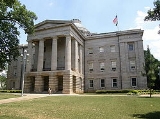
The
North Carolina General Assembly is the state legislature of the
U.S. stateA U.S. state is any one of the 50 federated states of the United States of America that share sovereignty with the federal government. Because of this shared sovereignty, an American is a citizen both of the federal entity and of his or her state of domicile. Four states use the official title of...
of
North CarolinaNorth Carolina is a state located in the southeastern United States. The state borders South Carolina and Georgia to the south, Tennessee to the west and Virginia to the north. North Carolina contains 100 counties. Its capital is Raleigh, and its largest city is Charlotte...
. The General Assembly drafts and legislates the state laws of North Carolina, also known as the
General Statutes. The General Assembly is a bicameral legislature, consisting of the
North Carolina House of RepresentativesThe North Carolina House of Representatives is one of the two houses of the North Carolina General Assembly. The House is a 120-member body led by a Speaker of the House, who holds powers similar to those of the President pro-tem in the state senate....
(formerly the North Carolina House of Commons until 1868) and the
North Carolina SenateThe North Carolina Senate is one of the two houses of the North Carolina General Assembly.Its prerogatives and powers are similar to those of the other house, the House of Representatives. Its members do, however, represent districts that are larger than those of their colleagues in the House. The...
. The House has 120 members, while the Senate has 50. There are no term limits for either chamber.
Legislators in both chambers serve two-year terms. Starting with the 2002 election, each legislator represents a single-member House or Senatorial district; prior to 2002, some districts elected multiple legislators.
The General Assembly meets in the state capital of
RaleighRaleigh is the capital and the second largest city in the state of North Carolina as well as the seat of Wake County. Raleigh is known as the "City of Oaks" for its many oak trees. According to the U.S. Census Bureau, the city's 2010 population was 403,892, over an area of , making Raleigh...
(except for special occasions, when legislators might decide to hold a ceremonial session in some other city). It met in the
CapitolThe North Carolina State Capitol is the main house of government of the U.S. state of North Carolina. Housing the offices of the Governor of North Carolina, it is located in the state capital of Raleigh on Union Square at One East Edenton Street. The cornerstone of the Greek Revival building was...
building until 1963, when the legislature relocated to the new
North Carolina State Legislative BuildingThe North Carolina State Legislative Building is the current meeting place of the North Carolina General Assembly, the state legislature of the U.S. state of North Carolina. It was opened in 1963, replacing the North Carolina State Capitol as the home of the legislature...
.
North Carolina Senate
The Senate has 50 members. Though its members represent districts that are larger than those of their colleagues in the House, its prerogatives and powers are no greater.
The President of the Senate is the
Lieutenant Governor of North CarolinaThe Lieutenant Governor of North Carolina is the second highest elected official in the U.S. state of North Carolina and is the only elected official to have powers in both the legislative and executive branches of state government...
, but the Lt. Governor has very limited powers and only votes to break a tie. Before the office of Lt. Governor was created in 1868, the Senate was presided over by a "Speaker." After the 1988 election of
James Carson GardnerJames Carson "Jim" Gardner is a North Carolina businessman and politician who served as a U.S. Representative and as Lieutenant Governor of North Carolina ....
, the first Republican Lt. Governor since Reconstruction, Democrats in control of the Senate shifted most of the power held by the Lt. Governor to the senator who is elected
President Pro TemporePro tempore , abbreviated pro tem or p.t., is a Latin phrase which best translates to "for the time being" in English. This phrase is often used to describe a person who acts as a locum tenens in the absence of a superior, such as the President pro tempore of the United States Senate.Legislative...
(or
Pro-Tem). The
President pro temporeThe President Pro Tempore of the North Carolina Senate is the highest-ranking officer of one house of the North Carolina General Assembly. The President of the Senate is the Lieutenant Governor of North Carolina, but the President Pro-Tem actually holds most of the power and presides in the...
appoints members to standing committees of the Senate, and holds great sway over bills.
The qualifications to be a senator are found in the
state ConstitutionThe Constitution of the State of North Carolina governs the structure and function of the state government of North Carolina, United States; it is the highest legal document for the state and subjugates North Carolina law...
: "Each Senator, at the time of his election, shall be not less than 25 years of age, shall be a qualified voter of the State, and shall have resided in the State as a citizen for two years and in the district for which he is chosen for one year immediately preceding his election."
According to the state constitution, the Senate is also the "Court for the Trial of Impeachments". The House of Representatives has the power to impeach state officials, after which the Senate holds a trial, as in the federal system. If the Governor or Lt. Governor is the official who has been impeached, the Chief Justice of the
North Carolina Supreme CourtThe Supreme Court of North Carolina is the state's highest appellate court. Until the creation of the North Carolina Court of Appeals in the 1960s, it was the state's only appellate court. The Supreme Court consists of six associate justices and one chief justice, although the number of justices...
presides.
North Carolina House of Representatives
The 120 members of the House are led by a
SpeakerThe Speaker of the North Carolina House of Representatives is the presiding officer of one of the houses of the North Carolina General Assembly. The Speaker is elected by the members of the house when they convene for their regular session in January of each odd-numbered year...
, who holds powers similar to those of the Senate President pro-tem.
The qualifications to be a member of the House are found in the
state ConstitutionThe Constitution of the State of North Carolina governs the structure and function of the state government of North Carolina, United States; it is the highest legal document for the state and subjugates North Carolina law...
: "Each Representative, at the time of his election, shall be a qualified voter of the State, and shall have resided in the district for which he is chosen for one year immediately preceding his election." Elsewhere, the constitution specifies that no elected official shall be under twenty-one years of age and that no elected officials may deny the existence of God, although this provision is not enforced and may be contrary to the spirit of the "
No religious test clauseThe No Religious Test Clause of the United States Constitution is found in Article VI, paragraph 3, and states that:This has been interpreted to mean that no federal employee, whether elected or appointed, career or political, can be required to adhere to or accept any religion or belief...
" of the
United States ConstitutionThe Constitution of the United States is the supreme law of the United States of America. It is the framework for the organization of the United States government and for the relationship of the federal government with the states, citizens, and all people within the United States.The first three...
.
History
The North Carolina legislature traces its roots to the first assembly for the "County of Albemarle," which was convened in 1665 by Governor
William DrummondWilliam Drummond was the first colonial governor of Albemarle Sound settlement in the Province of Carolina and a participant in Bacon's Rebellion....
. Albemarle County was the portion of the British colony of
CarolinaThe Province of Carolina, originally chartered in 1629, was an English and later British colony of North America. Because the original Heath charter was unrealized and was ruled invalid, a new charter was issued to a group of eight English noblemen, the Lords Proprietors, in 1663...
(under the control of the “Lords Proprietors” before becoming a royal province in 1729) that would eventually become North Carolina.
From approximately 1666 to 1697, the
Governor, his council, and representatives of various precincts and towns, elected by male freeholders, sat together as a unicameral legislature. By 1697, this evolved into a bicameral body, with the Governor and his council as the upper house, and the House of Burgesses as the elected lower house. The House, sometimes known simply as “the Assembly,” could only meet when called by the Governor, but it was allowed to set its own rules and to elect its own Speaker. It also controlled the salary of the Governor, and withheld that salary when the Governor displeased a majority of the House. Naturally, conflicts between the Governor and the legislature were frequent. In 1774 and 1775, the people of the colony elected a
provincial CongressThe North Carolina Provincial Congresses were extra-legal unicameral legislative bodies formed in 1774 through 1776 by the people of the Province of North Carolina, independent of the British colonial government.-First Provincial Congress:...
, independent of the royal governor, as the
American RevolutionThe American Revolution was the political upheaval during the last half of the 18th century in which thirteen colonies in North America joined together to break free from the British Empire, combining to become the United States of America...
began. Most of its members were also members of what would be the last House of Burgesses.
There would be five Provincial Congresses. The fifth Congress approved the first
constitutionThe Constitution of the State of North Carolina governs the structure and function of the state government of North Carolina, United States; it is the highest legal document for the state and subjugates North Carolina law...
(1776). Because of the history of distrust of the executive, the constitution firmly established the General Assembly, as it was now called, as the most powerful organ of the state. The bicameral legislature, whose members would all be elected by the people, would itself elect all the officers of the executive and judicial branches. As William S. Powell wrote in
North Carolina: A History, “The legislative branch henceforth would have the upper hand. The
governorThe Governor of North Carolina is the chief executive of the State of North Carolina, one of the U.S. states. The current governor is Bev Perdue, North Carolina's first female governor.-Powers:...
would be the creature of the assembly, elected by it and removable by it….The governor could not take any important step without the advice and consent of the 'council of state,' and he had no voice in the appointment or removal of [council of state members].” This constitution was not submitted to a vote of the people. The Congress simply adopted it and elected
Richard CaswellRichard Caswell was the first and fifth governor of the U.S. State of North Carolina, serving from 1776 to 1780 and from 1784 to 1787....
, the last president of the Congress, as acting Governor until the new legislature was elected and seated.
The new General Assembly, which first convened in April 1777, consisted of a Senate, which had one member from each county (regardless of population), and a House of Commons, which had two members representing each county, plus one each from certain towns. Only land-owning (100 acres for the House of Commons, 300 acres (1.2 km²) for the Senate), Protestant men could serve.
In 1835, the constitution was amended to make the Governor elected by the people, but the legislature still elected all other officials. Amendments also set the number of senators at 50 and the number of commoners at 120. Senators would now be elected by districts representing approximately equal numbers of citizens, rather than by counties. Members of the House were still elected by county, but more populous counties were entitled to more representatives.
In 1868, a new
constitutionThe Constitution of the State of North Carolina governs the structure and function of the state government of North Carolina, United States; it is the highest legal document for the state and subjugates North Carolina law...
changed the name of the House of Commons to the House of Representatives. It also established the office of Lieutenant Governor. Previously, the Speaker of the Senate was the constitutional successor to the Governor in case of death or resignation. Property qualifications for holding office were also abolished. Finally, the power to elect executive officers and judges was taken from legislators and given to the people.
Starting in 1966 (in the wake of
Reynolds v. SimsReynolds v. Sims, 377 U.S. 533 was a United States Supreme Court case that ruled that state legislature districts had to be roughly equal in population.-Facts:...
), members of the House of Representatives were elected from districts, much as senators already were. This left some counties without a resident member of the legislature for the first time in state history.
In 1868, African Americans were first elected to the General Assembly (fifteen representatives and two senators). But after Democrats consolidated power in the late 1890s, no African Americans were elected until
Henry FryeHenry E. Frye is an American judge and politician who concluded his public-service career as the first African-American chief justice of the North Carolina Supreme Court.He was born August 1, 1932 in Richmond County, North Carolina...
(a Democrat) in 1968.
Lillian Exum ClementLillian Exum Clement , also known as Lillian Stafford after marrying, was the first woman elected to the North Carolina General Assembly and the first woman to serve in any state legislature in the Southern United States....
became the first female member of the General Assembly in 1921.
Sessions
The General Assembly meets in regular session (or the "long session") beginning in January of each odd-numbered year, and adjourns to reconvene the following even-numbered year for what is called the "Short Session." Though there is no limit on the length of any session, the "long session" typically lasts for 6 months and the "short session" typically lasts for 6 weeks.
Occasionally, in the case of a special need, the Governor may call a Special Session of the General Assembly after they have adjourned for the year.
According to the state-published 2002 North Carolina Manual (
no longer available online), "Prior to 1957, the General Assembly convened in January at a time fixed by the Constitution of North Carolina. From 1957 through 1967, sessions convened in February at a time fixed by the Constitution. The 1969 General Assembly was the first to convene on a date fixed by law after elimination of the constitutionally fixed date. The assembly now convenes on the third Wednesday after the second Monday in January after the November election."
- North Carolina General Assembly of 1777
The North Carolina General Assembly of 1777 met in two sessions in New Bern, North Carolina, from April 7 to May 9, 1777, and from November 15 to December 24, 1777. This was the first North Carolina legislature elected after the last provincial congress wrote the first North Carolina Constitution...
- North Carolina General Assembly of 1778
The North Carolina General Assembly of 1778 met in three sessions in three locations in the years 1778 and 1779. The first session was held in New Bern from April 14 to May 2, 1778; the second session in Hillsborough, from August 8 to August 19, 1778; the third and final session in Halifax, from...
- North Carolina General Assembly of 1779
The North Carolina General Assembly of 1779 met in three sessions in three locations in the years 1779 and 1780. The first session was held in Smithfield from May 3 to May 15, 1779; the second session in Halifax, from October 18 to November 10, 1779; the third and final session in New Bern, from...
- North Carolina General Assembly of 1899-1900
Members of the North Carolina General Assembly for the 1899–1900 session were elected in November 1898. The election saw the Democratic Party return to majority status in both houses, replacing the fusion of Republicans and Populists...
- North Carolina General Assembly of 2001-2002
Members of the North Carolina General Assembly, 2001–2002 session were elected in November 2000. The 2001–2002 session of the General Assembly was the last in which some house and senate districts elected multiple representatives to the state legislature....
- North Carolina General Assembly of 2003-2004
Members of the North Carolina General Assembly, 2003–2004 session were elected in November 2002. The 2002 legislative elections were conducted under an interim redistricting map following the 2000 census; a more permanent redistricting map was passed in November 2003 for use through 2010.-State...
- North Carolina General Assembly of 2005-2006
Members of the North Carolina General Assembly, 2005–2006 session were elected in November 2004. These were the first elections for the state legislature under a new redistricting plan approved in 2003....
- North Carolina General Assembly of 2007-2008
Members of the North Carolina General Assembly, 2007–2008 session were elected in November 2006. This legislature first convened in January 2007....
- North Carolina General Assembly of 2009-2010
The North Carolina General Assembly 2009–2010 session first convened in January 2009. Members of the North Carolina Senate and the North Carolina House of Representatives were elected in November 2008.-State House of Representatives:...
- North Carolina General Assembly of 2011-2012
Elections
Elections for all seats in both houses are held in each even-numbered year. If a seat should become vacant between elections, there are no by-elections or special elections. Rather, the local leaders of the political party of the person who vacated the seat nominate a replacement, to serve until the next election. The Governor, ordinarily, accepts the nomination, and appoints that person.
- North Carolina General Assembly election, 2002
The North Carolina General Assembly election, 2002 was the first General Assembly election conducted using districts drawn following the 2000 Census....
- North Carolina General Assembly election, 2004
Elections to choose members of the North Carolina General Assembly, each of whom serves a two-year term, occurred on Tuesday, November 2, 2004. The U.S. Presidential election, 2004, U.S. House election, 2004, U.S...
- North Carolina Senate election, 2008
The North Carolina Senate election of 2008 was held on 5 November 2008 as part of the biennial election to the General Assembly. All fifty seats in the North Carolina Senate were elected....
Until 1982, a legislator's term in office was said to begin immediately upon his or her election. Since then terms begin on January 1 after a legislator's election.
External links