
All Topics  
Nok

 
Nok

   Email Print
   Bookmark   Link


Nok


The Nok civilization appeared in Nigeria
Nigeria

Nigeria, officially the Federal Republic of Nigeria, is a federation constitutional republic comprising States of Nigeria and one Federal Capital Territory, Nigeria....
 around 500 B.C. and mysteriously vanished around 200 AD. The civilization’s social system was highly advanced. The Nok civilization was considered to be the earliest sub-Saharan producer of life-sized Terracotta.


Discussion
Ask a question about 'Nok'
Start a new discussion about 'Nok'
Answer questions from other users
Full Discussion Forum


Encyclopedia


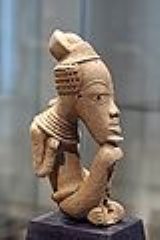
Nok Sculpture Louvre 70 1998 11 1
The Nok civilization appeared in Nigeria
Nigeria

Nigeria, officially the Federal Republic of Nigeria, is a federation constitutional republic comprising States of Nigeria and one Federal Capital Territory, Nigeria....
 around 500 B.C. and mysteriously vanished around 200 AD. The civilization’s social system was highly advanced. The Nok civilization was considered to be the earliest sub-Saharan producer of life-sized Terracotta. Nok culture terracottas are heralded as the prime evidence of the refinement of African civilizations, and it is suggested that the society eventually evolved into the later Jos Plateau
Jos Plateau

The Jos Plateau is a plateau located in Nigeria covering 7770 km?. With an average altitude of 1280 metres and its highest point at 2010 metres, it is the only region of temperate climate of Nigeria....
 community. The refinement of this civilization is attested to by the image of a Nok dignitary at the Minneapolis Institute of Arts
Minneapolis Institute of Arts

The Minneapolis Institute of Arts is an encyclopedic fine art museum located in the Whittier, Minneapolis neighborhood of Minneapolis, Minnesota on a campus that covers nearly 8 acres which was formerly Morrison Park....
. The dignitary is portrayed wearing a "shepherds crook" affixed with an elastic material to the right arm (, ). The dignitary is also portrayed sitting with flared nostrils, and an open mouth suggesting performance. According to some accounts, based on artistic similarities between early Yoruba art forms
Yoruba traditional art

The Yoruba people of South Western Africa , has a very rich and vibrant artisan community, creating traditional and contemporary art. The custom of art and artisans among the Yoruba is deeply routed in If? literary corpus indicating the orishas Ogun, Obatala, Oshun and Obalufon as central to creation mythology including artistry ...
 and Nok forms, there may be connections between Nok culture and contemporary Jos Plateau people. Later brass and terracotta sculptures of the Ife
Ife

Ife is an ancient Yoruba people city in south-western Nigeria. Evidence of settlement of the city has been discovered dating back as far as 500 BC....
 and Benin
Benin

Benin , officially the Republic of Benin, is a country in West Africa. It borders Togo to the west, Nigeria to the east and Burkina Faso and Niger to the north; its short coastline to the south leads to the Bight of Benin....
 cultures show significant similarities with those found at Nok.

Iron use, in smelting
Smelting

Smelting is a form of extractive metallurgy; its main use is to produce a metal from its ore. This includes iron extraction from iron ore, and copper extraction and other base metals from their ores....
 and forging
Forging

Forging is the term for shaping metal by using localized compressive forces. Cold forging is done at room temperature or near room temperature....
 for tools, appears in Nok civilization in Africa by 500 BC.

Sculptures

Nok sculptures also depict animals and humans. Their function is still unknown, since scientific field work is still missing. For the most part, the terracotta is preserved in the form of scattered fragments. That is why Nok art is well known today only for the heads, both male and female, whose hairstyles are particularly detailed and refined. The statues are in fragments because the discoveries are usually made from alluvial mud
Alluvium

Alluvium is soil or sediments deposited by a river or other running water. Alluvium is typically made up of a variety of materials, including fine particles of silt and clay and larger particles of sand and gravel....
, in terrain made by the erosion of water. The terracotta statues found there are hidden, rolled, polished, and broken. Rarely are works of great size conserved intact making them highly valued on the international art market.

The terracotta figures are hollow, coil built, nearly life sized human heads and bodies that are depicted with highly stylized features, abundant jewellery
Jewellery

Jewellery is an item of personal adornment, such as a necklace, ring , brooch or bracelet, that is worn by a person. It may be made from gemstones or precious metals, but may be from any other material, and may be appreciated because of geometric or other patterns, or meaningful symbols....
, and varied postures. Some artifacts have been found illustrating a plethora of physical ailments, including debilitating disease and facial paralysis. Other associated pieces include plant
Plant

Plants are Life organisms belonging to the Kingdom Plantae. They include familiar organisms such as trees, herbs, bushes, grasses, vines, ferns, mosses, and green algae....
 and animal
Animal

Animals are a major group of multicellular, eukaryotic organisms of the Kingdom Animalia or Metazoa. Their body plan eventually becomes fixed as they develop, although some undergo a process of metamorphosis later on in their life....
 motifs.

Little is known of the original function of the pieces, but theories include ancestor portrayal, grave markers, and charms
Amulet

An amulet , a close cousin of the talisman consists of any object intended to bring good luck and/or protection to its owner.Potential amulets include: Gemstone or simple Gemstone, statues, coins, drawings, pendants, jewelry ring, plants, animals, etc.; even words said in certain occasions?for example: vade retro satana?, to repe...
 to prevent crop failure, infertility, and illness. Also, based on the dome-shaped bases found on several figures, they could have been used as finials for the roofs of ancient structures.

Margaret Young-Sanchez, Associate Curator of Art of the Americas, Africa, and Oceania in The Cleveland Museum of Art, explains that most Nok ceramics were shaped by hand from coarse-grained clay and subtractively sculpted in a manner that suggests an influence from wood carving. After some drying, the sculptures were covered with slip and burnished to produce a smooth, glossy surface. The figures are hollow, with several openings to facilitate thorough drying and firing. The firing process most likely resembled that used today in Nigeria, in which the pieces are covered with grass, twigs, and leaves and burned for several hours.

In 1928, the first find was accidentally unearthed at a level of 24 feet in an alluvial tin mine in the vicinity of the village of Nok near the Jos Plateau region of Nigeria (Folorunso 32). As a result of natural erosion and deposition, Nok terracottas were scattered at various depths throughout the Sudan grasslands, causing difficulty in the dating and classification of the mysterious artifacts.

Luckily, two archaeological sites, Samun Dukiya and Taruga, were found containing Nok art that had remained unmoved. Radiocarbon and thermo-luminescence tests narrowed the sculptures’ age down to between 2000 and 2500 years ago, making them some of the oldest in tropical Africa.

Because of the similarities between the two sites, archaeologist Graham Connah believes that "Nok artwork represents a style that was adopted by a range of iron-using farming societies of varying cultures, rather than being the diagnostic feature of a particular human group as has often been claimed."

Nok1

Discovery


The Nok civilization was discovered in 1928 on the Jos Plateau
Jos Plateau

The Jos Plateau is a plateau located in Nigeria covering 7770 km?. With an average altitude of 1280 metres and its highest point at 2010 metres, it is the only region of temperate climate of Nigeria....
 during tin mining .

Lt-Colonel John Dent-Young, an Englishman, was leading mining operations in the Nigerian village of Nok. During these operations, one of the miners found a small terracotta of a monkey head. Other finds included a terracotta human head and a foot. The colonel, at a later date, had these artifacts placed in a museum in Jos. .

In 1932, a group of 11 statues in perfect condition were discovered near the city of Sokoto
Sokoto

Sokoto is a city located in the extreme northwest of Nigeria, near to where the Sokoto River and Rima River meet. As of 2006 it has a population of 583,039 ....
. Since that time, statues coming from the city of Katsina
Katsina

Katsina is a city, formerly a city-state, in northern Nigeria, and is the capital of Katsina State....
 were brought to light. Although there are similarities to the classical Nok style, the connection between them is not clear yet.

Later still, in 1943, near the village of Nok, in the center of Nigeria, a new series of clay figurines were discovered by accident while mining tin
Tin

Tin is a chemical element with the symbol Sn and atomic number 50. Tin is obtained chiefly from the mineral cassiterite, where it occurs as an oxide, SnO2....
. A worker had found a head and had taken it back to his home for use as a scarecrow
Scarecrow

A scarecrow is a device, traditionally a human figure dressed in old clothes, or mannequin, that is used to discourage birds such as crows from disturbing crops....
, a role that it filled (successfully) for a year in a yam
Yam (vegetable)

Yam is the common name for some species in the genus Dioscorea .These are perennial plant herbaceous vines cultivated for the consumption of their starchy tubers in Africa, Asia, Latin America and Oceania....
 field. It then drew the attention of the director of the mine who bought it. He brought it to the city of Jos
Jos

Jos is a city in Nigeria middle belt and is the administrative capital of Plateau State. It is located at , high on the Jos Plateau. During British colonial rule it was an important centre for tin mining....
 and showed it to the trainee civil administrator, Bernard Fagg
Bernard Fagg

Bernard Evelyn Buller Fagg was a United Kingdom archaeologist and Curator. He was born in Upper Norwood to William Percy Fagg, an antiquarian bookseller and his wife Lilian Fagg ....
, an archaeologist
Archaeology

Archaeology, archeology, or arch?ology is the science that studies Homo cultures through the recovery, documentation, analysis, and interpretation of material remains and environmental data, including architecture, Artifact , features, Biofact s, and cultural landscape....
 who immediately understood its importance. He asked all of the miners to inform him of all of their discoveries and was able to amass more than 150 pieces. Afterwards, Bernard and Angela Fagg ordered systematic excavations that revealed many more profitable lucky finds dispersed over a vast area, much larger than the original site. In 1977, the number of terra cotta objects discovered in the course of the mining excavation amounted to 153 units, mostly from secondary deposits (the statuettes had been carted by floods near the valleys) situated in dried-up riverbeds in savannah
Savannah

Savannah or savanna is a type of grassland.It can also mean:...
s in Northern and Central Nigeria (the Southwestern portion of the Jos Plateau).

Later, new discoveries had been found in an increasingly larger area, including the Middle Niger Valley
Niger River

The Niger River is the principal river of western Africa, extending about 4180 km . Its drainage basin is in area. Its source is in the Guinea Highlands in southeastern Guinea....
 and the Lower Benue Valley
Benue River

File:Lagdomap.jpgThe Benue River is the major tributary of the Niger River. The river is approximately 1,400 km long and is almost entirely navigable during the summer months....
. the parts that could have exploded when fired.

Nok2

See also

  • Early Nigerian history
    Early Nigerian history

    Recent archaeological research has shown that people were already living in south-western Nigeria as early as 9000 BC and perhaps earlier at Ugwuelle-Uturu in south-eastern Nigeria....